
NEWS
FDA Clears MeRT for PTSD, With a Narrower Label
The FDA cleared EEG-guided MeRT as a PTSD adjunct on June 3, 2026, but the 510(k) is narrower than the four-fold, first-of-its-kind pitch.

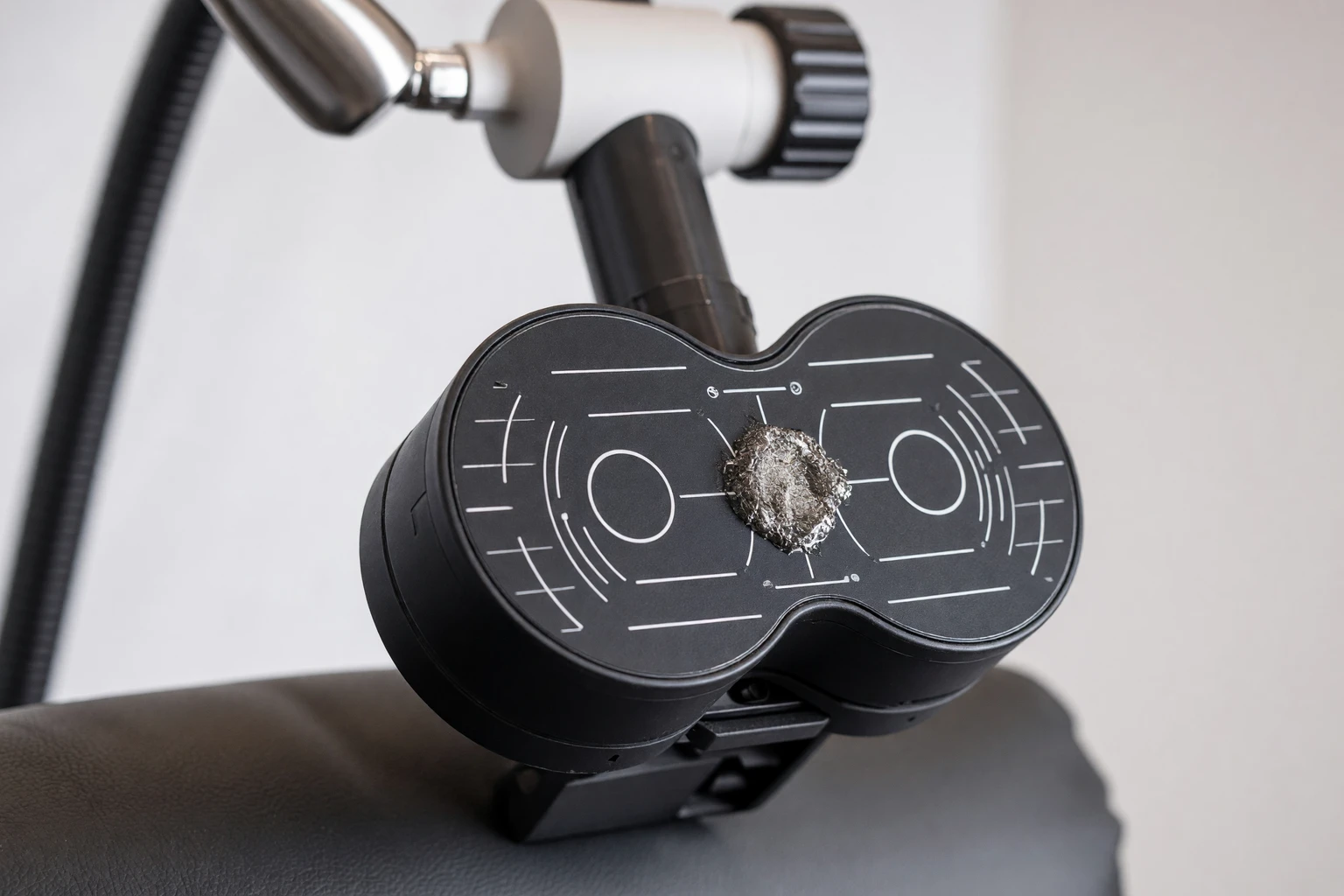
The FDA cleared Wave Neuroscience’s MeRT System on June 3, 2026, as an adjunct for adults with PTSD. The Newport Beach device uses an EEG reading to set the pulse rate on a clinic TMS coil.
Chief medical officer Erik Won, DO, said the trial cut symptoms by 52% and put 68% of patients into remission. The 510(k) summary reports a 27-point PCL-5 drop in the active arm and a modest gap versus sham.
The 510(k) Clears MeRT as a PTSD Adjunct
Letter K260402 classifies the MeRT System as Class II and finds it substantially equivalent to the MagVenture TMS Therapy System for OCD (K251119). The label is an adjunct for adult patients with PTSD, used in a clinic, not as a home device and not as a stand-alone cure.
Software called MRT-005 reads resting EEG and ECG and computes a pulse rate in the 8 to 13 Hz band. That rate is handed to a legally marketed TMS machine. The software does not fire the magnet.
Won, a former Navy flight surgeon, told a psychiatry interviewer the indication is broad: post-traumatic stress disorder, adjunctive use. Dr. Israel Liberzon, the trial’s lead psychiatrist at Texas A&M, said it would be the only FDA-cleared non-drug option built for PTSD. Two other devices already hold PTSD-related clearances, which sits beside that line rather than under it.
THE PATH TO K260402
- April 4, 2022: Texas A&M opens the pivotal MeRT-005-B study (NCT02990793).
- November 2024: FDA grants Breakthrough Device designation for MeRT in PTSD.
- November 4, 2025: The trial completes, with 158 people in the intention-to-treat set.
- February 6, 2026: FDA receives the 510(k) dated February 5.
- June 3, 2026: CDRH clears the MeRT System as substantially equivalent to MagVenture’s OCD TMS platform.
Dr. Rick Silva, executive director of clinical trials at Texas A&M’s Institute of Biosciences and Technology, said device trials often take about a decade and that this path took just over two years. Won said the file sat on the FDA docket about 90 days after it went in.
A 27-Point Drop and a Thin Gap Versus Sham
The National Center for PTSD estimates that 13 million Americans had PTSD in 2020. About 6% of U.S. adults will meet criteria in a lifetime, and about 5% do in a given year. Women (8%) are more likely than men (4%) to have it at some point. Veterans are more likely than civilians.
In 2023, 6,398 veterans died by suicide, about 17 or 18 a day. Among veterans in VA care who died by suicide that year, 26.6% had a PTSD diagnosis on the prior year’s record. That is the human backdrop for a clinic coil, not proof the coil will move the suicide count.
Won compared MeRT with a 2020 review of PTSD drugs in which self-reported scores moved 6.8 to 10.1 points and remission reached no more than 10.9%.
In comparison to that study, our FDA trial reported a 52% reduction in symptoms, so more than a four-fold increase in efficacy. And more importantly, we saw 68% remission in our clinical trial.
Erik Won, DO, chief medical officer, Wave Neuroscience
The 510(k) uses different yardsticks. The 27-point figure is the active group’s own pre-post change on the PCL-5, not the gap versus sham. Between-group effect sizes were about -0.32 on the PCL-5 and 0.51 on the CAPS-5, which the summary places in the upper range of the two FDA-approved drugs.
COMPANY LANGUAGE VERSUS THE 510(K)
| Claim | Company language | FDA 510(k) summary |
|---|---|---|
| Symptom change | 52% reduction | 27-point PCL-5 drop in the active arm; p < 0.046 vs sham |
| Remission | 68% | 68.2% of the active group at follow-up 2, a post-hoc cut (p < 0.008) |
| Versus drugs | More than a four-fold increase in efficacy | Effect sizes in the upper range of the two FDA-approved drugs |
| What is new | AI-derived personalized protocols | Trial not built to isolate EEG frequency from standard TMS |
Adults 18 and older entered with a CAPS-5 PTSD diagnosis and a PCL-5 score of at least 30. Seventy-seven were assigned to active treatment and 81 to sham. Eighty-four percent finished 20 to 25 sessions. PCL-5 was the primary endpoint because it is easy to repeat; CAPS-5, run after the primary hit, was stronger (p < 0.0006).
The active arm’s 27-point PCL-5 change is more than twice the VA’s 8.5 to 12.5-point bar for a meaningful within-person shift. Post-hoc analyses found the PCL-5 gain continued 2 to 4 months after the last session. There were no serious adverse events. Treatment-emergent events were similar in both arms, and the upper 95% confidence bound on a serious event in the active arm was under 4%.
Those are real sham-controlled results. They are also not a four-fold leap over sertraline and paroxetine on the metric the agency used to compare them.
Prism and Modius Spero Already Hold PTSD Clearances
A VA clinician guide still says only sertraline and paroxetine are approved by the FDA for PTSD. Sertraline gained that indication in 1999 and paroxetine in 2001. Venlafaxine is recommended in VA/DoD guidelines without the same label. Fluoxetine is used off-label. No new PTSD drug has cleared since 2001.
The dry spell in pills is not a dry spell in devices. GrayMatters Health’s Prism, a clinic neurofeedback system aimed at amygdala-frontal circuits, was cleared in 2023 as an adjunct after an open-label study of 79 adults. Neurovalens won a de novo order in May 2026 for Modius Spero, an at-home vestibular stimulation headset for PTSD symptoms in adults 22 and older, used with a clinician’s plan.
THREE CLEARED PTSD DEVICES
| Device | Path and date | How it is used | Pivotal sample |
|---|---|---|---|
| MeRT System (Wave Neuroscience) | 510(k) K260402, June 3, 2026 | Clinic TMS, EEG-set pulse rate, adjunct, adults | 158, sham-controlled |
| Modius Spero (Neurovalens) | De novo, May 2026 | Home, 30 minutes a day, adults 22+ | 383, sham-controlled |
| Prism (GrayMatters Health) | Cleared 2023 | Clinic neurofeedback, 15 sessions over 8 weeks | 79, open-label |
Neurovalens says two-thirds of Modius users had a clinically meaningful PCL-5 drop of at least 10 points at 12 weeks, with about a 24-point fall versus about 12 points on sham. The company began routing the headset to veterans through the VA in July 2026. Prism’s later write-up put mean CAPS-5 change at 13.5 points at three months, with 67% meeting a 6-point bar and 32% reaching remission, from an open-label design that has no sham arm.
MeRT’s claim that holds is narrower and still new: it is the first FDA-cleared EEG-guided TMS protocol with a PTSD indication. It is not the first non-drug device on that shelf.
What a Full MeRT Course Requires of Patients
Texas A&M sponsored the MeRT-005-B trial of 158 people, with Dr. Kenneth S. Ramos, MD, PhD, executive director of the Institute of Biosciences and Technology, as principal investigator. A earlier pilot randomized 74 active-duty and retired military participants on concussion and PTSD symptoms. The test phase mixed a general-public sample with military recruits at some sites.
Won has said the military slice is the smaller part of the trauma population the company now wants to reach, and that the larger groups are survivors of sexual trauma and domestic violence, plus first responders.
A CLINIC COURSE, STEP BY STEP
- Mapping visit: Resting EEG and ECG are recorded with eyes closed so MRT-005 can derive an 8 to 13 Hz pulse rate.
- Motor threshold: A clinician finds the TMS dose the way any TMS clinic does, then loads the algorithm’s rate into a compatible coil system.
- Daily sessions: One treatment a day, five days a week, for five weeks, 20 to 25 sessions in the packet.
- Follow-up: Symptom scales are repeated; the 510(k) reports further PCL-5 gains 2 to 4 months after the last pulse.
That schedule is the same grind as depression TMS, not a headset you wear while watching television. Patients have to reach a clinic that owns both EEG mapping and a compatible stimulator, then show up about 20 times. Psychotherapy remains first-line in VA/DoD guidelines, and Liberzon noted that many people drop those therapies because the work is anxiety-provoking. MeRT asks for time and travel instead of trauma homework. It does not ask for nothing.
Private Clinics Have Sold MeRT for Years
Wave Neuroscience, which dates to 2019, licensed MeRT to private clinics long before K260402. Flagship Brain Treatment Center sites in Newport Beach and San Diego say they have treated more than 6,000 people over a decade. Dr. Julie Kim, medical director there, has trained more than 100 physicians to read qEEG maps and run the protocol.
A Michigan clinic quotes a typical MeRT course at $8,000 to $13,000 and lists it as self-pay. The same shop says most insurers will cover ordinary rTMS for treatment-resistant depression and OCD when criteria are met. A Houston clinic posts $500 for the first EEG visit and bills private-pay MeRT in two-week blocks. San Diego lists TRICARE in-network and does not take Medicare or Medicaid.
Standard TMS for depression often runs $200 to $400 a session without insurance, or about $6,000 to $12,000 for a 36-session course, with Medicare and many commercial plans paying when prior drugs have failed. PTSD MeRT does not yet sit on that coverage map. Wave and Texas A&M say they are talking to payers. Until those talks land, the people who can buy 20 mapped sessions are the people who can write a check.
That is the bottleneck clinicians keep circling, because the magnet is not scarce. Depression TMS chairs already exist. EEG-guided software, trained staff, and a paid PTSD indication are what the clearance actually adds, and only the last of those is new this summer.
The Study Did Not Test the Personalization Step
Ramos has argued that ordinary TMS manages symptoms the way a tarp covers a leak, while MeRT aims at the individual’s brain rhythm. The 510(k) is blunter about what the RCT can support.
The pivotal trial was designed to evaluate the safety and effectiveness of the MeRT System as a whole, and was not structured to isolate the independent contribution of EEG-guided frequency selection relative to TMS delivered at a fixed frequency. As such, the relative contribution of the individualized frequency parameter to the observed treatment outcomes was not part of the study design.
MeRT System 510(k) summary, K260402, U.S. Food and Drug Administration
A later split of the active arm into low, medium, and high pulses per session found no significant differences. The file warns that a quiet result in a small slice is not proof that a personalized rate equals a fixed rate. Exploratory EEG work found a link between posterior coherence and symptom change in the active group only. That is a hint, not the test the marketing implies.
Won said in June the pivotal paper was in write-up. As of early September 2026 it has not appeared. Clinic directors who want more than p values and a 10-page summary are still waiting.
WHAT WE KNOW
- The label: FDA cleared MeRT as a clinic adjunct for adults with PTSD on June 3, 2026.
- The sample: 158 people, 77 active and 81 sham, 20 to 25 sessions, 84% completed.
- The safety line: No serious adverse events; TEAEs looked similar in both arms.
WHAT IS UNCONFIRMED
- The paper: Peer-reviewed tables, sham point totals, and the F2 denominator have not been published.
- The algorithm: No head-to-head shows EEG-set 8 to 13 Hz beats a fixed TMS protocol in PTSD.
- The bill: National coverage for this indication is not in place; published clinic prices remain cash-pay.
Leslie S. Prichep, PhD, Wave’s chief scientific officer and the 510(k) contact, said the clearance rests on decades of work using electrical brain markers to guide treatment. Fred Walke, the CEO, said the company wants mental health care to look more like other parts of medicine, with a picture of the organ being treated. The picture is an EEG. The organ still has to get to a chair 20 times, and someone has to pay for the chair.
Frequently Asked Questions
Does the MeRT Software Itself Stimulate the Brain?
No. MRT-005 is an algorithm that reads resting EEG and ECG and outputs a pulse rate between 8 and 13 Hz. A compatible, legally marketed TMS coil delivers the magnetic pulses. The 510(k) is explicit that the software does not generate or apply stimulation on its own.
Who Qualified for the Pivotal PTSD Trial?
Adults 18 and older with a CAPS-5 PTSD diagnosis and a PCL-5 symptom score of at least 30. The intention-to-treat set was 158 people. A separate pilot randomized 74 active-duty and retired military participants on concussion and PTSD measures before the 158-person test phase.
How Many MeRT Sessions Did the FDA Review?
The protocol was one session a day, five days a week, in weeks 1 through 5, for a total of 20 to 25 sessions. Eighty-four percent of participants completed treatment. The MagVenture OCD predicate uses a similar five-week block and adds four sessions in week 6.
Which Drugs Does the FDA Approve for PTSD?
Sertraline (Zoloft), approved in 1999, and paroxetine (Paxil), approved in 2001, remain the only two. VA dosing ranges are 50 to 200 mg a day for sertraline and 20 to 60 mg a day for paroxetine. Venlafaxine is recommended in VA/DoD guidelines without an FDA PTSD indication.
Disclaimer: This article is news reporting on an FDA device clearance and on trial figures released in a 510(k) summary and company statements. It is informational only and is not medical advice, a diagnosis, or a recommendation to start, stop, or change TMS, psychotherapy, or medication for PTSD. Anyone considering treatment should consult a licensed psychiatrist, psychologist, or other qualified clinician, and should check coverage with their insurer or VA care team before acting. Numbers, indications, clinic prices, and access rules reflect the sources as of September 2, 2026, and may change when the peer-reviewed paper, product labeling, or payer policies are updated.


Roman Space Telescope Begins a Million-Mile Data Run

FDA Clears MeRT for PTSD, With a Narrower Label

Guerrero’s Home Drought Outlasted Toronto’s 13-2 Loss

Collyer Bets on West Brom Minutes Over Hull City

Meta’s Smart Glasses Sell a Light That Needed Two Patches
Meta’s Smart Glasses Sell a Light That Needed Two Patches

Song Yadong Stops Umar Nurmagomedov the Only Way Left

The Mahape Fake Apple Raid Repeats a Dual-Shift Pattern

Gomez Says She Never Ran the Wondermind Investors Backed

LUN8’s First London Concert Filled a 620-Cap Club
-
 NEWS7 days ago
Meta’s Smart Glasses Sell a Light That Needed Two Patches
-
 NEWS1 week ago
Song Yadong Stops Umar Nurmagomedov the Only Way Left
-
 NEWS3 weeks ago
The Mahape Fake Apple Raid Repeats a Dual-Shift Pattern
-
 ENTERTAINMENT3 weeks ago
Gomez Says She Never Ran the Wondermind Investors Backed
-
 ENTERTAINMENT3 weeks ago
LUN8’s First London Concert Filled a 620-Cap Club
-

 ENTERTAINMENT1 week ago
Lanterns Puts Sinestro in a Cell and Lets Him Talk
-

 ENTERTAINMENT1 week ago
Hulu Cancels the Kaling Comedy Built for 10 Seasons
-

 NEWS3 weeks ago
Nueva Pescanova Drops the Octopus Farm as Wild Catch Continues