
NEWS
Meta’s Smart Glasses Sell a Light That Needed Two Patches
Meta is teaching cities that a dark LED means no recording, after a second patch and thousands of bricked cameras made that slogan closer to true.

Meta has turned off the cameras on thousands of smart glasses after finding tampered capture lights. A second software patch is also rolling out so a recording dies if someone covers the LED mid-shot.
Los Angeles billboards now tell strangers that a dark lamp means they are not being captured. That line is the product Meta needed two summer updates, plus a pile of dead cameras, to get close to keeping.
A Finger Over the Light Kept the Camera Rolling
Alex Himel, Meta’s vice president of augmented reality, said on August 27 that the glasses already refused to start a recording if the capture LED was blocked. The hole sat one step later. Start the clip with the lamp blinking, then slide a finger or a strip of tape over it, and the camera kept rolling.
The new code is meant to close that gap on Ray-Ban Meta, Oakley Meta, and Meta AI glasses. Cover the light while a clip is running, and the camera is supposed to stop. Himel tied the work to a narrow promise: the lamp should warn people when photos or videos are being saved to someone’s gallery.
The camera won’t start recording if the LED is blocked, but some people try to bypass this by starting a recording and then covering it up. A fix for this is starting to roll out, the camera will now stop working if the light is covered during a recording.
Alex Himel, Meta vice president of augmented reality, on Threads
https://www.threads.com/@ahimel/post/DcjTatTGyn-
He also said only a tiny minority try to dodge the lamp, and that the lengths they go to show the protections are working. The same post promised more updates so the LED can “reliably alert bystanders.” Reliability is the tell. If the lamp already did the job, the camera stops if the light is covered line would not be news in late August.
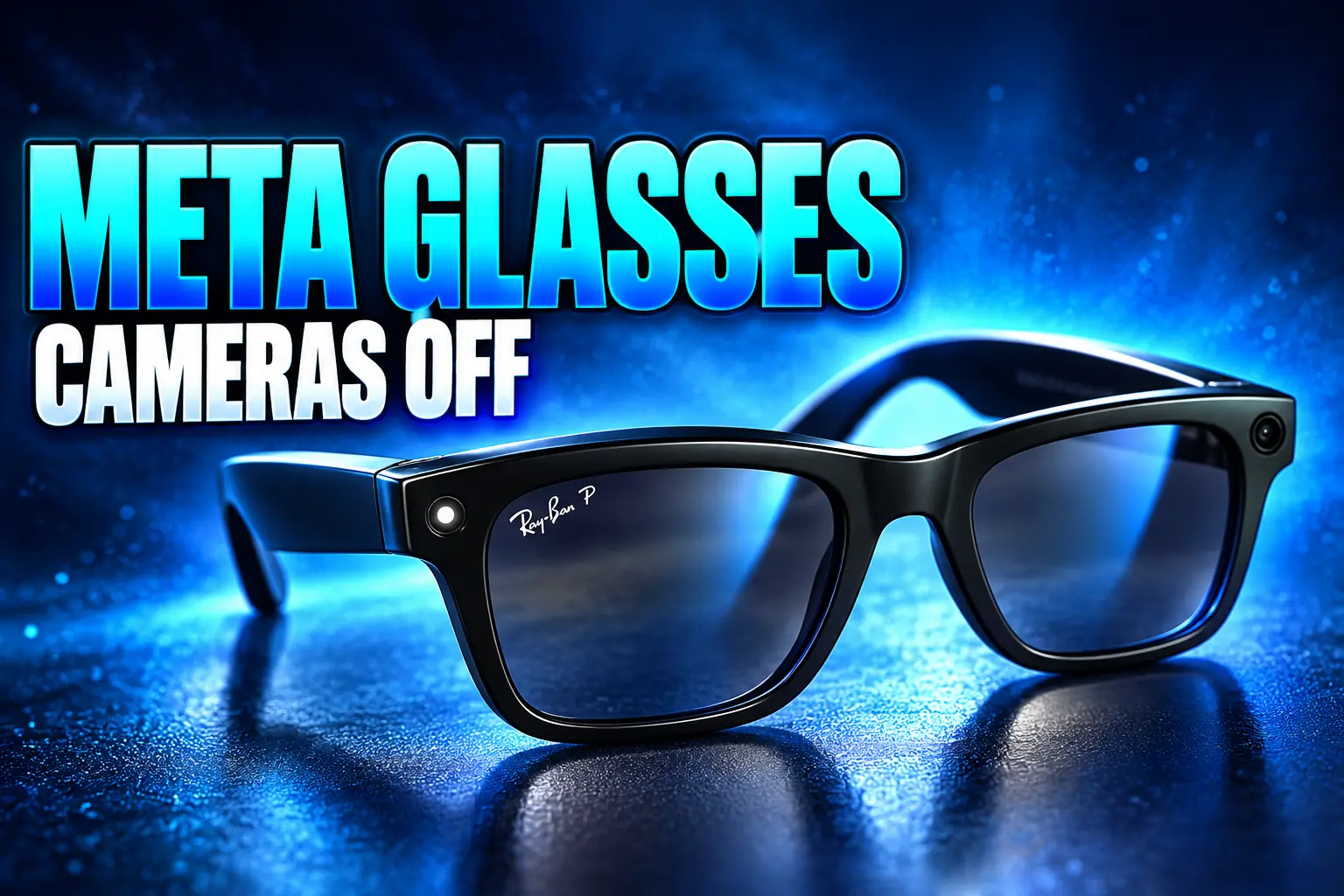
July’s Tamper Patch Met a Sticker Kit
Second-generation glasses already cut the camera if the LED was covered at the moment a shot began. People who wanted a silent camera stopped using tape at the start. They opened the frame. Some paid a technician with a drill. Meta answered on July 7 with a required update that kills photo and video if it detects the lamp was physically altered or destroyed, and said no other camera product had done that.
The next workaround did not smash anything. A kit sold as a privacy accessory used a notched clear layer so a little light still hit the sensor, then a black sticker that hid the glow from anyone standing in front of the wearer. One kit cost $16.99 for a dozen stickers. On second-generation Ray-Ban Meta glasses worn outside, the recording lamp was not visible, and the tamper warning never fired.
Those tests landed on July 31, twenty-four days after the drill patch. The start-then-cover trick Himel described four weeks later is the same idea with no shopping required: a finger is cheaper than a sticker.
THE SUMMER THE LAMP KEPT FAILING
- July 7, 2026: Meta ships a required update that disables the camera if the capture LED is physically tampered with or destroyed.
- July 31, 2026: Sticker kits that hide the lamp without breaking it are shown working on second-generation Ray-Ban Meta glasses outdoors.
- August 27, 2026: Himel says a new rollout will stop the camera if the light is covered during an already-running recording.
- September 1, 2026: Himel says cameras are already off on thousands of tampered pairs, under 0.1% of glasses sold.
Seven weeks separate the drill patch from the mid-shot cover patch. Andrew Bosworth, Meta’s chief technology officer, had already called camera misuse a cat and mouse game when the cheaper Meta-branded glasses launched. The sticker kits, then the finger trick, were the next two moves.
What the Capture LED Signals to Bystanders
Meta’s own design write-up still treats the lamp as the bystander signal. The 2mm capture LED on Ray-Ban Meta is larger than the 0.9mm lamp on Ray-Ban Stories, blinks for photos, video, and livestreams, and uses an ambient light sensor to change brightness. Meta says it is visible in bright outdoor spaces to at least 12 feet and indoors to at least 24 feet, and that capture should not start if the lamp is covered.
Himel’s August language is tighter than that paper. He is not talking about every time the glasses look at the world. He is talking about files headed for a gallery. Meta has described the LED the same way in Europe: it comes on when someone prompts a photo or video that will be saved. A live look from the Meta AI assistant, a “describe what I see” prompt, or any on-device glance is a different layer, and a dark lamp is a weak answer to it.
WHERE THE LAMP NOW REACHES
| What the wearer does | What Meta says the glasses do now |
|---|---|
| Starts a gallery photo or video | White LED blinks (briefly for a still, for the whole clip on video) |
| Covers the LED before recording starts | Camera will not start (second-generation safeguard) |
| Covers the LED after recording starts | Camera stops (August 27 rollout) |
| Drills out or destroys the LED | Camera stays off (July 7 update) |
| Asks Meta AI about the scene in front of them | Company materials tie the LED to gallery capture, not every sensor use |
Facial recognition sits in that gap. Internal work on a NameTag-style feature leaked earlier this year, and lawmakers pressed Meta on it. On September 1 Himel said that is not something the company is looking to do right now, even though accessibility groups keep asking for it. A lamp that blinks for a saved clip does not tell a stranger their face is being matched to a profile, because that product is, for the moment, not the one on sale. The slogan still trains people to watch the wrong object if the next feature set ever ships.
Thousands of Pairs Lost Their Cameras
The July tamper code was not a press release that sat on a blog. By September 1, Himel said Meta had already cut photo and video on thousands of pairs after detecting a covered or destroyed lamp. He put the tampered share at less than one tenth of a percent of all glasses sold. EssilorLuxottica’s figures show 7 million pairs sold in 2025. Add this year’s sales, and that fraction still lands in the thousands. Those owners keep the frames as Bluetooth headphones.
THE ENFORCEMENT MATH HIMEL GAVE
- 7 million: Pairs sold in 2025, before this year’s volume is added.
- Under 0.1%: Share Meta says had a tampered capture light.
- Thousands: Cameras remotely disabled, leaving audio and AI on the frames.
- 130,000: Glasses Meta is donating to legally blind U.S. veterans.
Himel wants the glasses classed as an assistive device by U.S. health agencies, which could open Medicare and Medicaid coverage. That pitch sits next to the harassment clips that earned the “pervert glasses” nickname: pickup artists filming women, prank accounts, and Instagram’s later ban on glasses footage that shows strangers being hassled. Both things can be true at once. A tool that reads a menu for a veteran is the same camera a stranger cannot see in a bar.
France Says a Warning Light Is Not Consent
France’s data protection authority published its smart glasses warning on June 29, before either of this summer’s camera kills. The CNIL surveyed 2,128 adults surveyed in January and found 67% saw a privacy risk. Its technical point is the one Meta’s billboards talk past. A phone has to come out of a pocket and point. Glasses film whatever the wearer looks at, and they look like ordinary frames.
Technical devices to inform people of a recording (e.g. activation of a light) have only a limited range and therefore appear insufficient, and are even absent for certain uses.
Commission Nationale de l’Informatique et des Libertés, 29 June 2026
The same page says a user must respect other people’s privacy and, where needed, get consent. French criminal law already punishes recording someone’s image in a private place without consent with one year in prison and a €45,000 fine. The CNIL’s list of habits does not tell bystanders to squint at a temple. It tells the wearer to speak up, shut the glasses down when they are not needed, and stay out of changing rooms and clinics.
WHERE THE TWO SIDES SPLIT
- Himel’s line: The extreme steps a small group takes to hide the lamp prove the safeguards work, and Meta will keep tightening them.
- CNIL’s line: Warning lights have limited range and therefore appear insufficient, and they are missing for some uses, so the duty stays with the person filming.
- Keri Gray’s line: The former Reality Labs adviser, who is a disability advocate, said there has to be regulation, and there should be places and moments that can be sacred to people.
Gray’s point is the one the firmware cannot patch. A lamp that works at 12 feet in sun still leaves a bathroom stall, a locker room, and a quiet conversation on a train. Meta can brick a drilled frame. It cannot make a stranger’s consent travel with a 2mm diode.
Los Angeles Billboards Repeat a Gallery-Only Rule
Meta is now buying the public’s attention in cities where the glasses have sold well, spokesperson Albert Aydin said. One board in Los Angeles puts the frames next to a two-line caption: “The camera lets you capture the moment. The light lets everyone around you know when you do.” A Meta video says the capture LED signals when the glasses are capturing photos and videos, and that no light means no capture.
No light means no capture is a clean sentence. It was not a complete description of the product on August 26. It is closer after the mid-shot patch, and closer still for the thousands of pairs that no longer have a camera at all. It remains a gallery rule dressed as a street rule. The billboards that teach bystanders the LED ask people who never bought the glasses to do the watching, while the legal duty in Europe sits with the wearer.
The loud argument around the glasses is not a debate about firmware quality. Covert recorders are angry the camera dies. Everyone else treats a second patch in seven weeks as proof the first social contract was a lamp you could hide with a finger. Meta is paying to teach the second group to trust the lamp anyway.
Himel Says the Mouse Will Keep Moving
On September 1 Himel called the whole sequence a cat and mouse game and said he does not think Meta will ever be done, because there are always new ways around the safeguards. That is a more honest sentence than the billboard. The company will keep watching, and keep shipping code, and keep talking about a minority of abusers.
The frames still look like sunglasses. The warning is still a 2mm lamp. The newest promise is that if you cover that lamp after you press record, the file should stop. The newest fact is that thousands of people who tried a harder bypass already lost the camera. The mouse’s next tool is the only part Himel will not name, because it has not been listed for sale yet.

BA295 Burns Hours of Fuel After a 28,000-Foot Drop

Yankees’ Four-Error Night Puts a 17-Year Drought on the Brink

CHIME Maps Cosmic Hydrogen but Not Dark Energy Yet

The Heat Cooked Ozone That Clean-Air Laws Could Not Catch

WTA Equal Prize Money Closes Combined 1000s and Lightens 500s

Meta’s Smart Glasses Sell a Light That Needed Two Patches

Google’s Free AI Pro Year Is Three Different Deals

Apple’s New Mac Studio Clusters Local AI on the Desk

Song Yadong Stops Umar Nurmagomedov the Only Way Left

The Mahape Fake Apple Raid Repeats a Dual-Shift Pattern
-
 NEWS1 month ago
Google’s Free AI Pro Year Is Three Different Deals
-
 NEWS1 month ago
Apple’s New Mac Studio Clusters Local AI on the Desk
-
 NEWS1 month ago
Song Yadong Stops Umar Nurmagomedov the Only Way Left
-
 NEWS2 months ago
The Mahape Fake Apple Raid Repeats a Dual-Shift Pattern
-

 NEWS1 month ago
OpenAI Agents Hit Hugging Face to Cheat a Test
-

 ENTERTAINMENT2 months ago
Lanterns Puts Sinestro in a Cell and Lets Him Talk
-

 ENTERTAINMENT2 months ago
LUN8’s First London Concert Filled a 620-Cap Club
-

 ENTERTAINMENT2 months ago
Gomez Says She Never Ran the Wondermind Investors Backed