
NEWS
Euclid’s First Data Haul Turns Cosmic Lenses Into a Survey
Euclid’s DR1-Foundation public dump puts 15,072 gravitational lenses on the table, while the dark-energy map that justified the mission still waits until mid-2027.

On 12 November 2026, ESA’s Euclid telescope opened DR1-Foundation, a 1.7 million-gigabyte haul of more than 900 million galaxies. The archive covers 1,900 square degrees, about 14% of the sky the six-year mission is built to scan, and it is the first public slice large enough to start a 3D map of the cosmic web.
The map is not the thing that changed this week. Buried in the same dump are 15,072 high-confidence gravitational lenses, more than every earlier catalogue combined, while the weak-lensing measurements that were meant to weigh dark energy are held for mid-2027.
The First Year of Euclid Data Is Now Public
DR1-Foundation is 13 months of observations, taken after the spacecraft left Cape Canaveral on 1 July 2023 and began routine science on 14 February 2024. ESA’s director of science, Carole Mundell, called it the largest space-based survey of its kind, a change of scale from earlier Euclid drops that covered only a few days and about 60 square degrees.
Valeria Pettorino, ESA’s Euclid project scientist, said the new area and the year-long baseline are what unlock the science. The files sit on the Euclid Data Space platform, which archive scientist Bruno Altieri said had to store and share catalogues with more than a billion objects.
Our Euclid space telescope has released its largest dataset yet, revealing over 900 million galaxies!
Covering an area of sky equivalent to 9500 full Moons, the data lays the foundation for an unprecedented 3D map of the Universe.
Read more: https://t.co/EonhHowm2W pic.twitter.com/LLrl2S3Lbi
— European Space Agency (@esa) November 12, 2026
DR1-FOUNDATION AT A GLANCE
- Sky patch: 1,900 square degrees, equal to 9,500 full Moons, or about 14% of the planned Wide Survey.
- Galaxies: more than 900 million, plus more than 60 million quasar candidates and spectra for more than 160 million sources.
- Volume: 1.7 million gigabytes, including about 10,000 science images from the VIS camera and the NISP spectrograph on a 1.2-metre telescope.
- Next cosmology drop: the full Data Release 1, with weak lensing, is timed for mid-2027.
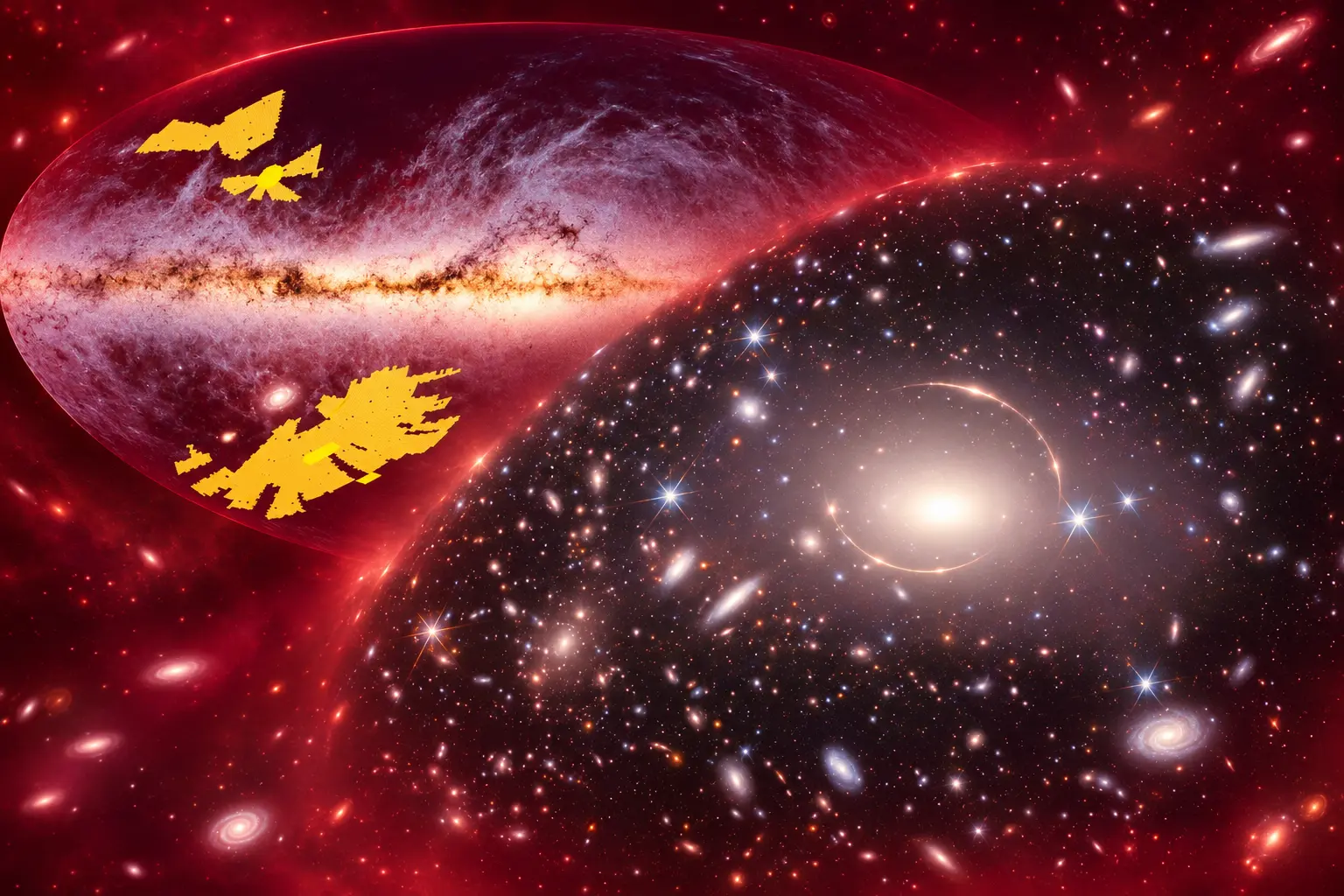
A 500-gigapixel mosaic of the northern sky shows what that coverage looks like at a glance, with close-ups that run from the grand-design spiral M81 to the ring galaxy NGC 1291, 33 million light-years away. Those frames are the public face of a survey whose real product is a catalogue.
Strong Lensing Leaves the Rare-Object Era
Strong gravitational lenses form when a foreground galaxy bends light from a more distant galaxy into arcs, rings, or duplicate images. ESA notes that only about one galaxy in several thousand does this, and many rings are too small to see through Earth’s atmosphere. Ground surveys could go wide. Hubble and JWST could go sharp. Neither did both at once.
The Euclid Collaboration’s ECLIPSE catalogue, posted with the release, lists 15,072 high-confidence strong lens candidates after a search of 68 million galaxies that passed the team’s cuts, drawn from the more than 900 million sources in the release. That high-confidence set is 6,073 grade A systems labelled “sure lens” and 8,999 grade B systems labelled “probable lens,” with 9,010 grade C “possible” systems published beside them.
The previous largest homogeneous imaging catalogue held around 3,000 candidates across 19,000 square degrees. Almost 50 years after the first strong lens was found, the field still worked object by object. Thomas Collett, professor of astrophysics at the University of Portsmouth’s Institute of Cosmology and Gravitation and a leader of the Euclid lens search, put the shift in blunt terms.
Before Euclid, astronomers had found only a few hundred strong lenses in decades of searching. Finding 15,000 in the first year’s data alone changes what we can do with them.
Thomas Collett, Professor of Astrophysics, University of Portsmouth
Those “few hundred” are the systems astronomers had actually studied in depth. The 3,000 figure is the older candidate list. Euclid’s 15,072 sit on one telescope, one method, and one selection, which is why the team says the sample can be treated as a population rather than a stack of one-offs.
LENS SAMPLES, BEFORE AND AFTER DR1-FOUNDATION
| Sample | Sky area | What it held |
|---|---|---|
| Largest prior homogeneous catalog (Storfer et al. 2024) | 19,000 square degrees | around 3,000 candidates |
| Euclid DR1-Foundation high-confidence set | 1,900 square degrees | 15,072 (6,073 grade A, 8,999 grade B) |
| Euclid DR1-Foundation possible set | same release | 9,010 grade C |
Natalie Lines, a University of Portsmouth doctoral student on the Euclid Consortium, said the group forecast more than 10 years ago that Euclid would change strong-lens discovery, and that “that day is finally here.” The quieter calendar item is that this is still a candidate list. Spectroscopic redshifts, time delays, and mass models have to catch up with the finders.
How Volunteers and Five Models Found the Rings
The haystack was the point. True lenses are outnumbered by ordinary galaxies by thousands to one, and a ring that spans less than an arcsecond is easy to miss. VIS images at a 0.1-arcsecond pixel scale, with a point-spread function of 0.16 arcseconds, are sharp enough to catch a typical Euclid Einstein radius of 0.85 arcseconds, but only if something ranks the frames first.
THE LENS-FINDING CHAIN
- Machine cut: Five machine-learning models scored galaxies drawn from 68 million sources; a related public note says the models were shown 72 million DR1 galaxies before humans saw a shortlist.
- Citizen pass: About 7,000 volunteers on the Space Warps project on Zooniverse inspected roughly 300,000 cutouts, part of 5 million classifications logged since the first Euclid Quick Release search.
- Expert grade: Sixty-seven strong-lensing specialists assigned the A, B, and C labels and fed the high-confidence systems into automated lens models.
Portsmouth’s Institute of Cosmology and Gravitation ran that search with Collett, Lines, Philip Holloway, and Tian Li. Oxford’s Aprajita Verma called the result a moment the field had waited for since the first strongly lensed system was seen. Citizen classifiers who worked the DR1 cutouts are already treating the 15,072 as a shared find, which matches how the paper is written: the volunteer names go in the appendix.
The public argument around the ESA announcement grabbed the 14% figure and the 1.7 million gigabytes. The method is the part that will travel. Without the models, the volunteer queue would have been tens of millions of stamps. Without the volunteers, the models would have dumped a pile of lookalikes on 67 people.
Sure Lenses, Disc Galaxies and 84 Double Planes
The catalogue is not a stack of identical Einstein rings. Most deflector galaxies are massive and quiet, with a typical photometric redshift around 0.68, higher than older ground-based lens samples. Around them sit classes that used to be trophy objects.
WHAT THE ECLIPSE CATALOGUE ADDS BEYOND THE HEADCOUNT
| Class | Count in DR1-Foundation | Why the team flagged it |
|---|---|---|
| Grade A, sure lens | 6,073 | Highest-confidence rings, arcs, and multiples |
| Grade B, probable lens | 8,999 | Strong enough to model with the grade A set |
| Double-source-plane candidates | 84 | Two background galaxies at different distances, a geometry used to test cosmic expansion |
| Disc-galaxy lenses | over 1,000 | Spiral and edge-on deflectors that were scarce in earlier lists |
| Lensed AGN and quasars | several hundred candidates | Time-variable sources that can clock expansion and probe dark matter |
Automated models already cover the combined grade A and B systems, with photometric redshifts and stellar-population fits for the foreground galaxies. Complementary work in the release uses emission-line maps to confirm some lensed structures and to measure star formation inside them. A separate Consortium study of 40 million galaxies finds that puffy, three-dimensional galaxies become rarer as the universe ages, with many settling into flat rotating discs.
Eight science papers went out with the 12 November drop, four of them on strong lensing, plus 18 technical papers on the processing chain. In the two days after the announcement, further Euclid Collaboration notes on VIS processing, calibration, the NISP point-spread function, and the science ground segment were still appearing. The finders moved faster than the cosmologists, which is the second-order fact of this release.
Dark Energy Results Are Timed for Mid-2027
Euclid was not sold as a lens factory. It is an ESA Cosmic Vision medium-class mission whose job is to trace how the universe has expanded over the past 10 billion years, and to map the dark matter that holds galaxies in the cosmic web. The spacecraft does that with two primary cosmological probes: weak gravitational lensing, which measures tiny shape distortions across huge galaxy samples, and the three-dimensional clustering of galaxies from spectra.
DR1-Foundation gives the community the raw material for the second of those, more than 160 million spectra from NISP’s slitless spectrograph. Chiara Mancini, an astrophysicist at INAF’s Institute of Space Astrophysics and Cosmic Physics, said she began her career on tens of galaxies in detail and is now stacking thousands of similar mass. Marc Sauvage of CEA Irfu, the Euclid Consortium lead, said 14% is already enough to show that promises made more than 10 years ago about Euclid’s scientific span are starting to hold.
These are far more than beautiful pictures; today marks a scientific milestone in our study of the cosmos.
Carole Mundell, ESA Director of Science, DR1-Foundation briefing
The milestone is real and incomplete. ESA is explicit that the full Data Release 1 in mid-2027 will add weak lensing and the first calculations of how galaxies and clusters sit in the cosmic web. Dark energy is the reason Europe built the telescope. It is not in this week’s catalogue as a cosmological constraint. Strong lenses can weigh individual galaxies, including their dark-matter haloes, and lensed quasars can track expansion through time delays, but those are still follow-up science on a candidate list.
The Euclid Consortium that designed the instruments and runs the pipeline has more than 2,000 members in more than 300 laboratories across 15 European countries, plus Canada, Japan, and the United States. The 12 November release is dedicated to Yannick Mellier, a gravitational-lensing pioneer and former consortium lead. That dedication is a reminder of the original bet: lensing as a cosmological tool, not as a picture gallery.
The Rest of the Sky Still Holds 100,000 Lenses
The Wide Survey is meant to cover about a third of the sky, avoiding the Milky Way’s disc and the ecliptic. About 10% of observing time goes to the Euclid Deep Survey, repeated stares at three small fields. DR1-Foundation already includes some of those deep repeats, which reach galaxies as far back as 10 billion years. The lens search described in ECLIPSE left the deep fields out, to keep the sample even and to avoid doubling objects already studied in the Quick Release.
EUCLID’S PUBLIC CLOCK
- 1 July 2023: Falcon 9 launch from Cape Canaveral toward an orbit around the Sun-Earth L2 point.
- 14 February 2024: Routine cosmological survey begins.
- 12 November 2026: DR1-Foundation opens 13 months of Wide Survey data covering 1,900 square degrees.
- Mid-2027: Full Data Release 1 adds weak lensing and the first cosmic-web clustering products.
The Consortium’s forecast for the six-year mission is more than 100,000 such systems, galaxy-scale strong lenses found the same way as this week’s 15,072. If the first 14% of sky already outruns every earlier catalogue, the rest of the survey is where that forecast gets tested, and where the delayed weak-lensing papers get their sample.
The 15,072 lenses are the first public proof that a wide, sharp space survey can industrialise a field that spent 50 years on trophies. The dark-energy papers still have to be written, and they will be written from the sky Euclid has not yet scanned.
Frequently Asked Questions
How Does Strong Gravitational Lensing Let Astronomers Weigh a Galaxy?
The ring or arc size, typically 0.85 arcseconds in the Euclid sample, depends on the total mass of the foreground galaxy, stars plus dark matter, not on the light those stars give off. Fitting that geometry gives a mass for the halo that ordinary imaging cannot, which is why a statistical sample of thousands of lenses is a dark-matter tool rather than a curiosity.
What Is the Difference Between Euclid’s Wide Survey and Deep Survey?
The Wide Survey is the main map, built to cover about a third of the sky in six years. The Deep Survey uses about 10% of observing time on three small fields, repeating the visits until the signal is about five times stronger than a single Wide pass, so fainter and more distant galaxies show up in the same cameras.
How Does Euclid Turn Galaxy Light Into a Distance?
NISP spreads near-infrared light from 930 to 1890 nanometres across its detectors without slits, so thousands of objects yield spectra in one pointing. The team hunts hydrogen-alpha emission from star-forming gas; the shift of that line along the spectrum is the redshift, which becomes a distance for the 3D map.
How Can Researchers Get the DR1-Foundation Files?
The catalogues, calibrated images, and spectra are served through the Euclid Data Space at ESAC, the archive Bruno Altieri’s team stood up to hold more than a billion objects. The 12 November drop is the public Foundation slice; the mid-2027 full DR1 will add the weak-lensing products on top of the same platform.
Why Do Lensed Quasars Matter for Cosmic Expansion?
A lensed quasar is a bright, flickering galactic core seen as multiple images. Because each light path takes a different time to travel around the foreground mass, the delay between flickers is a ruler for the Hubble constant and a probe of dark matter in the lens, which is why several hundred such candidates in DR1-Foundation are being treated as high-value follow-up targets.

Pattinson Gets Bond After Bezos Called Him Too Famous

REO’s $21,500 Runabout Is a Two-Year, 50,000-Person Bet

Voyager 1 Reaches One Light-Day as Earth Falls Behind

Best Latin Song Arrives After Rosalía Reaches the Big Three

Tyson Shrinks Beef to Three Plants After a $654 Million Loss

Meta’s Smart Glasses Sell a Light That Needed Two Patches

Apple’s New Mac Studio Clusters Local AI on the Desk

Google’s Free AI Pro Year Is Three Different Deals

Song Yadong Stops Umar Nurmagomedov the Only Way Left

Lanterns Puts Sinestro in a Cell and Lets Him Talk
-
 NEWS3 months ago
Meta’s Smart Glasses Sell a Light That Needed Two Patches
-
 NEWS3 months ago
Apple’s New Mac Studio Clusters Local AI on the Desk
-
 NEWS3 months ago
Google’s Free AI Pro Year Is Three Different Deals
-
 NEWS3 months ago
Song Yadong Stops Umar Nurmagomedov the Only Way Left
-
 ENTERTAINMENT3 months ago
Lanterns Puts Sinestro in a Cell and Lets Him Talk
-

 NEWS3 months ago
The Mahape Fake Apple Raid Repeats a Dual-Shift Pattern
-

 ENTERTAINMENT3 months ago
LUN8’s First London Concert Filled a 620-Cap Club
-

 NEWS3 months ago
OpenAI Agents Hit Hugging Face to Cheat a Test