
ENTERTAINMENT
James Gunn Loses DC Studios as Skydance Takes Control
James Gunn and Peter Safran lost DC Studios after a Nov. 6 lot meeting. The pay cut is tiny next to Skydance’s $6 billion savings drive.

James Gunn and Peter Safran lost DC Studios after a Nov. 6 meeting that Skydance later tied to cost-cutting. Co-CEOs David Ellison and Ynon Kreiz walked into the pair’s offices on the Warner Bros. lot in Burbank and said the plan had changed.
Jeremy Latcham takes over as president and chief creative officer on Dec. 1, and he will report to studio chiefs, not to Ellison. That change in the chain of command is the piece that actually moves.
A Friday Visit Ended Four Years at DC Studios
Gunn and Safran had lasted through the merger that already took out Warner film chiefs Mike De Luca and Pam Abdy. They had just watched Clayface, a slim horror movie, clear $100 million worldwide, and Gunn had finished shooting Man of Tomorrow, his Superman sequel dated for July 9, 2027. People around them said he was already writing a third Superman film, aiming for a picture every two years.
They thought they were staying. After the Warner Bros. Discovery deal closed on Oct. 6, 2026, they were told to keep going. Then Ellison and Kreiz arrived on Friday, Nov. 6, and ended a four-year run that began in 2022. The public announcement landed on Monday, Nov. 9, the same afternoon Skydance posted its first earnings as the combined company.
THE WEEK THE GROUND SHIFTED
- Oct. 6, 2026: Paramount closes the Warner Bros. Discovery purchase and the combined company takes the Skydance name.
- Early October 2026: Gunn and Safran are told they will remain, even as Josh Greenstein, co-chair of the Skydance Motion Picture Group, has already reached out to Latcham.
- Oct. 23, 2026: Clayface opens and later becomes the one cheap DC hit of the year.
- Nov. 6, 2026: Ellison and Kreiz tell the co-heads in Burbank that the plan has changed.
- Nov. 9, 2026: The ouster is made public; Latcham is named; Skydance reports Paramount-side results and restates a $6 billion savings target.
- Dec. 1, 2026: Latcham starts. Gunn stays in post-production on Man of Tomorrow.
By the time the news was out, Latcham and Gunn still had not spoken. They were due to talk by phone that Monday afternoon.
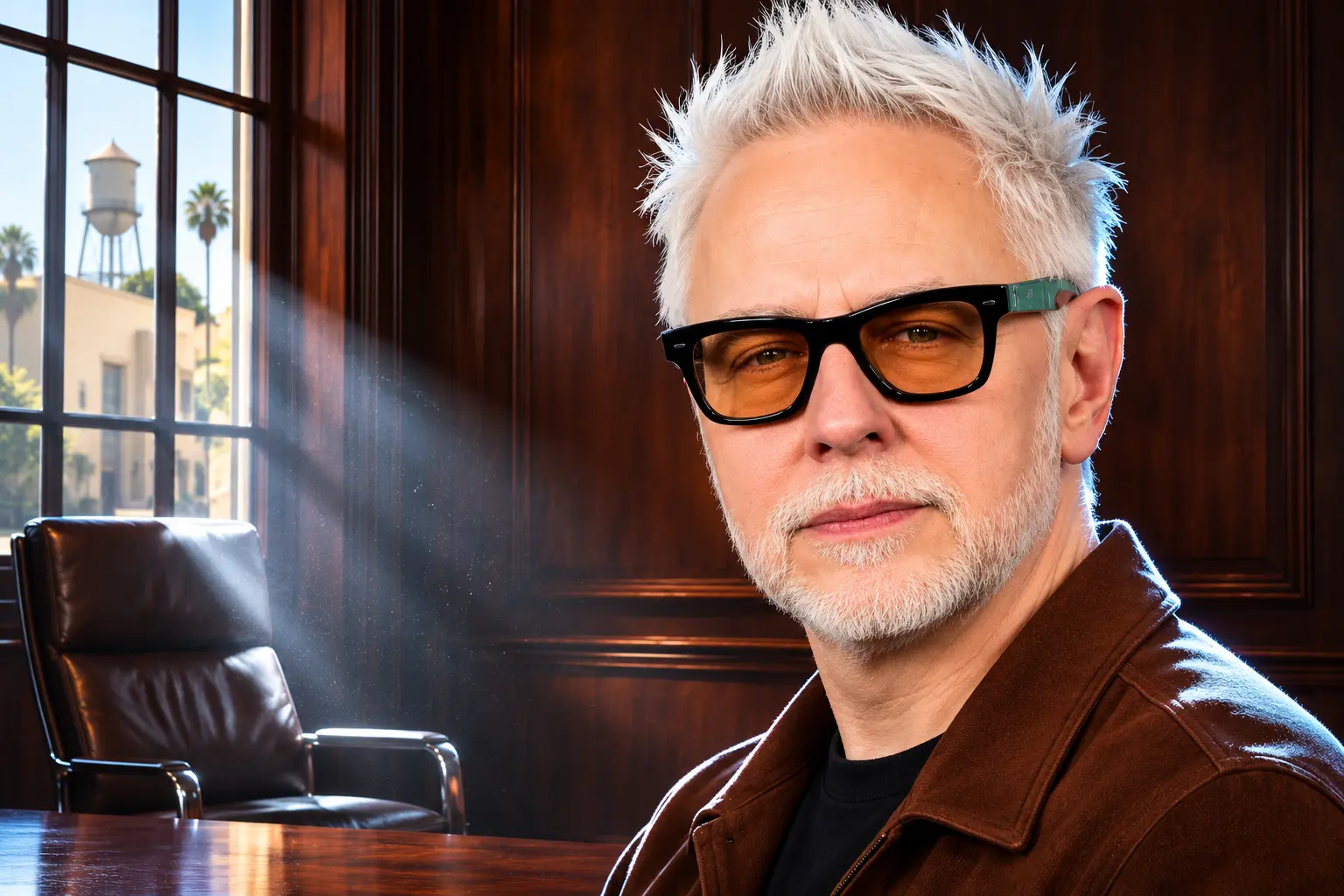
DC Will No Longer Report to the Chief Executive
The contract Gunn and Safran signed under David Zaslav said they would keep reporting to the chief executive if the company changed hands. Under Skydance, that person was Ellison. Dana Goldberg and Josh Greenstein, who co-chair the motion picture group, report to him on everything else. DC did not. That gap became the fight.
One insider put the old arrangement in a single line: the pair “had the final word on movies, TV shows, and animation.” They were not going to accept a layer of bosses between them and the top, and several people said they were slow to share slate plans, details, and footage with Greenstein and Goldberg. In the end the studio chiefs won. Latcham will report to them.
Another person was blunter. Ellison never wanted DC reporting to him, and he did not want to referee fights between division heads. Greenstein had worked with Latcham two decades earlier, when Latcham was a rising Marvel executive and Greenstein was in Paramount marketing on the first Iron Man films, then again on Spider-Man: Homecoming when Greenstein was at Sony. The hire was a known quantity for the people taking control of the slate, not a surprise name pulled off a shortlist in November.
WHERE THE TWO SIDES RUBBED
- The reporting line: Gunn and Safran’s deal kept them on a direct path to the chief executive; Greenstein and Goldberg wanted every movie under their group.
- The footage: DC was slow, insiders said, to hand over plans and cuts to the new studio chiefs.
- The taste: Gunn pushed lesser-known heroes and hard-R swings; Latcham is described as a middle-of-the-road hitter who asks whether a film will play for people outside the lot.
- The calendar: Greenstein’s outreach to Latcham started in early fall, while the co-heads were still being told they were safe.
That last point is the one that still stings on the lot. It is odd to tell two co-heads they are staying while the replacement search is already running. Cost-cutting later became the public reason. The org chart was the thing that changed.
How $10 Million Looks Next to $6 Billion
Insiders who have seen the old DC deal say it was unusually rich. Safran still ran The Safran Company on the side. Gunn collected producer fees on films such as Supergirl and Clayface, then larger checks when he wrote and directed, as he did on Superman and Man of Tomorrow. Those combined fees, they said, could reach as much as $10 million on a single DC movie. Latcham will cost less. That is true, and it is also not how you fill a $6 billion hole.
Skydance closed the Warner purchase with $87 billion of gross debt and about $10 billion in cash. Management has promised at least $6 billion a year in run-rate savings within three years, with 30 percent of that pace by the end of 2027 and 70 percent by the end of 2028. Ynon Kreiz told investors on the Nov. 9 call that the company sees “very large areas of opportunity to reduce cost” and has “very strong confidence in achieving the $6 billion of synergy in the next 3 years.” Gunn’s top fee is 0.17 percent of that yearly target.
The named buckets in the third-quarter earnings and shareholder letter are corporate, not a couple of producer deals: about $2.2 billion from overhead and real estate, $1 billion from a $5 billion marketing budget, and $1.4 billion from technology. Ellison and Kreiz wrote that growing the company and paying down debt are the top priorities, and that net leverage should fall to 3.0 times by the end of 2029. Until then, extra cash after reinvestment and the dividend goes to repay debt.
THE DEBT SKYDANCE HAS TO SERVICE
- Gross debt: $87 billion after the Oct. 6 close, against about $10 billion in cash.
- Savings target: at least $6 billion a year within three years, across more than 20 internal workstreams.
- Q3 snapshot: Paramount-side revenue of $7.0 billion, net earnings of $73 million, adjusted EBITDA of $1.0 billion, before full Warner consolidation.
- Q4 film hit: underperforming Warner titles are expected to drag adjusted EBITDA by $200 million this quarter.
An insider has put estimated losses on the inherited 2026 film pile, including Tom Cruise’s Digger and The Bride!, near $1 billion, a separate tally from that $200 million quarterly hit. Digger took about $50 million on a $125 million to $180 million budget. Warner’s domestic market share sat at 6 percent through late September, down from 21 percent in 2025. The savings push started at consumer level too: Discovery+ prices rose in week one after close. That is not solved by swapping two co-heads for one cheaper president. It is solved, if it is solved, by folding a semi-independent comic-book studio back into the group that already runs the rest of the movies.
Superman’s Haul Still Disappointed the New Owners
Skydance did not like the DC scorecard, and the numbers are not mysterious. Superman, released July 11, 2025, took $618.7 million worldwide on a $225 million budget, about 2.75 times production cost, and it was profitable. The new regime still called it light for a flagship hero, short on the pop-culture jolt they wanted from that character. Box Office Mojo’s listing of DC Universe theatrical grosses to date shows $354.2 million of that haul came from the United States and Canada.
Supergirl, with Milly Alcock in the title role and Craig Gillespie directing, opened June 26, 2026, to $37.1 million in North America and finished at $126.5 million worldwide on a $170 million to $186 million budget. Sources put the final loss, after digital and disc, at $135 million. It never got near a break-even theatrical number, and it became the film Ellison’s team cited when they talked about DC as a problem.
Clayface is the exception, and it is the exception because it was cheap.
DCU THEATRICAL SCORECARD
| Film | Budget | Worldwide gross | What Skydance saw |
|---|---|---|---|
| Superman (July 2025) | $225 million | $618.7 million | Profitable, 2.75 times budget, still judged light for the brand |
| Supergirl (June 2026) | $170 million to $186 million | $126.5 million | $135 million loss; the film that ended the benefit of the doubt |
| Clayface (October 2026) | $44 million | $111.7 million | Just over 2.5 times budget; the one small bet that worked |
That table is why a salary talking point was easy to sell, and why it still does not cover the decision. The expensive miss was a $170 million-plus cousin-of-Superman movie. The cheap hit was an R-rated Batman villain. The next person in the job is being hired to pick more of the second kind, or to swing back at a Justice League-scale film with a tighter chain of command. Those are creative bets. They are not a $10 million line item.
Jeremy Latcham Starts Dec. 1 Under Studio Chiefs
Latcham is not a splashy outside CEO. He was Marvel’s senior vice president of production and development, a right hand to Kevin Feige, and an early advocate for hiring Gunn on Guardians of the Galaxy, the film that made Gunn’s eight-figure directing fees possible. He later produced Dungeons & Dragons: Honor Among Thieves, then shifted toward faith-and-family work at Wonder Project, including Flyer and House of David, while lining up a live-action Naruto film for Lionsgate and Sony that he now has to unwind.
People who have worked with him describe a producer who asks whether his grandparents would like the movie, and who likes to be on set rather than in a talent-agent circuit. He is expected to split time between Los Angeles and Texas, where he lives with his family. If Gunn was the person who would greenlight an f-bombed deep-cut, Latcham is the person Skydance expects to aim at a wide audience. He will run film, television, and animation, and he will do it one rung below the people Gunn refused to report to.
Gunn, for his part, did not pretend he loved the executive chair. He posted a long note the day the news broke, thanking Safran as “the smartest and most competent person I know,” then describing four years that ate his time and his patience.
So, yes, I will miss the people around me, and I will miss being the co-caretaker of these great characters, but I’m also incredibly relieved and excited to get back to pure filmmaking.
James Gunn, Instagram, Nov. 9, 2026
He also said the job’s “at-times corporate nature” wore on him, that his wife Jennifer Holland was the happiest person in the house about the change, and that dividing an ADHD hyperfocus between films he loved and films he did not was the part that broke him. That is a man leaving an org chart, not a man leaving the characters. The cheaper-exec story treats those as the same exit. They are not.
The Cheap Horror Film That Paid Off
Clayface opened the weekend of Oct. 23 to about $24 million domestically and $43 million worldwide, a number that would have been a disaster on a Superman budget and a win on $44 million. Directed by James Watkins, from a script by Mike Flanagan and Hossein Amini, with Tom Rhys Harries in the lead, it has now taken $111.7 million worldwide, just over two and a half times its production cost. Gunn and Safran had started talking about more small, spooky DC movies on the back of it. That conversation is now Latcham’s, and Greenstein’s, and Goldberg’s.
The argument against Gunn was never that every film lost money. It was that the one film that needed to set the table, Superman, did not create the kind of heat Skydance wanted, and that the next expensive one, Supergirl, collapsed. Clayface arrived too late and too small to change the meeting on Nov. 6. It did prove that a $44 million DC movie can still crawl toward a profit, which is the kind of math a company carrying $87 billion of gross debt claims to want. Whether Latcham is allowed to keep making those, or is pushed toward a faster Justice League, will tell you if the savings talk is a budget or a slogan.
A Justice League rush would be the expensive kind of bet the $6 billion program is supposed to police. Cutting two co-heads does not fund that movie, and it does not stop it either. It only makes the people who greenlight it report to the same desk as the rest of Skydance’s slate.
Gunn Keeps Man of Tomorrow and Little Else
Man of Tomorrow is still dated for July 9, 2027. Gunn wrote and directed it, production is wrapped, and he is in post. He has said he and Safran “have just been engaged on another DC project which I’m writing, and we’ll see where it goes after that.” Safran still has a long Warner producing relationship through The Conjuring films. The Batman Part II remains on the board, with Steven Soderbergh recently stepping in to help Matt Reeves. Beyond those dates, the map Gunn and Safran unveiled in 2022, including talk of solo films for Batman’s most famous Robins and a Mister Miracle animated series, has no public guardian.
WHAT WE KNOW
- The job: Latcham starts Dec. 1 as president and chief creative officer and reports to Goldberg and Greenstein.
- The sequel: Man of Tomorrow stays on the July 9, 2027 date with Gunn in post.
- The other date: The Batman Part II is still in the pipeline.
WHAT IS UNCONFIRMED
- A full reset: Talk that Ellison will dismantle Gunn’s DC Universe after Man of Tomorrow has not been matched by a company slate.
- A third Superman: Gunn was writing one; whether Latcham shoots it is open.
- The side project: Gunn’s new DC writing gig has no title and no release plan.
For DC audiences, this is familiar weather. A new regime, a new taste test, and a warning not to get too attached to the last set of actors. The $110 billion bet on wobbly franchises that Skydance just bought includes a comic-book studio that has now been reorganized four years into its latest rebuild. Gunn will be on a mix stage in 2027. The people who decide what comes after him sit one level closer to Ellison than he did, which is what Nov. 6 bought, and what $10 million never could.

Pattinson Gets Bond After Bezos Called Him Too Famous

REO’s $21,500 Runabout Is a Two-Year, 50,000-Person Bet

Voyager 1 Reaches One Light-Day as Earth Falls Behind

Best Latin Song Arrives After Rosalía Reaches the Big Three

Tyson Shrinks Beef to Three Plants After a $654 Million Loss

Meta’s Smart Glasses Sell a Light That Needed Two Patches

Apple’s New Mac Studio Clusters Local AI on the Desk

Google’s Free AI Pro Year Is Three Different Deals

Song Yadong Stops Umar Nurmagomedov the Only Way Left

Lanterns Puts Sinestro in a Cell and Lets Him Talk
-
 NEWS3 months ago
Meta’s Smart Glasses Sell a Light That Needed Two Patches
-
 NEWS3 months ago
Apple’s New Mac Studio Clusters Local AI on the Desk
-
 NEWS3 months ago
Google’s Free AI Pro Year Is Three Different Deals
-
 NEWS3 months ago
Song Yadong Stops Umar Nurmagomedov the Only Way Left
-
 ENTERTAINMENT3 months ago
Lanterns Puts Sinestro in a Cell and Lets Him Talk
-

 NEWS3 months ago
The Mahape Fake Apple Raid Repeats a Dual-Shift Pattern
-

 ENTERTAINMENT3 months ago
LUN8’s First London Concert Filled a 620-Cap Club
-

 NEWS3 months ago
OpenAI Agents Hit Hugging Face to Cheat a Test