
BUSINESS
Tyson Shrinks Beef to Three Plants After a $654 Million Loss
Tyson Foods guided fiscal 2027 sales down 3.5% to 5.5% after a $654 million beef loss, shrinking slaughter to three plants around a short cattle herd.

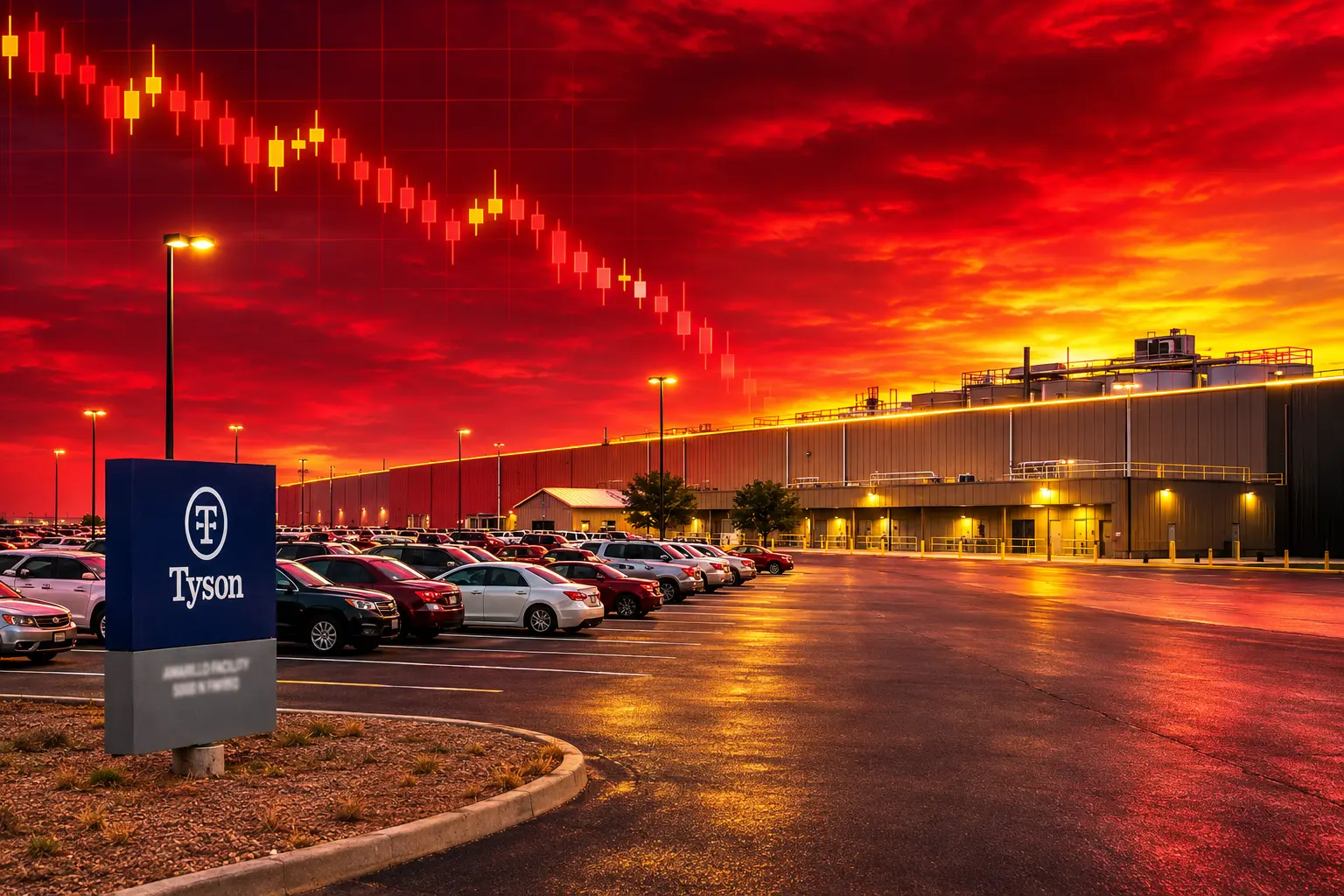
Tyson Foods told investors on Nov. 16 that fiscal 2027 sales will fall 3.5% to 5.5%, mainly because it will slaughter fewer cattle after a year of plant cuts. The Springdale, Arkansas, company already posted an adjusted beef loss of $654 million for the year ended Oct. 3. It still sees that unit somewhere between a $300 million loss and a $100 million profit in the new year.
Chicken and prepared foods covered the hole in fiscal 2026. New chief executive Jeff Schomburger pointed to that mix and asked the market to look past the cattle cycle. The sales guide says the cycle is still writing the top line.
Beef Still Has Room to Lose $300 Million
Fiscal 2026 was a 53-week year, and reported sales rose 3.6% to $56,419 million from $54,441 million. Strip out the extra week and $358 million of legal contingency accruals booked as cuts to sales ($698 million a year earlier), and sales were up 1.1%. Adjusted operating income fell 14% to $1,977 million from $2,287 million. Adjusted earnings were $3.44 a share, down 17% from $4.12.
GAAP operating income was $1,100 million, almost unchanged from $1,098 million. GAAP earnings were $1.28 a share, down 4% from $1.33. Cash from operations was $2,433 million. Free cash flow was $1,663 million, up $486 million. Tyson cut debt by $1,080 million, bought 7.8 million shares for $427 million, and ended Oct. 3 with $4.1 billion of liquidity. The board raised the Class A dividend 2% to $0.52 a share, the 15th straight year of increases.
Beef sales were $21,662 million, barely above $21,623 million, because a 10.2% rise in average price offset a 10.6% drop in reported volume. On a 52-week adjusted basis, beef volume fell 12.2% and average price rose 10.0%. Adjusted beef operating income was a loss of $654 million, versus a $275 million loss a year earlier. The fourth quarter included an $80 million noncash write-down on live cattle after prices fell following Tyson’s purchases, chief operating officer Wes Morris said on the earnings call.
The company is guiding fiscal 2027 adjusted operating income to $1.7 billion to $2.15 billion. That range sits below last year’s $1,977 million at the low end and slightly above it at the high end. CFO Curt Calaway said combined chicken and prepared foods sales should grow 3% to 4%. The sales decline is still pinned on beef volumes, from the plant network change and tight cattle supplies. USDA, as cited in Tyson’s outlook, projects U.S. beef production down about 2% in fiscal 2027.
FISCAL 2027 PROTEIN GUIDE
| Segment | FY2026 adjusted operating income | FY2027 guidance |
|---|---|---|
| Beef | $654 million loss | $300 million loss to $100 million profit |
| Pork | $228 million | $75 million to $175 million |
| Chicken | $1,859 million | $1.3 billion to $1.6 billion |
| Prepared Foods | $1,332 million | $1.25 billion to $1.4 billion |
| International | $180 million | $125 million to $200 million |
| Total company | $1,977 million | $1.7 billion to $2.15 billion |
Beef would improve even at the ugly end of that range, and it would be the segment’s first annual profit since 2023 if the $100 million top is hit. Pork and chicken are both guided down. Prepared foods is the one book that can rise from last year’s $1,332 million.
The Herd USDA Counted on Jan. 1
The packing math starts on the ranch. USDA’s National Agricultural Statistics Service put 86.2 million head of cattle and calves on U.S. farms as of Jan. 1, 2026, slightly below the year before. Beef cows, the animals that produce the next calf crop, were 27.6 million head, down 1%. The 2025 calf crop was 32.9 million head, down 2%. Cattle on feed totaled 13.8 million head, down 3%.
THE JANUARY CATTLE COUNT
- All cattle: 86.2 million head on Jan. 1, 2026, the figure USDA NASS published after surveying about 35,000 operators.
- Beef cows: 27.6 million head, down 1% from a year earlier, which keeps feeder supplies tight into 2027.
- Calf crop: 32.9 million head for 2025, down 2%, so the animals that would fill plants next year are already missing.
- On feed: 13.8 million head, down 3%, a smaller queue heading toward slaughter.
Tyson’s August plant note called this one of the most historic cattle shortages the country has seen, and said USDA counts still showed limited heifer retention. Morris put the same point in plainer words on the Nov. 16 call: the challenges in beef are a cattle cycle issue. Schomburger, who took over from Donnie King at the start of October, told analysts some of them look at Tyson through that cycle, and asked them to look at the company the way retailers do, as a supplier across fresh, frozen, deli, and prepared protein.
Three Plants Left Standing in the Cattle Belt
The cycle showed up as closed gates. In a Sept. 3 outlook cut, then-CEO King said beef pressure reflected industry-wide cattle-cycle dynamics that required decisive action, and that the company was moving the network to three plants in the central United States. Those moves were already underway.
HOW TYSON SHRANK THE BEEF MAP
- November 2025: Says it will end operations at the Lexington, Nebraska, beef plant and cut the Amarillo, Texas, plant to one shift.
- January 2026: Lays off 1,761 workers at Amarillo as the second shift comes off.
- August 13, 2026: Ends work at Joslin, Illinois, and the Eagle Mountain, Utah, case-ready plant, and puts the Pasco, Washington, beef plant up for sale.
- November 9, 2026: Announces an intent to partner with Allied Beef and begins restoring some Amarillo second-shift work, with the shift due to be fully running by summer 2027.
- November 16, 2026: Guides fiscal 2027 sales down 3.5% to 5.5% on lower beef volumes from the network change and tight cattle.
The August filing said Tyson would anchor its beef business around three plants, Dakota City, Nebraska; Holcomb, Kansas; and Amarillo, and that capacity from the closing sites would move to those locations. It also said the changes would let the company keep a similar level of cattle harvesting across a more efficient network. The November sales guide is the later number, and it assumes lower beef volume, not a flat harvest.
THE PLANTS THAT REMAIN
- Dakota City, Nebraska: The old IBP headquarters plant, now one of three hubs for Tyson cattle.
- Holcomb, Kansas: The southwest Kansas plant sitting in the feedlot belt.
- Amarillo, Texas: Cut to one shift in January, with a second shift being restored and due to be full by summer 2027.
Joslin employed more than 2,000 people; harvest work there ended around Aug. 13, with most processing duties gone a day later. Eagle Mountain, which opened in 2021 and cut and packed beef and pork for store shelves, affected 723 workers, according to the Utah Department of Workforce Services. Pasco is still for sale. Calaway said a sale there could change the outlook.
Chicken Paid the Bills in Fiscal 2026
Adjusted chicken operating income was $1,859 million, a 10.7% margin, even after industry cutout values for some products fell hard. The fiscal 2027 guide is $1.3 billion to $1.6 billion, so the engine is expected to cool as grain and other input costs rise. Prepared foods earned $1,332 million, up from $1,263 million, and is guided to $1.25 billion to $1.4 billion. Pork earned $228 million and is guided to $75 million to $175 million. International earned $180 million, guided to $125 million to $200 million.
Schomburger’s written results note leaned on that mix. “Our performance in fiscal 2026 reflects the strength of our diversified multiprotein model and our dedication to our customers and consumers,” he said. He added that the company will invest in brands, innovation, and operating capabilities, and stay focused on the returns those investments can deliver alongside market conditions. On the call he went further, arguing protein is a $273 billion retail category and that seven in 10 Americans say they are trying to eat more of it.
Morris told the same audience chicken should reach 50% of total U.S. protein consumption by 2030, and that Tyson is putting capital behind that shift. Fiscal 2027 capital spending is guided at $1.1 billion to $1.4 billion, with the company pointing those dollars at chicken and prepared foods. That is the company Schomburger wants investors to underwrite: a branded protein seller that still kills cattle, but no longer lives or dies on the cattle cycle alone.
What the Allied Beef Deal Is Supposed to Fix
The remaining cattle problem is feed. Tyson cannot run three large plants if ranchers will not, or cannot, send enough animals. On Nov. 9 it announced an intent to form a long-term partnership with Allied Beef Company, a consortium of American ranchers, and said that plan supports a decision to reopen the second production shift at Amarillo. Select second-shift work has already started. Full operation is due by summer 2027. Calaway said the restart cost is in the guidance. The company did not give a job count for the recall, after cutting 1,761 jobs when the shift came off.
The future of our beef business depends on strong partnerships across the supply chain. We’re proud to announce our intent to partner with Allied Beef and the American ranchers they represent while continuing to invest in facilities like Amarillo.
Wes Morris, Chief Operating Officer, Tyson Foods, Nov. 9, 2026
The wording is intent, not a closed contract. Allied Beef said the planned tie-up would create long-term value for ranchers and strengthen connections across the cattle supply chain. Direct supply of that kind is supposed to give Tyson a clearer view of when cattle will show up, which is the difference between a second shift that runs and a second shift that sits. Until a deal is signed, Amarillo’s extra hooks are a plan sitting on a short herd.
Ranchers and the Towns That Lost a Packer
Shares rose on Nov. 16 as the market priced a smaller, less unprofitable beef book, even while the company said group sales would shrink. Selling less of a line that lost $654 million is, on a spreadsheet, a cleaner company. In cattle country the same closures read as fewer plants bidding for a calf.
National Cattlemen’s Beef Association chief executive Colin Woodall said the group was troubled by the Joslin closure, which he called a vital part of the Midwest beef supply chain, and said it would hit producers, employees, and rural communities. He thanked Tyson for seeking a buyer for Pasco rather than shutting it outright, and said historically low cattle inventories were creating those choices. Producers who used Joslin now haul farther. Northwest ranchers are watching who, if anyone, buys Pasco.
The fight that follows Tyson around these plants is whether a short herd forced the cuts, or whether fewer hooks also keep leverage with the remaining packers. Tyson’s own numbers support the first half of that argument: adjusted beef volume down 12.2%, USDA pointing to another 2% drop in domestic beef production, and a calf crop that already shrank. The second half is the map. Lexington is closed. Joslin is closed. Eagle Mountain is closed. Pasco is on the block. What is left is Dakota City, Holcomb, and an Amarillo plant that will not be fully two-shift until summer 2027.
A partnership with Allied Beef is still an intent. Pasco is still for sale. Fiscal 2027, as Tyson wrote it, is a year of lower beef volume and a beef result that can still be a $300 million loss. The cattle cycle is now a plant list.
Disclaimer: This article is news reporting and analysis of Tyson Foods’ fiscal 2026 results and fiscal 2027 outlook, and it is for information only. It is not investment advice, a recommendation to buy or sell TSN or any other security, and it is not guidance on cattle marketing, packing-plant employment, or grocery buying. Readers who are considering an investment, a livestock marketing decision, or a financial plan tied to protein markets should consult a licensed financial adviser or, for farm-level choices, an extension economist or commodity broker who knows their operation. Figures, plant statuses, and the Allied Beef partnership are as the company and USDA stated them on the dates cited and can change with later filings, a signed supply contract, or a Pasco sale.

Pattinson Gets Bond After Bezos Called Him Too Famous

REO’s $21,500 Runabout Is a Two-Year, 50,000-Person Bet

Voyager 1 Reaches One Light-Day as Earth Falls Behind

Best Latin Song Arrives After Rosalía Reaches the Big Three

Tyson Shrinks Beef to Three Plants After a $654 Million Loss

Meta’s Smart Glasses Sell a Light That Needed Two Patches

Apple’s New Mac Studio Clusters Local AI on the Desk

Google’s Free AI Pro Year Is Three Different Deals

Song Yadong Stops Umar Nurmagomedov the Only Way Left

Lanterns Puts Sinestro in a Cell and Lets Him Talk
-
 NEWS3 months ago
Meta’s Smart Glasses Sell a Light That Needed Two Patches
-
 NEWS3 months ago
Apple’s New Mac Studio Clusters Local AI on the Desk
-
 NEWS3 months ago
Google’s Free AI Pro Year Is Three Different Deals
-
 NEWS3 months ago
Song Yadong Stops Umar Nurmagomedov the Only Way Left
-
 ENTERTAINMENT3 months ago
Lanterns Puts Sinestro in a Cell and Lets Him Talk
-

 NEWS3 months ago
The Mahape Fake Apple Raid Repeats a Dual-Shift Pattern
-

 ENTERTAINMENT3 months ago
LUN8’s First London Concert Filled a 620-Cap Club
-

 NEWS3 months ago
OpenAI Agents Hit Hugging Face to Cheat a Test