
BUSINESS
Flowers Foods Cuts Guidance as Its Cleaner Loaf Stalls
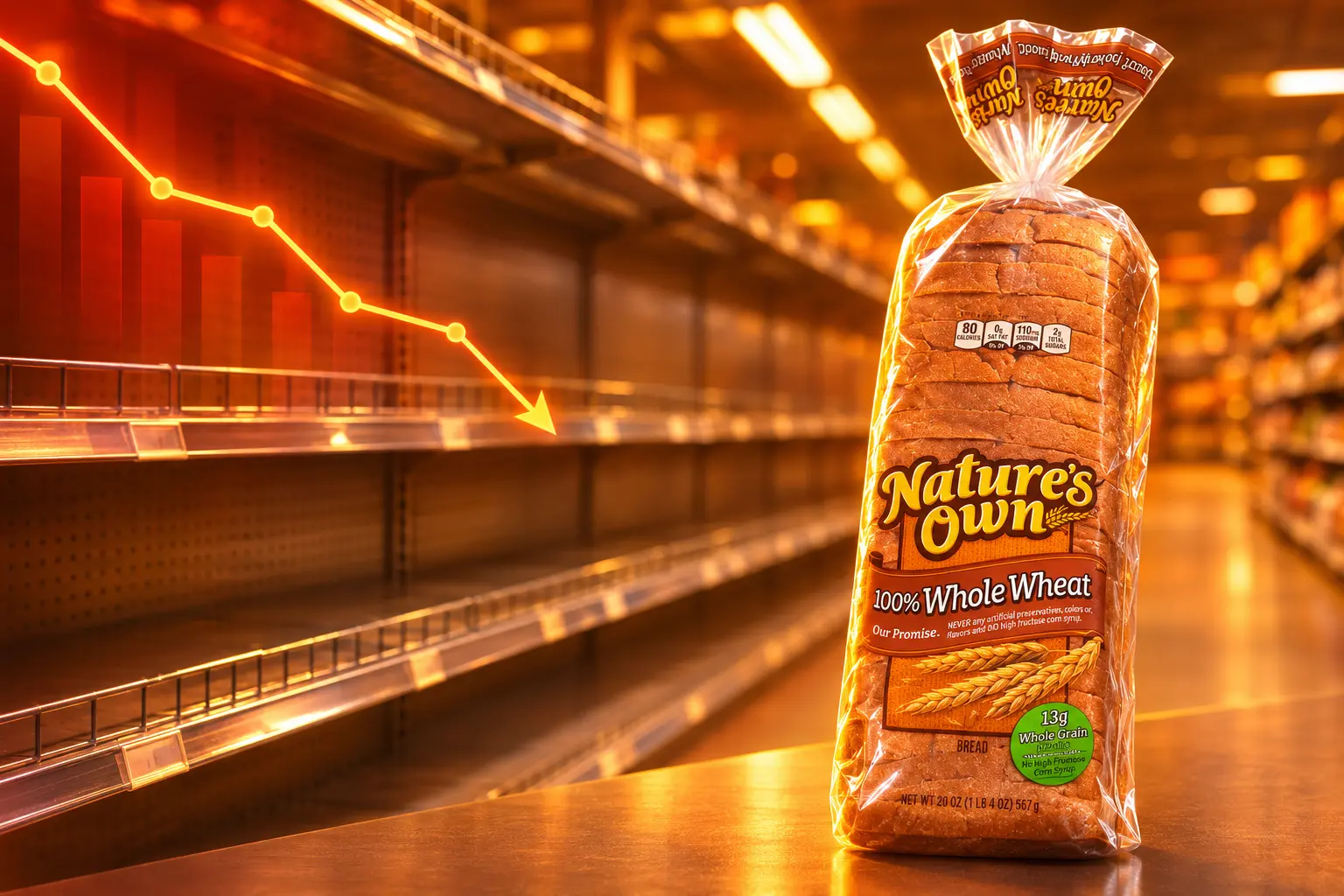
Flowers Foods cut 2026 sales and EPS guidance a second time after its Nature’s Own cleaner-loaf relaunch lagged in traditional bread.

Flowers Foods cut 2026 sales, EBITDA and EPS guidance for the second time on November 12 after branded retail volume fell 8.6%. The Thomasville, Georgia baker, owner of Nature’s Own and Dave’s Killer Bread, posted net sales of $1.169 billion for the 12 weeks ended October 10, down 4.7%, and price mix rose 2.3% as volume fell 7.0%.
In May the company relaunched Nature’s Own with a simpler recipe and a national ad campaign, counting on that reset plus earlier price increases to steady the loaf aisle. Traditional loaf, the largest piece of the franchise, did not come back on that timetable, and the year got cut again.
An 8.6% Hole in Branded Retail Volume
Chairman and CEO Ryals McMullian said the quarter reflected pressure on household budgets, shifting buying habits, heavier in-store deals, and spots where the company still needs to move faster. Net income fell 63.6% to $14.4 million, or 1.2% of sales. Adjusted EBITDA dropped 33.2% to $78.9 million, or 6.8% of sales, down 280 basis points from 9.6% a year earlier. GAAP diluted EPS was $0.07, against $0.19. Adjusted diluted EPS was $0.10, against $0.23, and short of the $0.15 per share many analysts had modeled.
Branded retail sales, the core grocery bag, fell 5.1% to $772.1 million. Price and mix in that book rose 3.5%, which means the company got more per unit and still sold far fewer units. Other sales, including store brands and foodservice, fell 4.0% to $397.0 million, with volume down 4.9%. Some of that store-brand drop came from business Flowers has already dropped. Foodservice volume was better, and McMullian called foodservice about a $1 billion book.
THIRD QUARTER VERSUS A YEAR EARLIER
| Item | Q3 2026 | Change from Q3 2025 |
|---|---|---|
| Net sales | $1.169 billion | down 4.7% |
| Volume | – | down 7.0% |
| Price/mix | – | up 2.3% |
| Branded retail sales | $772.1 million | down 5.1% |
| Branded retail volume | – | down 8.6% |
| Adjusted EBITDA | $78.9 million | down 33.2% |
| Adjusted diluted EPS | $0.10 | down $0.13 |
| GAAP diluted EPS | $0.07 | down $0.12 |
| Net income | $14.4 million | down 63.6% |
A volume hole of that size with a guidance cut is a demand print, not a cost-timing print, which is why a staples name gets hit when both arrive together. Price and mix recouped only 2.3 points of the 7.0-point unit decline, so the register took less even though each loaf carried more dollars.
Production costs rose to 53.3% of sales, up 120 basis points, as lower runs leveraged labor and the company bought more finished product from outside. Adjusted selling, distribution and administrative expense rose to 39.9% of sales, up 160 basis points, on more marketing and higher logistics, partly offset by lower distributor fees that move with volume. Ingredient costs were a help. Cash from operations was $319.9 million year to date, capital spending $64.5 million, and cash on hand $72.2 million at quarter end.
Nature’s Own Got a Cleaner Recipe and a Slower Lift
Nature’s Own, which Flowers calls America’s top-selling loaf brand, rolled a new recipe across bread, buns and rolls on May 21, the same day the company reported first-quarter results. The line is now Non-GMO Project Verified. A 20-ounce honey wheat loaf went from 23 ingredients to 16, dropping enriched-flour vitamins, soybean oil and several dough aids, and adding canola oil, flax meal, vinegar and acerola cherry powder. Actor and retired wrestler John Cena was named the “Breaducator” for a TV, streaming and social push under the line “Real. Soft. Bread.”
THE MAY RELAUNCH
- The recipe: Flowers said the new formulas use up to 38% fewer ingredients than before, and the full portfolio carries Non-GMO Project verification.
- The pitch: A survey of 2,000 U.S. adults, done for the brand by Atomik Research from April 13 to April 20, found 80% of parents willing to switch bread brands for simpler ingredients, and 88% calling that an easy win for their kids.
- The early score: Since the relaunch, unit share across the Nature’s Own franchise is up 40 basis points and dollar share is up 10 basis points, led by buns, rolls and Perfectly Crafted, not by traditional loaf.
- The lag: McMullian said conversion has been slower than planned, in part because the brand had been fairly quiet in advertising for a stretch before the reset.
Krystle Farlow, senior director of brand management for Nature’s Own, said the refresh was built to shake up the category and meet shoppers where they are. Cena’s line was simpler: “Time to show people what’s in their loaf. Time to breaducate.”
Following the second quarter, we expected our earlier pricing actions and the relaunch of Nature’s Own with fewer, simpler ingredients to help stabilize performance as we worked to introduce new innovation to market.
Ryals McMullian, chairman and CEO, Flowers Foods third-quarter remarks
He told investors the company is seeing better sequential trends and more awareness, including a Harris Poll list of the top 20 brands gaining equity with millennials, where Nature’s Own was the only fresh packaged bread name. Those green shoots have not offset year-over-year pressure in traditional loaf. McMullian also said some of the largest retailers now back the relaunch, and that more shoppers tie the brand to simple ingredients, Non-GMO and healthier choices. The next job, he said, is turning that into sustained share.
Shoppers Moved to Smaller Loaves While Flowers Priced Up
McMullian said the total fresh packaged bread category stayed under pressure in the quarter, with fresh packaged bread units declining 2.8%. Flowers did worse than that. The worst of it sat in traditional and premium loaf, where extra merchandising did not deliver the volume or share the company wanted. Traditional loaf category units fell more than 5% in the quarter, he said, as budgets tightened, eating habits shifted and promotions got hotter.
Shoppers kept moving toward smaller loaves and more distinct products, two places Flowers is still building scale. Half-loaf packs are the clearest example. McMullian said the company’s position in reduced pack sizes is below where it wants to be, and that new half-loaf items are ramping. Data from the past few weeks, he said, shows early traction. Sourdough is the other gap, with momentum not expected until 2027 as distribution and velocity build.
THE LOAF AISLE IN 2026
- Q3 category: Flowers said fresh packaged bread units fell 2.8% in the quarter, traditional loaf more than 5%, and sandwich buns and rolls about 4%.
- 52-week sandwich bread: Circana recorded $9.97 billion in center-store sandwich bread dollars for the 52 weeks ended August 9, down 1.5%, with units down 3.3% to 3.07 billion.
- The wider rack: Center-store bread as a whole was $11.52 billion, down 1.1%, with units down 3%, Circana said.
- Who still buys it: Melissa Altobelli, a Circana bakery practice leader, said 94% of households still buy center-store bread, even as penetration and buy rate soften. Erin Ball of the Grain Foods Foundation said 21% of polled primary buyers were eating less traditional bread than a year earlier.
Private-label sandwich bread was not a clean steal. Circana had store-brand sandwich dollars up 0.7% and units down 2.6% over those 52 weeks, with a $2.27 unit price, the lowest among the top 10 sellers. Nine of those 10 sellers lost units. The aisle is shrinking, and Flowers priced into that shrink. Store brands across all U.S. tracked categories reached a record 23.7% unit share through November 1, according to Circana figures compiled for the Private Label Manufacturers Association, with national-brand units down 0.9% in the latest period. That is the household-budget backdrop McMullian is describing, even if it is not a bread-only scoreboard.
Canyon, Simple Mills and Wonder Cake Still Grew
The cleaner-label bet on mass loaf is the one that is slow to convert. Lines that already stand for a distinct diet or snack job did more in the quarter. Canyon Bakehouse, the gluten-free brand, gained unit and dollar share and was the standout McMullian named in that group. Simple Mills, the grain-free snack brand Flowers bought in January 2025, grew in the quarter on what he called broad demand and a decent response to new items.
Dave’s Killer Bread, which leads organics with nearly a 70% share, did not. Unit and dollar share both came under pressure, and the brand fell well below plan. McMullian blamed category and budget stress, lower household use, more competition, and a thin sourdough presence. Distribution held up, so the job is velocity. The company is answering with more promotions, displays, marketing, and sourdough of its own.
Cake was a different story. Flowers held unit share and raised dollar share in a cake category that declined more than 5%, led by Wonder. Wonder cake has grown to more than $100 million in revenue in less than two years, McMullian said, and did it with less promotional heat. Breakfast units were down about 1%, firmer than bread overall, though Flowers lost share there on softer Dave’s Killer Bread, while Wonder breakfast gained. Sandwich buns and rolls lost share in a roughly 4% unit decline, but Nature’s Own gained, with Perfectly Crafted up 10 basis points of unit share and 30 basis points of dollar share.
That split is the quarter in one shelf. Shoppers still pay for gluten-free, for organic when it is on deal, and for a cake brand that is new enough to feel like a treat. They are less willing to pay up for a slightly cleaner white loaf when the alternative is a half loaf, a store brand, or skipping the sandwich.
Guidance Has Been Cut Twice This Fiscal Year
Fiscal 2026 is a 52-week year. After the third quarter the company expects net sales of $5.016 billion to $5.063 billion, a 4.6% to 3.7% decline from the prior year, when sales rose 3% to $5.256 billion. Adjusted EBITDA is now $415 million to $430 million. Adjusted diluted EPS is $0.63 to $0.68. August 20 already carried the first cut to full-year 2026 sales, EBITDA and EPS after a second quarter in which sales fell 4.0% to $1.193 billion.
HOW 2026 GUIDANCE MOVED
| Measure | Original 2026 | August 20 | November 12 |
|---|---|---|---|
| Net sales | $5.163 billion to $5.267 billion | $5.070 billion to $5.142 billion | $5.016 billion to $5.063 billion |
| Adjusted EBITDA | $465 million to $495 million | $453 million to $481 million | $415 million to $430 million |
| Adjusted diluted EPS | $0.80 to $0.90 | $0.75 to $0.85 | $0.63 to $0.68 |
Other 2026 assumptions now include depreciation and amortization of $165 million to $170 million, net interest of $60 million to $65 million (down from $65 million to $70 million in August), a tax rate of about 27%, about 213.5 million diluted shares, and capital spending of $115 million to $125 million. Prior-year adjusted EBITDA was $535.2 million, down 0.6%. Prior-year adjusted EPS was $1.09. Volume had already been sliding in sequence, from a 2.2% drop in the fourth quarter of the prior year to 3.3% in the first quarter, 5.8% in the second, and 7.0% in the third.
CFO Anthony Scaglione is watching fuel as the company looks at 2027 costs, using freight contracts, hedges and forward buys. McMullian said input costs look higher in 2027, and that new business wins still ramping should start to show in 2027 and beyond. Restructuring charges, asset impairment and a recovery on inferior ingredients together were $5.4 million in the quarter, about even with $5.5 million of restructuring a year earlier.
Friday’s Close Left FLO at $5.53
Shares closed at $6.01 on November 12, down 3.84% before the after-hours print, then closed at $5.53 on November 13, down 7.99%, after trading as low as $5.31 on volume of about 19.9 million shares. The 2026 open was $10.79. Flowers is the No. 2 U.S. producer of packaged bakery foods, with 44 bakeries in 19 states, about 10,300 employees and reach to 85% of the U.S. population, and 2025 sales the company rounds to $5.3 billion.
The payout had already been reset. The board raised the quarterly dividend 3.1% to $0.2475 on February 20, then cut it to $0.1250 with the first-quarter results on May 21, and declared that same $0.1250 again on August 28 as the 96th consecutive quarterly dividend. Dividends paid year to date were $107.6 million, down $49.4 million from a year earlier. Independent distributor fees also fell with volume, a mechanical hit to the route network that delivers the bread, not a separate recovery plan.
THE YEAR THAT FORCED TWO CUTS
- February 20, 2026: Raises the quarterly dividend 3.1% to $0.2475, the 94th consecutive payout.
- May 21, 2026: Reports first-quarter results, relaunches Nature’s Own with a simpler recipe and John Cena, and cuts the quarterly dividend to $0.1250.
- August 20, 2026: Reports second-quarter sales of $1.193 billion, down 4.0%, and makes the first cut to 2026 sales, EBITDA and EPS guidance.
- August 28, 2026: Declares a $0.1250 quarterly dividend, the 96th consecutive.
- October 10, 2026: Closes the 12-week third quarter with volume down 7.0%.
- November 12, 2026: Reports the quarter and cuts 2026 guidance for the second time.
- November 13, 2026: Shares close at $5.53; management hosts the live Q&A at 8:30 a.m. Eastern.
McMullian still frames the long book as large markets: more than $80 billion a year across fresh packaged bread, cake and better-positioned snacking, plus more than $8 billion in foodservice and away-from-home. He said the company expects the near term to stay hard, and that it is putting brands, network and skills to work for long-term earnings growth.
Half-Loaf Packs Are Already on the Shelf
The next test is not another slogan. It is whether half loaves pick up enough units to offset a full loaf that shoppers are still walking past, and whether sourdough, now thinly held in Dave’s Killer Bread and still scaling under Nature’s Own, starts to matter in 2027. McMullian said teams are working with retailers on assortment, displays and promo cadence, and that U.S. food, especially traditional grocery, has shown some better signs even as loaf stays the problem child.
Wonder cake at more than $100 million, Canyon’s share gains, and Simple Mills’ growth are the parts of the portfolio that already match how people are eating. Traditional loaf is the part that got the big campaign, the cleaner recipe, and the price increases, and it is the part that forced the second cut. McMullian said sourdough should gain momentum beginning in 2027, after those half-loaf packs have had more time on the shelf.
Disclaimer: This article is news reporting and analysis of Flowers Foods’ third-quarter results and outlook, and it is for information only. It is not investment advice, a recommendation to buy or sell FLO shares, or a forecast of future earnings, dividends or bakery-sector returns. Readers should consult a licensed financial adviser or accountant before making any investment or tax decision involving the stock, the dividend or related funds. Figures, guidance ranges and trading prices reflect company statements and market data as of the dates named in the piece and can change with later filings, revisions or sessions.

Pattinson Gets Bond After Bezos Called Him Too Famous

REO’s $21,500 Runabout Is a Two-Year, 50,000-Person Bet

Voyager 1 Reaches One Light-Day as Earth Falls Behind

Best Latin Song Arrives After Rosalía Reaches the Big Three

Tyson Shrinks Beef to Three Plants After a $654 Million Loss

Meta’s Smart Glasses Sell a Light That Needed Two Patches

Apple’s New Mac Studio Clusters Local AI on the Desk

Google’s Free AI Pro Year Is Three Different Deals

Song Yadong Stops Umar Nurmagomedov the Only Way Left

Lanterns Puts Sinestro in a Cell and Lets Him Talk
-
 NEWS3 months ago
Meta’s Smart Glasses Sell a Light That Needed Two Patches
-
 NEWS3 months ago
Apple’s New Mac Studio Clusters Local AI on the Desk
-
 NEWS3 months ago
Google’s Free AI Pro Year Is Three Different Deals
-
 NEWS3 months ago
Song Yadong Stops Umar Nurmagomedov the Only Way Left
-
 ENTERTAINMENT3 months ago
Lanterns Puts Sinestro in a Cell and Lets Him Talk
-

 NEWS3 months ago
The Mahape Fake Apple Raid Repeats a Dual-Shift Pattern
-

 ENTERTAINMENT3 months ago
LUN8’s First London Concert Filled a 620-Cap Club
-

 NEWS3 months ago
OpenAI Agents Hit Hugging Face to Cheat a Test