
NEWS
Voyager 1 Reaches One Light-Day as Earth Falls Behind
Voyager 1 reached one light-day from Earth on Nov. 18, 2026, so a radio hello now takes two days, weeks after a 48-hour silence.

NASA’s Voyager 1 reached one light-day from Earth on Nov. 18, 2026, at 5:16:07 a.m. EST, a straight-line gap of 16,094,799,096 miles (25,902,068,356 kilometers). A radio command now needs 24 hours to arrive, and the reply needs another 24 hours, so a single hello takes two days.
The probe, launched on Sept. 5, 1977, felt nothing at the mark. The change is on the ground, where the team that still flies it has to live with a lag that already showed its teeth in October.
A Radio Hello Now Takes Two Days
A light-day is a length, the distance light covers in 24 hours, not a stopwatch on the spacecraft. Voyager 1 has been the farthest human-made object for decades, and it adds to that record every hour at about 38,000 mph (61,155 kph). On Nov. 18 the Earth-to-ship line simply crossed a round number people can hold in their heads.
Radio waves ride the same speed limit as visible light. From that morning on, any instruction leaving California spends a full day in flight, and any confirmation spends a full day coming home. Suzanne Dodd, Voyager project manager at NASA’s Jet Propulsion Laboratory, put the new rhythm in one line.
If you want to say ‘hello’ to Voyager, you send your message and then you go home and you wait two days before you finally get a response.
Suzanne Dodd, Voyager project manager, NASA Jet Propulsion Laboratory
JPL’s own note on the lag tells operators they must wait two days for a response after they transmit. The spacecraft will not notice the anniversary. Fault protection still has to hold the bus steady for those two days before anyone in Pasadena can send a fix.
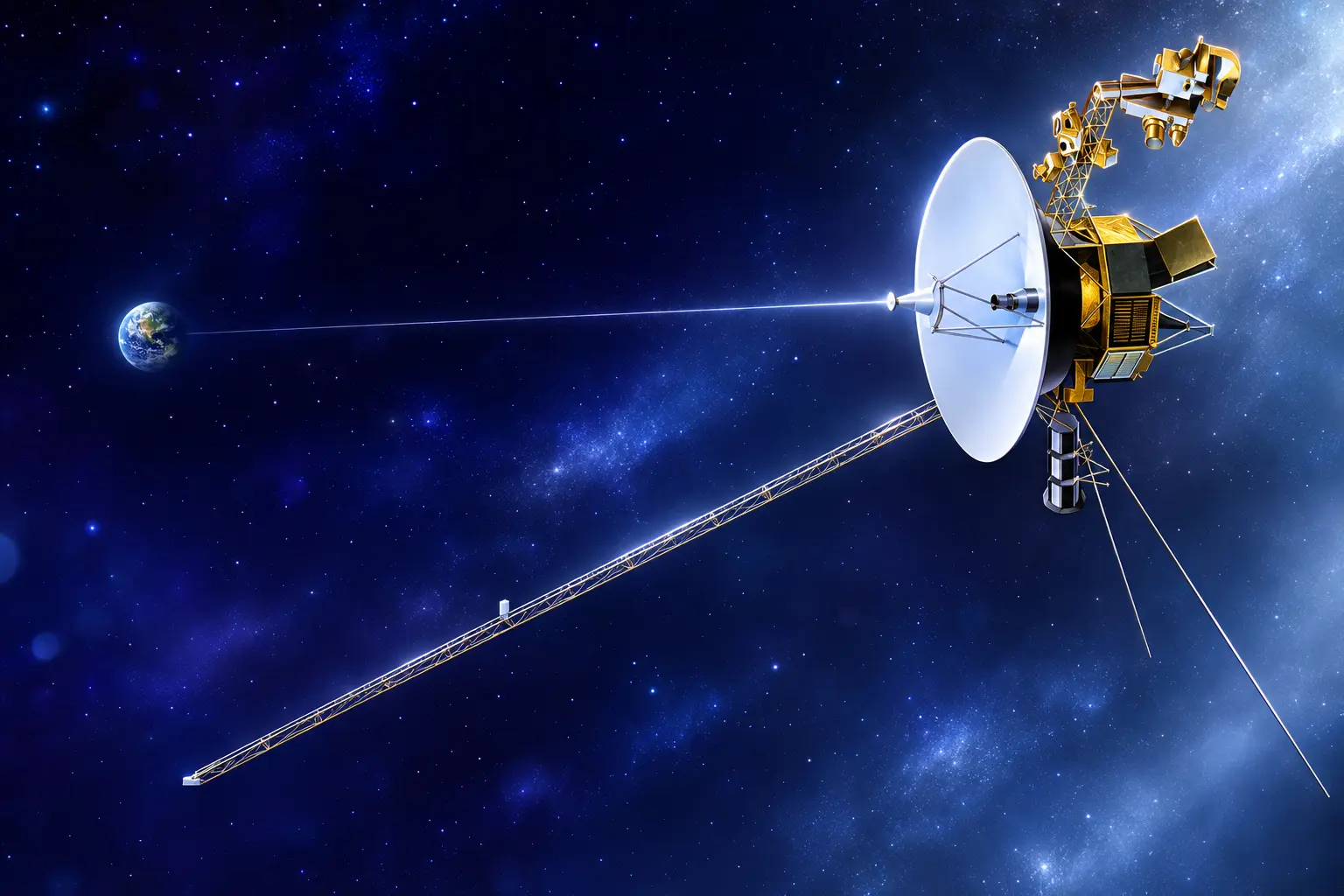
The link depends on NASA’s Deep Space Network tracking antennas in California, Spain, and Australia, 70-metre dishes spaced so Earth’s rotation does not drop the faint X-band whisper. Voyager 1 points a 3.7-metre high-gain dish back at that moving target and talks slowly. The first downlink that left the spacecraft after the crossing still had a day’s flight left, so the first post-mark packets were due on Nov. 19.
Voyager 1 Went Quiet for 48 Hours in October
On Oct. 18 and Oct. 19, 2026, the network heard nothing during two scheduled passes 24 hours apart. The probe was then about 16 billion miles (24 billion kilometers) from Earth. The carrier came back on Oct. 20, before troubleshooting commands had even left the ground.
Engineers later found that one set of thrusters, the small engines that keep the antenna aimed at Earth, had gone offline. Backup thrusters switched on by themselves. That automatic swap is fault protection: the computers freeze normal work, park the craft in a safe pose, and wait for people who, even in October, were already almost a day away.
Kareem Badaruddin, Voyager mission manager at JPL, said the team had not seen the spacecraft do this before.
This is the first time we’ve seen the spacecraft do something like this, but we are also at a point in the mission where we have to expect the unexpected. We’re relieved to be back in contact with Voyager 1 and are eager to understand what happened.
Kareem Badaruddin, Voyager mission manager, NASA Jet Propulsion Laboratory
The 48-hour gap closed itself. That is luck as much as design. At one light-day, the same fault would run for two full days before a command written in California could arrive, and another day before Pasadena would know whether it worked. The October silence was a rehearsal for the geometry the milestone made official.
A September Swap Delayed the Next Shutdown
Both Voyagers run on three radioisotope thermoelectric generators, which turn heat from decaying plutonium into electricity. Each probe loses about 4 watts a year. The units made about 158 watts apiece at launch in 1977. After nearly half a century, the margin is thin enough that heaters, instruments, and the radio compete for the same shrinking budget, in space near minus 80 degrees Celsius.
In early September 2026, JPL finished a months-long job it nicknamed the Big Bang. Engineers turned off three devices on Voyager 1 and switched on three lower-power stand-ins in one coordinated step, about six weeks after they did the same on Voyager 2. The six units help keep the bus warm, so the team could not swap them one at a time without leaving cold spots. NASA said that without that move, another science instrument on Voyager 1 would have been due off as early as summer 2027.
THE POWER-DOWN CALENDAR
- Feb. 25, 2025: Voyager 1’s cosmic ray subsystem is turned off to save power.
- March 24, 2025: Voyager 2’s low-energy charged particle instrument is turned off.
- Feb. 27, 2026: A planned roll on Voyager 1 is followed by an unexpected power drop, raising the risk of an automatic undervoltage shutdown.
- April 17, 2026: JPL commands Voyager 1’s low-energy charged particle instrument off; the sequence needs about 23 hours to arrive and about three hours and 15 minutes to finish.
- Early September 2026: The Big Bang heater swap is completed on Voyager 1.
- Oct. 18-20, 2026: Two missed passes, then the signal returns on its own.
The April cutoff was the Low-energy Charged Particles experiment, which had run almost without a break since 1977. A 0.5-watt motor that spins its sensor was left on, in case extra watts ever appear. Badaruddin said shutting a science instrument is nobody’s preference, and that it was the best option then on the table. NASA has not set a final end date. A mission FAQ says the two craft could stay in range of the Deep Space Network through about 2036, depending on how much power remains to run a transmitter.
What a Light-Day Measures
NASA clocks the milestone as 16,094,799,096 miles in 24 hours, with light moving about 186,000 miles every second. That is why the unit feels both huge and small. It is farther than any hardware has gone, and it is still a crawl next to the nearest star.
LIGHT TIMES FROM EARTH
| Marker | Distance | Light time |
|---|---|---|
| Moon (average) | 238,855 miles (384,400 km) | 1.3 seconds |
| Sun | 93 million miles (150 million km) | 8.3 minutes |
| Neptune (average) | 2.8 billion miles (4.5 billion km) | 4 hours 10 minutes |
| Voyager 1 on Nov. 18, 2026 | 16,094,799,096 miles (25,902,068,356 km) | 24 hours |
| Proxima Centauri | 4.24 light-years (40.15 trillion km) | 4.24 years |
Voyager 2 took a slower path that included Uranus and Neptune and is on pace, NASA says, to reach one light-day in November 2035. Whether it will still be talking then is a separate question from the math of the trajectory. Deana Weibel, an anthropologist at Grand Valley State University who studies spaceflight, said it has taken longer than half of a typical human lifespan to reach this distance, and that on that level it is amazing. She also noted that the craft is only a fraction of the way toward Proxima Centauri.
Flashlights for a Probe That Cannot See Them
After sunset on Nov. 17, NASA asked people to point phones, flashlights, and building lights at the sky and flash V-G-R, the mission’s three-letter call sign, in Morse code. The agency framed it as a golden wave around the planet. The photons from those lamps will not steer the spacecraft, and they will not be read as commands. The greeting was for the people holding the lights.
Today is the day! 💫 Tonight, after sunset, join people around the world in sending a signal skyward to celebrate Voyager 1's incredible journey and its milestone of reaching one light-day from Earth.
Learn more: https://t.co/gBKNMhOqg7 pic.twitter.com/iTPJbFAXa2
— NASA Science (@NASAScience_) November 17, 2026
The Golden Record already carries Morse. Both Voyagers fly with a copper phonograph disc of music, sounds, and greetings, and NASA notes that one line on it is the Latin phrase “Ad astra per aspera,” sent in dots and dashes. A Dutch radio telescope at Dwingeloo, built in 1956, spent the crossing live-streaming the probe’s carrier wave, a 1977 transmitter heard on a Cold War dish. That was the actual listen. The Morse party was a ritual aimed at a machine that cannot see it.
NASA also scheduled public Voyager 1 light-day events at JPL on Nov. 19, 2026, including a briefing with mission leaders. Linda Spilker, the Voyager project scientist, said that in California the crossing would fall a little after 2 a.m., and that she would go outside, wave at the night sky, and say congratulations.
Two Instruments Still Sending Interstellar Data
Voyager 1 entered interstellar space on Aug. 25, 2012. Voyager 2 followed on Nov. 5, 2018. They are still the only craft that have measured that region directly. Each launched with 10 dedicated science instruments. Cameras went off after the 1990 family portrait of the solar system, and the software that ran them was later removed. What remains is a pair of fields-and-particles sensors on Voyager 1, and those two plus a cosmic-ray detector on Voyager 2.
SCIENCE INSTRUMENTS STILL ON
| Instrument | Voyager 1 | Voyager 2 |
|---|---|---|
| Magnetometer | On | On |
| Plasma wave subsystem | On | On |
| Cosmic ray subsystem | Off (Feb. 25, 2025) | On |
| Low-energy charged particles | Off (April 17, 2026) | Off (March 24, 2025) |
The magnetometer reads the local magnetic field. The plasma wave instrument listens to oscillations in the thin charged gas and, from those tones, to density. Together they still catch the Sun’s longer reach. Blasts of solar material sometimes punch all the way through the heliosphere and rattle the quieter gas beyond it. Starting around 2020, an incoming pressure front drove magnetic fields around the Voyagers up, then down about six years later. Researchers are still working out why.
Jamie Rankin, a space physicist at Princeton University and the mission’s deputy project scientist, said people did not quite anticipate how far out those influences could be felt. That, she said, hints that other stars may stir the space between them more than older models allowed, “so that’s where it gets fun.” The remaining instruments are the reason the team keeps spending watts on a bus that can no longer photograph anything.
Gliese 445 Lies 40,000 Years Ahead
Voyager 1 is aimed toward a dim star in Ursa Minor catalogued as AC +79 3888, also called Gliese 445, more than 17 light-years from Earth. NASA expects the spacecraft to pass within about 1.7 light-years of it in 40,000 years. At 38,000 mph that is still a crawl next to light. The Golden Record will outlast the generators. The science will not.
Alan Cummings, a senior research scientist who has been on the mission since before launch, called the light-day mark an engineering milestone and a tribute to the people who designed and built a spacecraft that could get this far. The tribute has a cost. Every new kilometre makes the next recovery slower. The plutonium keeps fading by about 4 watts a year. The October outage already showed what a two-day blind period looks like, and the Big Bang only postponed the next instrument that would have gone dark.
Spilker’s 2 a.m. wave was aimed at a machine that will not hear a greeting for a day, and will not answer for a day after that. The record is real. So is the wait.
Frequently Asked Questions
What Is a Light-Day?
NASA also uses larger light units on the same scale: a light-year is about 5.88 trillion miles (9.46 trillion kilometers), and the Andromeda galaxy is about 2.5 million light-years away. A light-day is simply 24 hours of that travel, which is why radio, visible light, and X-rays all take the same time to cross it.
When Did NASA Launch Voyager 1?
Voyager 1 left Earth at 12:56:01 UTC on Sept. 5, 1977, after its twin Voyager 2 lifted off on Aug. 20, 1977. Voyager 1 flew past Jupiter on March 5, 1979, and Saturn on Nov. 12, 1980, then used a 1980 course change to climb away from the planets toward interstellar space, which it reached on Aug. 25, 2012.
How Long Does a Radio Signal Take to Reach Voyager 1?
Earth’s orbit around the Sun changes the exact Earth-to-spacecraft line by a small amount through the year, so the delay ticks by seconds from day to day even after the 24-hour mark. A round trip at the milestone is 48 hours of flight time, plus however long the spacecraft needs to act, which is why JPL now treats a simple hello as a two-day job.
Where Is Voyager 1 Heading Next?
It is not flying toward Proxima Centauri, the nearest star system at 4.24 light-years. Its path points at Gliese 445 in the constellation Ursa Minor, a much farther and fainter target, and NASA’s 40,000-year, 1.7-light-year flyby is a passing geometry, not an arrival.
When Will Voyager 2 Reach One Light-Day?
NASA says Voyager 2 is on pace to be one light-day from Earth in November 2035, nine years after its twin, because it took the longer grand-tour path past Uranus (Jan. 24, 1986) and Neptune (Aug. 25, 1989). It still has three science instruments on, including the cosmic ray subsystem that Voyager 1 shut down in 2025.
The packets that left the antenna after 5:16:07 a.m. EST on Nov. 18 were still in flight on the 18th. They were due to kiss a 70-metre dish on Nov. 19, a day late, which is now the ordinary pace of talking to Voyager 1.

Pattinson Gets Bond After Bezos Called Him Too Famous

REO’s $21,500 Runabout Is a Two-Year, 50,000-Person Bet

Voyager 1 Reaches One Light-Day as Earth Falls Behind

Best Latin Song Arrives After Rosalía Reaches the Big Three

Tyson Shrinks Beef to Three Plants After a $654 Million Loss

Meta’s Smart Glasses Sell a Light That Needed Two Patches

Apple’s New Mac Studio Clusters Local AI on the Desk

Google’s Free AI Pro Year Is Three Different Deals

Song Yadong Stops Umar Nurmagomedov the Only Way Left

Lanterns Puts Sinestro in a Cell and Lets Him Talk
-
 NEWS3 months ago
Meta’s Smart Glasses Sell a Light That Needed Two Patches
-
 NEWS3 months ago
Apple’s New Mac Studio Clusters Local AI on the Desk
-
 NEWS3 months ago
Google’s Free AI Pro Year Is Three Different Deals
-
 NEWS3 months ago
Song Yadong Stops Umar Nurmagomedov the Only Way Left
-
 ENTERTAINMENT3 months ago
Lanterns Puts Sinestro in a Cell and Lets Him Talk
-

 NEWS3 months ago
The Mahape Fake Apple Raid Repeats a Dual-Shift Pattern
-

 ENTERTAINMENT3 months ago
LUN8’s First London Concert Filled a 620-Cap Club
-

 NEWS3 months ago
OpenAI Agents Hit Hugging Face to Cheat a Test