
NEWS
BA295 Burns Hours of Fuel After a 28,000-Foot Drop
BA295 dropped 28,000 feet over Ireland, then spent hours burning fuel because the 777 could not dump 30 tonnes over landing weight.

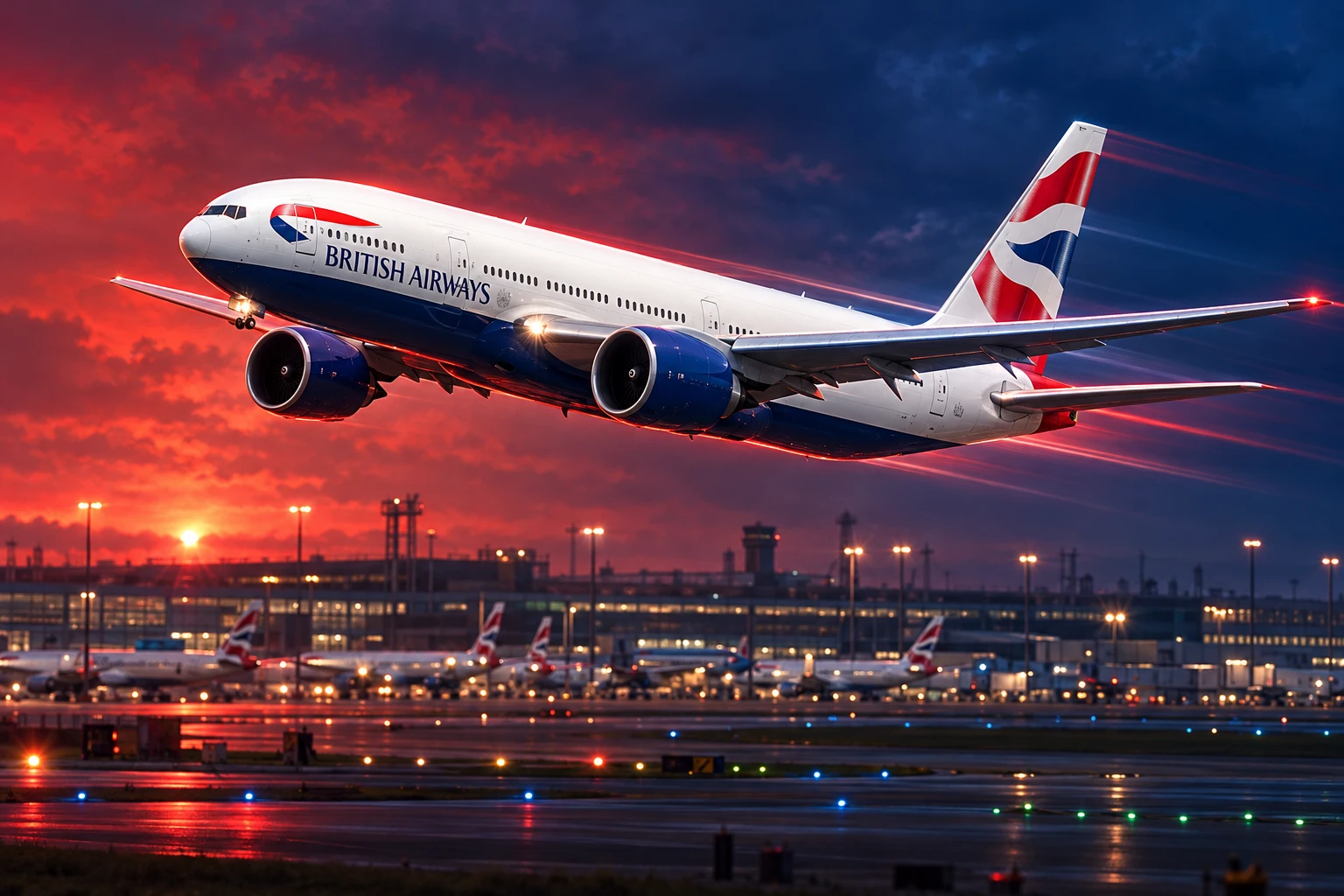
British Airways flight BA295 dropped 28,000 feet over Ireland on Monday and then spent the rest of the afternoon too heavy to land. The Boeing 777-200ER, bound for Chicago O’Hare, left Heathrow Terminal 5 at 12.14pm and turned back after the crew sent a pressure warning and a squawk 7700 alert.
Passenger oxygen masks came down. The jet levelled near 9,000 feet, burned off a transatlantic fuel load it could not dump, and rolled onto Heathrow’s runway 27L at 5.03pm. British Airways called it a technical issue. The Chicago service was cancelled.
BA295 Dropped 28,000 Feet Over Ireland
Tracking showed the 777, registered G-VIIA, at about 37,000 feet when the descent began, roughly an hour after takeoff. The floor of that dive was about 9,000 feet. An incident account later put the time to level off at about seven minutes, with the aircraft some 40 nautical miles south of Dublin.
Passenger Tom Nicholls said the jet adjusted but “didn’t feel like it was descending rapidly.” He credited the pilots. “The oxygen masks popped out soon after and there was a bit of uncertainty onboard. The couple in front couldn’t get to theirs, but by the time they’d found a spare seat with a mask, the captain announced we were below 10,000ft so they were not needed.”
That gap between the altitude tape and the cabin is the whole method. A 777 in a pressure emergency is flown down on purpose, fast and stable, until the air outside is thick enough to breathe. Former British Airways pilot Alastair Rosenschein said a stop at 9,000 feet “would suggest that it could have been something like a depressurisation,” because the bottled oxygen on board does not last for a slow cruise home.
British Airways has not named the failed part. A short crew message to the ground did. It read: WE ARE RETURNING TO LHR DUE PRESS PROBLEM. CAB ALT REACHED 10500. NO MEANS OF JETT FUEL 30T OVER MLW.
10,500 Feet in a Thin Cabin
Cabin altitude is the pressure inside the fuselage, written as a height. On a 777 it is usually held near 8,000 feet while the jet itself sits in the mid-30,000s. Air comes in from the packs. Air leaves through the outflow valve. If more leaves than arrives, the cabin climbs even as the aircraft stays level.
On BA295 that inside figure reached 10,500 feet. The cabin-altitude warning on this type comes on around 10,000 feet. Passenger masks on a 777 drop on their own nearer 14,000 feet of cabin altitude, or when the crew selects them. Photographs from the cabin showed the yellow cups hanging, so either the crew dropped them or the cabin kept climbing past the ACARS snapshot.
Licensed aircraft maintenance engineer Fahad Naim, posting as the jet headed home, listed the usual suspects a hangar will open first: a stuck outflow valve, a weak pack, or a leak in the pressure vessel. Any one of those can thin the air inside. At 35,000 feet, time of useful consciousness without extra oxygen is less than a minute, which is why 10,000 feet without extra oxygen is the height crews fly for.
WHAT WE KNOW
- The descent: BA295 went from about 37,000 feet to about 9,000 feet over Ireland and turned back to Heathrow.
- The crew message: The ACARS text cited a pressure problem, a cabin altitude of 10,500 feet, and 30 tonnes over maximum landing weight with no fuel jettison.
- The landing: The 777 arrived on runway 27L at 5.03pm. No injuries were reported, and passengers walked off normally.
WHAT IS UNCONFIRMED
- The failed part: British Airways has only said “technical issue.” The valve, pack, or leak has not been named.
- The investigation: No public AAIB file for the October 5 flight had appeared by Tuesday, October 6.
- The next flight: G-VIIA’s return to passenger service has not been given a date.
Masks on a jet like this are a short bridge, not a life-support system for an ocean crossing. Chemical generators over the seats are sized for the descent to 10,000 feet, not for hours at cruise. Once BA295 was down, the pressure emergency was contained. The fuel emergency was just starting.
Why This 777 Could Not Dump Fuel
The crew told the ground they had no means of jettison and were 30 tonnes over maximum landing weight. That single line explains the empty afternoon in the Irish Sea and the Bristol Channel. A 777-200ER leaving Heathrow for Chicago is tanked for about eight hours and 40 minutes. An hour out, almost all of that kerosene is still in the wings.
Landing that heavy risks the gear, the airframe, and a stop that does not fit the runway. In a fire or a failed engine, crews accept an overweight landing. A pressure problem that has already been flown down to 9,000 feet is different. The people in the cabin can breathe. The jet can stay up. So the pilots hold, and they burn.
Tracking updates said the crew dropped the landing gear in the hold to add drag. Gear hanging in the wind turns fuel into noise and heat faster than a clean 777 at 9,000 feet. There was no fuel spray. Early posts that the flight “dumped” 30 tonnes over the water had the number and the wrong method.
| Chicago plan | Monday afternoon | |
|---|---|---|
| Route | Heathrow to O’Hare | U-turn over Ireland, back to Heathrow |
| Cruise | About 37,000 feet | Held near 9,000 feet after the descent |
| Fuel | Full transatlantic load | 30 tonnes over landing weight, no dump |
| Time | 8 hours 40 minutes scheduled | Airborne 12.14pm to 5.03pm |
| End point | Chicago O’Hare | Heathrow runway 27L, flight cancelled |
Group Captain (retired) MJA Vinod, a former fighter and airliner pilot, called the descent textbook while the jet was still burning down to weight. “Masks on, emergency descent, cabin below 10,000 ft before crew and passengers black out,” he wrote. “They are now burning fuel, gear down in the hold, to get inside landing weight for the return to Heathrow.”
Hours of Holding Over the Bristol Channel
After the U-turn, BA295 did not rush the field. It ran a long loop over the Bristol Channel between Pembrokeshire and North Devon, the water chosen because a heavy 777 should not be dragging gear over towns if it does not have to. Flightradar24 followed the hold in public, then the inbound turn.
#BA295 now making its way back to Heathrow after lowering fuel weight. https://t.co/n4Szgf8cJC pic.twitter.com/4c0Nt3YY6c
— Flightradar24 (@flightradar24) October 5, 2026
Heathrow still had ordinary traffic. Before BA295 was cleared, the tracker had it number four to land, behind a Virgin Atlantic 787 and two British Airways A320s. Priority for a 7700 does not mean an empty sky the moment the code is set, especially once the crew has already solved the breathing problem and is only waiting on weight.
THE AFTERNOON AFTER THE DESCENT
- Monday, 12.14pm: BA295 leaves Heathrow Terminal 5 for Chicago on G-VIIA.
- About 1.11pm: The 777 is in a U-turn over Ireland, holding about 9,000 feet.
- 1.15pm: Return to Heathrow is confirmed, with no fuel jettison available.
- 1.58pm: The crew lowers the landing gear in the hold to burn weight faster.
- 4.26pm: After burning the extra 30 tonnes, the jet is inbound again.
- 5.03pm: Touchdown on runway 27L. Heathrow emergency vehicles SQUID 38 and SQUID 43 meet the arrival.
- 5.30pm: British Airways cancels the Chicago service.
Airline ops had already tried to save the rotation. A replacement departure was posted for 3pm, then pushed to 5.30pm, then killed once G-VIIA was still in the hold. The people who had planned to sleep in Chicago were going to be in Terminal 5 at dusk instead.
G-VIIA Is Boeing’s First 777-200ER
The jet on that Chicago run is not a random 777. Planespotters lists G-VIIA as the first Boeing 777-200ER built, manufacturer serial 27483, line number 41. It first flew on 4 October 1996 under the test registration N5022E at Everett, and British Airways took delivery on 3 July 1997. The engines are GE90-85B.
It is the oldest airframe still flying in the British Airways fleet. Data compiled by ch-aviation put more than 120,000 flight hours and about 17,500 cycles on the jet by mid-2026, including a Covid storage spell at Cardiff from 25 April 2020 to 14 December 2021. British Airways still schedules 43 Boeing 777-200ERs, a family whose average age is about 26 years, with the 777X still late.
G-VIIA ON PAPER
- The prototype: First 777-200ER off the line, delivered to British Airways in July 1997.
- The cabin: Fitted F8, C49, W40, Y138, a 235-seat layout after the December 2021 refit.
- The hours: More than 120,000 flight hours and about 17,500 cycles by mid-2026.
- The file: An AAIB report already sits against this registration from 26 June 2003.
That 2003 accident was a different failure. Shortly after takeoff from Gatwick for Antigua, a 4-by-6-foot, 70-pound access door detached near Reigate. Investigators found only one of 13 catches fastened. Fragments hit two cabin windows. Two hundred and eighty-six people were aboard. Nobody was hurt. Walk-rounds had missed the open catches.
Monday’s problem was inside the pressure system, not a panel on the belly. The same registration, though, is now back in the hangar conversation: a 30-year-old lead airframe, still on a premium North Atlantic turn, until engineers can show the cabin will hold.
What Squawk 7700 Does for a Crew
Setting 7700 does not tell a controller why a jet is in trouble. It lights every scope in range with the same fact: this aircraft wants priority. ICAO emergency descent guidance for crews also covers the rest of the drill, including a turn off the assigned track where the airspace allows, exterior lights on, and a call to the ground as soon as the masks and the descent are under way.
Boeing 757 and 767 captain Ken Hoke, speaking for a Flightradar24 explainer on the code, put the cockpit logic in plain terms. Most 7700 events, he said, are crews buying room to think, not a film-scene fight for the aircraft.
If a crew resets their transponder to the emergency code of 7700 (squawking 7700), all air traffic control facilities in the area are immediately alerted that the aircraft has an emergency situation. It’s up to the crew to let ATC know what the exact situation is.
Ken Hoke, Boeing 757/767 captain, Flightradar24
BA295 used the code the way the squawk 7700 for a general emergency playbook intends. Over Ireland the need was immediate: get the cabin down. Over Wales the need was administrative: keep the sky organised while a heavy 777 circled with the gear out. The same four digits covered both hours.
Most Customers Were Rebooked for Tuesday
British Airways said passengers left the aircraft in the normal way. Heathrow’s SQUID 38 and SQUID 43 were in the greeting party, the airport’s heavy emergency trucks, and then the story moved to the terminal. Most customers were rebooked for Tuesday, October 6. A replacement aircraft for the original Monday evening slot never happened.
The safety of our customers and crew is always our top priority, and the aircraft landed safely after our highly trained pilots returned to Heathrow following a technical issue. Customers disembarked the aircraft normally, and our teams are working to get their travel plans back on track as quickly as possible.
British Airways spokesperson, statement on BA295
Chicago will see the passengers, not G-VIIA, until the pressure system is signed off. The seven-minute descent did what it was drawn to do. The hours that followed were the bill for a long-haul 777 that cannot dump fuel, still flying the first extended-range airframe Boeing ever built, on a route that does not wait for a 30-tonne hold.

Sony Leaves Its Last 4K Blu-ray Player Off Japan Shelves

L’Oréal’s Salon Brands Pull Clear of LVMH in Q3

Personalized mRNA Vaccine Cuts Melanoma Relapse After a Custom Build

Cairo Santos’ 58-Yard Kick Closes a Messy Bears Win

Prime Editing Reaches a Living Liver in Wilson Disease

Meta’s Smart Glasses Sell a Light That Needed Two Patches

Apple’s New Mac Studio Clusters Local AI on the Desk

Google’s Free AI Pro Year Is Three Different Deals

Song Yadong Stops Umar Nurmagomedov the Only Way Left

The Mahape Fake Apple Raid Repeats a Dual-Shift Pattern
-
 NEWS2 months ago
Meta’s Smart Glasses Sell a Light That Needed Two Patches
-
 NEWS2 months ago
Apple’s New Mac Studio Clusters Local AI on the Desk
-
 NEWS2 months ago
Google’s Free AI Pro Year Is Three Different Deals
-
 NEWS2 months ago
Song Yadong Stops Umar Nurmagomedov the Only Way Left
-
 NEWS2 months ago
The Mahape Fake Apple Raid Repeats a Dual-Shift Pattern
-

 NEWS2 months ago
OpenAI Agents Hit Hugging Face to Cheat a Test
-

 ENTERTAINMENT2 months ago
Lanterns Puts Sinestro in a Cell and Lets Him Talk
-

 ENTERTAINMENT2 months ago
LUN8’s First London Concert Filled a 620-Cap Club