
BUSINESS
Europe’s New Greenwashing Rules Empty Fashion Hangtags
EmpCo now bars generic green fashion claims in the EU, after Brussels dropped a verification law and 20 capitals missed transposition.

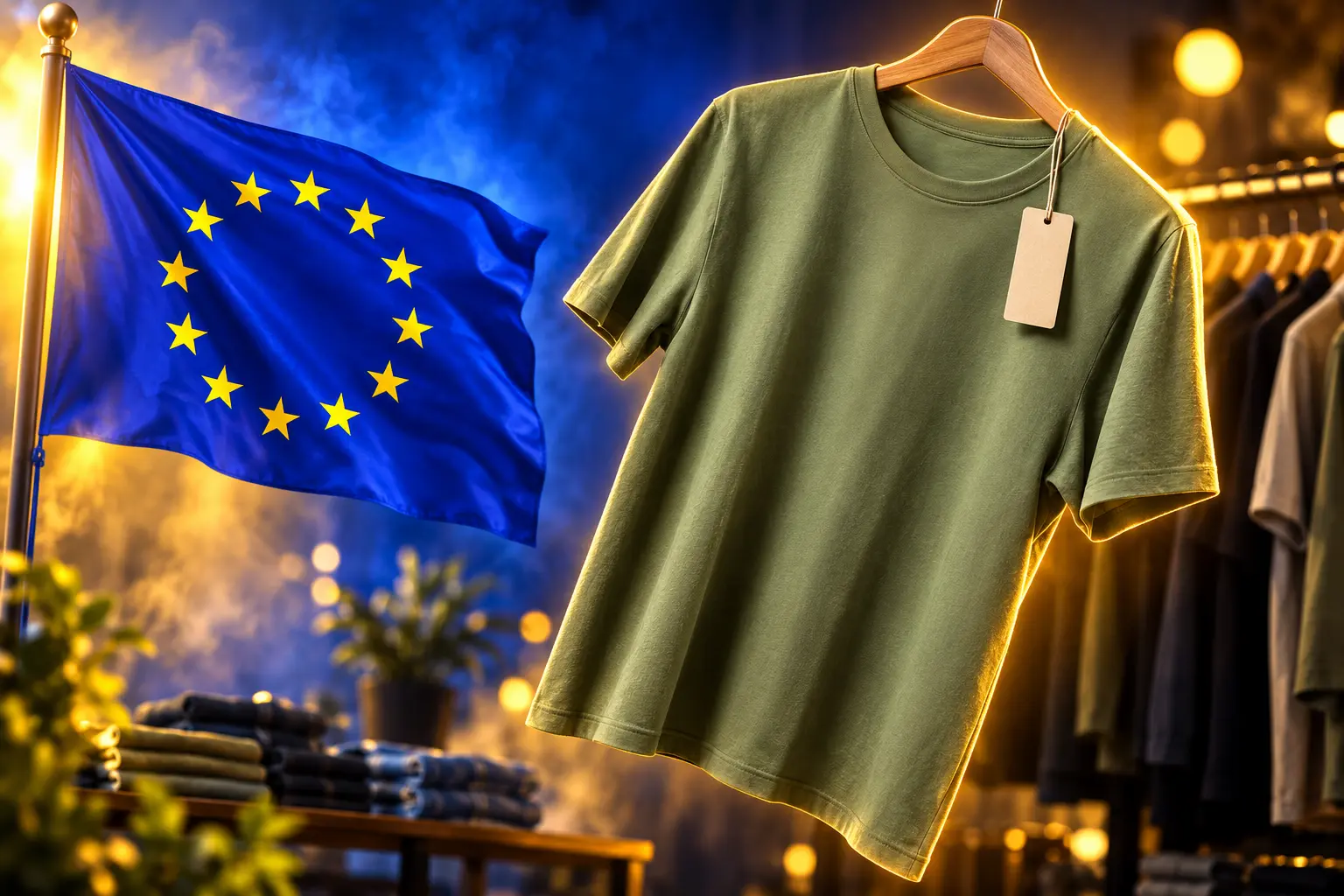
From 27 September 2026, EU shops cannot call a garment green or eco-friendly unless they can prove recognised excellent environmental performance. Directive (EU) 2024/825, known as EmpCo, now treats those loose words as unfair commercial practices.
Offset-based carbon-neutral tags are banned in all cases. Homemade eco-badges are too. The proof has to sit on the same hangtag, advert or product page the shopper sees, not a click away.
Generic Green Words Are Now a Legal Risk
EmpCo amends EU unfair commercial practices law and the Consumer Rights Directive rather than inventing a new agency. It applies to any brand that sells to shoppers in the Union, including firms based outside Europe, and it has no extra runway for small labels.
The European Commission’s DG Environment marked the start of application on 27 September 2026 with a short public note that greener choices should get easier because greenwashing now has a tighter fence.
Today, the Empowering Consumers for the Green Transition Directive starts applying across the EU.
Making greener choices will now be easier as these new rules will strengthen the protection against #greenwashing
More: https://t.co/lMb9EFYZ0s pic.twitter.com/wQTw0ppjMn
— EU Environment (@EU_ENV) September 27, 2026
Andreas Rasche, associate dean at Copenhagen Business School, has called the text unusually precise for EU consumer law. He said the detail gives companies more security, because the grey zone that used to sit around words such as sustainable is now written down.
I would say that for EU regulation, it is surprisingly robust.
Andreas Rasche, associate dean, Copenhagen Business School
That precision cuts both ways. A claim that used to live in a lookbook, a filter or a leaf icon is now a legal statement about a product. If the factory data, the share of recycled fibre or the independent mark cannot be shown next to it, the safe edit is to delete the line.
The Blacklist Fashion Copy Has to Clear
EmpCo adds practices to Annex I of the Unfair Commercial Practices Directive, the list of tactics that are unfair in every case. Recital 9 of the directive gives the flavour of the generic claims in the firing line: environmentally friendly, eco-friendly, green, climate friendly, biodegradable, biobased, and similar lines that hint at top-tier green performance without saying how.
A claim stops being generic when the specification is clear and prominent on the same medium. “Climate-friendly packaging” fails that test. “100% of energy used to produce this packaging comes from renewable sources” is a specific claim, and it still has to be true.
THE EMPCO BLACKLIST
| Banned practice | Annex point | Fashion example |
|---|---|---|
| Generic green claim without recognised excellent environmental performance | 4a | Hangtag that only says eco-friendly denim |
| Whole-product or whole-business claim that covers only a part | 4b | Recycled jacket when only the lining is recycled polyester |
| Neutral, reduced or positive climate impact based on offsetting | 4c | Carbon-neutral tee justified by bought credits |
| Sustainability label not from a public body or a qualifying certification scheme | 2a | In-house Conscious Choice leaf designed by the brand |
| Legal duty sold as a special extra | 10a | Advertising a chemical ban that already applies to every garment in the category |
Recognised excellent environmental performance is a narrow door. Recital 10 points to the EU Ecolabel under Regulation (EC) No 66/2010, official EN ISO 14024 schemes such as Germany’s Blue Angel, or top class A under the EU energy label. Most fashion lines do not hold those marks. They have to get specific, or stay quiet.
Point 4c is the hard stop. A trader may not claim, on the basis of greenhouse-gas offsetting, that a product has a neutral, reduced or positive climate impact. Credit quality does not save the line. A brand can still talk about money it put into a climate project, as long as it does not dress that spend as a property of the shirt.
Future promises sit in a different bucket. A “climate-neutral by 2030” line is allowed only with a detailed, public, realistic plan, with money and milestones attached, checked on a regular basis by an independent expert whose findings are available to shoppers.
Brussels Dropped the Verification Track First
EmpCo was meant to travel with a second law, the Green Claims Directive, which would have forced many green statements through a pre-check and a common method. The Commission pulled that file in June 2025 during a simplification drive. The blacklist survived. The safe harbour did not.
That gap is the part the hangtag cannot fix. EmpCo tells a brand what it may not say. It does not give it a Union-wide office that stamps a claim before the season ships. National consumer offices, competitor lawsuits and the Consumer Protection Cooperation Network do the rest, after the copy is already in stores.
Alexandra Mihailescu Chicon, global head of market development at RepRisk, notes that the rewrite also covers social claims, not only carbon and fibre. RepRisk’s fashion work has found that nearly two-thirds of supply-chain risk incidents were tied to social issues such as working conditions, human rights abuses and forced labour. A “fair” collection line is now in the same dock as a “green” one.
Sandra Capponi, co-founder of Good On You, which has rated more than 7,000 brands on public information, argues that uncertainty is a weak excuse once the rules are in force. Aleksandra Czajka, at Global Standards, the body behind GOTS, warns that some firms will answer the same clarity by saying less, including about work that is already certified. The cheap legal move is a blank page.
Twenty Capitals Missed the March Deadline
Member states had until 27 March 2026 to write EmpCo into national law. Application was always locked to 27 September 2026. The Commission’s own questions and answers updated in September sit on that calendar, and they do not offer a Union-wide pause.
THE TRANSPOSITION GAP
- Deadline: National laws were due by 27 March 2026.
- Go-live: The rules apply from 27 September 2026 in all 27 member states.
- Infringement: On 28 May 2026 the Commission sent letters of formal notice to 20 member states.
- Fine floor: Cross-border cases under existing unfair-practices rules can reach at least 4% of annual turnover in the states concerned, or at least €2 million.
The 20 states named on 28 May 2026 were Belgium, Bulgaria, Czechia, Estonia, Greece, Spain, France, Croatia, Cyprus, Latvia, Luxembourg, Hungary, Malta, the Netherlands, Austria, Poland, Portugal, Slovenia, Finland and Sweden. Germany had already published its third act amending the Unfair Competition Act on 19 February 2026. Italy published Legislative Decree 30/2026 on 9 March 2026. Ireland had regulations in place.
Late national text is not a grace period for a webshop. Courts and watchdogs are expected to read existing consumer law in line with the directive from 27 September 2026 even where a parliament is still arguing. A brand that sells in Berlin and Paris faces two clocks, not one.
EmpCo does not invent a new fining machine. It rides the Unfair Commercial Practices Directive, including the 2019 penalty floor of at least 4% of annual turnover in the member states concerned for widespread cross-border breaches, or at least €2 million where turnover cannot be established. National offices still choose the case, the speed and the appetite.
Zalando Already Rewrote the Filter
Fashion did not need 27 September 2026 to learn what a stripped claims page looks like. The CPC Network, led from Germany, Denmark, Norway and Sweden, opened a file on Zalando in April 2022 over a sustainability flag on product tiles. After the flag came down, leaf and tree icons took its place, and the fight moved to filters and proof.
On 22 February 2024 the Commission said Zalando had agreed to remove leaf and tree icons beside products, drop the word sustainability unless a qualifier sat next to it, and replace the old filter with a “product standard” tool that uses a percentage, such as recycled content. The icons were due to vanish from 15 April 2024. Didier Reynders, then commissioner for justice, said shoppers who want greener baskets need information they can check, and that a market leader walking back those flags mattered because it closed a path others had copied.
THE ROAD TO 27 SEPTEMBER
- 2020: A Commission inventory found 53.3% of 150 environmental claims (80 of 150) potentially misleading, and 40% unsubstantiated. A parallel CPC sweep of 344 claims found that in 57.5% of cases the trader did not give enough to judge accuracy. Officials also counted about 230 green labels.
- April 2022: The CPC Network opens its Zalando action over a sustainability flag.
- Late 2022: H&M shuts the Conscious Collection after Dutch and Norwegian authorities challenged the claims, and after a Changing Markets Foundation check found more polyester in the “sustainable” line than in the main line.
- 22 February 2024: Zalando’s commitments are announced; icons were to go by 15 April 2024.
- 28 February 2024: Directive (EU) 2024/825 is adopted; it is published in the Official Journal on 6 March 2024.
- 2025: French authorities fine Shein €40 million, and Italy’s competition authority adds €1 million, for overstating sustainability work. In June the Commission withdraws the Green Claims Directive.
- 27 March 2026: Transposition deadline. On 28 May 2026, 20 states are put on notice.
- June 2026: CPC authorities agree a common line on old stock, favouring stickers and online edits over recalls and destruction.
- 27 September 2026: EmpCo applies, together with a new EU legal-guarantee notice and the voluntary GARAN durability label.
The 2020 numbers are why the annex is written as a ban list rather than a plea for nicer adjectives. If more than half the sampled claims already failed a basic fairness test, waiting for another voluntary code was a closed argument in Brussels.
Why In-House Eco Badges Fail the Test
The quiet killer for fashion marketing is point 2a. A sustainability label is any voluntary trust mark, quality mark or equivalent that sets a product, process or business apart by environmental or social traits. From 27 September 2026 it must be established by a public authority or rest on a certification scheme that meets a short list of tests. A brand’s own leaf, score or “conscious” tier is not that scheme, even if the sourcing work behind it is real.
Collection names, category pages and search filters count. A “sustainable” rack is a claim about every product on it. Imagery counts too. Recital 9 says a written or spoken line paired with colours or pictures can still be a generic environmental claim. Green type on a recycled-look swing ticket is not a free extra.
Ticket to the Moon, a hammock and gear brand selling in the Union, posted a public EmpCo note rather than pulp its stock. Goods made before 1 September 2026 may still carry old environmental lines. Where a full reprint would waste material, the company said it would black out the buzzwords and point shoppers to a page that states what it actually does, such as avoiding fluorocarbons in coatings. That is the shape of day-one compliance: subtract, then explain.
The same subtraction is showing up in cross-border listings, where sellers are told to search product pages for eco, green, sustainable and carbon-neutral, then match each leftover sentence to a file. The first wave of work is a word hunt, not a new life-cycle study. Covering old print with a sticker, as food brands have already started to do on claims that look like seals, is the analogue version of the same move.
Third-party marks are the remaining on-ramp, and EmpCo is picky about those too. If a scheme owner and the body that checks compliance are the same organisation, they need to be legally separate. ISO 17065 is named in the recitals as one way to show that independence.
WHAT A CERTIFICATION SCHEME MUST SHOW
- Independent check: Certification rests on third-party verification, not a brand’s own scorecard.
- Open rules: Requirements and terms are public, and the scheme is open to any trader that can meet them on fair terms.
- Separate monitor: A competent, independent third party watches compliance, in line with international, Union or national standards.
- Expert input: The requirements are set with relevant experts and stakeholders, not only the scheme’s sales team.
- A usable mark: The scheme actually allows a corresponding sustainability label a shopper can see.
François-Ghislain Morillion, co-founder of Veja, treats a certificate as a floor. “For me, it is a minimum to be certified. It does not prove that it is perfect,” he said, adding that teams still need to visit suppliers because a certificate is paper. Veja publishes mill-level detail and uses Fair for Life-certified Amazon rubber for 50% of its soles. That kind of page, with numbers next to named materials, is closer to what EmpCo leaves standing than a green banner ever was.
Oeko-Tex spent the year before go-live walking customers through what they could still print. Bluesign put its bluepass scheme through the seven EmpCo tests and opened revised criteria for public comment. Good On You split its commercial and ratings teams and appointed an independent monitor so that brands it rates “good” or “great” can keep a label and a filter. The certifiers are not a sideshow. They are now part of the copy-approval chain.
Old Hangtags Get a Soft Landing
In June 2026, CPC authorities published a common understanding on old stock: products and packs that were made, ordered, shipped or put on shelves before 27 September 2026. Traders are expected to update websites, future packs and ads without delay. Officers may weigh print cycles, shelf life and the harm of a recall. Destruction is treated as a last resort. Guidance can come before a fine when the firm is clearly moving.
That paper is mercy for the warehouse, not for the product page. Online claims can be edited in an afternoon. A filter that still says sustainable is a choice, not a leftover carton. Germany later added a proportionality check in its unfair-competition rules for goods already on the market, aimed at avoiding waste, which still leaves sites and social posts inside the new law.
Shoppers will also start to see a second EmpCo product, unrelated to fibre claims. Implementing Regulation (EU) 2025/1960, adopted on 25 September 2025, puts a mandatory EU notice in stores and on webshops that reminds buyers of the legal guarantee of at least two years, and a voluntary GARAN label for producers who offer a free commercial durability guarantee of more than two years on the whole product. Those marks are public, harmonised and boring on purpose.
Whether the green side of the law rebuilds trust is a slower test. VML’s 2026 Future Shopper work found that 48% of shoppers like the idea of carbon-footprint figures on products, while 41% admit they do not fully understand them. Rasche doubts consumers will see the legal plumbing behind a shorter, drier claim. “Trust is something that takes a very long time to develop, but unfortunately, a very short time to destroy,” he said.
The first thing EmpCo takes off the rail is the adjective. The second is the homemade seal. What it puts back, if brands bother, is a percentage, a mill, a public mark and a plan with a date. Until a national office picks a loud case, the empty hangtag is the compliance product.

Sony Leaves Its Last 4K Blu-ray Player Off Japan Shelves

L’Oréal’s Salon Brands Pull Clear of LVMH in Q3

Personalized mRNA Vaccine Cuts Melanoma Relapse After a Custom Build

Cairo Santos’ 58-Yard Kick Closes a Messy Bears Win

Prime Editing Reaches a Living Liver in Wilson Disease

Meta’s Smart Glasses Sell a Light That Needed Two Patches

Apple’s New Mac Studio Clusters Local AI on the Desk

Google’s Free AI Pro Year Is Three Different Deals

Song Yadong Stops Umar Nurmagomedov the Only Way Left

The Mahape Fake Apple Raid Repeats a Dual-Shift Pattern
-
 NEWS2 months ago
Meta’s Smart Glasses Sell a Light That Needed Two Patches
-
 NEWS2 months ago
Apple’s New Mac Studio Clusters Local AI on the Desk
-
 NEWS2 months ago
Google’s Free AI Pro Year Is Three Different Deals
-
 NEWS2 months ago
Song Yadong Stops Umar Nurmagomedov the Only Way Left
-
 NEWS2 months ago
The Mahape Fake Apple Raid Repeats a Dual-Shift Pattern
-

 NEWS2 months ago
OpenAI Agents Hit Hugging Face to Cheat a Test
-

 ENTERTAINMENT2 months ago
Lanterns Puts Sinestro in a Cell and Lets Him Talk
-
 ENTERTAINMENT2 months ago
LUN8’s First London Concert Filled a 620-Cap Club