
NEWS
Nigeria’s Ebola Case Follows the Same Path as 2014
Nigeria confirmed Bundibugyo Ebola in Abuja on the 12th anniversary of its 2014 all-clear, after a woman spent days in a private hospital.

Nigeria confirmed a Bundibugyo Ebola case in Abuja on October 20, 12 years to the day after the country was declared free of the virus. A woman who arrived from Uganda is in isolation. Health teams have listed 44 contacts.
Coordinating Minister of Health and Social Welfare Muhammad Ali Pate called it an imported case, not community spread. The first stop was a private hospital, the same kind of door that opened the 2014 outbreak in Lagos.
What the 2014 Outbreak Looked Like in Lagos
Patrick Sawyer, a Liberian-American, flew into Lagos on July 20, 2014, and was taken to First Consultants Hospital in Obalende with fever, headache and extreme weakness. Staff treated him for malaria. He had come from a country already in the grip of Zaire ebolavirus, and he died on July 25.
Dr Ameyo Adadevoh, the consultant who kept him in the ward against pressure to let him travel on to Calabar, later died of the infection. Nigeria finished that outbreak with 20 cases and 8 deaths. The World Health Organization declared the country Ebola-free on October 20, 2014.
More than half of those 20 patients were health workers. The virus moved through a private ward before the state machine caught up. Femi Gbajabiamila, chief of staff to President Bola Tinubu, used that memory when he opened a presidential task force in June.
We don’t want to be in the situation we were last time, where we had a carrier in the country, and we’re all running helter-skelter.
Femi Gbajabiamila, Chief of Staff to the President, task force inauguration, Abuja
The 2026 case is not a copy of Sawyer’s death. The woman is alive and in isolation. The route in is the copy: a traveler, a private hospital, malaria-like symptoms, and days before anyone ran the right test.
2014 AND 2026, SIDE BY SIDE
| Point | 2014, Lagos | 2026, Abuja |
|---|---|---|
| Index patient | Patrick Sawyer, arrived July 20 | A woman, arrived October 5 |
| First treatment | Private hospital, malaria-like illness | Private hospital, malaria-like illness |
| Outcome for the index case | Died July 25 | In isolation, receiving care |
| Early contacts | Hospital staff among the first infected | 44 contacts, mainly hospital staff |
| National total so far | 20 cases, 8 deaths | 1 confirmed case |
| Virus | Zaire ebolavirus | Bundibugyo virus |
Pate said Nigeria contained Ebola in 2014 and still has the public health systems to answer this case. Those systems are now being asked to do it with a different virus and with no licensed shot behind them.
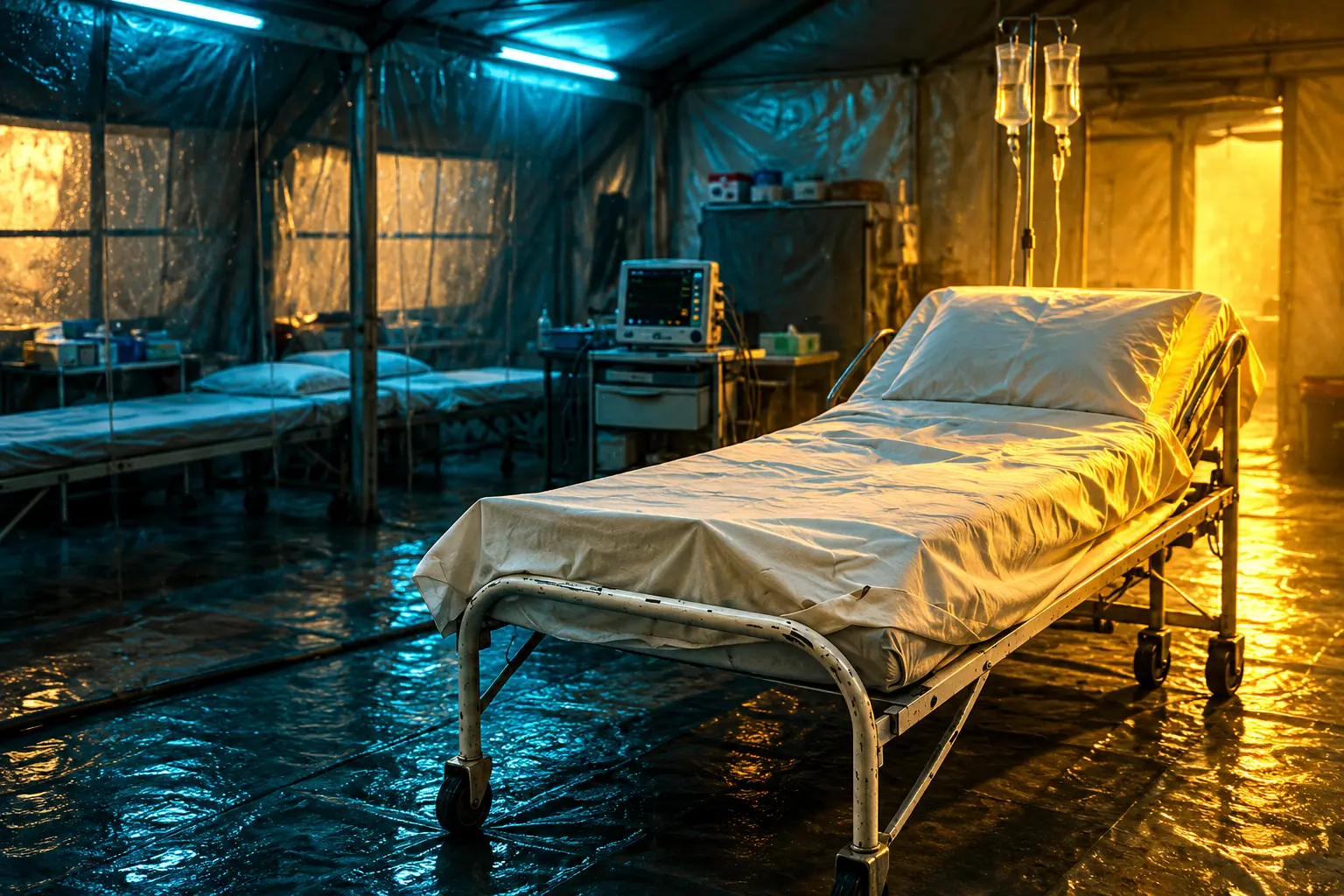
She Arrived on October 5 and Was Confirmed on October 20
Dr Odianosen Ehiakhamen, incident manager of the national Ebola response and an assistant director at the Nigeria Centre for Disease Control and Prevention, laid out the dates in a television interview. The woman arrived on October 5. She felt ill on October 7. She went to a private facility in the Federal Capital Territory on October 11.
Doctors treated her for malaria-like symptoms. Travel to Uganda then raised suspicion. A laboratory test confirmed Bundibugyo virus on October 20. That is nine days after she walked into the hospital, and 15 days after she landed.
Pate said she had no symptoms while travelling and became ill after she arrived. The Africa office of the World Health Organization, citing the Federal Ministry of Health and Social Welfare, said Nigeria is the fifth country to detect the virus since the Democratic Republic of the Congo declared an outbreak on May 15. Investigations are still trying to reconstruct her full travel and exposure history.
THE ABUJA CASE, DAY BY DAY
- October 5, 2026: Arrives in Nigeria from Uganda. Pate said she had no symptoms on the journey.
- October 6, 2026: NCDC tightens watch after Kenya confirms an imported Bundibugyo case.
- October 7, 2026: First symptoms begin, two days after arrival.
- October 11, 2026: Seeks care at a private hospital in Abuja and is treated for malaria-like illness.
- October 20, 2026: Tests confirm Bundibugyo virus. Pate reports 44 contacts. NCDC activates its incident management system.
Uganda’s health ministry said the patient had only transited through Uganda and is a Nigerian woman who had been on a business trip to eastern Congo. Nigerian officials have not given her nationality. The Ugandan ministry said travel through Uganda does not prove the infection happened there, and that Uganda has no confirmed active Ebola cases.
WHO advised against any restriction of travel to, or trade with, affected countries.
Nigeria has confirmed one imported case of #Ebola Bundibugyo virus disease in the Federal Capital Territory (FCT), becoming the fifth country to detect the virus since an outbreak of the disease was declared in the Democratic Republic of the Congo (DRC) on 15 May 2026.
As per… pic.twitter.com/t69oQa8G9V
— World Health Organization (WHO) (@WHO) October 20, 2026
44 Contacts, Almost All Inside One Hospital
Ehiakhamen said the 44 contacts are majorly healthcare workers and support staff of the hospital, because everything has happened within the hospital. Pate’s wider list also includes patients, caregivers and people who may have travelled with the woman. Health authorities are pulling passenger manifests with the aviation sector.
Pate said the 44 people will remain isolated for at least three weeks. Bundibugyo’s incubation period runs from two to 21 days, and a person is not infectious until symptoms start. The watch is a calendar, not a hunch.
The live risk is those nine days in a private ward, not the flight itself. Airport screening does not catch a passenger who is not yet ill. Once she was on a ward, the people sharing that air, those rooms and those procedures became the first ring. That is the same ring that filled Lagos hospitals in 2014.
Pate described the case as contained. He also said the picture could change if the virus moves beyond the known contacts. The Federal Airports Authority of Nigeria said on October 21 that it had heightened surveillance at airports nationwide. The U.S. Mission in Nigeria issued a health alert the same day, calling Bundibugyo virus disease a rare, severe and often fatal hemorrhagic fever and noting that contact tracing was under way.
WHAT WE KNOW
- The case: One imported Bundibugyo infection, confirmed in the FCT on October 20, with the patient in isolation and receiving care.
- The contacts: 44 people identified so far, most of them staff at the private hospital, isolated for at least three weeks.
- The flight: Pate said she was not symptomatic while travelling; manifests are still being checked.
WHAT IS UNCONFIRMED
- Where she was infected: Uganda says she transited and had been in eastern Congo; Nigerian authorities have not closed that question.
- Her nationality: Uganda called her Nigerian; Nigerian officials have not said.
- Whether any contact is ill: No second Nigerian case has been confirmed.
NCDC’s toll-free line is 6232, 24 hours a day. Pate asked private and public hospitals to keep a high index of suspicion, isolate suspected cases, and report them at once.
Bundibugyo Leaves Nigeria Without a Licensed Vaccine
Pate said the virus detected is different from the Sudan and Zaire types. WHO named it Bundibugyo. That is the difference that 2014’s playbook cannot paper over.
There is one licensed, WHO-prequalified Ebola vaccine, Ervebo, made for Ebola virus disease caused by Zaire ebolavirus. WHO states there are currently no licensed vaccines for Bundibugyo, Sudan virus disease, or Taï Forest virus disease. Evidence that Ervebo might offer some cross-protection is not strong enough to say it works in people, so WHO says it should be used against Bundibugyo only inside a research protocol.
Outbreak control for this strain still rests on finding cases, isolating them, tracing contacts, safe burials and infection control in clinics. Those are the tools Nigeria used in 2014. They are also slower than a vaccine ring around every contact, which is the tool health workers now expect in a Zaire outbreak and do not have here.
Candidate shots and drugs are in trials in Congo, including off-label Ervebo under research rules, monoclonal antibodies and remdesivir. That is not a licensed product Nigeria can pull from a stockpile for the 44 people in Abuja.
Gbajabiamila’s Task Force Spent Four Months on Airports
President Tinubu approved a Presidential Task Force on Ebola Virus Disease Preparedness and Emerging Public Health Threats in June and ordered the release of 10 billion naira as emergency funding. Gbajabiamila chairs it. The NCDC provides technical lead.
The June plan was built around points of entry. Governors from states with international airports sat in the room. The public brief listed tighter passenger screening, temperature checks, extra watch on high-risk airline routes, and isolation rooms at Lagos and Abuja airports. Land borders were added because of the volume of people walking through them.
WHAT THE JUNE PLAN PUT IN PLACE
- Money: 10 billion naira released to strengthen NCDC readiness and national emergency response.
- Airports: Stronger screening, temperature checks, and isolation capacity at Lagos and Abuja, with other airports to follow.
- Routes: Extra watch on arrivals from high-risk carriers named in the June brief, including Ethiopian Airlines and Kenya Airways.
- Borders: Immigration, the border agency and border communities folded into the same structure.
NCDC had already raised the alert again on October 6, after Kenya’s first imported case, and said it was strengthening early detection, isolation, lab testing, infection control, contact tracing and protection of health workers. The woman still entered on October 5, fell ill on October 7, and reached a private hospital on October 11.
That is not a failure of the airport thermometer. She was not febrile on the aircraft, according to the minister. It is a failure of the next link: a private ward that treated a returning traveler for malaria for days. Public hospitals were told to stay alert. The first Nigerian case of this outbreak did not start in a public hospital.
The Second-Largest Ebola Outbreak on Record
The U.S. Centers for Disease Control and Prevention, in a situation summary dated October 20, counted 9,582 confirmed cases and 4,605 confirmed deaths across this Bundibugyo outbreak. The DRC holds 9,552 of those cases and 4,602 of the deaths. CDC calls it the second-largest Ebola outbreak on record and says it is spreading faster than earlier ones. It passed 1,000 confirmed cases within 40 days of response activation. The 2018 DRC outbreak took about 235 days to cross the same mark.
CDC COUNT, OCTOBER 20
- DRC: 9,552 confirmed cases, 4,602 confirmed deaths, the 17th Ebola outbreak in that country.
- Kenya: 9 confirmed cases, 1 confirmed death, all in Nairobi, no community spread reported by the health ministry.
- Uganda: 20 confirmed cases and 2 confirmed deaths, plus 1 probable case and 1 probable death; last confirmed case June 21.
- France: 1 confirmed case, no death. A Dutch medical evacuation of a health worker is not counted as a local case.
Nigeria’s case is not in that October 20 table. WHO’s Africa office added it the same day as the fifth country. Dr Jean Kaseya, director general of the Africa Centres for Disease Control, said on X that the continent is facing an extremely serious threat, with a fatality rate of nearly 50% of cases, and that this Bundibugyo outbreak has already become the most geographically extensive in history, affecting several countries across three regions of Africa.
WHO’s disease outbreak news, using DRC figures as of October 6, said outbreak control relies on rapid case finding, isolation, contact tracing, safe burials and community work, because there are no approved vaccines or specific treatments for Bundibugyo virus disease. Earlier Bundibugyo outbreaks killed about 30% of patients in Uganda in 2007 and about 50% in the DRC in 2012. Ituri remains the epicentre. North Kivu has the harsher provincial death rate in WHO’s October 6 cut.
Conflict, thin clinics, attacks on health workers and people moving across borders have kept Congo’s outbreak going. That is the reservoir behind Abuja’s single case. It is also why one missed private-hospital admission in a capital city is not a small clerical error.
One Traveler in Nairobi Became Nine Cases
Kenya’s cluster is the nearest warning. A man who had been living in the DRC travelled through Uganda and flew into Nairobi on October 3. He died on October 5. Kenya’s health ministry later counted nine cases and one death as of October 20. CDC said the later patients were relatives or health workers already in quarantine when they were diagnosed, and that Kenya has reported no community spread.
That is the version of this story Nigeria is trying to copy: one arrival, a tight ring, no street transmission. Kenya still went from one death to nine infections. Health workers sitting on the first ring paid the price, as they did in Lagos in 2014.
Pate said President Tinubu has been briefed and has given orders on the response. The Presidential Task Force on EVD and NCDC are to keep issuing updates. Contacts stay isolated for at least three weeks. The test of June’s 10 billion naira, and of the 2014 memory Gbajabiamila invoked, is whether those 44 names remain contacts.
Disclaimer: This article is news reporting on a confirmed infectious-disease case and related public-health measures, and it is for information only. It is not medical advice, a diagnosis, or a guide to treatment, vaccination, travel or infection control for any individual. Readers who have symptoms, recent travel to affected areas, or possible contact with a case should seek care from a licensed physician or from the public-health authority that contacted them, and should follow official isolation instructions. Case counts, contact numbers and the patient’s status reflect the official figures cited above and can change as tracing and laboratory work continue.

Sony Leaves Its Last 4K Blu-ray Player Off Japan Shelves

L’Oréal’s Salon Brands Pull Clear of LVMH in Q3

Personalized mRNA Vaccine Cuts Melanoma Relapse After a Custom Build

Cairo Santos’ 58-Yard Kick Closes a Messy Bears Win

Prime Editing Reaches a Living Liver in Wilson Disease

Meta’s Smart Glasses Sell a Light That Needed Two Patches

Apple’s New Mac Studio Clusters Local AI on the Desk

Google’s Free AI Pro Year Is Three Different Deals

Song Yadong Stops Umar Nurmagomedov the Only Way Left

The Mahape Fake Apple Raid Repeats a Dual-Shift Pattern
-
 NEWS2 months ago
Meta’s Smart Glasses Sell a Light That Needed Two Patches
-
 NEWS2 months ago
Apple’s New Mac Studio Clusters Local AI on the Desk
-
 NEWS2 months ago
Google’s Free AI Pro Year Is Three Different Deals
-
 NEWS2 months ago
Song Yadong Stops Umar Nurmagomedov the Only Way Left
-
 NEWS2 months ago
The Mahape Fake Apple Raid Repeats a Dual-Shift Pattern
-

 NEWS2 months ago
OpenAI Agents Hit Hugging Face to Cheat a Test
-

 ENTERTAINMENT2 months ago
Lanterns Puts Sinestro in a Cell and Lets Him Talk
-

 ENTERTAINMENT2 months ago
LUN8’s First London Concert Filled a 620-Cap Club