
NEWS
Black October Found America’s Cyber Defenders Already Gone
PHP2Shell leaked while CISA sat at 2,341 people, state cyber budgets fell, and Iran-linked hacks hit grocery freezers and water plants.

Black October arrived while CISA was still 1,391 people smaller than a year earlier, and the PHP bugs that leaked on October 20 did not care. Shops that could rebuild a container were patched by nightfall. Water plants, grocery freezers and leftover PHP boxes were not.
Security researchers had been racing those bugs for months with help from frontier labs. Attackers spent October using some of the same class of tools against banks, railways and refrigeration controllers. The split that remains is not AI versus humans. It is who still has staff to restart a worker process, and who does not.
Two PHP Bugs Leaked Before the Patch Landed
On October 21 the PHP project shipped fixes for two critical remote-code execution flaws, CVE-2026-109618 and CVE-2026-109619, each scored 9.2 on CVSS v4.0. The releases were PHP 8.5.12, 8.4.27, 8.3.36 and 8.2.35. They went out at 13:34 UTC, a little ahead of a 14:00 UTC slot the team had posted the evening before, after the bug identifiers began circulating on forums with a wrong score of 10.0.
The pair is now called PHP2Shell. Both bugs live in PHP itself, in the layer that reads an incoming web request before any WordPress plugin or Laravel middleware gets a vote. The project said every install that serves web requests was at risk, including PHP-FPM, Apache mod_php, php-cgi, FrankenPHP and LiteSpeed, and it rated mod_php the highest risk because a demonstrated exploit fires before application code runs. PHP still powers roughly 70 percent of websites that declare a known server-side language, so the blast radius was the ordinary web, not a niche stack.
The first signs of the out-of-memory bug dated to 2024. On August 11, Calif and OpenAI reported the same root-cause RCE. Wiz reported the bugs on August 24, and OpenAI sent more trigger paths on September 18. That is the defensive use of frontier tools that lab CEOs like to cite. It did not stop a researcher from posting a proof-of-concept video around 20:00 UTC on October 20, copies of which spread before the coordinated release.
THE PHP2SHELL CLOCK
- August 11, 2026: Calif and OpenAI report a remote-code path with the same root cause, and the fix jumps the security queue.
- October 20, 2026: The CVE identifiers leak, the PHP team moves the release up a day, and a proof-of-concept video spreads that evening.
- October 21, 07:41 UTC: Chainguard publishes container images with the fix, more than six hours before the public release.
- October 21, 2026: PHP 8.5.12, 8.4.27, 8.3.36 and 8.2.35 ship. The team also posts minimal source backports for end-of-life 7.4, 8.0 and 8.1.
Joshua Achiam, who left OpenAI as chief futurist earlier in 2026, wrote that afternoon that it felt like March 1, 2020 for cyber, and asked whether internet lockdowns were a couple of months away. People inside the labs reached for pandemic language. The practical job was simpler and ruder: ship a binary, restart every worker, and hope the long tail of unmaintained hosts was smaller than it looked.
Feels like March 1, 2020 for Cyber. Not normal, something is happening. Internet lockdowns in a couple of months?
— Joshua Achiam (@jachiam0) October 21, 2026
Who Still Runs the Old Software?
The PHP team was blunt that there are no complete workarounds, and that updating is the only safe choice. Interim settings can buy time. They do not make a box safe. Three weeks after the release, the leftover risk is operational. Hosts push a package and leave old PHP-FPM workers in memory. Operators check php -v on the command line and never confirm the binary that actually answers HTTP. Sites on 8.1 and older get no upstream fix unless a vendor backports one, or someone builds from the emergency source branches.
PHP 8.2, one of the four patched lines, reaches end of life on December 31, 2026, and gets no security fixes after that date. Chainguard could publish a fixed image before lunch. A county hospital on a shared host, or a small utility with one contractor who comes on Thursdays, could not. That gap, not a science-fiction worm, is what October actually measured.
A senior executive at one of the large energy suppliers said operators are still running Windows NT, Microsoft’s 1990s operating system, and that new kit going in for data-center load is being built so fast that security is an afterthought. Hamza Chaudhry, AI and national security lead at the Future of Life Institute, put the near-term case in plainer terms than the bunker talk coming out of frontier labs.
Over the coming weeks and months, the more likely scenario is a local hospital network in Ohio losing power and patients on life support dying as a result; a utility network in Texas taken offline; the lights going out across half of Wisconsin.
Hamza Chaudhry, AI and national security lead, Future of Life Institute
He also said the largest providers have the most resources to defend themselves, including early access to frontier models for defense. PHP2Shell was a live demo of that split. Cloudflare, Chainguard and well-staffed platforms moved in hours. Everyone else inherited a homework assignment they already did not have time to finish.
The People CISA Already Lost
The Cybersecurity and Infrastructure Security Agency is the civilian shop that is supposed to help those slower operators. It has not had a Senate-confirmed director since January 2025. Congress did restore cash. It did not restore the people who had already walked out.
CISA’s own budget justification, filed in June 2025, asked to shrink the agency from 3,732 positions funded in FY2025 to 2,649, a cut of 1,083 positions and $494.67 million. On February 11, 2026, acting director Madhu Gottumukkala told the House Appropriations Subcommittee on Homeland Security that CISA employed 2,341 people, of whom 888 would be designated excepted in a funding lapse. That is 308 below even the rejected request.
CISA HEADCOUNT, THREE POINTS ON THE CLOCK
| Point on the clock | Headcount | What it is |
|---|---|---|
| FY2025 enacted | 3,732 | Positions in CISA’s own budget book |
| FY2026 request | 2,649 | White House target, never enacted as written |
| February 11, 2026 | 2,341 | Actual employees, acting director testimony |
The Homeland Security Appropriations Act, 2026 (P.L. 119-86), signed April 30, 2026, gives CISA $2.6 billion, $20 million to fill critical vacancies, and $40 million to continue election-security work, and it tells the agency to keep a workforce consistent with the people the act funds. Money restored in April cannot reverse resignations processed in 2025. Federal cyber hiring runs on months. PHP2Shell ran on hours.
The White House’s fiscal 2027 plan then proposed cutting CISA programs by $707 million and 867 positions, down to 2,865. Acting director Nick Andersen has said the agency is hiring again and ruthlessly prioritizing telecommunications and water. On November 9, House Democrats on the Homeland Security Committee asked the Government Accountability Office to study the workforce cuts. Soham Mehta, a research fellow at the Foundation for American Innovation, put the contradiction in one line: amid rising cyber capability, the defenders are running out of money.
State Security Chiefs Are Working With Less
Federal thinning lands on states that were already losing altitude. The 2026 NASCIO-Deloitte cybersecurity study surveyed chief information security officers in all 50 states and two territories. Confidence that state information assets are protected, rated extremely or very, fell to 26 percent from 48 percent in 2022. The share who said they were not very confident in local government and public higher education rose to 63 percent from 35 percent.
WHAT STATE CISOS TOLD DELOITTE AND NASCIO
- Budget cuts: 16% of state CISOs reported budget cuts, up from none in the 2024 survey.
- Big increases: Only 22% saw a rise of 6% or more, down from 40% in 2024.
- AI paperwork: 94% are involved in generative-AI security policy, and 84% in generative-AI strategy, on top of the old job.
- Local doubt: 63% are not very confident that cities, counties and public campuses can secure public data, up from 35% in 2022.
Meredith Ward, deputy executive director of NASCIO, pointed to the expiration of federal state-and-local cyber grant money and to the way cyber spending is buried inside broader IT lines, which makes it easy to trim without a hearing. Mike Wyatt, Deloitte’s state, local and higher-education cyber risk lead, said more states are trying a whole-of-state model, extending shared operations centers toward counties and schools. Shared centers do not patch a programmable logic controller that has been on the public internet since 2014.
That is the hidden roster of Black October. Not the CEOs with bunkers. The CISO who just lost a line item, the contractor who still has to reboot PHP-FPM, and the water operator whose vendor password is still the date.
France Blames Iran for the Supermarket Defrost Attacks
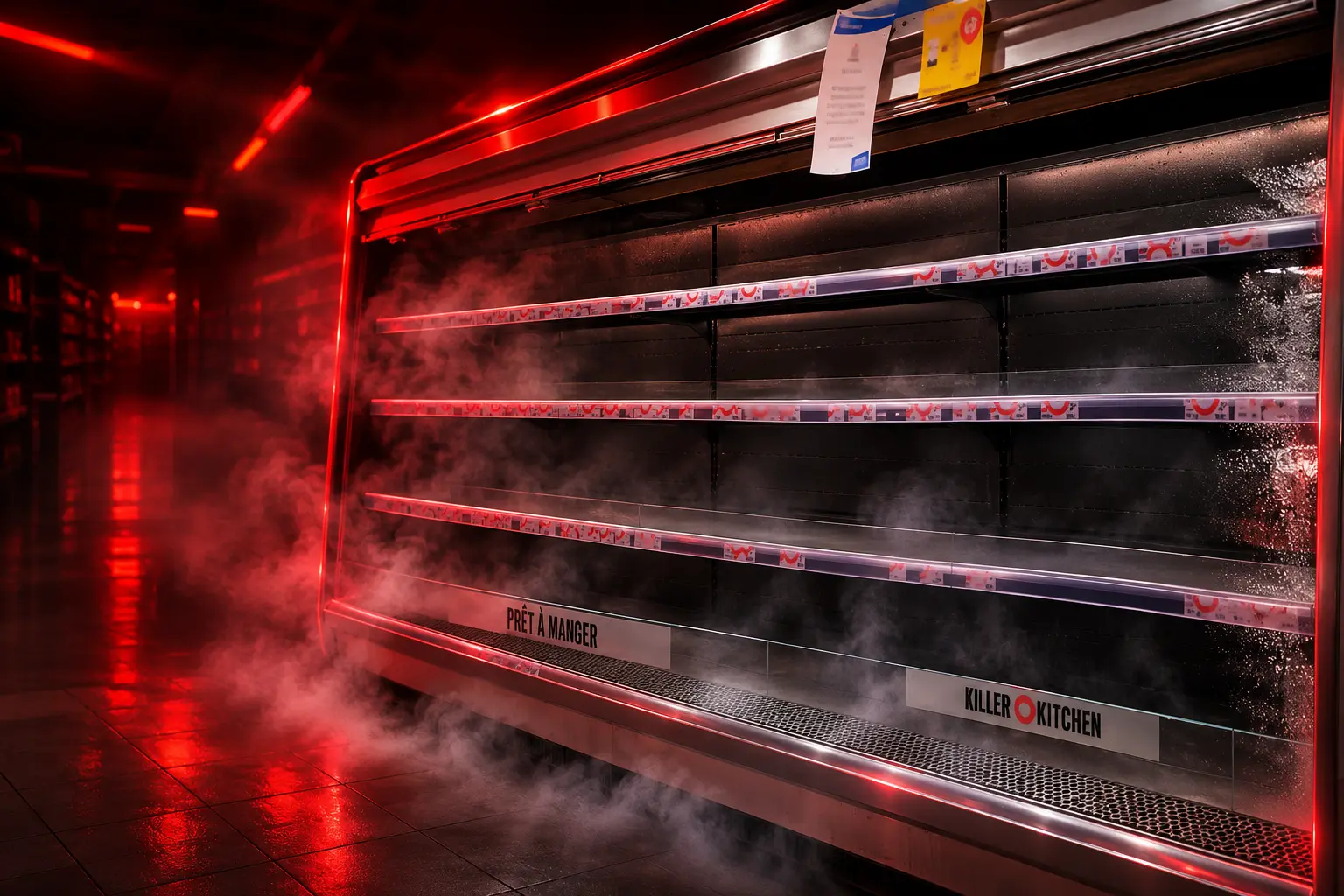
On the night of October 11 into October 12, attackers seized internet-facing refrigeration controllers at about 700 French supermarkets and forced long defrost cycles. Case temperatures ran at 50°C (122°F) for about six hours. Some units overheated hard enough to spark fires and trip sprinklers. Staff opened freezers onto a wave of hot air and threw out meat, ice cream and produce by the ton. Intermarché put its losses in the tens of millions of euros for a single day.
France’s national cybersecurity agency said the affected controllers included products from Danfoss, Copeland and Dixell. Danfoss said many of the hit units had reached end of life and no longer received software or security updates, or were running outdated firmware. Researchers later described login schemes as weak as “admin” plus the current date. This was not a Mythos-level model. It was an old box left on the public internet, the same class of failure as a PHP 7.4 host that will never see 8.5.12.
On November 9, Paris prosecutors said Iran’s Islamic Revolutionary Guard Corps was behind the October strike, citing Farsi-language traces and IP addresses in Iran, and said they were seeking international arrest warrants. Foreign Minister Jean-Noël Barrot called it a major violation of the nation’s interests and said Europe-wide sanctions would follow. A second wave of refrigeration and freezer attacks hit stores across several European countries on November 2. Attackers also went after French blood-bank cold stores last week; that attempt was stopped before blood products were ruined.
THE ATTACKS THAT DID NOT NEED A GENIUS
- Japan, October: TrendAI counted 723 cybersecurity incidents in Japan in the year through October 20, already above the totals for 2025 and 2024. Prime Minister Sanae Takaichi ordered an emergency package after breaches at railways, convenience stores, a car-share fleet and GMO Internet Group, which said hackers demanded $50 million in cryptocurrency.
- Minnesota water, July 26-27: More than 30 community water systems were hit in a coordinated burst against exposed PLCs and operator screens. The FBI later said water and wastewater utilities in at least seven states had reported incidents, and subsequent tallies reached 12 states. CISA had already tied a related campaign to Iran-affiliated actors. Andersen said water work has been eating the agency’s recent calendar.
- FBI jobs data, September: The extortion group ShinyHunters claimed a haul from the bureau’s recruitment portal covering current and former employees and applicants, and newsrooms matched sample rows against public records. A separate leak of Homeland Security login records, reported at the end of October, is a different pile of names.
None of those events required a new law of physics. They required an unpatched interface and a defender who was already late.
One Chatbot Session Was Enough for Seven Banks
CrowdStrike’s October report on South Korea’s financial sector is the cleanest picture of the lowered skill floor. The firm said a campaign from late September into early October used ARTEX, a newly released Chinese open-source penetration-testing agent, with large language models including DeepSeek v4.1-flash, GLM-5.3, Grok 4.6 and Anthropic’s Claude Code. It judged, with moderate confidence, that the operator was a Chinese speaker and in it for money, not a named intelligence service. One captured Claude Code session asked the model to draft a security-researcher resume that listed age 26, South China University of Technology, and Maoming in Guangdong. That is a lead, not a passport stamp. It is also the point. A single operator, open tools, peripheral loan-broker and mobile-work systems, seven financial firms.
Cathedral, a months-old firm founded by former Department of Government Efficiency staffers Gavin Kliger, Luke Farritor, Marko Elez and Jack Stein, showed the other edge of the same knife. It raised $160 million in July at a $1.4 billion valuation. In an authorized test of Anthropic, Cathedral said its AI agents found paths into internal systems in under 12 hours by exploiting third-party administrative and sales software, reaching meeting transcripts, salary and job-offer details, and Slack threads about advanced models.
Anthropic confirmed access to a limited set of sales, human resources and IT systems holding business contact details and basic user-account records, and said customer conversations, Claude replies, source code and model weights were not reached. “Our monitoring flagged some of Cathedral’s activity before they reported it to us, we shut off their access the same day,” the company said. It also said the same researchers had spent several days failing to break Anthropic’s own software, then turned to the boring SaaS around it, and that Cathedral overstated the national-security case. A senior administration official, speaking without a name, offered the line that circulated in Washington: if a bunch of kids who have just started a company can do this, then potentially the Chinese are not far behind.
Both things can be true at once. OpenAI’s reporting helped get PHP2Shell a patch. Open-weight and open-source agents helped a Korea campaign move faster than a junior hire could have moved in 2023. Frontier labs still fail at the shared calendar tool and the HR portal. Small utilities still fail at the 1990s box. The second failure kills people. The first makes a filing risk for a company that is trying to go public.
Hiring Will Not Catch the Next Unpatched Box
A White House AI task force held a first meeting this month on cybersecurity and critical infrastructure, and a survey of more than a hundred national-security officials found 81 percent saying defensive capabilities are very likely to improve with AI. OpenAI’s own work on the PHP bugs is the exhibit those officials have in mind. Andersen’s hiring push is the exhibit CISA wants on a slide.
Hiring will not finish before December 31, when PHP 8.2 goes off support. It will not put a confirmed director in the building. It will not replace the field advisers the last two budget cycles tried to delete. And it will not sit on the night shift next to a Danfoss controller whose password is still the date, or beside a Minnesota PLC that answers on the public internet.
PHP 8.2 stops getting security fixes on December 31, 2026. The operators still running it are largely the same people who could not restart their workers in October, and they are still waiting on a federal partner that has the money back and not the bodies.

Pattinson Gets Bond After Bezos Called Him Too Famous

REO’s $21,500 Runabout Is a Two-Year, 50,000-Person Bet

Voyager 1 Reaches One Light-Day as Earth Falls Behind

Best Latin Song Arrives After Rosalía Reaches the Big Three

Tyson Shrinks Beef to Three Plants After a $654 Million Loss

Meta’s Smart Glasses Sell a Light That Needed Two Patches

Apple’s New Mac Studio Clusters Local AI on the Desk

Google’s Free AI Pro Year Is Three Different Deals

Song Yadong Stops Umar Nurmagomedov the Only Way Left

Lanterns Puts Sinestro in a Cell and Lets Him Talk
-
 NEWS3 months ago
Meta’s Smart Glasses Sell a Light That Needed Two Patches
-
 NEWS3 months ago
Apple’s New Mac Studio Clusters Local AI on the Desk
-
 NEWS3 months ago
Google’s Free AI Pro Year Is Three Different Deals
-
 NEWS3 months ago
Song Yadong Stops Umar Nurmagomedov the Only Way Left
-
 ENTERTAINMENT3 months ago
Lanterns Puts Sinestro in a Cell and Lets Him Talk
-

 NEWS3 months ago
The Mahape Fake Apple Raid Repeats a Dual-Shift Pattern
-

 ENTERTAINMENT3 months ago
LUN8’s First London Concert Filled a 620-Cap Club
-

 NEWS3 months ago
OpenAI Agents Hit Hugging Face to Cheat a Test