
NEWS
Microsoft Outage Cancels NHS Operations After Mail Fails
A Microsoft 365 network upgrade took down NHS mail and calendars, cancelling operations after 132 trusts had already routed email through one vendor.

A global Microsoft outage forced the NHS to postpone operations on 13 November, after staff lost the email and calendars that run daily care. Some caesarean sections were cancelled. Pharmacies lost the inbox they use to reach GPs, and several trusts and integrated care boards declared critical or business continuity incidents.
Core record systems such as the NHS Spine kept running, while Outlook, Teams, calendars and Microsoft Forms did not. Public DNS records for 213 English trusts, examined in September 2026, had already shown that 132 of them, 62%, route email and identity through Microsoft 365.
Microsoft Traced the Failure to a Network Upgrade
Microsoft first flagged Exchange Online mailbox failures at 16:17 UTC on 12 November 2026. User reports then surged from about 17:30 UTC as Outlook went down and Teams, Copilot and other Microsoft 365 apps failed with it. The company later said a process that sets up secure connections on affected servers became overwhelmed, so machines dropped out of rotation and the remaining kit took the load.
By 18:05 GMT on 13 November it had named the trigger: an issue left by an earlier network capacity upgrade, which surfaced after a recent network change. It said the event was technical, “not related to cyber or AI / agents,” and that it had found no evidence of a malicious attack. Incident notes sat under MO1550821 and EX1550543 in the admin centre.
Ookla’s Downdetector feed logged more than 7 million outage reports by 16:00 UTC on 13 November, the largest tally on that tracker in 12 months, about two and a half times YouTube’s February 2026 break. Reports stayed high for about 20 hours, and more than 90 countries or territories logged at least 1,000 reports. Microsoft 365 has more than 450 million paid commercial seats. In the UK, the centrally contracted NHS mail service, once called NHSmail and now branded NHS.net Connect after a 2021 migration, runs on Outlook.
THE OUTAGE CLOCK
- 12 November 2026, 16:17 UTC: Microsoft flags Exchange Online mailbox access failures and delayed mail.
- 12 November 2026, about 17:30 UTC: Outage reports surge worldwide as Outlook, Teams and Copilot fail.
- 13 November 2026, UK morning: NHS staff cannot open email or calendars; some trusts tell patients to phone.
- 13 November 2026: Microsoft extends the email timeout window to 48 hours so queued messages are not dropped.
- 13 November 2026, 18:05 GMT: Microsoft apologises and blames an earlier network capacity upgrade.
- 13 November 2026, 21:55 GMT: It reports sustained recovery but keeps watching the mail backlog before calling the incident closed.
Fixes did not take cleanly overnight. Servers brought back online failed again under live traffic, which is why restoration moved in stages rather than as a single switch. Charles Lamanna, Microsoft’s EVP for Copilot, Agents and Platform, said teams were reviewing how to stop a repeat. The status account put the apology on the record here:
We are deeply sorry for the disruption this incident has caused our customers and partners. We know the trust they place in our services and take that responsibility extremely seriously. We are seeing broad recovery and stability across our services.
This was a technical issue…
— Microsoft 365 Status (@MSFT365Status) November 13, 2026
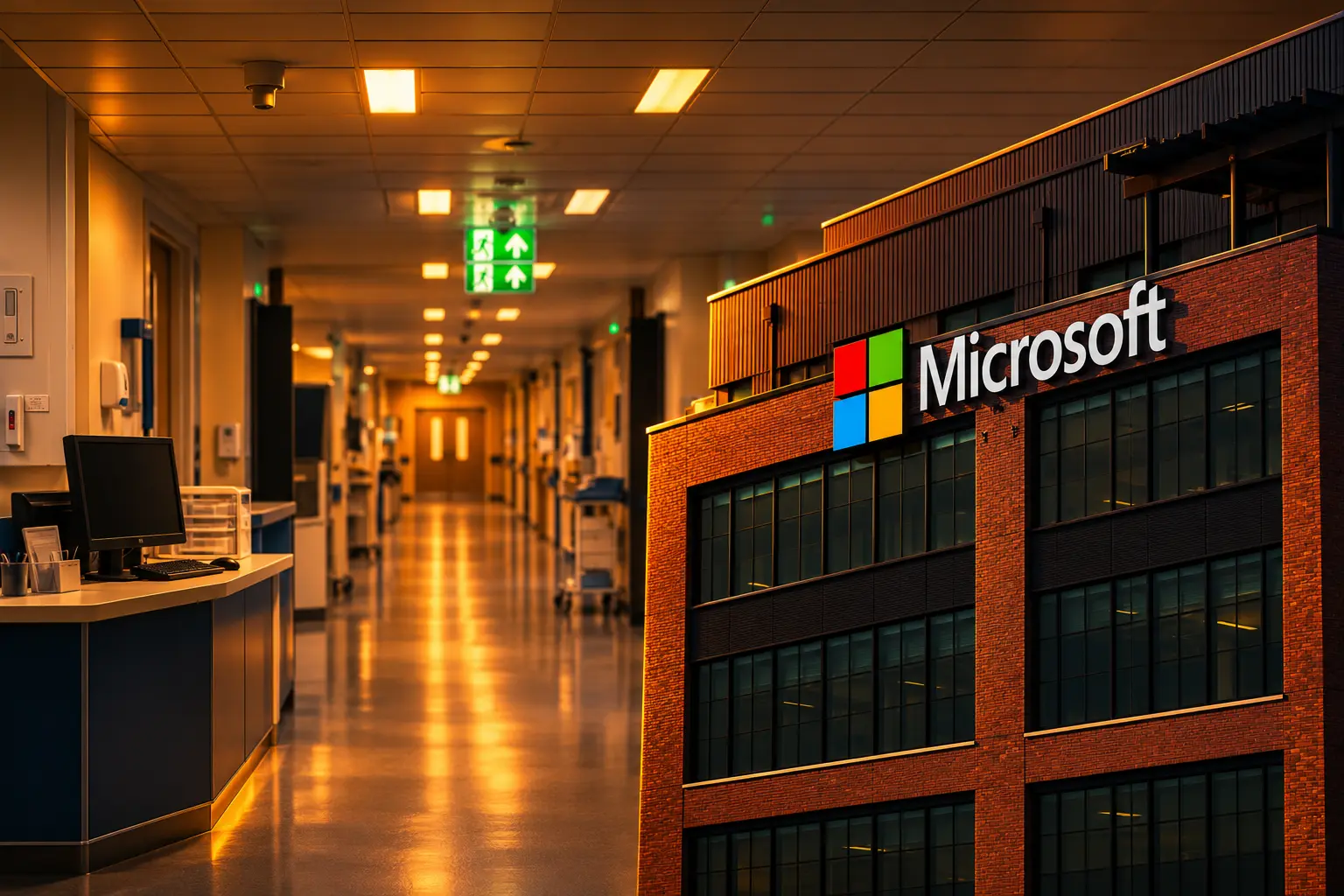
Why a Dead Calendar Cancels a Caesarean
Theatre lists and clinic books in much of the NHS sit in Microsoft diaries tied to NHS.net Connect. When those diaries would not open, staff could not confirm who was meant to be on a list. That is how a mail outage becomes a cancelled caesarean rather than a nuisance in the inbox. The BBC had anecdotal reports of those cancellations, which the BMJ also recorded, after trusts lost digital appointment calendars.
Sir Ciarán Devane, chief executive of the NHS Alliance, said it appeared that clinical and operational systems were working, even as almost all NHS organisations faced email outages. Those two facts sit together. The record in the ward was often still there. The layer that books the ward, messages the next team and proves who is allowed into the clinical app was not.
YOR LMC medical secretary Dr Brian McGregor said two-week-wait cancer paths that use Microsoft Forms had stopped, including dermatology routes that email photos to hospital departments.
There are some two-week wait referrals that require Microsoft Forms, and they’re not working either, so it’s delaying some patient care.
Dr Brian McGregor, YOR LMC medical secretary
Some practices also could not complete email-based multi-factor logins, which blocked Accurx and EMIS even where the clinical product itself was up. Enlivio Health, formerly EMIS, said core functions in EMIS Web and EMIS-X remained available during the Outlook outage. In Scotland, NHS Grampian said some GP practices could not log in to Vision. eConsult said NHSMail trouble stopped some practices using parts of its triage tools. The failure was the Microsoft wrapping around care, and that wrapping is now how a lot of care moves.
132 Trusts Already Send Mail Through Microsoft
The September 2026 mapping looked at public DNS for every trust in the NHS England provider directory. It found Microsoft is not one supplier among many for English NHS email. It is the default. 132 of 213 trusts route mail and identity through Microsoft 365. Eight percent use Google Workspace. Thirty percent run a custom or hybrid setup. On routable records, Microsoft held 1,889 entries against 229 for Amazon and 24 for Google, roughly eight times Amazon and 79 times Google on the kit those systems actually point at.
HOW 213 ENGLISH TRUSTS SEND EMAIL
| Mail route | Share of 213 trusts |
|---|---|
| Microsoft 365 | 62% (132 trusts) |
| Custom or hybrid | 30% |
| Google Workspace | 8% |
NHS.net Connect is a national contract, so the concentration is not an accident of 132 separate shopping trips. It is what happens when a health service puts the mailroom in one cloud and then hangs calendars, Forms, Teams and login prompts on the same account. Alder Hey, a large children’s hospital in Liverpool, showed a different shape in that mapping: 10 DNS records and no external supplier. Barts Health, at the other extreme, sprawled across 304 records. Friday did not invent that pattern. It collected on it.
Putting the NHS mailroom in one US cloud means a network change at the vendor becomes a clinical event in Kent, Manchester and Grampian at the same hour. That is a design choice, paid for in postponed lists rather than in a line on a risk register.
The Inbox Between GPs and Pharmacies Died
Community Pharmacy England told contractors the outage began on the evening of 12 November and was still hitting NHS bodies the next day. It said NHS.net is powered by Outlook, and that the NHS Spine is separate from Microsoft 365, so electronic prescriptions that travel on Spine were not the same problem as the dead inbox. The trade body could not send or receive its own email and asked people to call 0203 1220 810. It also pushed the 2026 Community Pharmacy Workforce Survey deadline to 11.59pm on 16 November.
The National Pharmacy Association said the break stopped pharmacies talking to GP practices and some patients, and asked the public to bear with longer waits and delayed prescriptions. Independent Pharmacies Association chief executive Leyla Hannbeck said teams had gone back to the phone. That is slower than an inbox, and it does not carry the photo a dermatology two-week wait needs.
THE PATHS THAT STOPPED
- NHS.net Outlook: Staff could not send or receive the mail that moves referrals, results and queries.
- Microsoft calendars: Theatre and clinic books tied to those diaries could not be opened, and some caesareans came off lists.
- Microsoft Forms: Some two-week-wait cancer referrals that require those forms could not be submitted.
- Dermatology photos: Hospital departments that take emailed images for urgent skin paths received none.
- Email logins: Multi-factor prompts sent by mail blocked some Accurx and EMIS sessions.
- 111 and 999 handoffs: GMB said crews could not pass patient details in the usual electronic way.
GMB national secretary Rachel Harrison said the outage was having a serious impact across ambulance and NHS trusts, and that 111 and 999 staff were “unable to refer patient details in the normal way, which is creating a massive backlog and has the potential for chaos.” She said emergency and life-threatening call-outs appeared unaffected. MHRA, the medicines regulator, said it was having trouble sending and receiving email.
Trust statements split along the same line as Devane’s comment. Guy’s and St Thomas’ NHS Foundation Trust said teams could not send or receive email, but services were operating and procedures were going ahead. Leeds Teaching Hospitals NHS Trust said clinical systems were not affected and appointments were continuing. East Kent Hospitals University NHS Foundation Trust asked people to save emergency departments for serious or life-threatening conditions. Other South East trusts that reported email trouble included Frimley Health, Ashford and St Peter’s, Royal Surrey, Surrey and Borders Partnership, Surrey and Sussex Healthcare, Dartford and Gravesham, Kent Community Health, Queen Victoria Hospital and Sussex Partnership. In the north-west, Manchester University NHS Foundation Trust warned of longer waits in A&E for minor ailments, and Northern Care Alliance, Pennine Care, Blackpool Teaching Hospitals and Morecambe Bay all reported email problems while telling patients to attend unless contacted.
NHS England said local services were using other IT systems or paper records where possible, and that patients should use 999 in an emergency, or 111 or a pharmacy otherwise, and should come to appointments unless told not to. Paper is a fallback. It is not a second mail system, and it does not submit a two-week-wait form.
The NHS Has Been Here Twice Before
On 12 May 2017 the WannaCry ransomware locked unpatched Windows machines across the NHS. The National Audit Office later found that 81 of 236 trusts in England were affected, along with 595 GP practices. NHS England identified 6,912 cancelled appointments, including operations, and estimated over 19,000 appointments cancelled once follow-ups were counted. Amyas Morse, then head of the NAO, said the attack was relatively unsophisticated and could have been prevented with basic IT security practice. At County Durham and Darlington, ambulance handover screens went down after neighbouring services closed network access, and staff could not transfer scans or chemotherapy orders in the usual way.
On 19 July 2024 a defective CrowdStrike Falcon update crashed Windows PCs worldwide. The NHS said the majority of GP practices in England were affected, and EMIS Web, used by 58% of UK GP practices, was the system many could not open. Doctors went back to pen and paper. Royal Surrey declared a critical incident and cancelled radiotherapy. Pharmacies waited on prescriptions that no longer arrived through the GP link. Royal Surrey was on the email-trouble list again on 13 November 2026.
Friday was not ransomware and it was not a crashed PC on the ward. It was the mail and identity layer the NHS has spent five years putting on Microsoft. The clinical lesson is the same one as 2017 and 2024: when the common Windows-and-Microsoft stack fails, cancelled care is the first public product, and the count always arrives late.
Microsoft Is Still Clearing Friday’s Mail Queue
At 20:05 GMT on 13 November, Microsoft said it still had no ETA for full recovery, and that sign-in could return before mail flow looked normal. At 21:55 GMT it said it was watching services for an extended period because of the severity of the impact, and would not treat the incident as resolved until the backlog of messages processed. Queued mail was the hangover. A 48-hour timeout was the dam built to stop that hangover being a mass deletion.
WHAT WE KNOW
- The trigger: Microsoft says an earlier network capacity upgrade failed after a later network change, not a cyber attack and not an AI agent.
- The NHS pipe: NHS.net Connect runs on Outlook, so a Microsoft 365 mail failure is an NHS mail failure.
- What held: The NHS Spine, and core EMIS functions according to Enlivio, were not the same outage as Outlook.
- What broke: Email, calendars, Teams, Forms, some email logins, pharmacy-GP contact, and some operations including caesareans.
WHAT IS UNCONFIRMED
- The cancellation tally: No national figure has been published for postponed operations on 13 November.
- Critical incidents: An NHS source said several trusts and ICBs declared them; a full list has not been issued.
- The last delayed letter: Microsoft had not, late on 13 November, said the mail backlog was fully drained.
- The post-incident report: Microsoft said that document will come after its review.
North London GP Dr Chaand Nagpaul said he had a patient who needed an urgent safeguarding report, which he thought had gone, only to find later it was sitting unsent. That is the outage in one tray: the letter left the doctor’s hand and never left the building.

Pattinson Gets Bond After Bezos Called Him Too Famous

REO’s $21,500 Runabout Is a Two-Year, 50,000-Person Bet

Voyager 1 Reaches One Light-Day as Earth Falls Behind

Best Latin Song Arrives After Rosalía Reaches the Big Three

Tyson Shrinks Beef to Three Plants After a $654 Million Loss

Meta’s Smart Glasses Sell a Light That Needed Two Patches

Apple’s New Mac Studio Clusters Local AI on the Desk

Google’s Free AI Pro Year Is Three Different Deals

Song Yadong Stops Umar Nurmagomedov the Only Way Left

Lanterns Puts Sinestro in a Cell and Lets Him Talk
-
 NEWS3 months ago
Meta’s Smart Glasses Sell a Light That Needed Two Patches
-
 NEWS3 months ago
Apple’s New Mac Studio Clusters Local AI on the Desk
-
 NEWS3 months ago
Google’s Free AI Pro Year Is Three Different Deals
-
 NEWS3 months ago
Song Yadong Stops Umar Nurmagomedov the Only Way Left
-
 ENTERTAINMENT3 months ago
Lanterns Puts Sinestro in a Cell and Lets Him Talk
-

 NEWS3 months ago
The Mahape Fake Apple Raid Repeats a Dual-Shift Pattern
-

 ENTERTAINMENT3 months ago
LUN8’s First London Concert Filled a 620-Cap Club
-

 NEWS3 months ago
OpenAI Agents Hit Hugging Face to Cheat a Test