
NEWS
Galápagos Corals Show Stronger El Niño Now Cuts Carbon Uptake
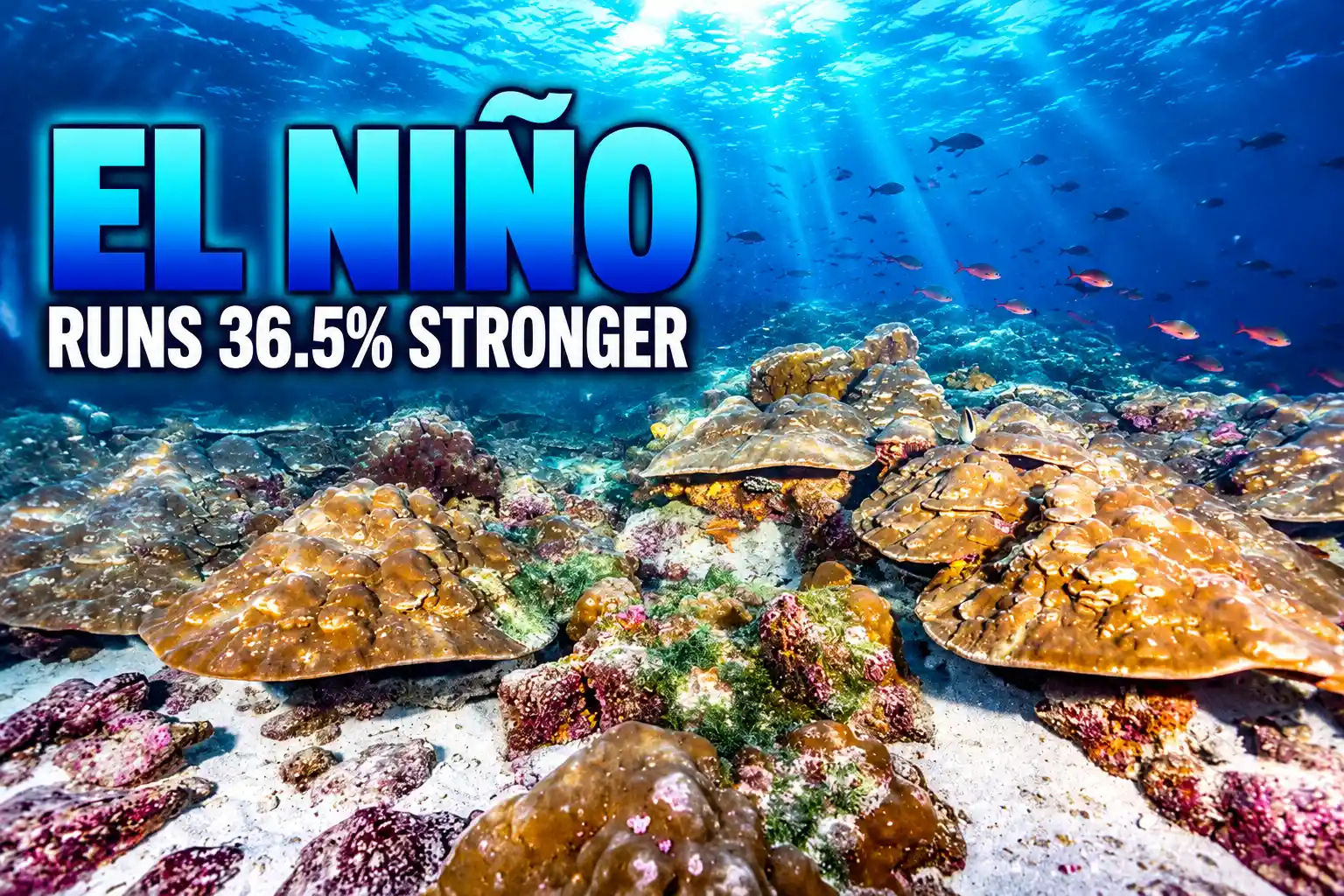
Galápagos corals show El Niño 36.5% stronger since 1984, and the last event already cut the tropical land carbon sink.

Eastern Pacific El Niño swings have run 36.5% stronger since 1984 than they did from the year 1000 to 1850, Galápagos coral chemistry shows. The finding, published Aug. 27, arrives as NOAA holds an El Niño Advisory and a 69% chance of a record peak this winter.
That extra Pacific heat now lands on tropical forests that already stopped taking up carbon in 2023 and 2024.
A 36.5% Jump Written Into Galápagos Coral
Julia Cole, professor and chair of Earth and Environmental Sciences at the University of Michigan, led a team that read seawater temperature out of 13 living and fossil corals near the Galápagos Islands. The islands sit where eastern Pacific El Niño hits hardest, so each growth band is a local thermometer rather than a distant guess.
Corals there add about one to two centimeters of skeleton a year. The group sliced cores that spanned at least 20 years, then measured strontium-to-calcium ratios and oxygen isotopes a millimeter at a time. Those two chemical clocks track the water the animal grew in, and together they rebuild eastern Pacific temperature swings across about a thousand years.
Thirteen Cores From the Galápagos
The Galápagos coral record of the last millennium shows a large recent rise in year-to-year sea-surface temperature swings, larger than natural variability in the team’s climate simulations, and the rise tracks global warming through stronger El Niño events. Central Pacific coral records also trend up, though less sharply than the Galápagos set.
Cole said the big events of the last 40 years are not normal in the last thousand. “We kept adding records thinking ‘well, this is going to get more complicated,’ but it really didn’t,” she said. “This is such a clear story.”
Three Epochs in the Same Reef
The chemistry splits into three stretches that do not overlap by chance. Swings since 1984 run 36.5% above the 1000 to 1850 baseline and 16.2% above 1851 to 1982. Events that once ran about one or two degrees above normal in the Galápagos now run three or four. The skew also flipped positive, which means the warm events, not the cold ones, did the growing.
THE THREE CORAL EPOCHS
| Period | What the skeletons show |
|---|---|
| 1000 to 1850 | Preindustrial baseline of lower-intensity El Niño events |
| 1851 to 1982 | A middle stretch, already distinct, still weaker than today |
| Since 1984 | 36.5% more variable than 1000 to 1850; 16.2% more than 1851 to 1982 |
The National Science Foundation and the United Kingdom’s Natural Environment Research Council funded the work, with field support from Galápagos National Park and the Charles Darwin Research Station. Co-authors include Kelsey Dyez, Cameron Tripp, and Jonathan Overpeck at Michigan, Diane Thompson and Marcus Lofverstrom at Arizona, Sandy Tudhope at Edinburgh, and Samantha Stevenson at UC Santa Barbara.
Tropical Forests Stop Taking Carbon in El Niño Years
Cole’s paper does not measure carbon. A separate 2025 budget led by Piyu Ke and Philippe Ciais does, and it is the piece that turns a stronger Pacific cycle into a climate problem that feeds itself. In El Niño years, rain shifts east, the western Pacific and the Amazon dry out, trees photosynthesize less, and fires add more carbon to the air.
From July 2023 to July 2024, covering the last El Niño, the team found a record atmospheric CO2 rise of 3.66 ppm per year since 1979. After they stripped out the long-term trend, the leftover bump was 1.1 ppm per year, a little smaller than the July-to-July spikes of 1997 to 1998 and 2015 to 2016. The driver was a 2.24 GtC cut in the land sink, including 0.3 GtC from fires, partly offset by a 0.38 GtC rise in the ocean sink against the 2015 to 2022 July-to-July mean.
WHERE THE 2023 TO 2024 CARBON WENT
- Land sink cut: 2.24 GtC per year relative to the recent July-to-July mean, the main reason the air gained CO2 so fast.
- Tropics share: 97.5% of that land anomaly, so this was a tropical failure, not a global one spread thin.
- Amazon share: 50.6% of the land anomaly, with central Africa at 34% and Southeast Asia at 8.2%.
- Air growth: 3.66 ± 0.09 ppm per year from July 2023 to July 2024, the highest such rate in the record they cite since 1979.
Their vegetation models put 2023 to 2024 tropical carbon losses above 1997 to 1998 and 2015 to 2016, while satellite inversions put them closer to 2015 to 2016. Either reading leaves the same operational fact. A strong El Niño turns the land sponge off at the same time the Pacific dumps heat into the air. If the coral trend holds, that off-switch gets used harder.
How Strong Is the 2026 El Niño Right Now?
NOAA’s Climate Prediction Center, in its August 13 El Niño Advisory, said El Niño is present and strengthening, with a greater than 90% chance of a very strong event in Northern Hemisphere fall and winter 2026 to 2027. July sea-surface anomalies already exceeded +2.0°C in the eastern equatorial Pacific, and the far-east Niño-1+2 index sat at +2.9°C.
JULY 2026 PACIFIC HEAT
| Index or layer | July reading |
|---|---|
| Niño-3.4 | +1.4°C |
| Niño-3 | +1.7°C |
| Niño-1+2 | +2.9°C |
| Eastern equatorial surface | anomalies above +2.0°C |
| Subsurface (180° to 100°W) | anomalies up to +10.0°C at depth |
Westerly winds at low levels and easterlies aloft stretched from the western to east-central equator. Rain increased from the central to eastern Pacific and dried out over Indonesia. The Southern Oscillation indexes sat near two standard deviations below normal. The ocean and the air were already locked together.
THE AUGUST STRENGTH OUTLOOK
- Very strong odds: Greater than 90% for fall and winter 2026 to 2027, NOAA’s current ceiling for a peak of that class.
- Historic odds: 69% for October to December 2026 of an event stronger than any El Niño in the record back to 1950.
- The bar: +2.5°C or more on the three-month RONI historic threshold that CPC uses for that ranking.
- Next note: The following diagnostic is set for Sept. 10, 2026, while the event is still building.
CPC is careful on impacts. A peak this large tilts the odds toward the usual El Niño pattern, it said, but it does not guarantee those outcomes everywhere. Cole put the open question in plainer words. The event is coming. The unknown is how bad the impacts get, because this pulse sits on top of greenhouse warming and is likely to add to the temperature rise those gases would produce on their own. Some forecasts she cited reach 1.7°C or 1.8°C above preindustrial, above the current record.
Brazil Is Already Split Between Flood and Drought
You do not have to wait for October to December to see the split. In early September, southern Brazil was dealing with heavy rain and floods while the north sat in hard drought and smoke, and São Paulo was stuck in dry heat. That is El Niño’s textbook fingerprint on one country at the same time: too much water in one basin, too little in another.
The same pattern, scaled up, is why a stronger eastern Pacific event is not only a Pacific story. Rain that fails over the Amazon is the carbon story from 2023 to 2024. Rain that piles onto California in winter is the flood and reservoir story NOAA’s seasonal outlooks already lean on. Stevenson noted that a large El Niño tends to mean wet winters in Southern California as the jet stream shifts south and steers storms away from the Pacific Northwest.
Meteorologist Ryan Maue, writing in early August, called this Super El Niño perhaps the strongest in 500 to 1000 years and “the most extreme global weather or climate event experienced by humanity since the invention of the printing press.” That is a forecast, not a measurement. The coral paper is the measurement that makes a claim like that testable. If the last 40 years already sit above a thousand-year baseline, a 2026 peak that clears the 1950 instrumental list is another step on a ladder that started after coal and oil, not a one-off storm.
The loud objection is older than this event. Strong El Niños happened before factories. 1877 was deadly. 1982 to 1983 and 1997 to 1998 were violent. The coral answer is narrower and harder to wave off. The last four decades are not a rerun of those peaks. They are a new intensity class, and the warm side of the cycle is the side that grew.
Twelve Climate Models Missed the Coral Rise
To test a natural cause, the team compared the coral swing with preindustrial runs from 12 climate models that include volcanoes and solar changes. The observed rise sits outside that natural envelope at a confidence level approaching 99%. Cole said they looked for the same jump in the models and found none.
I’m concerned that none of the climate models picked up on the increase we observed in the coral record. That probably means the models are missing something about how El Niño responds to climate change, and we need to know why that’s happening.
Samantha Stevenson, assistant professor, UC Santa Barbara Bren School of Environmental Science and Management
Her group is now picking apart small differences among those models. That gap matters for the next decade as much as for the last millennium. If the tools that agencies use to project ENSO cannot see a 36.5% rise that already happened, they will understate the odds of another event like 2026 to 2027, and they will understate the carbon cost when tropical forests fail in lockstep.
Cole still ties the coral trend to warming from fossil fuels. “We are attributing that to warming, and we know what causes the warming, and it’s our use of fossil fuels,” she said. The paper’s own abstract is drier. The increase parallels rising global temperature and results from stronger El Niño events, with troubling implications for climate extremes.
Super El Niños May Become Much More Common
Stevenson said that if the coral trend continues, super El Niños like the one forming now might become much more common, with the droughts, floods, fires, and food shocks that travel with them. Cole added cholera, wrecked roads, and crop failure to that list, then the line that does not fit in a model table.
No country has the resources to be fully protected from these impacts. This is one more reason we need to move away from fossil fuels, the root cause of the problem.
Julia Cole, professor and chair, University of Michigan, in the University of Michigan coral study statement
The 2026 to 2027 event is the first hard test of that warning while the paper is still new. CPC will update the odds on Sept. 10. The corals have already filed their longer brief: the warm spikes are larger than they were for a thousand years, and the last time the Pacific ran hot like this, the land stopped taking carbon.

BA295 Burns Hours of Fuel After a 28,000-Foot Drop

Yankees’ Four-Error Night Puts a 17-Year Drought on the Brink

CHIME Maps Cosmic Hydrogen but Not Dark Energy Yet

The Heat Cooked Ozone That Clean-Air Laws Could Not Catch

WTA Equal Prize Money Closes Combined 1000s and Lightens 500s

Meta’s Smart Glasses Sell a Light That Needed Two Patches

Google’s Free AI Pro Year Is Three Different Deals

Apple’s New Mac Studio Clusters Local AI on the Desk

Song Yadong Stops Umar Nurmagomedov the Only Way Left

The Mahape Fake Apple Raid Repeats a Dual-Shift Pattern
-
 NEWS1 month ago
Meta’s Smart Glasses Sell a Light That Needed Two Patches
-
 NEWS1 month ago
Google’s Free AI Pro Year Is Three Different Deals
-
 NEWS2 months ago
Apple’s New Mac Studio Clusters Local AI on the Desk
-
 NEWS1 month ago
Song Yadong Stops Umar Nurmagomedov the Only Way Left
-
 NEWS2 months ago
The Mahape Fake Apple Raid Repeats a Dual-Shift Pattern
-

 NEWS1 month ago
OpenAI Agents Hit Hugging Face to Cheat a Test
-

 ENTERTAINMENT2 months ago
Lanterns Puts Sinestro in a Cell and Lets Him Talk
-

 ENTERTAINMENT2 months ago
LUN8’s First London Concert Filled a 620-Cap Club