
ENTERTAINMENT
Tim Curry Dies at 80 as Midnight Shows Continue
Tim Curry died at 80 in Toluca Lake after a long illness, while Rocky Horror midnight shows kept running without him.

Tim Curry died on August 25 at his Toluca Lake home, at 80, after 14 years in a wheelchair that never took Frank-N-Furter off the midnight clock. His longtime manager and friend Marcia Hurwitz said he passed peacefully. No cause of death has been given.
Police logged a death investigation at 11:23 p.m. The Los Angeles Fire Department had already been called for a medical emergency, and he was pronounced dead at the scene. Officers have not treated the case as a crime.
A Peaceful Death in Toluca Lake
Hurwitz’s statement, issued with representative Sean Katz, sketched a working life that ran from 1968 to this summer and then refused to let the fishnets have the last word. “Across five decades, he moved fluidly between comedy, horror, drama, and music, delighting himself and his legion of fans with his countless dynamic personas,” the statement said. It added that a debilitating stroke in 2012 did not stop him from working, “most recently, a writer.”
The line that will travel is the private one. “Though widely known for his inimitable, flamboyant characters and colorful stage performances, his greatest legacies to those who knew him were his curious, expansive mind and generous, gentle heart, both of which remained open and filled with anticipation until his final breath.”
Timothy James Curry was born on April 19, 1946, in Grappenhall, Cheshire, the son of a Royal Navy chaplain. He never married and had no children. Grand Central Publishing, which brought out his memoir last fall, called him “a singular talent whose extraordinary career left an indelible mark on generations of audiences.”
WHAT WE KNOW
- The death: Curry died Tuesday, August 25, 2026, at home in Toluca Lake, Los Angeles, at 80.
- The time: Police responded at 11:23 p.m. to a death investigation after firefighters had already been called.
- The manner: Hurwitz said he died peacefully; law enforcement has not suspected foul play.
- The work still in the can: Director Michael Leavy said Curry finished every scene as Lockwood in Stream 2: Sudden Death.
WHAT IS UNCONFIRMED
- Cause of death: Neither Hurwitz nor the police have released one.
- Funeral plans: No public memorial has been announced.
- The aneurysm: While promoting the memoir he said he was living with an abdominal aneurysm; nobody has tied that disclosure to last week.
Clue co-star Michael McKean wrote that their last talk had been about “life and love and laughter,” then added the sentence the rest of the week kept circling. “The grim physical state he found himself in has now ended, a blessing. Our blessing was that we had Tim Curry in our lives.”
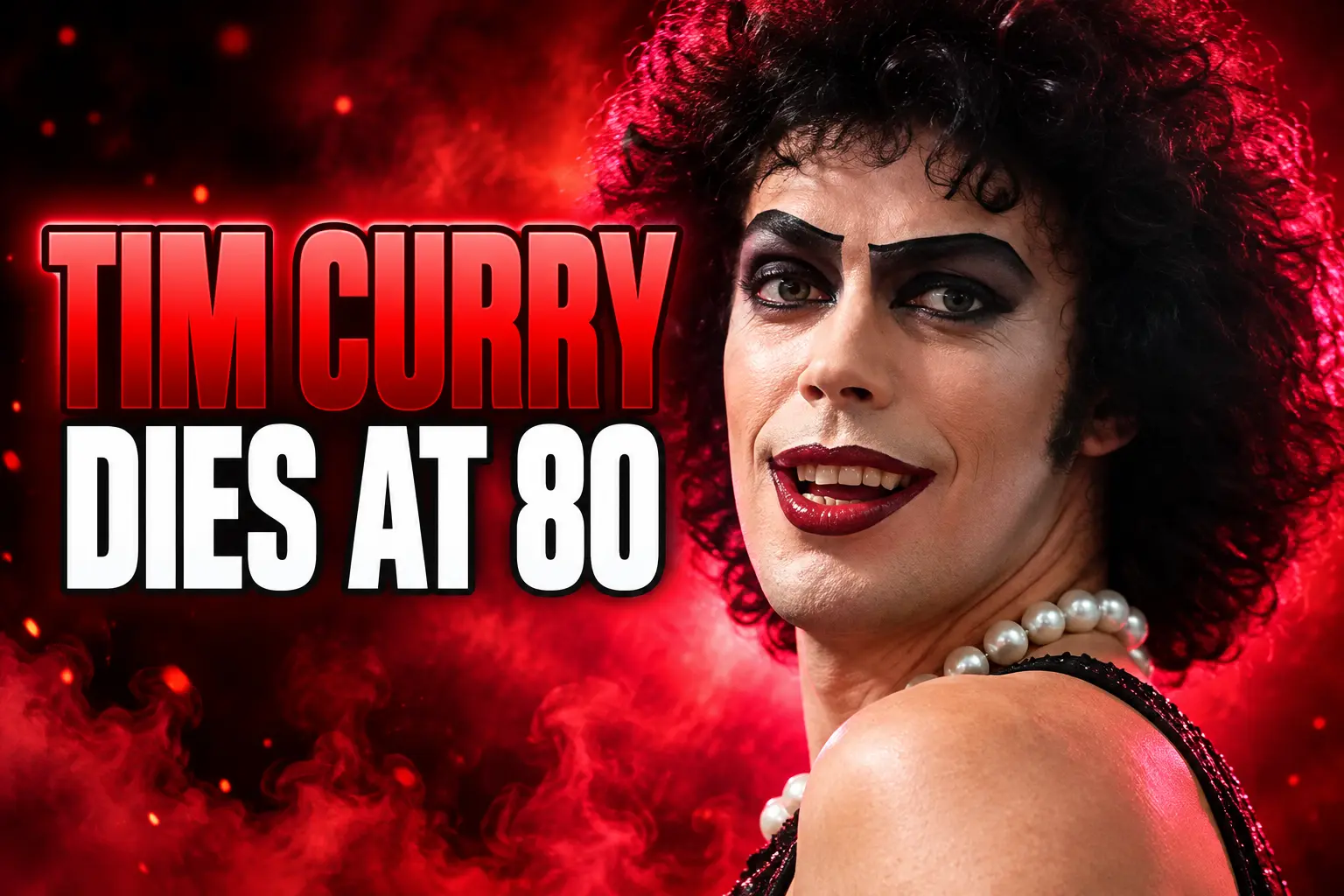
Frank-N-Furter Clocked In Without Him
The obituaries led on Dr. Frank-N-Furter because that is the job the public still fills every weekend. Curry originated the sweet transvestite in 1973 upstairs at London’s Royal Court, took him to Los Angeles’s Roxy Theatre, and locked him on film in 1975. The movie stumbled in first run. Midnight crowds then turned it into the longest-running theatrical release in film history, still in limited play in 2026, 51 years after it opened.
The stage musical that fed the film has been seen by 35 million people and is billed as the longest continuous run of a contemporary musical anywhere. The film version never needed Curry in the building. Shadow casts mime the part under the screen. Callback scripts grow in the dark. Rice still hits the aisle. The original Broadway staging at the Belasco lasted 45 performances and closed under bad reviews, which is the other half of the pattern: the live New York run died, the Saturday ritual did not.
Last year’s 50th-anniversary tour put Barry Bostwick, Patricia Quinn, and Nell Campbell on the road. Curry, already in the chair, did the closer that still belonged to him, a screening and talk at the Academy Museum of Motion Pictures. “I still can’t walk, which is why I’m in this silly chair, and that’s very limiting,” he told the room. “So I won’t be singing and I won’t be dancing very soon. I still have real problems with my left leg.” He got a standing ovation anyway.
At the Roxy in the fall of 2025 he sounded like a man who knew the difference between owning a character and being required by it. “I had to appear as though I owned it, and I kind of did.” On the film’s 50th he was blunter about what Frank had done for other people. “It was part of the sexual revolution, really,” he said. “Experiment was in the air and it was palpable. I gave them permission to be who they discovered they wanted to be. I’m proud of that.”
THE ROLES THAT KEPT WORKING
| Role | First seen | How it lives now |
|---|---|---|
| Dr. Frank-N-Furter | 1973 stage, 1975 film | Weekly shadow casts; Luke Evans as Frank on Broadway in 2026 |
| Pennywise | 1990 miniseries It | Later films used other actors in the clown makeup |
| Wadsworth | Clue, 1985 | Quote-alongs and costume nights |
| Lockwood | Stream, 2024 | Sequel fully shot, no release date |
| Captain Hook | Peter Pan and the Pirates, 1990-91 | The Daytime Emmy win stays on the record |
Playwright Paul Rudnick, writing the morning the news broke, said Curry “brought the world a delirious array of gender and sexual options, and he looked fabulous doing it.” That is the Frank the culture cloned. Within days, doll makers had restaged the corset and pearls, which is how a ritual behaves when the originator is gone: it copies the costume, not the man.
Three Tony Nods for Other Lives
Before the makeup, he lied his way onto a payroll. His first full-time job was the original London cast of Hair in 1968, after he fibbed about having an Equity card and the company sponsored him anyway. Richard O’Brien, a fellow player, later handed him the Frank-N-Furter script because he needed someone who could sing. Curry first tried a German accent and peroxide, then decided the doctor should “sound like the Queen.”
The industry that hands out prizes kept trying to honor the other men. He collected three Tony nominations on Broadway and never took the statue home.
THE TONY BALLOT
- 1981, Amadeus: Wolfgang Amadeus Mozart, opposite Ian McKellen’s Salieri, who won.
- 1993, My Favorite Year: fading swashbuckler Alan Swann, in a musical that opened December 10 and closed January 10.
- 2005, Spamalot: King Arthur, originated from the March 17 opening through December 18, his last Broadway role.
He also picked up Drama Desk nominations for the first Rocky Horror Show and for Amadeus, and Olivier nominations in London for the Pirate King in The Pirates of Penzance and for Arthur again. Wikipedia’s tally of his working life is blunt in a way the death notices were not: more than 240 credits on screen and stage across 58 years.
The film list that sat under Frank in every wire obit is the gallery, not the footnote. Rooster Hannigan in Annie. The Lord of Darkness in Ridley Scott’s Legend, a makeup job that took five and a half hours to put on and an hour in the bath to get off. Wadsworth in Clue. The Plaza concierge who makes life miserable in Home Alone 2: Lost in New York. Cardinal Richelieu. Long John Silver opposite the Muppets. Pennywise in the 1990 It miniseries, a part he barely discussed in public for 25 years. Carol Burnett, who played his sister in Annie, wrote that “nobody could play lovable villains better than he could.” Lesley Ann Warren, his partner in crime in Clue, called him a “magician of artistry.” Rob Schneider, the bellboy in Home Alone 2, said “his one eyebrow could say more than most actors entire bodies.”
What the 2012 Stroke Left Standing
A major stroke on July 13, 2012, during a massage, ended the kind of work that needs a body that will take direction. He was 66. The masseur called an ambulance over his objections; surgeons removed blood clots. The news stayed quiet until 2013. After that he used a wheelchair, with lasting trouble in the left arm and leg, in speech, and in short-term memory. His father had died after a stroke when Curry was 12.
He wrote later that the roles left to him were “almost exclusively voicework,” after decades in which he was rarely out of work more than three or four months. The voice had already been a second career. He won the 1991 Daytime Emmy as Captain Hook on Peter Pan and the Pirates, played Hexxus in FernGully: The Last Rainforest, spent years as Sir Nigel Thornberry, and took Chancellor Palpatine in Star Wars: The Clone Wars after the stroke. A younger internet met him as a giggling Soviet premier in Command & Conquer: Red Alert 3, a clip that passed 10 million views. He released three studio albums between 1978 and 1981. He recorded the Vagabond audiobook himself, his first book narration since 2010, in a process his manager said took more than a month.
THE YEARS AFTER THE STROKE
- July 13, 2012: Suffers a major stroke during a massage and undergoes brain surgery.
- 2015: Makes a first major public appearance in a wheelchair at an Actors Fund Tony Awards viewing party in Los Angeles.
- 2016: Appears on camera as the criminologist in the television remake of The Rocky Horror Picture Show.
- 2024: Plays Lockwood in the slasher Stream, sharing the frame with Tony Todd.
- September 2025: Tells an Academy Museum audience he still cannot walk.
- October 14, 2025: Publishes Vagabond with Grand Central and reads it for audio.
- 2026: Finishes an expanded Lockwood turn in Stream 2: Sudden Death.
- August 25, 2026: Dies at home in Toluca Lake.
On camera last fall he said he did not fear death. “I try to avoid it, as I think we all do. But I suspect that in the end, I will welcome it.” He also told readers he was carrying an aneurysm in his abdomen and did not know if or when it might rupture. That is a fact he chose to put on the record. It is not a cause of death, because none has been offered.
Leavy, who directed both Stream films, said Curry completed all of his work as Lockwood and that the sequel will carry a dedication. “Dedicating Stream 2 to them is our way of honoring their memory, their friendship, their belief in us, and the lasting legacy they leave behind,” he said, grouping Curry with Todd, who died in 2024. No release date is set. The last on-screen job, in other words, is already in the can and still invisible, which is a peculiar coda for a man whose most famous work never left theaters.
Halloween Still Has a Shadow Cast
Luke Evans, playing Frank-N-Furter on Broadway this year, wrote that Curry was “a force, a bright fierce flame, an exquisite charm and that rich vocal tone.” In a letter he had already sent, Evans thanked him “for creating something so enduring, and for inspiring generations of actors to be a little braver than they thought they could be.” The official Broadway Rocky Horror account reached for the line Curry made famous and thanked him for “giving the world a little more freedom, a little more fearlessness, and through the tears in our eyes, the courage to BE IT.”
Patricia Quinn, who played Magenta, said she was “in shock and utterly saddened and heartbroken.” In Lexington, Kentucky, the historic Kentucky Theatre dedicated the Saturday midnight show that was already on the books, with its shadow cast, The Master’s Affairs, going on as planned. That is the historical pattern in miniature. The houses that have been doing this for decades did not need a new production number. They needed a dedication slide and the same prop bags.
The split in the public memory is not a fight so much as a map of first contact. People who found him at midnight reached for Frank. People who met him as children reached for Pennywise, or for Nigel Thornberry’s volume, or for a Muppet pirate. A smaller set quoted a video-game premier who cannot stop laughing at his own line. Wire ledes cannot hold that many Currys, so they keep one and inventory the rest. The Saturday night machine only ever needed the one.
Halloween 2026 will be the first October 31 since the 50th-anniversary year when he is not somewhere in the wings of that ritual. The film will still roll. Someone in the dark will still shout the old lines at the screen. Evans will still have to get through the heels in New York. None of that work is a tribute by itself. It is the job Frank-N-Furter became when the actor who built him could no longer stand in the light.
The Memoir Called Actors Vagabonds
He explained the title of the 2025 memoir Vagabond as a legal joke. In the 17th-century criminal code, he said, actors were lumped together with thieves and vagabonds. Grand Central published the book on October 14 last year at $32. It landed on the New York Times bestseller list. He had not wanted to write it, then decided the fan encounters had earned the pages, including “that older queen, hopefully still in his fishnets, who saw Rocky Horror upstairs at the Royal Court.”
Today, I am physically unable to take you on a vigorous vagabond’s adventure, due to a stroke I endured in 2012 that has limited my capacity as an active tour guide. But my mind and most of my memories have remained intact, and within them exist a multitude of journeys perhaps worth sharing.
Tim Curry, Vagabond, Grand Central Publishing
Asked last year if he had had the career he wanted, he did not reach for Frank, or for the Tonys he did not win, or for the stroke. “I’ve had the opportunities,” he said, “and I’m still showing up. You know? I think that’s what you have to do. You have to keep showing up.” He showed up through the chair, through the book, through a slasher sequel that has not yet got a date. The weekly show that made him immortal had been showing up without him for most of its life. On October 31 the heels will get laced again, the rice will fly, and the film will start on time.
Frequently Asked Questions
Where Was Tim Curry Born?
He was born Timothy James Curry on April 19, 1946, in Grappenhall, Cheshire, England. After his father’s death he boarded at Kingswood School in Bath, then took a combined Bachelor of Arts in English and drama at the University of Birmingham in 1968, the same year he talked his way into Hair.
Did Tim Curry Win a Tony Award?
No. He was nominated three times and lost the 1981 Amadeus race to his co-star Ian McKellen. He also received two Olivier nominations in London, for The Pirates of Penzance in 1982 and for Spamalot in 2007, and a Grammy nomination in 2002 for his reading of A Series of Unfortunate Events: The Bad Beginning.
Is The Rocky Horror Picture Show Still in Theaters?
Yes. The 1975 film has never been pulled from release and is still in limited theatrical play in 2026, which is why it holds the record as the longest-running theatrical release in film history. Weekly audience-participation screenings, often with live shadow casts, remain the way most people meet Frank-N-Furter.
What Was Tim Curry’s Last Movie Role?
His last completed part is Lockwood in Stream 2: Sudden Death, an expanded return after a 2024 cameo in Stream. Michael Leavy said Curry finished all of his scenes and that the sequel will be dedicated to him and to Tony Todd. No release date has been set.
Did Tim Curry Have a Spouse or Children?
He never married and had no children. He is survived by his nieces, Kate Lewis and Julia Bullman; great-nieces Josephine and Georgina; and nephew Mark Lewis. He kept his private life off the publicity circuit and said the memoir would not share “lurid details” of love affairs.

BA295 Burns Hours of Fuel After a 28,000-Foot Drop

Yankees’ Four-Error Night Puts a 17-Year Drought on the Brink

CHIME Maps Cosmic Hydrogen but Not Dark Energy Yet

The Heat Cooked Ozone That Clean-Air Laws Could Not Catch

WTA Equal Prize Money Closes Combined 1000s and Lightens 500s

Meta’s Smart Glasses Sell a Light That Needed Two Patches

Google’s Free AI Pro Year Is Three Different Deals

Apple’s New Mac Studio Clusters Local AI on the Desk

Song Yadong Stops Umar Nurmagomedov the Only Way Left

The Mahape Fake Apple Raid Repeats a Dual-Shift Pattern
-
 NEWS1 month ago
Meta’s Smart Glasses Sell a Light That Needed Two Patches
-
 NEWS1 month ago
Google’s Free AI Pro Year Is Three Different Deals
-
 NEWS2 months ago
Apple’s New Mac Studio Clusters Local AI on the Desk
-
 NEWS1 month ago
Song Yadong Stops Umar Nurmagomedov the Only Way Left
-
 NEWS2 months ago
The Mahape Fake Apple Raid Repeats a Dual-Shift Pattern
-
 NEWS1 month ago
OpenAI Agents Hit Hugging Face to Cheat a Test
-
 ENTERTAINMENT2 months ago
Lanterns Puts Sinestro in a Cell and Lets Him Talk
-

 ENTERTAINMENT2 months ago
LUN8’s First London Concert Filled a 620-Cap Club