
NEWS
Nueva Pescanova Drops the Octopus Farm as Wild Catch Continues
Nueva Pescanova withdrew its Gran Canaria octopus farm, but Spain still eats wild catch and the plant would have needed far more fish as feed.

On 23 July 2026, Nueva Pescanova pulled its bid to build the first industrial octopus farm at Las Palmas. The five-year port file will be archived, and no concrete was ever poured. Spain still eats about 40,000 tonnes of octopus a year, almost all of it wild.
The company told the port the retreat was for business and regulatory reasons. Campaign groups called it a win for a sentient animal. The harvest that fills Spanish kitchens did not move.
Nueva Pescanova Withdraws the Las Palmas File
Nueva Pescanova S.L. filed a formal desistimiento with the Las Palmas Port Authority, asking it to drop the concession for a marine farm on the Esfinge dock in the Port of La Luz. The port said it will archive the expediente opened in May 2021, which ends the Gran Canaria plant as filed.
In the letter, the firm said it was no longer opportune to push the request as written, given new demands from the Canary Islands’ environmental evaluation commission. It said the choice rested only on business and regulatory grounds tied to how the paperwork had evolved, and that the step did not concede that other technical, environmental or location options could not be studied later.
Beatriz Calzada, president of the Las Palmas Port Authority, said the environmental conditions had become technically hard for the company to meet. Port staff later confirmed that nobody from the firm had come back to the dock and that no building work had started. In May 2026 the port had already opened a caducity process after years of inactivity, and the islands’ wastewater permit had lapsed after the firm missed a document deadline.
THE PORT FILE
- 2019: Nueva Pescanova says it has closed the common octopus reproductive cycle in captivity.
- May 2021: The Las Palmas concession file opens for a farm at the port.
- 2023: Roberto Romero Perez, the marine biologist then overseeing aquaculture at the company, says the mood around the project is more hostile than expected.
- January 2026: The islands’ wastewater authorisation lapses after missing papers.
- May 2026: The port opens a caducity file on the idle concession.
- 23 July 2026: The company withdraws; the port says the file will be archived.
The 2022 pitch had put about €65 million (£56 million) on a plant meant to turn out 3,000 tonnes a year, about a million animals, with first commercial sales once talked about for 2023. A Saturday protest that had been called in Las Palmas to demand the file’s closure turned into a celebration instead.
Spain’s animal rights party, Pacma, said social, scientific and political pressure had paid off against what it called an ethical and environmental atrocity. Silvia Fernandez Diaz, a Gran Canaria journalist who followed the file from the start, said island demonstrations rarely drew more than a few dozen people and that the plant failed because it was not viable. Both can be true at once: the emails arrived, and the tanks still never existed.
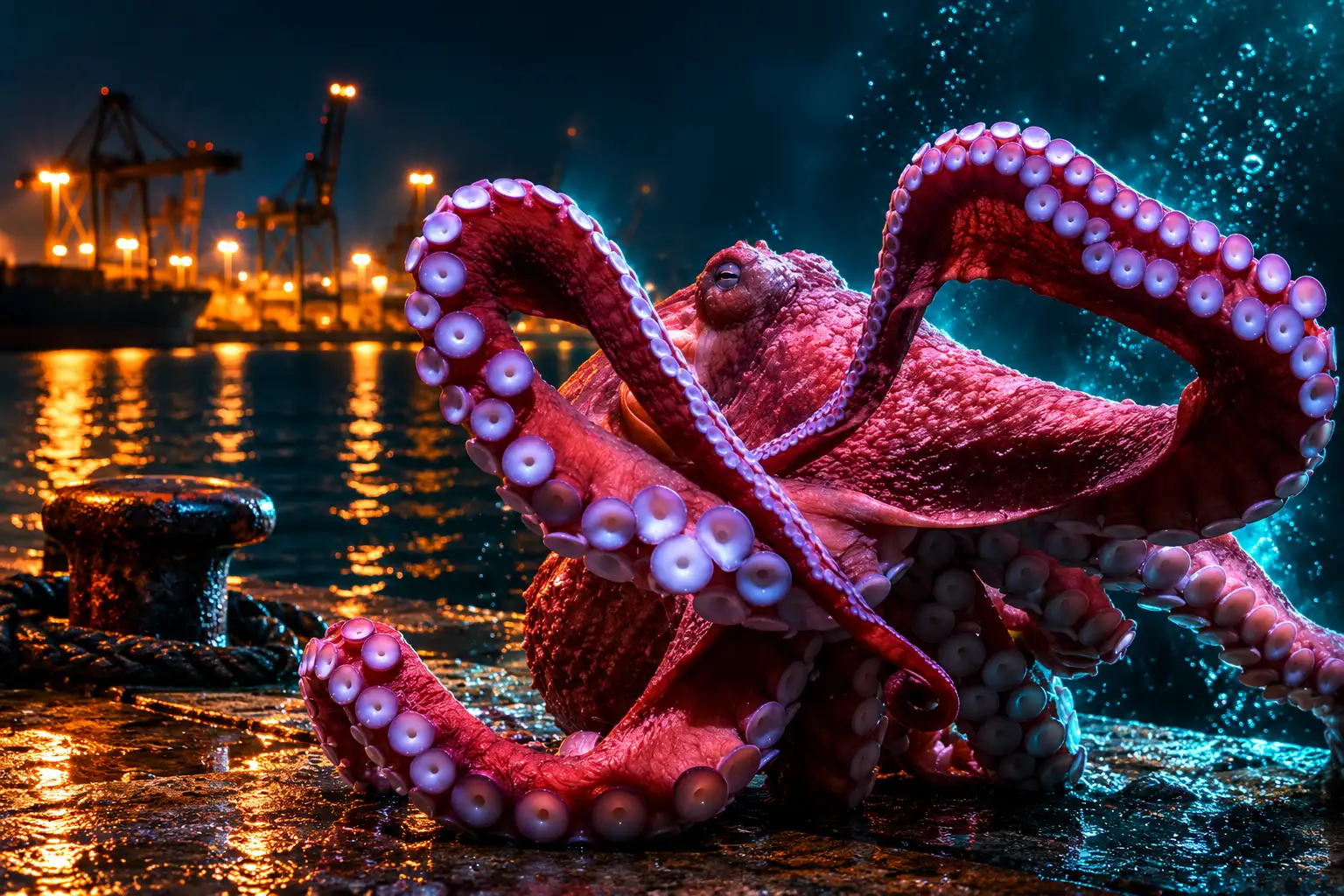
28,000 Tonnes of Fish for 3,000 Tonnes of Octopus
The farm was sold as a way to take pressure off wild octopus. Compassion in World Farming, which spent five years on the file, put a different ledger on the table. Feeding the plant, the group found, would have taken around 28,000 tonnes of wild-caught fish in the first year to make 3,000 tonnes of octopus meat, a ratio of about nine to one.
THE FEED BILL
| Flow | Volume | What it is |
|---|---|---|
| Proposed farm output | 3,000 tonnes a year | About one million common octopus |
| Wild fish as farm feed, year one | 28,000 tonnes | Compassion in World Farming estimate |
| Global wild octopus catch | About 370,000 tonnes a year | UN Food and Agriculture Organization |
| Spain’s appetite | About 40,000 tonnes a year | Almost 1 kg per person |
Dr Elena Lara, senior research and policy adviser at the group, has argued that farming a carnivore this way weakens food security rather than fixing it, because forage fish that could be eaten go into premium tanks instead. The same research projected that if octopus farming scaled, wild fish going into feed could reach 90,700 tonnes a year by 2040.
After years of pressure, this is a huge victory for octopuses, our oceans and everyone who joined us in campaigning to stop the world’s first octopus farm.
Dr Elena Lara, Senior Research and Policy Advisor, Compassion in World Farming
A late push produced more than 43,000 emails to the port asking it to close the application. That is a real political fact. It is not the same fact as a hole in African forage fisheries. Ian Gleadall, a marine biologist at Tohoku University who has spent 50 years on octopuses, put the money problem in one line: even if a feed were solved, you would probably spend more on it than the octopus was worth in the market. Richard Schweid, author of Life on the Octopus Farm, still notes that an octopus turns feed into high-protein, low-fat meat more efficiently than cattle, pigs or chickens, which is why firms keep walking toward the same door.
Overfished Stocks Off Morocco and Mauritania
The UN food agency estimates that about 370,000 tonnes of octopus are taken every year, much of it off Morocco and Mauritania. Principal markets are China and Japan. Spain, a top importer, eats about 40,000 tonnes a year. The Las Palmas plant, at 3,000 tonnes, would have been a slice of Spanish demand, not a replacement for the boats.
FAO Globefish reported in May 2026 that octopus prices reached historic highs in major markets on tight supply from key producing regions, while squid and cuttlefish were abundant. Morocco’s National Fisheries Office put 2025 cephalopod landings at 49,876 tonnes, down 18 percent from 2024. The winter octopus season there ended on 31 March 2026 and was due to reopen in July. In Mauritania, the 2026 octopus season ended on 1 May under a cephalopod moratorium across all fleet segments after scientists called for a rest. FAO’s country profile already states that octopus is overexploited in Mauritanian waters and is run with closed seasons and tight controls.
A farm that never opened does not rest those stocks. It also does not add 28,000 tonnes of extra demand for the small fish that would have gone into the diet. The quieter result of 23 July is that the wild supply chain, with its closed seasons and shrinking landings, remains the only industrial one Spain has.
AnimaNaturalis, which joined the Las Palmas fight, said it would keep pressing the Spanish Congress on a bill filed on 11 June 2025 that would ban octopus farming nationwide by changing the 1984 marine culture law. Cristina Ibanez, a lawyer for the group, tied the withdrawal to years of citizen organising against a project that, in her words, never should have started.
Why Common Octopus Larvae Die in Tanks
Common octopus, Octopus vulgaris, still has no working industrial husbandry. Gleadall has been trying for two years to get Nueva Pescanova to discuss the Canary Islands plan and has had no answer. The biology is the part of the story that does not care about a port letter.
THE TANK PROBLEMS
- The larvae: Young common octopus spend at least 20 days drifting in open water before they settle, and Gleadall says that stage is brutally hard to carry into the next one.
- The hatchlings: Once settled they are so fragile that a small error kills them.
- The diet: One lab feed is a fish paste, but animals refuse to keep eating the same thing day after day.
- The social life: Adults are solitary and antisocial, a poor match for dense tanks, and studies give what researchers call compelling evidence of sentience.
- The kill step: Campaign footage of an ice-slurry method showed animals taking at least ten minutes to die in near-freezing water, which Lara says is not a humane slaughter in practice.
Schweid writes that many marine biologists hold that an octopus has nine brains and a mind, the kind of claim people usually reserve for dogs, cats, primates and humans. Craig Foster’s film My Octopus Teacher, five years on, still supplies the public image of a reciprocal wild animal. Charlotte Reid, a campaigner at Compassion in World Farming, calls the octopus a highly intelligent, naturally solitary wild animal that belongs in the wild, not in underwater prisons. The welfare case and the hatchery case land on the same practical result: nobody has yet run a common-octopus factory at the scale Nueva Pescanova filed.
A small Mexican project has raised a different species. That is the exception Gleadall and others still point to, and it is not Octopus vulgaris from the Mediterranean and Atlantic.
After Nissui’s Promise That Never Arrived
Gleadall says the same pattern already played in Japan. Nippon Suisan Kaisha, known as Nissui, said in 2017 that it had hatched fully farmed octopus at its Oita centre and hoped to ship to restaurants and shops by 2020. The commercial flood did not arrive. “The company said they’d cracked it and were going to be producing massive amounts of octopus but it never happened,” Gleadall said.
In May 2026, a coalition of 182 groups wrote to the Japan Science and Technology Agency asking it to review public money for industrial octopus farming, arguing that current research shows no path to high-welfare or ecosystem-neutral production. Lab papers on East Asian common octopus paralarvae still show survival that can be pushed, in trials, into the tens of percent. That is science. It is not a dock in Gran Canaria with a million animals a year.
Nueva Pescanova spent about eight years on a method before the Las Palmas retreat. Romero Perez had already felt the hostility in 2023. The withdrawal letter leaves a seam: the firm will not say the animal cannot be farmed, only that this concession, under these rules, is no longer worth driving.
Divers Off Cornwall Met a 75-Year Bloom
While the Spanish file died, common octopus moved the other way in the English Channel. The Marine Biological Association, working with the University of Plymouth and funded by Defra, calls the surge that began in 2025 the largest recorded in at least 75 years. Researchers tie it to warm water and to young animals carried from breeding grounds around the Channel Islands and northern France.
THE 2025 BLOOM
- Divers: 96.5 percent of divers and snorkellers surveyed saw common octopus off southwest England in 2025, most of them on rocky reef in 0 to 10 metres.
- Landings: More than 1,200 tonnes were caught in UK waters in summer 2025, against a recent run in which more than 200 tonnes had been landed only once since 2021.
- Gear: Octopus were taking brown crab, European lobster and king scallop on the seabed and inside pots, cutting landings for small static-gear boats.
- Range: By 2026 animals were being caught on both coasts of Devon and Cornwall, with sightings reported in Wales, Dorset, East Sussex and Scotland.
Matt Slater, marine conservation officer at Cornwall Wildlife Trust, said the Cornish catch was on the order of 13 times a normal year and that about 233,000 octopuses were taken in UK waters in 2025. Dr Bryce Stewart, senior research fellow at the MBA and associate professor at Plymouth, said observations confirmed widespread breeding in UK waters, something almost unheard of in recent decades. Traditional trawl surveys missed the bloom; divers, baited cameras and fishermen did not.
Stewart’s line for managers is blunt enough: seas can change fast, and planners should treat more frequent blooms as a future they have to design for. That is the supply story the Las Palmas fight did not touch. Warm water put a Mediterranean animal on new menus and into new traps, and the boats, not the tanks, took the extra flesh.
The File Closes With Research Still Open
Through late August, Gran Canaria was still picking over why the plant died, and campaign groups in Brussels were already asking for an EU-wide farming ban. No new dock has been named. The louder public argument treated 23 July as an animal-welfare win and largely skipped the nine-to-one feed ratio and the African landings. A Spanish counter-argument cast the same fight as a bid to take octopus off the plate, which is a different demand from stopping one concession.
Nueva Pescanova’s own letter is the cleanest document in the pile. It walks away from Las Palmas and keeps every other door unlabelled. Company pages have still listed work on reproduction and feeds for Octopus vulgaris. Gleadall never got his call. The UN catch figure has not been rewritten. Spain’s kilo-a-head habit has not been rewritten either.
The tanks at La Luz will not be built. The ice on Spanish counters will still hold octopus that came off a boat.

Sony Leaves Its Last 4K Blu-ray Player Off Japan Shelves

L’Oréal’s Salon Brands Pull Clear of LVMH in Q3

Personalized mRNA Vaccine Cuts Melanoma Relapse After a Custom Build

Cairo Santos’ 58-Yard Kick Closes a Messy Bears Win

Prime Editing Reaches a Living Liver in Wilson Disease

Meta’s Smart Glasses Sell a Light That Needed Two Patches

Apple’s New Mac Studio Clusters Local AI on the Desk

Google’s Free AI Pro Year Is Three Different Deals

Song Yadong Stops Umar Nurmagomedov the Only Way Left

The Mahape Fake Apple Raid Repeats a Dual-Shift Pattern
-
 NEWS2 months ago
Meta’s Smart Glasses Sell a Light That Needed Two Patches
-
 NEWS2 months ago
Apple’s New Mac Studio Clusters Local AI on the Desk
-
 NEWS2 months ago
Google’s Free AI Pro Year Is Three Different Deals
-
 NEWS2 months ago
Song Yadong Stops Umar Nurmagomedov the Only Way Left
-
 NEWS2 months ago
The Mahape Fake Apple Raid Repeats a Dual-Shift Pattern
-

 NEWS2 months ago
OpenAI Agents Hit Hugging Face to Cheat a Test
-

 ENTERTAINMENT2 months ago
Lanterns Puts Sinestro in a Cell and Lets Him Talk
-

 ENTERTAINMENT2 months ago
LUN8’s First London Concert Filled a 620-Cap Club