
NEWS
CHIME Maps Cosmic Hydrogen but Not Dark Energy Yet
CHIME’s 12.4 sigma solo 21 cm map at redshift 1.16 works without other telescopes, yet still sits on scales too small for a dark-energy BAO test.

The Canadian Hydrogen Intensity Mapping Experiment has measured a 12.4 sigma 21 cm hydrogen auto power spectrum at mean redshift 1.16, using only its own maps. The CHIME Collaboration published the result on September 28, 2026, in The Astrophysical Journal, from 94 nights of 2019 data.
That is the first time this telescope has seen large-scale structure in hydrogen without stacking its maps on galaxies or quasars from another survey. It is also not yet a measurement of dark energy. The signal lives on small, nonlinear scales. The filter that pulled it out of the radio sky still cuts away the larger modes a baryon-acoustic-oscillation test would need.
CHIME’s 12.4-Sigma Hydrogen Detection Stands Alone
On 94 nights from January through November 2019, CHIME recorded maps between 608.2 MHz and 707.8 MHz. That band spans redshift 1.34 to 1.01, with a mean of about 1.16, when the universe was about five billion years old.
The team measured the 21 cm auto power spectrum at redshift 1 over wavenumbers from 0.4 to 1.5 h Mpc^-1. Detection significance is 12.4 sigma for the full band. Split in two, the same nights still show the signal: 8.6 sigma at redshift about 1.08, and 9.1 sigma at redshift about 1.24.
THE 2019 AUTO POWER SPECTRUM
- Full band: Mean redshift 1.16, 12.4 sigma, 608.2 to 707.8 MHz.
- Upper sub-band: Mean redshift about 1.08, 8.6 sigma, an independent split of the same nights.
- Lower sub-band: Mean redshift about 1.24, 9.1 sigma, the other independent split.
- Scales used: 0.4 to 1.5 h Mpc^-1, which the companion analysis treats as nonlinear.
Arnab Chakraborty, a University of Toronto postdoctoral fellow who first proposed the finding, said the work was a long argument against a false alarm, not a single clean night.
We worked very hard to convince ourselves that this wasn’t a false alarm. After all the tests, the signal remained. That gave us confidence we were seeing real hydrogen from the distant universe.
Arnab Chakraborty, postdoctoral fellow, University of Toronto, in a UBC statement
New radio-frequency-interference masks, achromatic beamforming, and a foreground filter applied before time averaging cut leakage that had blocked earlier auto spectra. A check against eBOSS quasars on the same nights found a matching amplitude, which the team used as a sanity test rather than as the detection itself.
Sixteen Years of Proof Rode on Other Telescopes
Hydrogen’s 21 cm line is a tracer of where matter sits, because the gas follows the same web of clusters and voids that galaxies do. Intensity mapping adds up that faint radio glow over huge volumes instead of naming each galaxy. The catch has always been the foregrounds. Galactic synchrotron and other continuum sources are several orders of magnitude brighter than the cosmological signal, so leftover ripples in a radio map can look like clustering even when they are junk.
Cross-correlation was the workaround. Pair a messy radio map with an optical catalog, and noise that lives in only one dataset falls away. That is how the field moved for more than a decade. A catalog-free auto spectrum is harder, and more useful, because it can disagree with those surveys instead of being forced to echo them.
HOW 21 CM MAPPING GOT TO A SOLO DETECTION
- 2010: The Green Bank Telescope, crossed with the DEEP2 galaxy survey, reports the first large-scale 21 cm intensity-mapping signal at redshift about 1, from 15 hours on 2 square degrees.
- September 7, 2017: CHIME is completed at the Dominion Radio Astrophysical Observatory near Penticton, British Columbia, as a dedicated hydrogen mapper.
- 2023: CHIME stacks 102 nights from 2019 on eBOSS luminous red galaxies, emission-line galaxies, and quasars, at 7.1, 5.7, and 11.1 sigma.
- 2024: CHIME crossed with the eBOSS Lyman-alpha forest detects 21 cm emission at mean redshift 2.3, at 9 sigma, from 88 days.
- September 28, 2026: CHIME publishes the 12.4 sigma auto power spectrum at mean redshift 1.16 from 94 nights, with no external catalog in the measurement.
MeerKAT has claimed auto detections at redshift 0.32 and 0.44. The CHIME paper cites those as claimed results and frames its own as the first auto detection at redshift about 1. As recently as 2022, working cosmologists could still say no experiment had a clean auto detection at all.
The Filter That Finds the Signal Also Hides the Ruler
CHIME was built to measure baryon acoustic oscillations, the leftover sound-wave scale from the early universe. That scale is a standard ruler. Compare its apparent size across redshift and you reconstruct how fast the universe expanded, which is the practical test of dark energy.
The 2026 auto spectrum does not do that. Foreground cleaning throws out the spectrally smooth modes where Galactic emission lives. Those are also the largest cosmic scales, the ones that carry the acoustic feature. What survives, at 0.4 to 1.5 h Mpc^-1, is clustering on smaller, nonlinear scales. That is enough to prove the hydrogen is real. It is not enough to weigh dark energy.
Mark Halpern, a University of British Columbia physics professor and CHIME’s principal investigator, still called the solo map a Canadian method, not a finished cosmology result.
This is a completely new technique for probing the cosmos, delivered by an instrument that was conceived, built and funded by Canadians.
Mark Halpern, CHIME principal investigator, University of British Columbia
UBC’s first standalone detection of hydrogen’s glow puts the same point in institutional language: the telescope can now test competing dark-energy ideas with its own maps. The paper is narrower. It shows CHIME can measure large-scale structure in 21 cm without borrowing someone else’s catalog. The expansion-history measurement is the job that remains.
CHIME has made its first standalone detection of hydrogen's ancient radio glow, using only its own observations. The result opens a new way to study dark energy and the evolution of the universe. 🔭
Read more ⤵️ https://t.co/Rfo2cGE9XM
— UBC News and University Affairs (@UBCNews) September 28, 2026
Simulations Underpredict How the Gas Clusters
A companion paper in The Astrophysical Journal asks what the auto spectrum is actually seeing. Shabbir Shaikh, a postdoctoral fellow at Arizona State University, said the data indicate that roughly 2 percent of the hydrogen was in neutral atomic form at this epoch, broadly consistent with other telescopes.
“By measuring how that hydrogen is distributed and clustered, CHIME gives us a new way to test our understanding of how galaxies form and evolve,” Shaikh said.
The same analysis compared the measured power with hydrogen maps drawn from the IllustrisTNG hydrodynamical simulations, then run through CHIME’s own pipeline. After a free amplitude is fit, the data still disagrees with the TNG300 simulation run at 4.0 sigma, and with TNG100 at 3.1 sigma. The mismatch is in how strongly the gas clusters in redshift space, not in the total amount of hydrogen. That is a galaxy-evolution problem the auto spectrum can now pose on its own.
CHIME AUTO SPECTRUM VERSUS ILLUSTRISTNG
| Comparison | Tension with CHIME | What the team infers |
|---|---|---|
| TNG100 hydrogen maps | 3.1 sigma | Too little redshift-space clustering of HI |
| TNG300 hydrogen maps | 4.0 sigma | Same clustering shortfall, larger box |
| Neutral atomic fraction | Broadly consistent | About 2 percent of hydrogen still neutral |
Chakraborty put the tracer case in one line: “Hydrogen is the most common element in the universe and the raw material from which stars form. Its faint radio emission acts like a cosmic tracer, revealing how matter is distributed across space.”
A $16 Million Array Maps the Northern Sky Daily
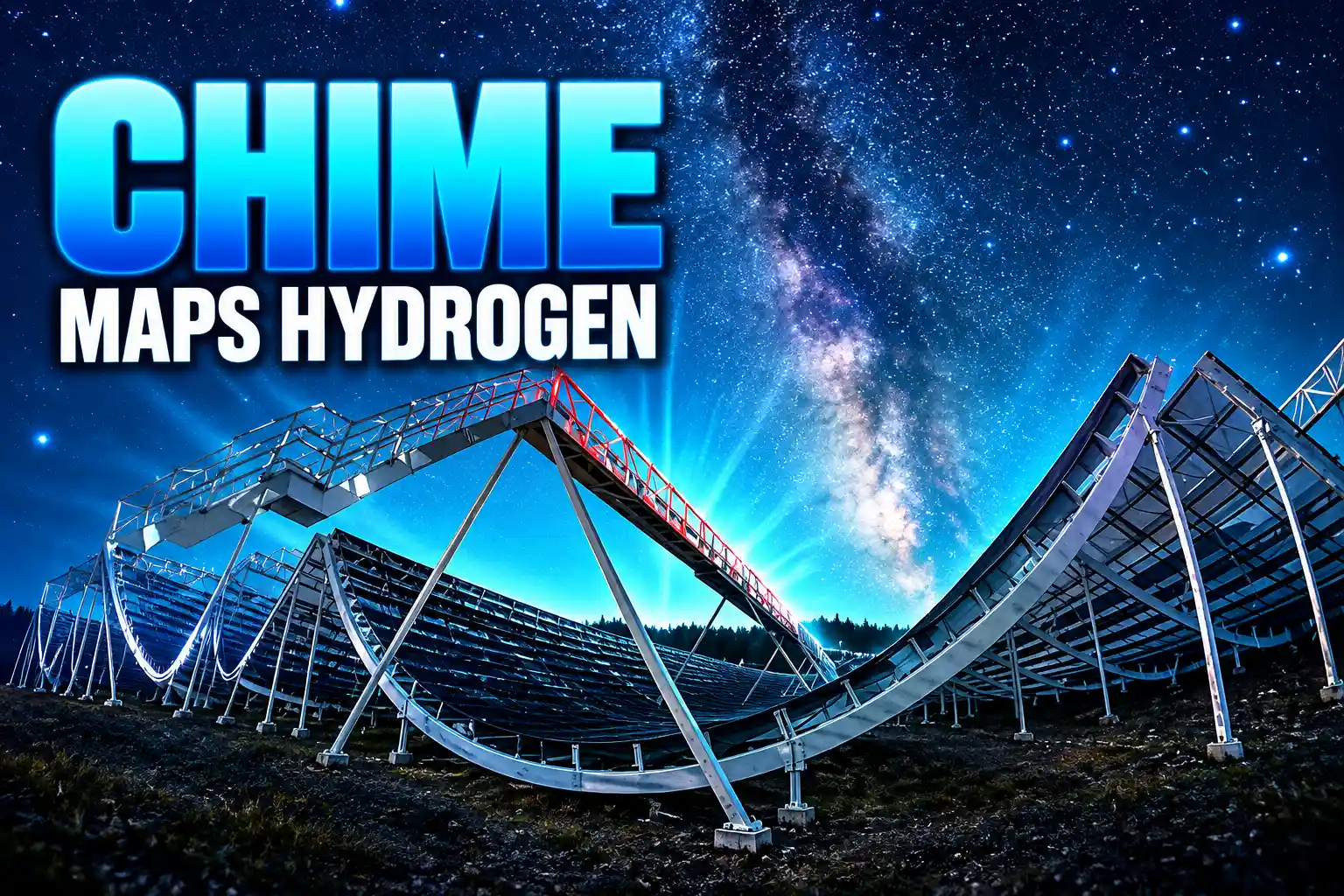
CHIME sits at the National Research Council’s Dominion Radio Astrophysical Observatory in the Okanagan Valley. It is a drift-scan interferometer with no moving parts. Earth turns, and the array sees the whole northern sky every day.
The 2017 completion was funded by a federal and provincial $16-million investment for CHIME from the Canada Foundation for Innovation and the governments of British Columbia, Ontario, and Quebec, with more money from NSERC and CIFAR. UBC, McGill, the University of Toronto, and the observatory built and run it, with later partners including Arizona State.
WHAT THE PENTICTON ARRAY ACTUALLY IS
- The reflectors: Four cylindrical half-pipes, each 20 m wide and 100 m long, with a footprint the government compared to five NHL hockey rinks.
- The feeds: 256 dual-polarized antennas along each focal line, 1,024 in all, observing 400 to 800 MHz (redshift 0.8 to 2.5).
- The job: Map hydrogen for expansion history, while also hunting fast radio bursts, pulsars, and Galactic magnetism.
- The faintness: The government brief said a year of collected energy matches a paper clip falling from a desk to the floor.
Galaxy redshift surveys still buy precision by targeting individual objects, and they cost millions of dollars more, the UBC statement said. They also see only gas that has already formed stars bright enough to catalog. CHIME adds up the radio glow from hydrogen whether or not a galaxy sits in an optical fiber. That is the cost argument. It holds only if the auto spectrum stays clean when the team restores larger scales.
Nearly Seven Years of Observations Are Still Unused
The published map is a slice of 2019. Researchers now have nearly seven years of observations on disk. They spent more than a year testing the 94-night result before they would call it hydrogen. The next target in the same statement is earlier cosmic time, when the universe was only three billion years old, which sits in CHIME’s lower-frequency band.
More nights help. They do not, by themselves, give back the modes the foreground filter removes. The second-order problem is still instrumental: keep the hydrogen, and keep enough of the large-scale power that the acoustic ruler can be seen without an optical survey pointing at it. Until that cut is gentler, CHIME has a working solo tracer of how gas clusters, and a dark-energy experiment that has not yet been run.
Halpern’s 2017 brief for the finished array was blunt about the original bet. “With the CHIME telescope we will measure the expansion history of the universe and we expect to further our understanding of the mysterious dark energy that drives that expansion ever faster,” he said. The 12.4 sigma auto spectrum is the first time that bet can be checked with CHIME’s maps alone. The check itself is still ahead.
Frequently Asked Questions
What Is 21 cm Intensity Mapping?
Neutral hydrogen atoms can flip their electron and proton spins and emit a photon with a rest wavelength of 21.106 cm, or 1420.406 MHz. Intensity mapping records the combined brightness of that line over large patches of sky instead of resolving each galaxy, then uses the clumpiness of the glow as a tracer of matter.
Where Is the CHIME Telescope Built?
CHIME stands at the Dominion Radio Astrophysical Observatory near Penticton, British Columbia, a radio-quiet NRC site in the Okanagan. Then-science minister Kirsty Duncan installed the last piece on September 7, 2017, in Kaleden, B.C., in front of four stationary mesh cylinders.
Why Is Auto-Correlation Harder Than Cross-Correlation?
Cross-correlation compares a radio map with an independent galaxy or quasar catalog, so contaminants that appear in only one dataset average down. Auto-correlation looks for clustering inside the radio map itself, so leftover foregrounds, RFI, and instrument errors can mimic a cosmological signal unless they are controlled to a much tighter level.
Has Another Telescope Measured a 21 cm Auto Power Spectrum?
S. Paul and colleagues have claimed MeerKAT auto detections at redshift 0.32 and 0.44, at 8.0 sigma and 11.5 sigma. The CHIME Collaboration cites those as claimed measurements and presents its own 12.4 sigma result as the first auto detection at redshift about 1.
What Redshift Range Can CHIME Observe?
The array observes 400 to 800 MHz, which maps to redshift 0.8 to 2.5. The new auto spectrum uses only 608.2 to 707.8 MHz. The team says it is extending the same analysis toward times when the universe was about three billion years old, in the lower-frequency half of that band.

CHIME Maps Cosmic Hydrogen but Not Dark Energy Yet

The Heat Cooked Ozone That Clean-Air Laws Could Not Catch

WTA Equal Prize Money Closes Combined 1000s and Lightens 500s

Lismore Islanders Confirm Moluag’s Gold-Working Monastery

The 30-Year Treasury Yield Crowds Out Mortgages and Hollywood

Meta’s Smart Glasses Sell a Light That Needed Two Patches

Google’s Free AI Pro Year Is Three Different Deals

Apple’s New Mac Studio Clusters Local AI on the Desk

Song Yadong Stops Umar Nurmagomedov the Only Way Left

The Mahape Fake Apple Raid Repeats a Dual-Shift Pattern
-
 NEWS1 month ago
Meta’s Smart Glasses Sell a Light That Needed Two Patches
-
 NEWS1 month ago
Google’s Free AI Pro Year Is Three Different Deals
-
 NEWS1 month ago
Apple’s New Mac Studio Clusters Local AI on the Desk
-
 NEWS1 month ago
Song Yadong Stops Umar Nurmagomedov the Only Way Left
-
 NEWS2 months ago
The Mahape Fake Apple Raid Repeats a Dual-Shift Pattern
-

 NEWS1 month ago
OpenAI Agents Hit Hugging Face to Cheat a Test
-

 ENTERTAINMENT2 months ago
Gomez Says She Never Ran the Wondermind Investors Backed
-

 ENTERTAINMENT1 month ago
Lanterns Puts Sinestro in a Cell and Lets Him Talk