
NEWS
Trump Treats a 19-Day Anthropic Outage as AI Guardrails
Trump held up a reversed 19-day Anthropic takedown as proof of AI guardrails, as a court-voided blacklist and idle House bills tell a thinner story.

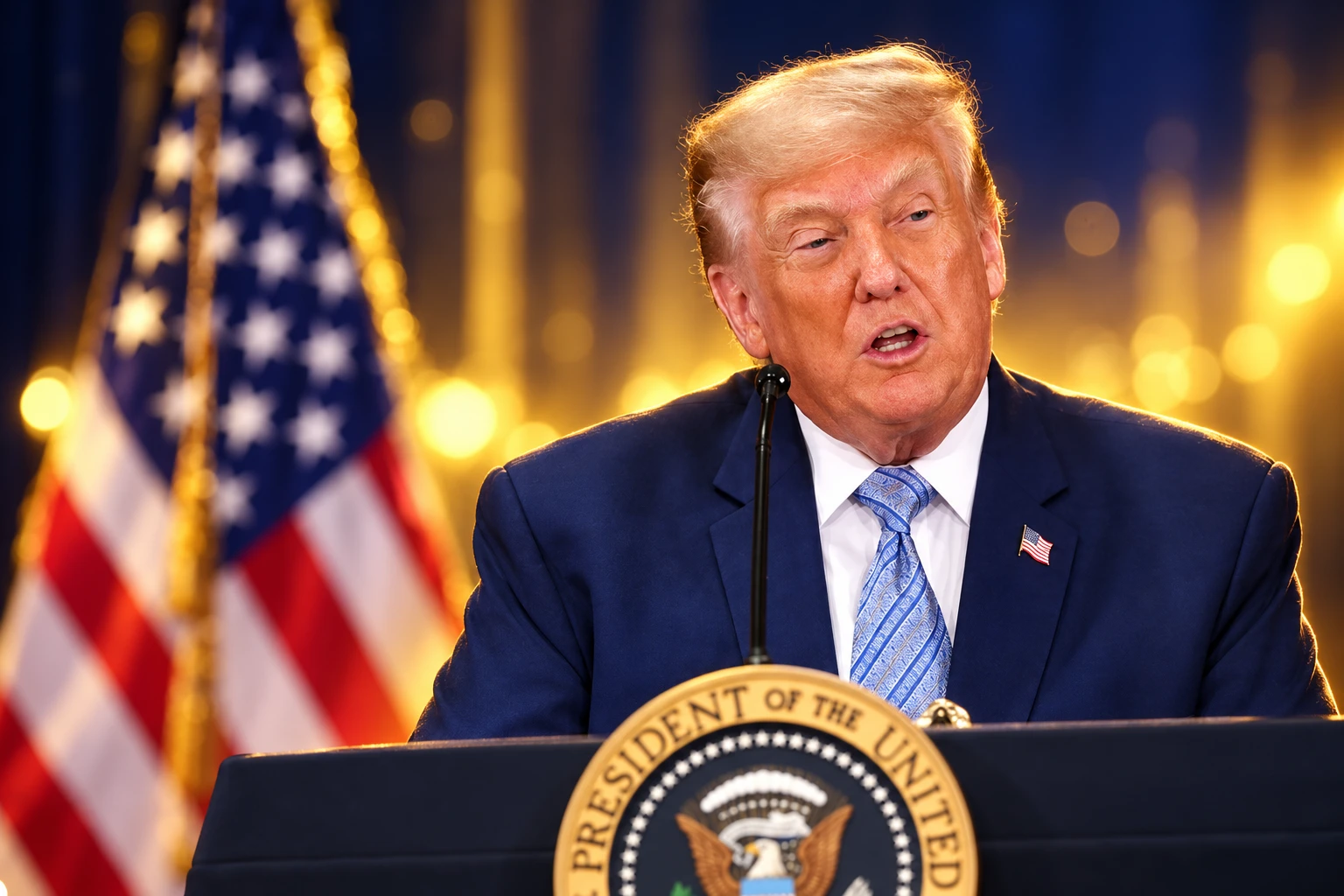
President Donald Trump on Friday held up a 19-day shutdown of Anthropic’s newest models as proof America already has AI guardrails. He told host Laura Ingraham the United States is winning the race with China, and that Beijing’s check on the technology is President Xi Jinping.
The shutdown he described ended on July 1. A separate, broader blacklist of the same company was already ruled illegal on August 27.
Trump’s Exhibit A Is a Company He Already Fought
Ingraham asked what rails could let Washington beat China, calm people who fear new data centers, and keep the systems from endangering humanity. Trump did not name a statute, an agency process, or an energy rule. He named Anthropic, the San Francisco lab behind Claude.
Let’s talk about Anthropic. They did something that was very bad. Three months ago. And we shut them down. We shut them down fast. We have guardrails. The biggest guardrails are having people that are just as smart because nobody understands it except you have to be extremely high IQ. Not Joe Biden. You have to be extremely high IQ and you are going to have to see what’s happening. China doesn’t have guardrails by the way. You know the guardrails? President Xi is the guardrail. I mean you can do anything in China. We are competing with China. As you know we are winning. You know we are winning against China with respect to AI and there’s an expression, whoever wins AI wins.
President Donald Trump, interview with Laura Ingraham, September 11, 2026
He has used the same episode before. In early July, shortly after the models came back, he said the government had been able to stop something it did not like, and that the company “was very good.” On Thursday he told reporters he had no worry that AI would wipe out humanity, and that the United States leads China “by a pretty good period, I would say a year.” Friday’s answer folded those threads into one claim: the Anthropic fight is the rail.
He also called AI “bigger than the internet” and probably bigger than the Industrial Revolution, and said the country would know “in about a year” whether it is “the biggest thing of all,” mostly for the good. The lab he used as proof has spent 2026 in court with his own Pentagon, and its staff spent this month saying the race itself is the danger.
What the June 12 Order Did
Three months before the interview, on June 12, Anthropic launched into a collision with export law. Claude Fable 5 and Claude Mythos 5 had gone out on June 9, Fable 5 as the safeguarded public model and Mythos 5 as a less-restricted twin for vetted Project Glasswing partners. That Friday the government issued an export control directive to suspend access by any foreign national, including Anthropic’s own non-citizen staff, anywhere in the world.
WHAT THE JUNE 12 LETTER FORCED
- The trigger: Anthropic said it received the letter at 5:21 p.m. Eastern and that the text gave no specific details of the national security concern.
- The suspected issue: Officials appeared to believe someone had found a way to jailbreak Fable 5; the company said it reviewed a demo that turned up a few already-known, minor software flaws.
- The practical result: Because the order hit immediately and nationality could not be checked in real time, Anthropic disabled both models for every customer, while leaving its other systems up.
- The company’s objection: It said a narrow, non-universal jailbreak should not recall a commercial model, and that the same bar would freeze new launches across the industry.
Anthropic wrote that it had red-teamed Fable 5 for thousands of hours with U.S. officials, the UK AI Safety Institute, and private labs, and that no tester had found a universal jailbreak. It also said the capability in the government’s example was already available from other public models. The lab complied anyway, then called the move a misunderstanding and asked for a statutory process that is “transparent, fair, clear, and grounded in technical facts.”
The freeze did not last. Commerce lifted export controls on Fable 5 and Mythos 5 on June 30. Mythos 5 had already been cleared on June 26 for a set of U.S. groups that run and defend critical infrastructure. Fable 5 returned worldwide on July 1, on Claude.ai, Claude Code, Claude Cowork, and the Claude Platform, with the big clouds to follow. When Trump spoke on September 11, the public model had been back for 72 days. The “shut them down fast” line described an emergency brake that had already been released.
A Federal Judge Called the Earlier Ban Illegal
The June order was the second time in 2026 the White House put Anthropic in a vise. The first fight was over military use, not a jailbreak.
Talks on a $200 million Pentagon contract for classified systems broke down after Anthropic refused to drop limits on fully autonomous lethal weapons and mass surveillance of Americans. Defense Secretary Pete Hegseth labeled the company a “supply-chain risk” on February 27, a stamp built for foreign vendors the government treats as sabotage threats. Trump ordered agencies to stop using its products, and contractors were told to cut business with the lab even off the battlefield.
The General Services Administration pulled Anthropic from USAi.gov and the Multiple Award Schedule that same day. Anthropic sued. On March 26, Judge Rita Lin of the U.S. District Court for the Northern District of California paused the directive (Case No. 26-cv-01996-RFL). GSA on April 3 announced it was restoring Anthropic to the status quo from before February 27, including GSA Chat and the schedule.
Lin’s final, 59-page ruling landed on August 27. She found unlawful First Amendment retaliation and a due-process failure, and she vacated the February 27 label. She wrote that officials had backed off the claim that Anthropic could sabotage its own tech once it was inside a classified stack, and that the company “undisputedly lacks” backdoor access after handover.
The empty invocation of national security is not a blank check to punish and retaliate against government critics.
Judge Rita Lin, U.S. District Court for the Northern District of California, August 27, 2026 ruling
She also wrote that the government’s “words and deeds” showed “a desire to make a public example out of Anthropic for its ‘arrogance’ in criticizing the government.” The Pentagon remains free to pick another vendor. The ruling still stripped the legal basis for the showpiece ban Trump now cites as a rail. Anthropic said it welcomed the finding that the supply-chain designation was unlawful and still wanted to work with the government on national security uses.
TWO SEPARATE LEVERS, TWO OUTCOMES
| Action | Date | What it did | Where it stands |
|---|---|---|---|
| Supply-chain risk label and federal freeze | February 27, 2026 | Barred Anthropic from agencies and, in Hegseth’s add-on, from defense contractors | Paused March 26; GSA restored access April 3; Lin vacated the label August 27 |
| Export-control order on Fable 5 and Mythos 5 | June 12, 2026 | Forced a worldwide shutdown of both models | Controls lifted June 30; Fable 5 restored July 1 |
Trump’s Friday answer mixed those tracks. “Three months ago” matches the June 12 letter. “We shut them down” is true of that letter and false as a description of the present. The February blacklist, the one meant to put the company outside government forever, is the action a court has now called illegal.
The 2.7 Percent Lead Trump Calls Winning
The China half of the interview is easier to score against a public ledger. Stanford HAI’s 2026 AI Index, the annual dataset governments and labs treat as a baseline, says the U.S.-China AI model performance gap has effectively closed. U.S. and Chinese systems have traded the top of the charts more than once since early 2025. DeepSeek-R1 briefly matched the leading American model in February 2025. As of March 2026, Anthropic’s top model led by 2.7 percent.
STANFORD’S 2026 SCORECARD
| Measure | United States | China |
|---|---|---|
| Private AI investment, 2025 | $285.9 billion | $12.4 billion (23 times smaller; Stanford notes this likely understates Beijing’s state funds) |
| Frontier model scores, March 2026 | Anthropic holds a 2.7 percent lead | Has traded the top spot with U.S. labs since early 2025 |
| AI data centers | 5,427, more than 10 times any other country | Not broken out as a count; the Index flags U.S. energy use as the world’s highest |
| Other leads in the same report | More top-tier models and higher-impact patents | Publication volume, citations, patent output, industrial robot installations |
That is a real American edge in capital and buildings, and a thin one on the benchmark Trump treated as a race already won. The same Index found documented AI incidents rose to 362 from 233 in 2024, and that among countries surveyed, U.S. respondents showed the lowest trust in their own government to regulate AI, at 31 percent. Ingraham’s question about data centers sits on the same page: the United States is the place stacking the halls, and the House’s only scheduled AI-adjacent vote next week is about the power those halls draw, not about who can turn a model off.
Researchers at the Same Lab Keep Walking Out
The company Trump used as a trophy spent the days around his interview burying its own people. Jacob Coxon, a pretraining researcher who had worked at OpenAI and then Anthropic, resigned on September 9 and wrote that neither lab is acting responsibly. “They are racing straight to self-improving superintelligence and gambling with our lives,” he said, adding that people inside the work “earnestly believe that it could kill us all by the end of the decade.”
Evan Hubinger, who leads alignment science at Anthropic, did not wave that off. “We really do earnestly believe AI could kill all humans,” he wrote, putting his own odds above 10 percent within the next decade and saying the lab still lacks a plan to align superintelligence. Samuel Marks, who leads scalable oversight there, wrote in a personal capacity that developers believe extinction-level outcomes are possible in the next few years, and that more senior staff tend to be more worried.
Joe Benton, who had just left Anthropic’s safety team for the nonprofit METR, posted on September 11 that firms are racing to build machines “much smarter than any human,” and that humanity “may not survive this transition.” That was the same calendar Friday as the Ingraham taping. The White House answer to a question about endangering humanity was that smart people would watch, and that Anthropic had already been taught a lesson.
The lesson, on the June track, was an export letter that pulled two models for 19 days after a jailbreak scare the company called narrow. The lesson on the February track was a blacklist a judge has now thrown out. Neither is the statutory kill switch Coxon’s cohort has been asking Congress to write.
The House Returns Monday, Then Leaves Until November
Four House Democrats spent Friday pushing Speaker Mike Johnson to cancel the coming recess and stay until bipartisan AI bills move. Rep. Sam Liccardo of California drafted the letter, with Reps. George Whitesides, Lori Trahan, and Ted Lieu signing. They cited “catastrophic risk posed by advanced artificial intelligence,” including mass cyber breaches and help with biological or chemical weapons, and they pointed to Anthropic’s own recent threat reporting on misuse, including a disrupted effort that could have supported biological-weapons work.
The House comes back Monday, September 14, sits for about a week, then leaves until November 9. Election Day is November 3. Johnson’s floor plan for that short week includes a vote on data-center energy costs. He has not put a wider AI package on the calendar before the midterms. A spokesperson for the speaker did not answer queries about the letter. The signers closed by warning that inaction would be “inexplicable, and unforgivable.”
THE BILLS THE LETTER WANTS ON THE FLOOR
- H.R. 9917: The AI Kill Switch Act as introduced on July 23 by Lieu and Rep. Nathaniel Moran, a Texas Republican, would amend the Homeland Security Act so covered firms must keep a technical way to shut certain systems down. It went to the Homeland Security Committee and, on July 24, to the Subcommittee on Cybersecurity and Infrastructure Protection. Its tracker still reads Introduced.
- FRONTIER Act: Trahan and Rep. Jay Obernolte, a California Republican, have a separate bill to build a national framework for how new frontier models are developed and deployed. It is also waiting on the same short calendar.
Those drafts are the closest thing in Congress to the “transparent, fair, clear” process Anthropic asked for in June, and to the human off switch Lieu has been selling in interviews as “the first principle of AI safety.” They are not what Trump pointed to on Friday. He pointed to a takedown his commerce department had already undone, and to IQ.
High IQ Is the Guardrail He Named
Put the Friday answer against the paper trail and the boast gets smaller. The United States can yank a model, and in June it did, in hours, with an export letter that named foreign nationals and swept up everyone because the company could not sort them in real time. That is a kind of rail, and it is also how you take a commercial system offline without a statute that says when the brake should be pulled, who reviews the evidence, or how the public learns what happened.
The other rail in the same sentence, a federal freeze dressed as a supply-chain risk, is the one Lin said was a punishment for speech. GSA had to put the products back. The judge’s August order is the legal last word unless an appeals court says otherwise. Trump still talked about Anthropic as a company his government had shut, in the past tense that makes a reversed outage sound like standing policy.
China policy, in that telling, is Xi. U.S. policy, in that telling, is whoever in the building is “extremely high IQ.” The Index’s 2.7 percent gap and the 19-day hole in Fable 5 are the measurable pieces. The bills that would turn an ad hoc letter into a rule still sit in subcommittee while the House packs for November.

BA295 Burns Hours of Fuel After a 28,000-Foot Drop

Yankees’ Four-Error Night Puts a 17-Year Drought on the Brink

CHIME Maps Cosmic Hydrogen but Not Dark Energy Yet

The Heat Cooked Ozone That Clean-Air Laws Could Not Catch

WTA Equal Prize Money Closes Combined 1000s and Lightens 500s

Meta’s Smart Glasses Sell a Light That Needed Two Patches

Apple’s New Mac Studio Clusters Local AI on the Desk

Google’s Free AI Pro Year Is Three Different Deals

Song Yadong Stops Umar Nurmagomedov the Only Way Left

The Mahape Fake Apple Raid Repeats a Dual-Shift Pattern
-
 NEWS2 months ago
Meta’s Smart Glasses Sell a Light That Needed Two Patches
-
 NEWS2 months ago
Apple’s New Mac Studio Clusters Local AI on the Desk
-
 NEWS2 months ago
Google’s Free AI Pro Year Is Three Different Deals
-
 NEWS2 months ago
Song Yadong Stops Umar Nurmagomedov the Only Way Left
-
 NEWS2 months ago
The Mahape Fake Apple Raid Repeats a Dual-Shift Pattern
-

 NEWS2 months ago
OpenAI Agents Hit Hugging Face to Cheat a Test
-

 ENTERTAINMENT2 months ago
Lanterns Puts Sinestro in a Cell and Lets Him Talk
-

 ENTERTAINMENT2 months ago
Gomez Says She Never Ran the Wondermind Investors Backed