
NEWS
A Tanzania Fossil Shifts the Oldest Dinosaur Clock
A 240-million-year-old Tanzanian dicynodont, Dinodontosaurus isiyavamanda, ties the Manda Beds to younger South American rocks and slides the oldest dinosaur.

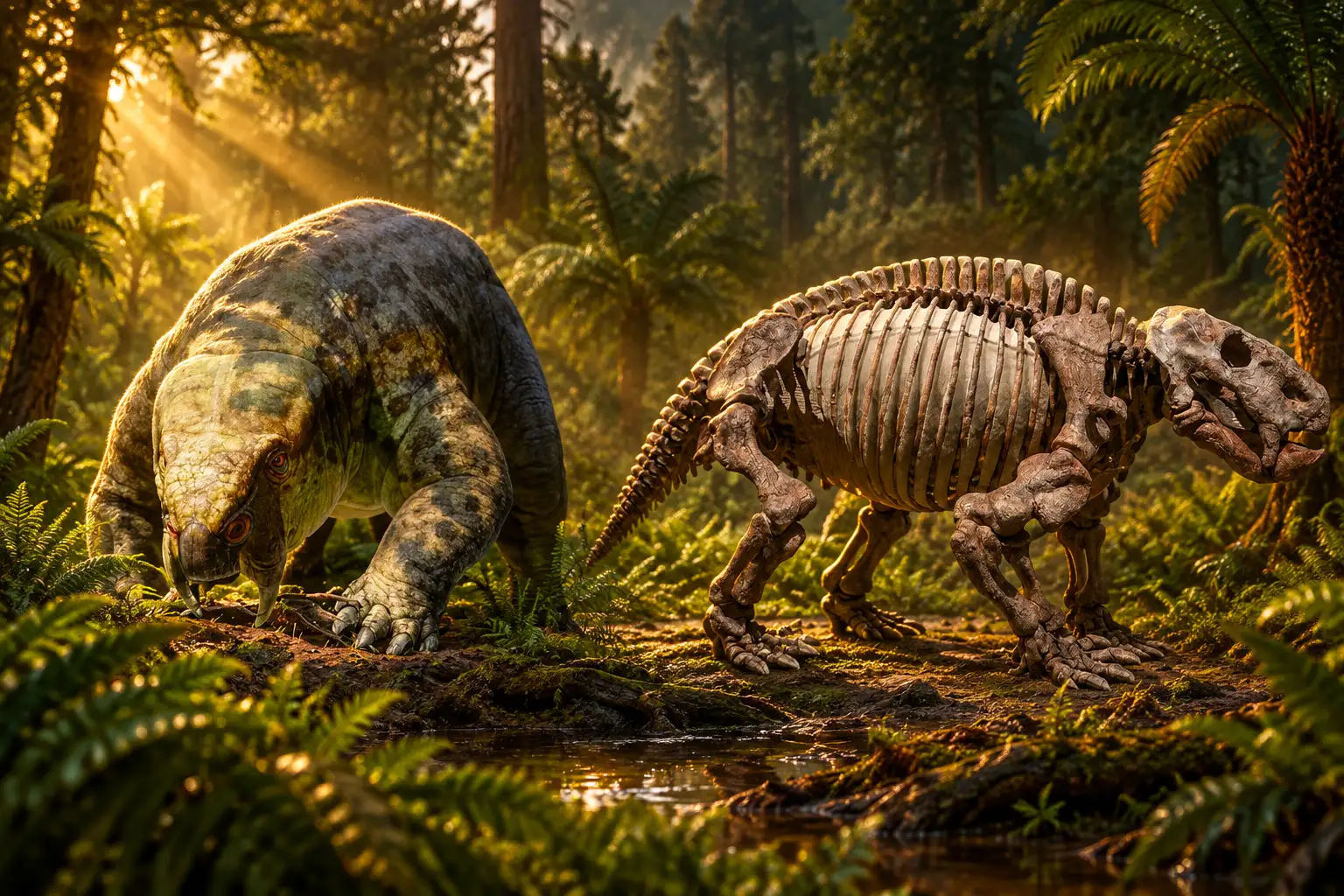
A 240-million-year-old plant-eater from Tanzania, named Dinodontosaurus isiyavamanda, is forcing scientists to treat some of the world’s oldest possible dinosaur fossils as younger than they thought. The species was named on September 16, 2026 in the Journal of Vertebrate Paleontology by a University of Bristol-led team. The animal is a dicynodont, a tusked, beaked plant-eater on the mammal line, and the team says its presence ties Tanzanian rock to South American beds dated up to 10 million years younger than classic South African matches.
That is the part that travels. The new name is real, and so is the skeleton. The clock it is being asked to set belongs to dinosaurs that may never have been as early as the Manda Beds were said to be.
A Tusked Plant-Eater From the Manda Beds
The bones come from the mid-to-upper Lifua Member of the Manda Beds in the Ruhuhu Basin of southern Tanzania. Hady George, a PhD student in Bristol’s School of Earth Sciences and the lead author, said the find is the first confirmed record of the genus Dinodontosaurus outside South America. Until this paper, that genus was a South American animal.
Two specimens carry the new name. The holotype, catalogued as NHMUK PV R 12710 at the Natural History Museum in London, is a skull and partial skeleton collected in 1963. A second skull, NMT RB462, was collected later at locality Z143 and is held in Tanzania. CT scans of the London skull show a bulbous ridge on the palate and a midline groove along the temporal bar, traits the team did not find in the South American material.
Those mouth parts are why the bones are a new species and not a stray D. tener or D. brevirostris. The paper argues the odd palate helped this animal process food in a different way from other large plant-eaters living on the same river plains. Charles B. Saanane of the University of Dar es Salaam is on the author list, as is Juan A. Escobar of CONICET in Buenos Aires, who brought the South American skulls into the comparison.
The species name points to the land of the Wamanda people, who live in the region where the 1963 bones were taken from the ground. The animal lived around 240 million years ago, in the Triassic. It walked on four legs, cut plants with a beak, and kept a pair of tusks in the upper jaw.
The Skeleton Sat Unnamed in London for Decades
The 1963 field season was the British Museum (Natural History)-University of London Joint Paleontological Expedition, led by A. Charig and B. Cox. Synapsid bones from that trip went into London drawers and were only partly studied. Some of the associated skull-base pieces were later parked in Shansiodon, a Sino-African genus. The new analysis says this skeleton lacks the traits of Shansiodon and of the other dicynodonts already named from the Manda Beds.
FROM THE RUHUHU BASIN TO A NAME
- 1963: The Charig and Cox expedition collects the associated skeleton from the Manda Beds and sends it to London.
- 1994: Nigel Larkin describes the same bones in an MSc thesis at University College London and uses the unpublished name Ruhuhuungualasaurus croucheri.
- 2004: Skull-base bones filed under the same catalog number are referred to Shansiodon, a label later treated as uncertain.
- September 16, 2026: The skeleton is published as Dinodontosaurus isiyavamanda, with NMT RB462 referred to the same species.
Larkin, now a visiting research fellow at the University of Reading and a co-author, had already judged the animal new in 1994. The manuscript reached the journal on December 5, 2024 and was accepted on May 14, 2026. Micro-CT and surface scanning did work that a 1990s thesis could not.
I studied this dicynodont skeleton for my MSc thesis at University College London back in 1994 and judged it to be a species new to science, but it took me nearly 30 years to start the process of writing it up for publication.
Nigel Larkin, Visiting Research Fellow, University of Reading, University of Bristol release
Mike Day, curator of non-mammalian tetrapods at the Natural History Museum, said the specimen had been in the museum’s care for over 60 years before it had a usable name. He also said going back through collections can change the past as much as a new dig, which is the unglamorous half of this story. The other half is what the name does to a dinosaur argument.
A South American Genus in Tanzanian Rock
Fossil workers had long matched the mid-to-upper Lifua Member to the Cynognathus Assemblage Zone of South Africa, a Middle Triassic pairing built on shared genera such as Cricodon. That link made the Tanzanian layer look Anisian, and it made anything dinosaur-like in those beds look earlier than the famous South American record.
Dinodontosaurus breaks that pairing. The genus is at home in the Dinodontosaurus Assemblage Zone of Brazil and in the Chañares Formation of Argentina. Finding it in Tanzania, the team writes, means the mid-to-upper Lifua Member was laid down at about the same time as those South American units, not with the older South African zone.
Our discovery marks the first confirmed record of the genus Dinodontosaurus outside South America. The finding links the Tanzanian and South American fossil-bearing rocks, showing they are of equivalent age. This helps confirm that the oldest dinosaur candidates from Tanzania are probably no older than those from South America, refining the timeline of dinosaur origins.
Hady George, PhD student, University of Bristol, Journal of Vertebrate Paleontology study
The continents were still joined, so a South American genus in East Africa is not a miracle crossing. It is a time mark. The paper’s own title calls that mark younger age for alleged oldest dinosaurs, and the Bristol release is blunter: Tanzanian Triassic rocks can no longer be treated as the ones that hold the oldest possible dinosaur fossils.
One honest limit sits under that sentence. Nobody on this team dated a Tanzanian zircon. They borrowed a clock from beds that already have one, and they did it with a genus. If Dinodontosaurus lived for longer than the South American dates imply, the Tanzanian layer could still be older. The paper treats the overlap as tight enough to move the age.
What Happens to the Oldest Dinosaur Claim?
The fossil in the firing line is Nyasasaurus parringtoni, named from the Lifua Member. A 2013 study in Biology Letters presented it as the earliest dinosaur or its sister taxon, and argued that the first dinosaur radiation may have started perhaps 15 million years earlier than the South American skeletons suggested. The holotype is a right humerus and several vertebrae, not a complete animal, and that thin record is why the “oldest dinosaur” line was always a claim with an asterisk.
If the mid-to-upper Lifua Member is late Ladinian to Carnian, Nyasasaurus does not vanish. It loses the long head start that made it famous. The same layer also holds Asilisaurus, a silesaurid close to dinosaurs, and a wider set of archosaurs. Those animals would then sit nearer in time to the early dinosaurs of Argentina, not 10 or 15 million years in front of them.
WHAT WE KNOW
- The bones: Nyasasaurus comes from the same Lifua Member that produced the new dicynodont, and its 2013 description left it as a dinosaur or the closest sister.
- The new clock: The Bristol team says that layer matches South American beds, so the Tanzanian candidates are probably no older than the South American ones.
- The method: The shift rests on a shared genus, not on a new radioisotopic date from Tanzania.
WHAT IS UNCONFIRMED
- Dinosaur identity: The 2013 paper did not close whether Nyasasaurus sits inside Dinosauria or just outside it.
- A Tanzanian lab date: The Manda Beds still lack the kind of published zircon ages that pin Chañares to the early Carnian.
- How long the genus lived: A longer range for Dinodontosaurus would loosen the tie between Tanzania and the South American dates.
That last gap is why this paper reads as a second blow, not a first one. Dating work in Argentina had already pulled dinosaur-precursor beds younger. The Tanzanian species is how that younger clock gets applied to the African side of the old map.
Late Ladinian to Carnian, Not Anisian
Historic charts put the mid-to-upper Lifua Member in the Anisian, 247-242 million years ago. The new paper assigns it to the late Ladinian to Carnian, 242-227 million years ago. The round figure of around 240 million years used in the Bristol release sits inside that window.
The hard numbers on the South American side come from earlier lab work. Claudia Marsicano, Randall Irmis and colleagues published high-precision ages for the Chañares Formation in 2016, using U-Pb zircon dates that put the classic dinosaur-precursor assemblage at 236-234 million years ago, in the early Carnian. That was 5 to 10 million years younger than the Middle Triassic age those rocks had been given from fossil matching. The same study noted that Tanzanian sequences, including the Manda Beds, had no published radioisotopic dates and were hanging on vertebrate correlations with South Africa.
HOW THE ROCK CLOCK SHIFTED
| Rock unit | Historic assignment | Age now argued |
|---|---|---|
| Mid-to-upper Lifua Member, Tanzania | Anisian, 247-242 million years | Late Ladinian to Carnian, 242-227 million years |
| Chañares Formation, Argentina | Middle Triassic by fossil matching | Early Carnian, 236-234 million years |
| Cynognathus Assemblage Zone, South Africa | Matched to the Manda Beds | No longer treated as the same age as the Tanzanian layer |
| Dinodontosaurus Assemblage Zone, Brazil | South American only | Tied to the mid-to-upper Lifua Member |
Marsicano’s group also argued that dinosaurs originated in a window of less than 5 million years and only later became the main large animals at mid to high latitudes, closer to the Triassic-Jurassic boundary. If the Manda Beds move into the late Ladinian-Carnian, the African “first dinosaurs” stop sitting far in front of that window. They fall into it.
The team’s own wording is careful on the next step. Future work, they write, should use this younger age for the mid-to-upper Lifua Member when people chase the origins of major Mesozoic groups, including dinosaurs. That is a instruction to other labs, not a new Tanzanian date.
Several Big Herbivores Shared One Floodplain
The Lifua Member was already crowded with kannemeyeriiform dicynodonts before this species was named. The new palate is the team’s way of explaining how so many large plant-eaters could feed on the same floodplains without one type wiping the others out. The rest of the Tanzanian Dinodontosaurus skeleton, especially the bones behind the skull, is still largely undescribed, and that is where gait, stance and feeding will get tested.
LARGE PLANTEATERS ALREADY NAMED FROM THE MANDA BEDS
- Tetragonias: The first dicynodont named from the mid-to-upper Lifua Member, originally published as “Dicynodon” njalilus.
- Angonisaurus cruickshanki: A kannemeyeriiform from the same layer, long used in correlations with South Africa.
- Sangusaurus parringtonii: A stahleckeriid, another heavy plant-eater in the mid-to-upper Lifua Member.
- Dolichuranus: Known from the lower Lifua Member, a slightly older slice of the same formation.
- Dinodontosaurus isiyavamanda: The South American genus, now in Tanzania, with a palate the team links to a different way of processing food.
George said later projects will go back through the remaining bones and look at how Triassic dicynodonts moved and fed. Comparison with South American Dinodontosaurus is next, because the Tanzanian skull is already the proof of contact. The postcranial skeleton is the part that can show whether the African animal walked and cropped like its Brazilian and Argentine cousins, or whether the shared genus name is hiding different bodies.
Most of the Tanzanian Dinodontosaurus skeleton behind the skull has yet to be described. The Manda Beds still lack a published zircon date of their own.
Frequently Asked Questions
What Does the Name Dinodontosaurus Isiyavamanda Mean?
Isiyavamanda refers to the land of the Wamanda people, who inhabit the part of Tanzania where the 1963 skeleton was collected. In 1994 Nigel Larkin used Ruhuhuungualasaurus croucheri in an unpublished master’s thesis; that label was never validly published, so it has no standing, and the official name is the 2026 one.
What Is a Dicynodont?
Dicynodonts were synapsids on the line that leads to mammals, not dinosaurs. Most species had a horn-covered beak and a pair of tusks, and they were among the most common large plant-eaters on land from the late Permian through the Triassic.
How Did the Chañares Formation Get a Firm Date?
Marsicano and colleagues used chemical abrasion thermal ionization mass spectrometry on zircon crystals from volcanic beds that sit against the main fossil layer, giving maximum ages of 236 million years at the base of that layer and 235-234 million years above it, which places the assemblage in the early Carnian.
When Did Dinosaurs Become the Main Large Land Animals?
The 2016 Chañares dating study found that after dinosaurs originated they only gradually dominated mid- to high-latitude ecosystems, with that takeover falling millions of years later and closer to the Triassic-Jurassic boundary rather than at the first appearance of the group.

BA295 Burns Hours of Fuel After a 28,000-Foot Drop

Yankees’ Four-Error Night Puts a 17-Year Drought on the Brink

CHIME Maps Cosmic Hydrogen but Not Dark Energy Yet

The Heat Cooked Ozone That Clean-Air Laws Could Not Catch

WTA Equal Prize Money Closes Combined 1000s and Lightens 500s

Meta’s Smart Glasses Sell a Light That Needed Two Patches

Apple’s New Mac Studio Clusters Local AI on the Desk

Google’s Free AI Pro Year Is Three Different Deals

Song Yadong Stops Umar Nurmagomedov the Only Way Left

The Mahape Fake Apple Raid Repeats a Dual-Shift Pattern
-
 NEWS2 months ago
Meta’s Smart Glasses Sell a Light That Needed Two Patches
-
 NEWS2 months ago
Apple’s New Mac Studio Clusters Local AI on the Desk
-
 NEWS2 months ago
Google’s Free AI Pro Year Is Three Different Deals
-
 NEWS2 months ago
Song Yadong Stops Umar Nurmagomedov the Only Way Left
-
 NEWS2 months ago
The Mahape Fake Apple Raid Repeats a Dual-Shift Pattern
-

 ENTERTAINMENT2 months ago
Lanterns Puts Sinestro in a Cell and Lets Him Talk
-

 NEWS2 months ago
OpenAI Agents Hit Hugging Face to Cheat a Test
-

 ENTERTAINMENT2 months ago
Gomez Says She Never Ran the Wondermind Investors Backed