
NEWS
Luminescence Dating Puts South Dakota Mammoths in a Deeper Ice Age
Feldspar dating moves South Dakota’s Mammoth Site out of the last ice age and into a poorly dated Great Plains climate chapter.

New feldspar dates put South Dakota’s Mammoth Site at 160,000 to 232,000 years old, more than 100,000 years older than bone radiocarbon had implied. The paper, posted 11 August 2026 in Quaternary Research, moves the Hot Springs sinkhole out of the last ice age and into Marine Isotope Stages 6 and 7.
That shift changes what the bones can say about the Black Hills. It also leaves the bottom third of the trap unread, because the museum over the pit has nowhere to store another haul of megafauna.
Apatite Dates That Groundwater Could Rewrite
Jim I. Mead, an emeritus researcher at the Mammoth Site and the University of Arizona, had not trusted the young ages for years. He had worked as a graduate student in Arizona’s radiocarbon lab, and the numbers from bone mineral, called apatite, looked off for a wet spring setting.
“I have always wanted to get a different chronology method to date the site,” Mead said, “and a decade later here we are.”
The bones had no collagen, the protein labs prefer for radiocarbon, so earlier crews dated apatite instead. Six calibrated results ran from about 42,000 to 23,000 years ago, and the round figure of 26,000 years became the story visitors heard. Uranium-series ages on mammoth tooth enamel, about 129,000 and 150,000 years, and a thermoluminescence age on sediment of about 101,000 years already pointed the other way.
DATING METHODS AT THE MAMMOTH SITE
| Method | What was dated | Age |
|---|---|---|
| Radiocarbon | Mammoth bone apatite and carbonate | 42,000 to 23,000 years |
| Uranium-series | Mammoth tooth enamel | About 129,000 and 150,000 years |
| Thermoluminescence | Phase II west sediment | About 101,000 years |
| IRSL on feldspar | Sinkhole sand in the bone bed | 160,000 to 232,000 years |
Emma T. Krolczyk, a U.S. Geological Survey geologist and a co-author, said old carbon in apatite can dissolve and recrystallize with new carbon from groundwater. “This essentially resets the radiocarbon signal,” she said. In a karst spring, that reset is not a rare glitch. It is what the water does.
Quartz Hit Its Limit, Feldspar Did Not
With the bones in conflict, the team dated the sand around them. Luminescence asks when mineral grains last saw daylight. Buried grains soak up radiation from uranium, thorium, rubidium, potassium, and cosmic rays; sunlight resets the mineral grain clock. The USGS luminescence lab writes the age as equivalent dose divided by dose rate.
Shannon A. Mahan, a USGS research geologist who led the work, sampled inside the building that now roofs the dig, using metal tubes near the laminated center of the hole. Quartz, the usual target, was already full. It could give only a minimum of about 75,000 years. The crew switched to potassium feldspar and used infrared-stimulated luminescence, including a post-infrared protocol built to limit fading.
Splits went to two labs and came back in agreement. The paper reports infrared-stimulated luminescence ages on feldspar from about 232,000 years near the base of the present excavation to about 160,000 years near the top. Sample MS-16-6, the oldest, is 232,000 years plus or minus 23,000. Sample MS-16-2, near the top, is 159,000 years plus or minus 21,000. The grains look well bleached, washed in as sandy-silt couplets from the pond margin rather than dumped in the dark.
THE FELSPAR SAMPLE SET
- Bone-bed tubes: Six sinkhole samples carry the new ages.
- Terrace checks: Three samples on two lower Fall River terraces date far younger ground.
- Lab split: Two laboratories returned matching feldspar results.
- Quartz ceiling: Saturated quartz only proved the sand is older than 75,000 years.
Terrace T2, down in town, is about 30,000 years by luminescence and radiocarbon. Terrace T3 is about 65,000 years. The Mammoth Site sits on T4, the high bench, about 70 meters above the Fall River at 1,088 meters elevation. The young terraces are not a second guess at the bone bed. They show the hole is stranded above the modern river, on an older step of the valley.
What a 160,000-Year Shift Does to the Black Hills Record
The last ice age, in marine isotope language, is MIS 2 and MIS 3. That is where the apatite dates had parked the trap, a short window near the Last Glacial Maximum, when the Laurentide Ice Sheet stood along the Missouri River about 326 kilometers away. The Black Hills themselves were never glaciated. They still sat in cold, dry air on the ice sheet’s front porch.
The feldspar ages put the sediments span MIS 6 and MIS 7, the penultimate glacial and the interglacial that came before it, known in North America as the Illinoian and the warm interval that preceded it. A USGS data release on the same campaign says the hole dried, cemented, and filled by the start of MIS 5, after that older glacial maximum. Christopher N. Jass, curator of Quaternary paleontology at the Royal Alberta Museum and principal investigator at the site, said the stack now looks like a long warm stretch and a long cold stretch, not a brief last-ice-age accident.
The sedimentary sequence appears to include both an extensive, warmer, interglacial period and an extensive, cooler glacial period. We previously estimated a much shorter timeframe in which mammoths would have been trapped. We now suspect the deposit spans interglacial and glacial time.
Christopher N. Jass, principal investigator, The Mammoth Site
Most North American mammoth sites that have tight dates are younger than 30,000 years. The paper notes that Columbian mammoth form in some populations was already in place between about 255,000 and 130,000 years ago, so the new ages fit the animals as well as the sand. What they do not fit is the old visitor script, which still treats the sinkhole as a last-ice-age death trap. That script was easy to tell. It was also the wrong chapter.
One Sample, 40,000 Years Out of Line
Sample MS-16-4, taken near the middle of the section, came back at 131,000 years plus or minus 13,000, roughly 40,000 years younger than the sand around it. Paul R. Hanson of the University of Nebraska-Lincoln, a co-author, said several processes could shave an age, and pinning one is hard.
“There is a good reason that we don’t rely on just one or two ages, but instead want to see the variability in age estimates for at least five or so sites in the sediments,” Hanson said. The team wants uranium-thorium dates as a check. Until those exist, the 131,000-year tube is an outlier in a six-sample stack, not a second official age for the site.
WHAT WE KNOW
- The working range: Five feldspar ages place the bone bed at 160,000 to 232,000 years.
- The match: Two labs dated splits the same way, and most ages sit in stratigraphic order.
- The quartz floor: Saturated quartz independently requires an age older than 75,000 years.
WHAT IS UNCONFIRMED
- The middle tube: MS-16-4 at 131,000 years has no single agreed cause.
- Uranium-thorium: A planned enamel and bone check has not yet tested the feldspar range.
- The unread floor: The bottom third of the sinkhole has not been dug.
A single young grain population can come from mixing, incomplete bleaching, or later water moving sand. Hanson is not picking a favorite. The paper’s claim rests on the cluster, not on the stray.
Hot Springs Built a Museum Over an Unfinished Trap
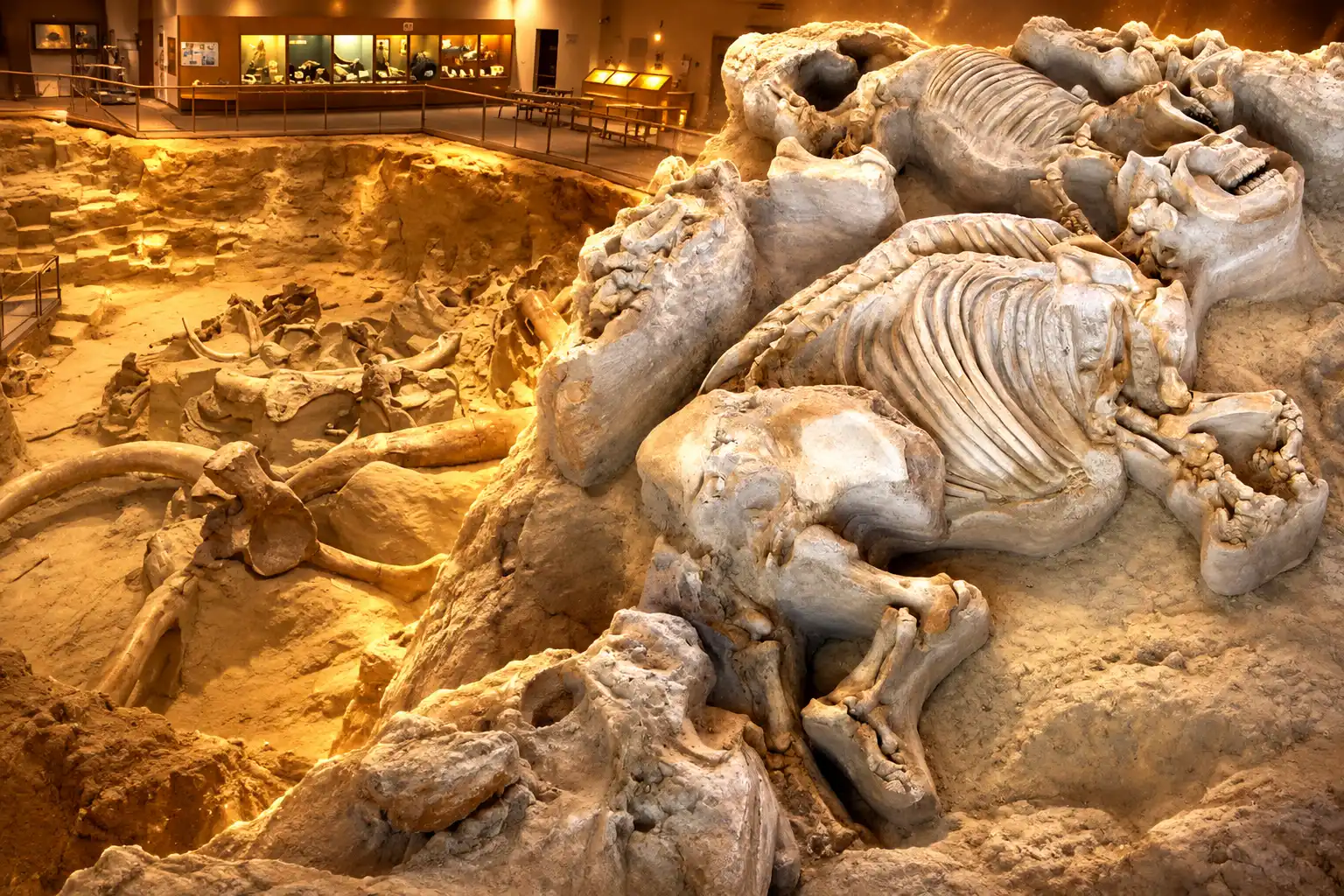
The hole opened in 1974 when a housing cut on the southwest side of Hot Springs hit tusks. Larry D. Agenbroad, then at Northern Arizona University, and Mead started pulling bones the same year. Community leaders later bought the ground and put a building over it, so the bone bed stayed where it died. That choice is why Mahan could date the sand at all. Dig-and-display sites rarely leave the sediment clock intact.
Jass put the paper on X the day it posted, with a line that did not oversell the math.
It's older than we thought!
Age reassignment using luminescence dating for The Mammoth Site, Black Hills, South Dakota, USA | Quaternary Research | Cambridge Core – https://t.co/Br5hzRmbZN
— Chris Jass (@jasscn) August 11, 2026
Mahan has said sampling days inside the museum were a running class. Visitors walked up, asked what the tubes were for, and got an answer that did not depend on who they were. “It was the purest form of science education because it did not matter what that person’s religion was, what their political affiliation was, or even their educational level,” she said.
HOW THE SITE’S AGE KEPT MOVING
- 1974: Construction work in Hot Springs exposes mammoth tusks and stops a housing project.
- 1975: Agenbroad and Mead return for a full digging season on the sinkhole.
- 2016: USGS crews drive metal tubes into laminated sand inside the museum.
- August 11, 2026: Quaternary Research posts the feldspar ages that reassign the bed.
The trap itself was a collapse over a breccia pipe in karst, fed by warm artesian water. The paper and earlier site work describe a steep-sided pond about 4 to 5 meters deep (13 to 16 feet) and about 90 to 95 degrees Fahrenheit (32 to 35 degrees Celsius). Slick walls left little chance of climbing out. The bone-bearing fill that has been studied is about 6 meters thick. The lowest third is still in the ground.
Jass has said the delay is storage, not curiosity. The museum has no room for another season of skulls, and the crew will not lift bones it cannot house. “I suspect we’ll find more mammoths, but we could also find other extinct megafauna,” he said. “We won’t know until we look!”
The New Dates Open a Deeper Faunal Record
The official count is more than 60 mammoths still in place, the largest Columbian concentration in North America, mostly young males, with at least two woolly mammoths mixed in. The same hole has held a giant short-faced bear, a North American camel, a wolf, and a coyote. Other Ice Age mammals are in the collection. The warm pool was a magnet, then a pit.
ANIMALS TIED TO THE SINKHOLE
- Columbian mammoths: Most of the more than 60 skeletons, many of them young males.
- Woolly mammoths: At least two, at the southern edge of that species’ usual range.
- Short-faced bear: At least one, sharing the trap with the elephants.
- Camel, wolf, coyote: Other large mammals that went in and did not climb out.
Mead and Jass have said the point of a better age is not a plaque on the wall. “What we want to know is what the environment and evolution of large mammals in the Black Hills were,” they said. “It turns back the pages to a deeper time interval.” In a Mammoth Site news release, Jass called the paper a chance to test old readings because so much of the hole was left in place, bones and sediment together.
Accurate ages are the base for pollen, snails, fish, and bone chemistry that were read as last-ice-age evidence. Those proxies now describe a longer, older Black Hills, including a full glacial-interglacial swing the 26,000-year story never had room for. The unread floor may hold more of that swing, or a different fauna entirely. Until there is shelf space, the deepest page stays under the walkway.
Frequently Asked Questions
How does infrared-stimulated luminescence dating work on sinkhole sand?
Buried quartz and feldspar store a radiation dose in their crystal lattices; labs evict that dose with light and divide it by the yearly dose rate to get an age. Quartz bleaches in about 10 seconds of direct sun, while the easily reset feldspar infrared signal is gone after about 5 to 10 minutes, which is why well-washed pond-margin sand can be dated if the grains were last bleached at the surface.
Why did radiocarbon dating fail on the mammoth bones?
The fossils lacked collagen, so earlier dates used bone apatite and one bone-carbonate sample, a mineral fraction that in spring water can dissolve and recement with younger carbon. That is why six apatite and carbonate results clustered between 42,000 and 23,000 years while enamel uranium-series and sediment luminescence sat more than 100,000 years older.
When was the Mammoth Site in Hot Springs discovered?
In 1974 a construction crew leveling ground for housing on the southwest side of town hit large bones later identified as mammoth tusks, and landowner decisions plus work by Larry Agenbroad and Jim Mead converted the lot into an in-place museum rather than a subdivision.
What is the difference between Columbian and woolly mammoths at the site?
Columbian mammoths, Mammuthus columbi, dominate the bone bed and are the larger, less heavily furred form of the Great Plains; woolly mammoths are present in at least two individuals, and the paper notes that classic Columbian morphology was already reached in some populations by about 255,000 to 130,000 years ago, in range with the new sand ages.
The walkway still crosses sand that has not been opened. Jass’s line stands until someone has a place to put whatever comes up.

BA295 Burns Hours of Fuel After a 28,000-Foot Drop

Yankees’ Four-Error Night Puts a 17-Year Drought on the Brink

CHIME Maps Cosmic Hydrogen but Not Dark Energy Yet

The Heat Cooked Ozone That Clean-Air Laws Could Not Catch

WTA Equal Prize Money Closes Combined 1000s and Lightens 500s

Meta’s Smart Glasses Sell a Light That Needed Two Patches

Apple’s New Mac Studio Clusters Local AI on the Desk

Google’s Free AI Pro Year Is Three Different Deals

Song Yadong Stops Umar Nurmagomedov the Only Way Left

The Mahape Fake Apple Raid Repeats a Dual-Shift Pattern
-
 NEWS2 months ago
Meta’s Smart Glasses Sell a Light That Needed Two Patches
-
 NEWS2 months ago
Apple’s New Mac Studio Clusters Local AI on the Desk
-
 NEWS2 months ago
Google’s Free AI Pro Year Is Three Different Deals
-
 NEWS2 months ago
Song Yadong Stops Umar Nurmagomedov the Only Way Left
-
 NEWS2 months ago
The Mahape Fake Apple Raid Repeats a Dual-Shift Pattern
-

 ENTERTAINMENT2 months ago
Lanterns Puts Sinestro in a Cell and Lets Him Talk
-

 NEWS2 months ago
OpenAI Agents Hit Hugging Face to Cheat a Test
-

 ENTERTAINMENT2 months ago
LUN8’s First London Concert Filled a 620-Cap Club