
BUSINESS
Poland Turns an EU Pasta Ruling on Food Giants
Poland’s watchdog is using an EU pasta-label ruling to test whether Danone, Mondelez, Nestlé and Unilever mislead shoppers when packs shrink.

Poland’s consumer watchdog opened explanatory proceedings against four manufacturers on 1 September 2026 over shrinkflation. UOKiK is asking whether Danone, Mondelez, Nestlé and Unilever tell shoppers when food, cleaning and personal-care packs get lighter while the box looks the same.
The files are not charges. They rest on an April EU court ruling that a correct weight line on a food pack does not block a case for a misleading commercial practice.
UOKiK Opens Files on Danone, Mondelez, Nestlé and Unilever
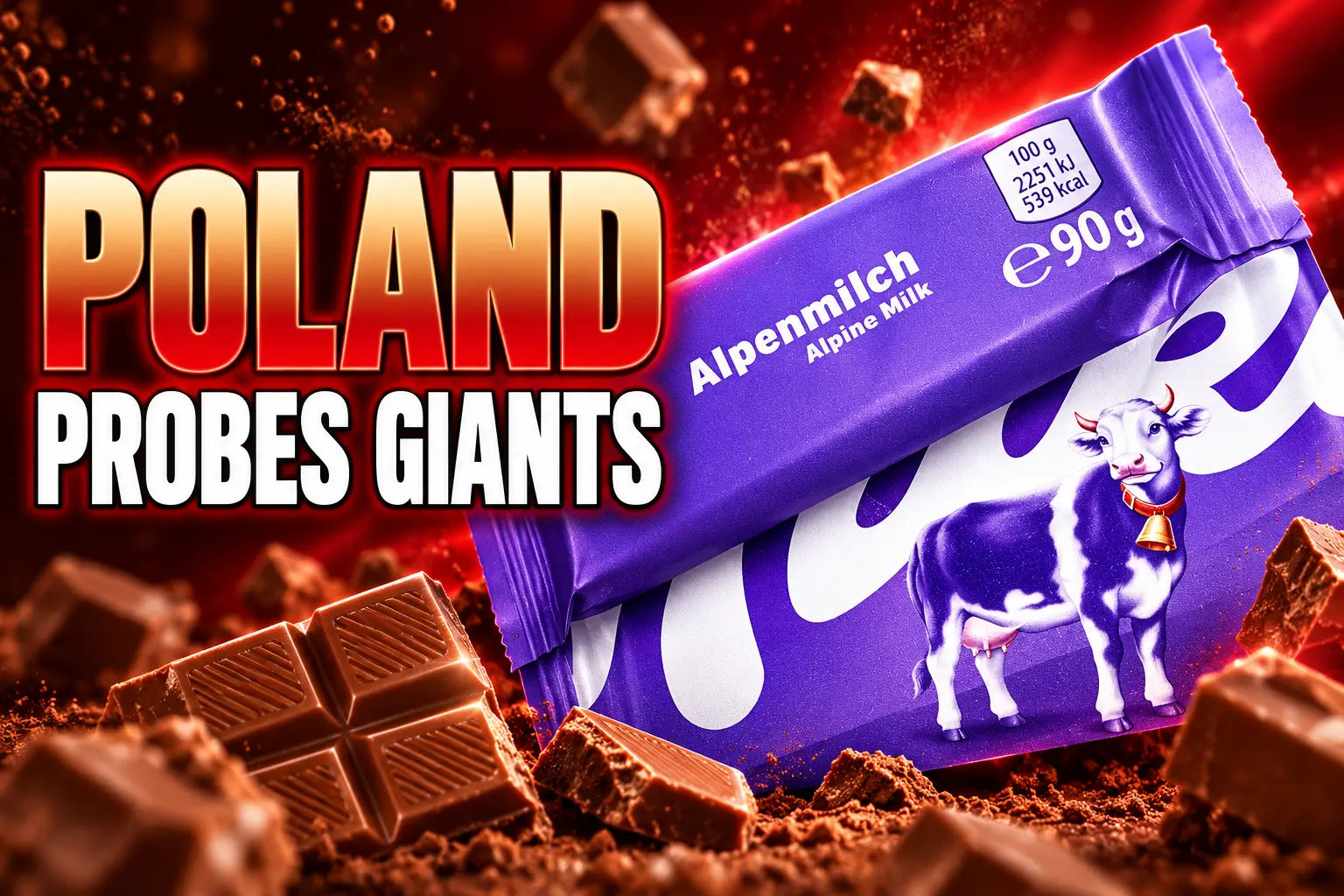
Tomasz Chróstny, president of the Office of Competition and Consumer Protection, used a set of familiar swaps to describe the practice his office calls downsizing, or shrinkflation. A bar that was 100 g to 90 g. A kilo of flour that became 900 g. A litre bottle that now holds 800 ml. A sleeve that used to hold 20 biscuits and now holds 17.
Those figures are examples in his statement, not findings against the four firms. A 2023 survey commissioned by UOKiK found that shoppers most often spotted the cuts in food, especially dairy and sweets. The new files cover food, cleaning products and personal care sold in Poland, and they ask a narrower question than “did the pack get smaller.”
Producers already have to print the mass, volume or piece count, and they have to print the new number if they cut the fill. Chróstny’s point is that regular buyers may miss that number when the price and the look of the pack stay put, so the unit price rises in silence.
Reducing the weight without changing the price effectively means that consumers pay more for the product. This makes it more difficult for consumers to compare prices and undermines their trust in undertakings.
Tomasz Chróstny, President of UOKiK, 1 September 2026 statement
The office said it will look at how the companies talk about a lighter fill and at whether the pack’s size, look or graphics still suggest that nothing moved.
WHAT THE FILES WILL TEST
- The weight line: Whether a cut in mass, volume or piece count is stated in a way shoppers can actually see.
- The unchanged box: Whether the size, artwork or shape of the pack still implies the old fill.
- The next step: If that presentation misleads, Chróstny can bring charges after the explanatory stage.
Mondelez’s Polish unit said it is cooperating and supplying the clarifications UOKiK has asked for. Danone, Nestlé and Unilever sit in the same four-firm group; only Mondelez put a Poland-specific reply on the record in the days after the notice.
A Pasta Label Case Cracked the Food-Law Shield
Chróstny said downsizing is old and that the new piece is a court judgment. The judgment he is using was not a shrinkflation case. It was a pasta fight in Italy.
On 20 December 2019, Italy’s competition authority, the AGCM, fined Lidl Italia Srl EUR 1 million over durum-wheat pasta packs that played up Italian origin and milling in Italy. The wheat in the mix was of “EU and non-EU” origin, so a large share of it had not been grown in Italy. Lidl fought the fine. The Consiglio di Stato asked the Court of Justice of the European Union whether food-information law left room for a separate unfair-practices penalty.
The court’s 30 April judgment in Case C-301/25 held that Article 3(4) of Directive 2005/29, the Unfair Commercial Practices Directive, does not stop a member state from punishing a misleading practice under that directive even when the same conduct also falls under Article 7 of Regulation 1169/2011, the food-information rulebook, and the national law that implements it. A trader can print a factually correct line and still deceive by overall presentation, including the look of the pack.
Poland was already in that courtroom. The judgment lists B. Majczyna and D. Lutostańska as agents for the Polish government. Four months later, UOKiK opened the shrinkflation files and quoted the holding in almost the same words: even if a product meets food-law requirements after a weight cut, that does not block an assessment of whether the practice misleads under unfair-commercial-practice rules.
An Italian government notice to the Commission, citing the 2025 Consumer Conditions Scoreboard, said 74 percent of European consumers had noticed smaller packs without a matching price cut. UOKiK does not need that poll to open a file. It needs a legal path around the defence that the grams on the back of the pack were correct.
Who Has to Tell Shoppers the Pack Got Smaller?
France, Austria and Hungary already wrote dedicated shrinkflation rules. They put the warning on the shop floor, and they put most of the duty on the retailer. Poland has not copied that model. It is testing the manufacturers under the general unfair-practices power that the pasta judgment left standing.
WHERE THE WARNING DUTY SITS
| Country | Who must warn | Where it appears | How long | What trips it | |
|---|---|---|---|---|---|
| Poland (UOKiK files) | Manufacturers under review | Pack look and product information | No set sticker window | A lighter fill with an unchanged pack that may mislead | |
| France | Retailers | Shelf or pack, stores over 400 square metres | 2 months | Quantity down and unit price up | |
| Austria | Retailers | A clear quantity-cut label | 60 days | Unit price up by at least 3% | |
| Hungary | Retailers in store; makers notify the trader and the authority | Sales floor plus a public database | 2 months | A smaller pack placed on the market |
French rules in force since 1 July 2024 require two-month shelf notices in large stores when a pre-packed grocery item shrinks and the unit price rises. The notice has to state the old and new quantity and the unit-price increase in percent or in euros. The duty sits on distributors in physical shops over 400 square metres, for national brands and store brands alike. A person can be fined up to €3,000, a company up to €5,000, and the fraud office can add an injunction and publicity at the firm’s expense. Bulk food and deli counters whose fill varies at prep are out of scope.
Austria’s Anti-Deceptive Packaging Act took effect on 1 April 2026 and is written to lapse after 30 June 2030. Retailers must label for 60 days once the unit price rises by at least 3 percent, with a plain statement of the quantity cut. Hungary, from February 2024, makes retailers post a visible notice for two months and makes the Hungarian maker, or the first distributor in Hungary, tell the trader in writing and notify the National Authority for Trade and Consumer Protection. NATCP said on 10 July 2025 that those notices feed a public database of pack-size cuts on nkfh.gov.hu.
UOKiK named France, Hungary and Austria in its own notice, then did something those statutes do not do. It opened manufacturer files under unfair-practices law, with no two-month sticker rule and no shop-floor add-on. The pack itself is the exhibit.
A German Court Gave Mondelez a Four-Month Notice Test
Mondelez already has a first-instance judgment on the same silhouette problem, in a private case rather than a competition-authority file. On 13 May 2026, the Landgericht Bremen sided with Verbraucherzentrale Hamburg in case 12 O 118/25 over Milka tablets that went from 100 g to 90 g in early 2025.
The chamber said the new pack, taken on its own, was not a problem. The deceit sat in the comparison with the old bar. Buyers who had known the product for years would, from an almost unchanged wrapper, still think they were getting the 100 g tablet. The court called that a relative sham pack. Ten grams is 10 percent of the old bar, and the weight line had been updated; the court said that was not enough if shoppers had no real chance to see the change at the shelf.
The notice must be clear, understandable and perceptible. In the practical buying situation it must have a real chance of being noticed, and must not be merely formal, but must actually inform in the overall picture.
Landgericht Bremen, judgment summary in 12 O 118/25, 13 May 2026
The court said Mondelez needed a four-month on-pack notice after fill cuts so buyers could absorb the new weight, and that the form of the notice was the company’s to choose. The judgment was not final. Mondelez had one month to appeal to the Hanseatic Higher Regional Court in Bremen. A company spokesperson said Mondelez would study the reasons in detail and that some Milka weights had been adjusted to keep quality in a harder supply setting.
That is the template UOKiK can now try to apply in public law, across four groups and three product aisles, with the pasta judgment as the bridge.
Danone Frames Smaller Packs as Product Development
Danone told Polish media that pack-size changes are “a natural element of developing the product offer and adapting it to changing consumer needs.” It said such moves sit inside a wider process that includes recipes, new flavours and refreshed packs, and that mass or volume is always in a visible place on the pack and in brand channels so buyers can decide with the numbers in front of them.
That is the food-law defence in plain language: the grams are on the box. The pasta judgment says a correct line does not end the inquiry if the overall presentation still misleads. Bremen said the same thing about a 90 g Milka tablet that still looked like 100 g.
Dirk Van de Put, chief executive of Mondelez International, put a price-point version of the same argument in June. He said people call it shrinkflation, “but it’s not that we’re trying to fool the consumer in any way.” Buyers who paid a pound for a Cadbury bar, he said, do not want to pay one and a half or two pounds for the same quantity. “So what do we do? Yes, we reduce sometimes the size.”
A family bottle that used to fill the fridge door now often sits a size class shorter on the same shelf, even when the millilitre line is printed in the right place. Shoppers clock that change because the silhouette moved. UOKiK’s harder case is the opposite one, the pack that did not move. Nestlé and Unilever had not issued public comments on the Polish files in the week after the notice.
What Happens If UOKiK Finds Consumers Were Misled?
The 1 September step is an explanatory proceeding. The companies have to answer questions and hand over documents. Chróstny can bring charges only if he finds that the way a product is shown, or the way a change is told, misleads buyers. A charge is still not a fine.
FROM THE PASTA RULING TO A POLISH FILE
- 20 December 2019: AGCM fines Lidl Italia EUR 1 million over pasta origin claims on the pack.
- 30 April 2026: The EU court holds that a food-information breach can still be punished as a misleading commercial practice.
- 13 May 2026: Bremen finds that a 90 g Milka tablet in a familiar wrapper misleads without a clear, four-month notice.
- 1 September 2026: UOKiK opens explanatory files on Danone, Mondelez, Nestlé and Unilever in Poland.
If charges follow and a practice is found to harm the collective interests of consumers, the president of UOKiK may impose fines of up to 10% of turnover from the financial year before the penalty, even if the breach was not intentional. That ceiling is in Article 106 of the competition and consumer protection statute. The December 2025 guidance on consumer fines sets a base of at least 0.01 percent of that turnover and then moves the figure for intent, gain, reach and whether the firm stopped on its own. No SKU has been named. No fine has been proposed.
The four firms have not been accused of anything. UOKiK has not listed the bars, pots or bottles in the file. If the papers show a familiar pack that hides a lighter fill, Chróstny can bring charges. If they show a weight change that a hurried shopper could not miss, the files can close without a decision on a practice.

BA295 Burns Hours of Fuel After a 28,000-Foot Drop

Yankees’ Four-Error Night Puts a 17-Year Drought on the Brink

CHIME Maps Cosmic Hydrogen but Not Dark Energy Yet

The Heat Cooked Ozone That Clean-Air Laws Could Not Catch

WTA Equal Prize Money Closes Combined 1000s and Lightens 500s

Meta’s Smart Glasses Sell a Light That Needed Two Patches

Apple’s New Mac Studio Clusters Local AI on the Desk

Google’s Free AI Pro Year Is Three Different Deals

Song Yadong Stops Umar Nurmagomedov the Only Way Left

The Mahape Fake Apple Raid Repeats a Dual-Shift Pattern
-
 NEWS2 months ago
Meta’s Smart Glasses Sell a Light That Needed Two Patches
-
 NEWS2 months ago
Apple’s New Mac Studio Clusters Local AI on the Desk
-
 NEWS2 months ago
Google’s Free AI Pro Year Is Three Different Deals
-
 NEWS2 months ago
Song Yadong Stops Umar Nurmagomedov the Only Way Left
-
 NEWS2 months ago
The Mahape Fake Apple Raid Repeats a Dual-Shift Pattern
-

 NEWS2 months ago
OpenAI Agents Hit Hugging Face to Cheat a Test
-

 ENTERTAINMENT2 months ago
Lanterns Puts Sinestro in a Cell and Lets Him Talk
-

 ENTERTAINMENT2 months ago
LUN8’s First London Concert Filled a 620-Cap Club