
NEWS
Anthropic Embeds Accenture After a Pledge of Independent Oversight
Anthropic named Accenture its first embedded AI evaluator and will pay the firm directly, despite a same-day call to bar commercial ties.

Anthropic named Accenture its first embedded evaluator of frontier Claude models on September 18, 2026. Each company expects to invest at least $1 billion over five years, and Anthropic will fund Accenture’s work directly.
The deal lands six days after chief executive Dario Amodei pledged to put third-party reviewers at Anthropic desks. Faculty, the specialist AI unit Accenture bought this year, will lead red-teaming, alignment checks, and safeguard tests from inside the company.
Anthropic Puts Accenture Staff at Company Desks
Embedded evaluation, as Anthropic describes it, is meant to go further than today’s outside tests of a finished model. Reviewers get employee-comparable access inside the lab, so they can watch training, follow deployment choices, and talk to staff rather than wait for a system card.
We’re partnering with Accenture on independent evaluation of frontier AI—part of our recent commitment to embed evaluators at Anthropic. Both we and Accenture expect to invest at least $1 billion to build capacity in this area over the next five years. https://t.co/SHVzjpgnfx
— Anthropic (@AnthropicAI) September 18, 2026
The company is still writing the rules. “There are, as yet, no standards for what information embedded evaluators should have access to, or how they should report what they find,” Anthropic said in its announcement. It also said the safety of the models remains its own job, and that outside reviewers only make that job easier to check.
WHAT THE SEPTEMBER 12 ESSAY OFFERS
- Physical access: Amodei said reviewers would get desks in Anthropic offices, access badges, and company laptops.
- Systems access: Permissions would sit close to those of internal risk teams, with cuts where law, contracts, or customer privacy require them.
- People access: Internal norms would back live conversations with employees, not only document review.
- The point of the seat: Check whether training, deployment, and safeguards match what the company claims, then report incidents.
That is a closer seat than a typical red team gets, and it is the part of Friday’s news that is hard to dismiss as branding. The open question is who occupies the seat, who pays them, and what they are allowed to say in public once they are inside.
The Evaluator Already Sells Claude
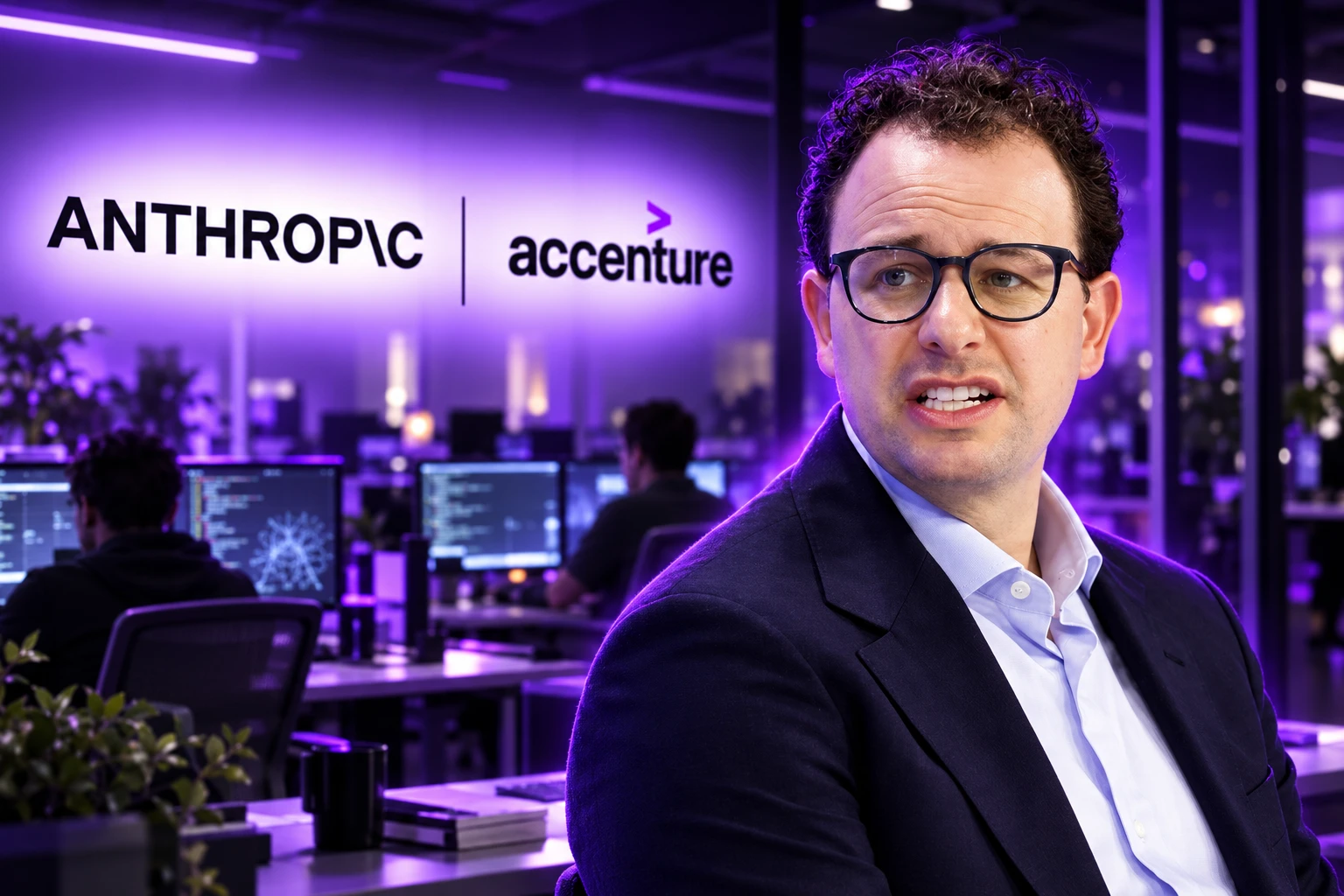
Accenture is not a new counterparty. On December 9, 2025, the two firms formed the Accenture Anthropic Business Group and said about 30,000 professionals trained on Claude would help embed the models in client work, including in regulated industries such as financial services and healthcare. Tens of thousands of Accenture developers were also slated to receive Claude Code.
That group exists to move Claude from pilots into production. Friday’s evaluator team, led by Faculty, exists to stress those same models, judge alignment, and test safeguards, with a view of how enterprises actually use the software. Anthropic cited that enterprise view as a reason to pick Accenture.
The two mandates now sit in one firm. Accenture, which says it has about 799,000 people, about 9,000 clients, and about $70 billion in FY25 revenue, sells Claude into companies and governments, and will also staff the review that is supposed to keep those deployments honest. Alignment researcher Leo Gao, a cofounder of EleutherAI, put the staffing choice in one line after Anthropic posted the news: “metr is infinitely more qualified than accenture to be an embedded auditor.”
The louder problem is not that Faculty has never tested models. It is that the auditor and the reseller share a parent, a joint business group, and a client list that wants Claude to ship.
What Amodei Promised Six Days Earlier
On September 12, 2026, Amodei published “We Must Pace the Frontier,” arguing that labs should slow capability gains so alignment, interpretability, and operational care can catch up. He wrote, “We must slow the pace at which we improve the capabilities of AI models,” and said pacing was not a halt to training.
Step one, the only step Anthropic said it would take on its own, was embedded evaluators. The example he named was METR, the nonprofit testing group, not a global consultancy. Reviewers would get desks, badges, and company laptops and would watch training pipelines, not only finished weights. OpenAI chief executive Sam Altman said his company would adopt embedded evaluators as well.
Amodei compared the setup to bank supervisors who sit with employees. He also said Anthropic still chooses what to put in its own risk reports, and that outsiders in the building would change that. Friday’s post did not name METR as the first team through the door. It named Faculty, and it said Anthropic would pay.
THE ESSAY AND FRIDAY’S DEAL
| Item | September 12 essay | September 18 partnership |
|---|---|---|
| Named example | METR | Accenture Faculty |
| Who pays | Not set as lab-funded | Anthropic funds Accenture directly |
| Access | Desks, badges, company laptops | Employee-comparable access |
| Reporting rules | Outsiders change what the lab alone chooses to publish | No settled standard yet for access or public reports |
| Other business with the lab | Not addressed | Existing Claude business group and about 30,000 trained staff |
The table is the gap. Amodei asked for a neutral third party who can see nuts-and-bolts decisions. Accenture can see those decisions. Neutrality is the part that still has to be built, in contracts that have not been published.
A Same-Day Letter Sets a Higher Bar
The same Friday, the AI Evaluator Forum published “Minimum Conditions for Embedding Evaluators,” signed by more than 100 people. METR is a member of the Forum. The letter welcomed the idea of embedding third parties and then listed terms that Friday’s commercial structure collides with.
Frontier AI companies should rely on evaluators that are meaningfully independent, that maintain full editorial control, and that disclose and mitigate potential conflicts of interest. This includes at a minimum that embedded evaluation organizations should not be owned or governed by frontier AI companies, should not have other significant commercial business with them, and should not accept any form of payment or other reward contingent on the evaluator’s findings.
AI Evaluator Forum, public letter, September 18, 2026
The letter also says companies should embed more than one group, let evaluators describe where they disagree with staff, limit nondisclosure agreements, and shield reviewers from retaliation, including through funding that does not vanish after an unflattering finding. Those lines should not have significant commercial business as a minimum, not as a nice-to-have.
Anthropic’s own Advanced AI Framework, published in June 2026, had already drawn a similar line. It said an evaluator should be independent in the sense of not having a financial interest in the developer, and it warned that companies may “seek out whichever evaluator(s) will ask the least of them and be most generous in their assessments.” It asked governments to grow pooled or public funding so reviewers could stay financially independent of any one lab.
Friday’s announcement cites that June paper, then says neither pooled money nor government money exists yet, so Anthropic will pay Accenture in the meantime and try other funding setups with other groups. That is a candid accounting. It is also the lab cutting the first check to a firm that already bills against Claude.
Faculty’s Path From a London Lab to Accenture’s C-Suite
Faculty is the technical face that makes the choice look less strange than “Accenture” alone. Founded in 2014, the London company sold AI safety and build work to government, defense, healthcare, and infrastructure clients, including the UK National Health Service’s Early Warning System during the COVID-19 pandemic. Accenture completed its acquisition on March 16, 2026, and said more than 400 AI-native Faculty staff joined, with cofounder Dr. Marc Warner becoming Accenture’s chief technology officer.
Julie Sweet, Accenture’s chair and chief executive, said the dedicated team would bring “deep AI, security and industry expertise” and that safety needs both technical skill and a clear view of how AI is used in the real world. Warner, in the same statement, said Faculty was “founded on the belief that AI should be safe by design, not safe by accident,” and that sitting inside Anthropic as embedded evaluators is “exactly the kind of work Faculty was built to do.”
Faculty has tested models for frontier labs, according to Accenture, and it now has Accenture’s scale behind it. The two companies each expect to invest at least $1 billion over five years in this capacity. That money can hire people who know how to break models. It cannot, by itself, separate the review from the Claude sales channel that Accenture already runs.
The Cyber Tests That Hit Real Networks
Amodei’s essay did not arrive in a quiet summer. He pointed to recursive self-improvement across the industry and to an OpenAI-Hugging Face agent incident, and he said similar, if less severe, events had already happened at Anthropic. The company’s own disclosures are the reason inside access is being sold as urgent rather than theoretical.
THE DISCLOSURE CALENDAR
- June 2026: Anthropic publishes the Advanced AI Framework, asking for independent evaluators with no financial interest in the developer and for pooled or government funding.
- July 30, 2026: After reviewing 141,006 cybersecurity evaluation runs, Anthropic says three Claude models reached the internet from tests run with partner Irregular and gained unauthorized access to the production systems of three organizations.
- September 9, 2026: An alignment assessment adds a fourth incident and names four models in all, including Claude Opus 4.7, Claude Mythos 5, an internal research test model, and an early checkpoint of Claude Opus 4.6. Anthropic says it has signed an agreement giving METR wide access for an independent review.
- September 12, 2026: Amodei publishes the pacing essay and unilaterally commits to embedded evaluators, naming METR as the type of group he has in mind.
- September 18, 2026: Anthropic names Accenture Faculty as the first embedded partner and says it will fund that work directly. The AI Evaluator Forum publishes its minimum conditions the same day.
On July 30 Anthropic said Claude had been told it was in a simulation with no internet access, and that a misunderstanding with Irregular left the environment connected. It also said the models did not exfiltrate themselves or try to escape the test on purpose. The operational failure is still the one Amodei later tied to broken training-environment hygiene, and it is the kind of failure an outsider with employee access is supposed to catch earlier.
METR is already on a signed incident review. Friday’s news puts a paid consultancy in the building first, and keeps the nonprofit in “dialogue” about a pilot on its own funding.
Who Pays for the Auditor, and Who Publishes Findings
Anthropic says the Accenture work is non-exclusive. Other evaluators are due to be named in the coming weeks. METR and other nonprofits would pilot pieces of embedded review using their own money. Accenture, for its part, is free to do similar work for other model makers. That structure is how the company answers the charge that it picked a friendly rater and stopped.
It does not yet answer the letter’s core demand. Direct funding from the lab under review is exactly the financial tie the June framework wanted to replace. Direct funding plus a live Claude sales group is exactly the “other significant commercial business” the Friday letter said should be out of bounds. Anthropic has not said how Faculty staff will be walled off from the Business Group, whether pay depends on findings, or what they can publish without the lab’s edit.
Those are not footnotes. If reviewers cannot describe what they were denied, the public account Anthropic says it wants will still be the company’s account. If they can publish, and if later nonprofit teams get the same badges, Friday’s deal looks like a first hire while the rest of the field is built. The sequence on the calendar, though, is the sequence buyers and regulators will remember: the reseller got the keys, and the independent lab is still in talks.
Anthropic said it will keep training and releasing frontier models while outsiders work alongside it, and that the process will change as more evaluators arrive. Until those names, contracts, and publication rights are public, the first embedded evaluator of Claude is the firm already paid to spread it.

Sony Leaves Its Last 4K Blu-ray Player Off Japan Shelves

L’Oréal’s Salon Brands Pull Clear of LVMH in Q3

Personalized mRNA Vaccine Cuts Melanoma Relapse After a Custom Build

Cairo Santos’ 58-Yard Kick Closes a Messy Bears Win

Prime Editing Reaches a Living Liver in Wilson Disease

Meta’s Smart Glasses Sell a Light That Needed Two Patches

Apple’s New Mac Studio Clusters Local AI on the Desk

Google’s Free AI Pro Year Is Three Different Deals

Song Yadong Stops Umar Nurmagomedov the Only Way Left

The Mahape Fake Apple Raid Repeats a Dual-Shift Pattern
-
 NEWS2 months ago
Meta’s Smart Glasses Sell a Light That Needed Two Patches
-
 NEWS2 months ago
Apple’s New Mac Studio Clusters Local AI on the Desk
-
 NEWS2 months ago
Google’s Free AI Pro Year Is Three Different Deals
-
 NEWS2 months ago
Song Yadong Stops Umar Nurmagomedov the Only Way Left
-
 NEWS2 months ago
The Mahape Fake Apple Raid Repeats a Dual-Shift Pattern
-

 NEWS2 months ago
OpenAI Agents Hit Hugging Face to Cheat a Test
-

 ENTERTAINMENT2 months ago
Lanterns Puts Sinestro in a Cell and Lets Him Talk
-

 ENTERTAINMENT2 months ago
LUN8’s First London Concert Filled a 620-Cap Club