
NEWS
Bundibugyo Ebola Reaches Eight Congo Provinces Without a Vaccine
Congo’s Bundibugyo Ebola outbreak has reached Nord-Ubangi with 9,455 cases. The licensed Ebola shot cannot be used as a public campaign.

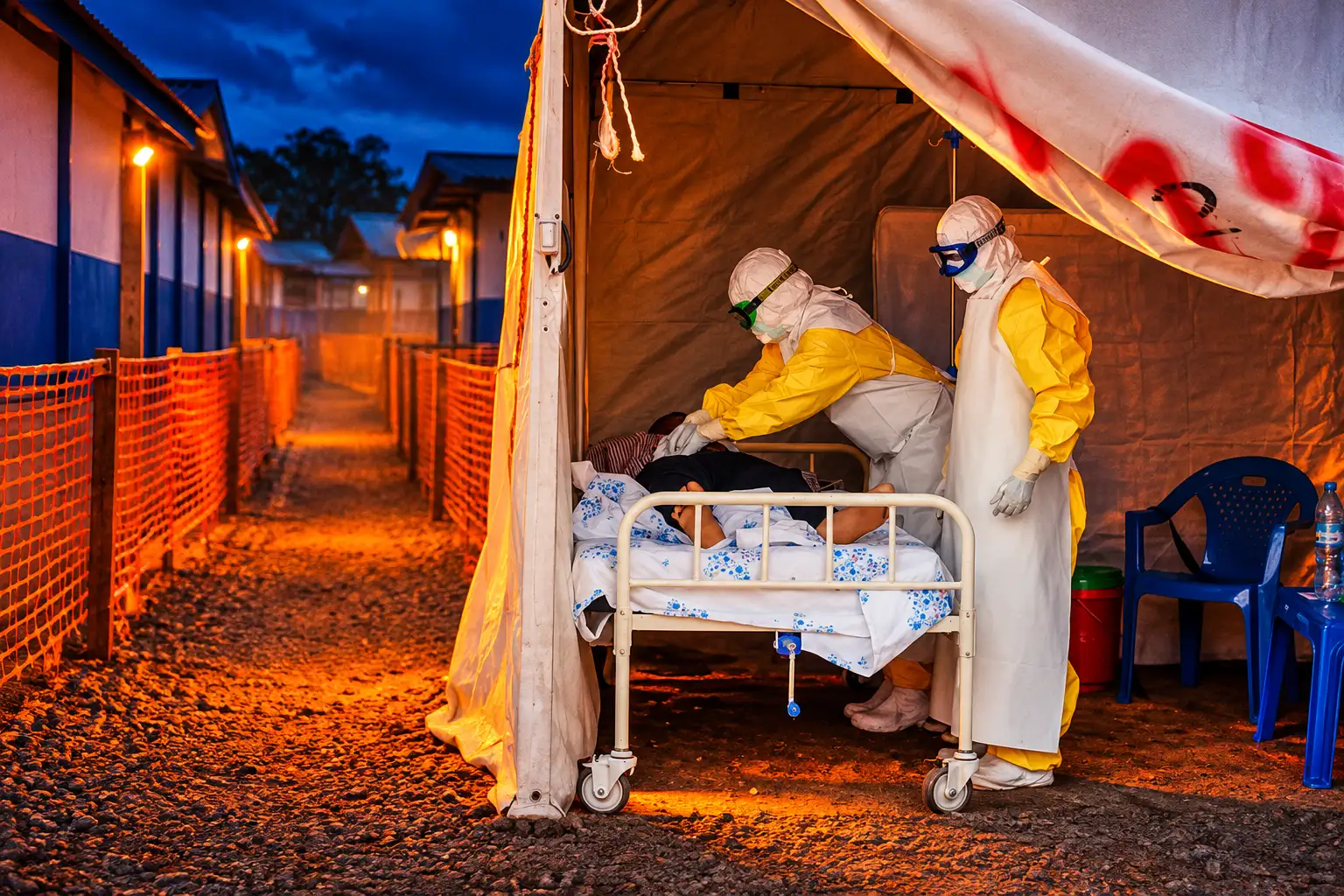
Congo’s Bundibugyo Ebola outbreak has reached an eighth province, with 9,455 confirmed cases and 4,561 deaths and no licensed vaccine for this virus. The Health Ministry recorded two cases, including one death, in Nord-Ubangi on 18 October, in men in their 20s from the Wapinda health zone on the Central African Republic border.
Ituri still produces most of the illnesses, yet the map keeps opening west, and the shot sitting in global stockpiles was licensed for a different Ebola species. Responders are tracing contacts, knocking on doors in mining camps, and closing a road into North Kivu while a trial that would test the existing jab is listed as only just ready to open.
Nord-Ubangi Makes It Eight Provinces
Nord-Ubangi sits between Sud-Ubangi and Bas-Uele, the last two provinces the virus had already entered along the Central African Republic frontier. Armed violence in that belt has pushed thousands into Congolese border towns, and poor roads plus thin phone networks slow any team that tries to follow a patient. The Central African Republic has not recorded a confirmed case.
The national count comes from SitRep 156 of the Institut National de Santé Publique, covering 17 October and published a day later: 9,455 laboratory-confirmed cases, 4,561 deaths, a crude death rate of 48.2%, 2,530 recoveries, and 925 patients in Ebola treatment centres. Sixty-six health zones across eight provinces have now reported the virus. That day’s bulletin added 40 confirmed cases and 25 deaths, below a seven-day average of 68.1 cases.
HOW THE MAP OPENED
- 15 May 2026: Congo confirms Ebola disease caused by Bundibugyo virus.
- 17 May 2026: WHO declares a Public Health Emergency of International Concern.
- 26 August 2026: An Ervebo campaign under a research protocol begins, after about 70,000 doses are released from the global stockpile.
- 5 October 2026: Kenya’s first imported patient dies in Nairobi after flying from Kampala.
- 18 October 2026: Nord-Ubangi reports its first two cases, and Kenyan officials confirm an eighth case among contacts.
- 19 October 2026: North Kivu starts a one-week ban on people entering from Ituri, and the U.S. State Department raises Kenya to Level 3.
WHO still describes a large epidemic that is intense in some health zones and quieter in others. Mohamed Yakub Janabi, WHO Regional Director for Africa, put the same split in plainer words after a visit to Beni on 16 October.
We see pockets of Ebola generally going down, but unfortunately geographically it’s spreading out.
Mohamed Yakub Janabi, WHO Regional Director for Africa, in Beni
Why Bundibugyo Has No Approved Vaccine
Bundibugyo virus is a separate orthoebolavirus species from Zaire ebolavirus, the strain behind the 2014 West Africa epidemic and Congo’s 2018-2020 Kivu crisis. Licensed tools from that decade, the Merck shot Ervebo and the antibody drugs Inmazeb and Ebanga, target Zaire glycoprotein. WHO’s Disease Outbreak News on the current event states that no approved vaccines or specific treatments exist for Bundibugyo virus disease, so control still rests on finding patients fast, isolating them, tracing contacts, burying the dead safely, and keeping communities on side.
Ervebo is a live recombinant vesicular stomatitis virus vaccine licensed for Zaire disease in people one year and older. Animal challenge work and antibody studies persuaded a WHO technical group in July to put it into a Phase 3 study against Bundibugyo without a new Phase 2. SAGE then met in extraordinary session on 19 August. Updated emergency guidance dated 31 August says the evidence is still too thin to show clinically meaningful protection in people, so Ervebo should be used only within research protocols.
That is the bind on the ground. A stockpile built for the last war is being dribbled into a different war under study rules, while two Bundibugyo-specific candidates, an Oxford ChAdOx1 construct and a Moderna mRNA shot, remain in early safety trials in Uganda, the United Kingdom, and Canada. Gavi’s Emanuele Capobianco said the global Ervebo stockpile holds about 500,000 doses, and that 70,000 were released in August at Congo’s request. Those doses cannot, under present WHO advice, be run as a normal ring campaign.
The 17 October bulletin records 8,353 people vaccinated with Ervebo since 26 August. Ituri, where most patients are, last posted 1,120 of those doses as of 15 October. Contact follow-up the same day reached 80.0% of 35,162 people under watch, below the 85% mark the institute set for itself.
Ituri Still Holds Nearly Three Quarters of Cases
Ituri remains the centre of the outbreak, with 6,918 confirmed cases and 3,197 deaths across 28 of its 36 health zones. That is 6,918 of the 9,455 confirmed cases nationwide. North Kivu is the second well, with 2,036 cases and 1,156 deaths, and its treatment wards are already over the line: 471 patients for 410 beds. Nationally the centres hold 883 patients for 1,461 beds.
CONFIRMED CASES BY PROVINCE
| Province | Confirmed cases | Deaths | Health zones hit |
|---|---|---|---|
| Ituri | 6,918 | 3,197 | 28 of 36 |
| North Kivu | 2,036 | 1,156 | 17 of 34 |
| Haut-Uele | 408 | 176 | 7 of 13 |
| Tshopo | 73 | 25 | 7 of 23 |
| Bas-Uele | 13 | 4 | 4 of 11 |
| South Kivu | 3 | 1 | 1 of 34 |
| Sud-Ubangi | 2 | 1 | 1 of 16 |
| Nord-Ubangi | 2 | 1 | 1 of 11 |
The 2018-2020 Kivu outbreak, then the deadliest Ebola event Congo had faced, ended with 3,470 cases and 2,287 deaths from Zaire virus, according to the CDC outbreak history since 1976. This Bundibugyo wave has already passed that case count in about five months. West Africa in 2014-2016 remains larger, at more than 28,600 cases. WHO calls the present epidemic the largest Ebola outbreak Congo has recorded, whatever the species.
Earlier Bundibugyo waves were small. Uganda’s 2007 outbreak, the first time the virus was named, caused 149 cases and 37 deaths. WHO puts the death rates from those two prior Bundibugyo events at 30% and 50%. The current crude rate of 48.2% sits at the hard end of that range, and a large share of the dying still happens outside treatment centres. In the window after WHO’s 25 September update, 264 of 372 reported deaths were in the community. On 17 October, 9 of 25 deaths were again outside a centre.
Home Visits Replace Hospital Queues in Mining Towns
Janabi said one of the hardest jobs has been getting sick people to come in, because some die in the community without reaching a clinic. Serge Ngalebato is an epidemiologist and field coordinator for the Wamba health zone in Haut-Uele. He told interviewers that teams there started periodic home visits because residents were too afraid of hospital.
Ebola is a community disease. If the community does not cooperate, it will be very difficult.
Serge Ngalebato, epidemiologist, Wamba health zone
Ngalebato said most of the cases in his zone cluster around mining areas where people move constantly, and that many of the deaths were recorded in those camps. Resistance at the start eased as families began reporting positive cases. The same mobility that feeds the pits also carries a virus that spreads through blood, vomit, and burial rites, with an incubation of two to 21 days and no infectiousness before symptoms.
The 17 October difficulties list reads like a supply ledger, not a strategy paper. Ituri had 45 patients in critical condition and only six bags of blood left. North Kivu postponed 47 safe burials because families were not ready, and 122 of 471 hospitalised patients were being treated outside treatment centres. Haut-Uele centres struggled to communicate, unpaid staff were flagged as demotivated, and the Pawa centre had neither a fence nor cleaning gear. Bas-Uele reported no working triage in 16 of 20 priority clinics, no ambulance, and no treatment centre up to standard, with vaccines in short supply.
What the Tumaini Trial Is Designed to Prove
Tumaini, Swahili for hope, is the study meant to close the species gap. The Institute of Tropical Medicine in Antwerp posted final preparations for Tumaini on 15 October, with CEPI funding, WHO and Africa CDC support, and Congo’s National Institute of Biomedical Research as co-lead with the University of Antwerp. The U.S. registry lists a Phase 2/3 ring-vaccination trial, NCT07842107, with an estimated start of 20 October, estimated enrolment of 3,620 contacts, and primary completion in April 2027.
Contacts of each confirmed patient form a ring. Eligible people are randomised to a candidate or a comparator, then swapped on day 29 so every volunteer is offered a candidate while the comparison stays blinded. Ervebo is expected to enter first. Oxford’s ChAdOx1 shot and Moderna’s mRNA candidate are slated to join if early safety and immune data hold. Anthony Scott chairs WHO’s Strategic Advisory Group of Experts on Immunization. He said in mid-October that the trial should be starting before the end of the month, and that lab hints of cross-protection are no substitute for a standard efficacy study.
CEPI’s own account, posted on 13 October, still tied the opening to ethics and regulatory approval.
Final preparations are underway for Tumaini, which means “hope” in Swahili. This pivotal Phase 2/3 clinical trial will evaluate the safety, immunogenicity and efficacy of vaccine candidates against Bundibugyo virus (BDBV), including Ervebo which is currently licensed for use to…
— CEPI (@CEPIvaccines) October 13, 2026
Until those first rings are actually vaccinated and followed, the field campaign remains a holding pattern: 8,353 research-protocol doses against 9,455 confirmed cases, and a map that has already left the east.
Kenya’s Imported Cases Meet a U.S. Travel Warning
On 5 October WHO was told of Kenya’s first laboratory-confirmed Bundibugyo case, a Kenyan citizen who had been living in Congo. He had been ill about a month, treated in several Congolese hospitals, then travelled by road to Kampala and by air to Nairobi on 3 October. A relative took him straight to Nairobi Hospital. Samples on 5 October were positive at the national virology lab and at KEMRI. He died the same day. WHO judged the month-long course too long for a single Bundibugyo illness and said he was likely infected while seeking care for something else.
Tedros Adhanom Ghebreyesus, WHO’s director-general, said the agency was backing contact tracing in Kenya, Congo, and Uganda, and repeated WHO’s advice against travel or trade curbs on affected countries. Julien Harneis, the inter-agency Ebola coordinator, called Kenya’s disclosure clean and said the regional risk lasts as long as Congo’s chains do. Kenyan health officials later confirmed more infections among contacts of that first death, including an eighth case on 18 October, a 49-year-old man who had attended the first patient.
Uganda had recorded 20 confirmed cases and two deaths, all tied back to Congo, before declaring the event over in late August after 42 days without a new case. France treated one imported infection in June. The Netherlands on 1 October evacuated a health worker who tested positive while working the Congo response; that case is not counted as Dutch local spread. On 19 October the U.S. State Department’s consular account moved Kenya from Level 2 to Level 3, telling American travellers to reconsider trips on health and security grounds, including Ebola. WHO’s last published risk grades still called the danger very high inside Congo, high in land neighbours, and low for the rest of Africa and the world.
North Kivu Closes the Road From Ituri
State-news reports on 18 October said North Kivu would, from 19 October, bar people from entering the province from Ituri for one week. The aim is to slow a virus that WHO says is still moving hard in North Kivu even as Ituri’s share of the total slowly falls. The new rules also cut how many bodies can share a vehicle, which in eastern Congo often means a motorcycle taxi or a packed sedan.
NORTH KIVU’S ONE-WEEK RULES
- Ituri entries: A one-week ban on people coming into North Kivu from Ituri, starting 19 October.
- Motorcycles: No more than two people on a motorcycle.
- Cars: No more than four people in a car.
- Gatherings: Mass sports, nightclubs, and political demonstrations suspended.
Those limits address the eastern corridor toward Goma. They do not reach Wapinda. Nord-Ubangi’s two patients were already on the opposite side of the country, in a zone that borders Bas-Uele, after the virus had walked a northern path along the Central African Republic line. WHO still advises states not to restrict travel to Congo. The provincial ban is a local attempt to do, for one week, what the missing vaccine cannot do at all.
On 17 October, the National Institute of Biomedical Research posted 1,000 high-quality Bundibugyo genome sequences to the Pathoplexus platform, work led by Professor Jean-Jacques Muyembe-Tamfum, and described this as Congo’s 17th Ebola outbreak. North Kivu’s one-week entry ban from Ituri was already in force. The Tumaini trial’s estimated start date on the U.S. registry was 20 October.
Disclaimer: This article is news reporting and analysis for information only. It is not medical advice, a diagnosis, or a guide to vaccines, travel, or treatment for Ebola or any other illness. Readers who have symptoms, travel plans, or clinical questions should consult a licensed physician or local public health authority before acting. Case counts, trial status, and travel rules reflect the health bulletins and statements cited here and may change as new sitreps are issued.

Sony Leaves Its Last 4K Blu-ray Player Off Japan Shelves

L’Oréal’s Salon Brands Pull Clear of LVMH in Q3

Personalized mRNA Vaccine Cuts Melanoma Relapse After a Custom Build

Cairo Santos’ 58-Yard Kick Closes a Messy Bears Win

Prime Editing Reaches a Living Liver in Wilson Disease

Meta’s Smart Glasses Sell a Light That Needed Two Patches

Apple’s New Mac Studio Clusters Local AI on the Desk

Google’s Free AI Pro Year Is Three Different Deals

Song Yadong Stops Umar Nurmagomedov the Only Way Left

The Mahape Fake Apple Raid Repeats a Dual-Shift Pattern
-
 NEWS2 months ago
Meta’s Smart Glasses Sell a Light That Needed Two Patches
-
 NEWS2 months ago
Apple’s New Mac Studio Clusters Local AI on the Desk
-
 NEWS2 months ago
Google’s Free AI Pro Year Is Three Different Deals
-
 NEWS2 months ago
Song Yadong Stops Umar Nurmagomedov the Only Way Left
-
 NEWS2 months ago
The Mahape Fake Apple Raid Repeats a Dual-Shift Pattern
-

 NEWS2 months ago
OpenAI Agents Hit Hugging Face to Cheat a Test
-

 ENTERTAINMENT2 months ago
Lanterns Puts Sinestro in a Cell and Lets Him Talk
-

 ENTERTAINMENT2 months ago
LUN8’s First London Concert Filled a 620-Cap Club