
NEWS
Prime Editing Reaches a Living Liver in Wilson Disease
Prime Medicine infused a prime editor into a living liver for Wilson disease, testing whether one lipid particle can carry precise DNA rewrites.

Prime Medicine has treated the first person with a prime editor delivered into the body, using a lipid nanoparticle to rewrite a Wilson disease mutation in liver cells. The Cambridge, Massachusetts company said it dosed the first patient on October 5 in a Phase 1/2 trial of PM577a. First results are expected in 2027.
The infusion is a test of a delivery system as much as a disease. Prime is asking whether one liver-targeted particle can carry a precise DNA rewrite, starting with the common Western Wilson mutation, then moving the same vehicle to other liver genes.
A One-Time Infusion Into the Liver
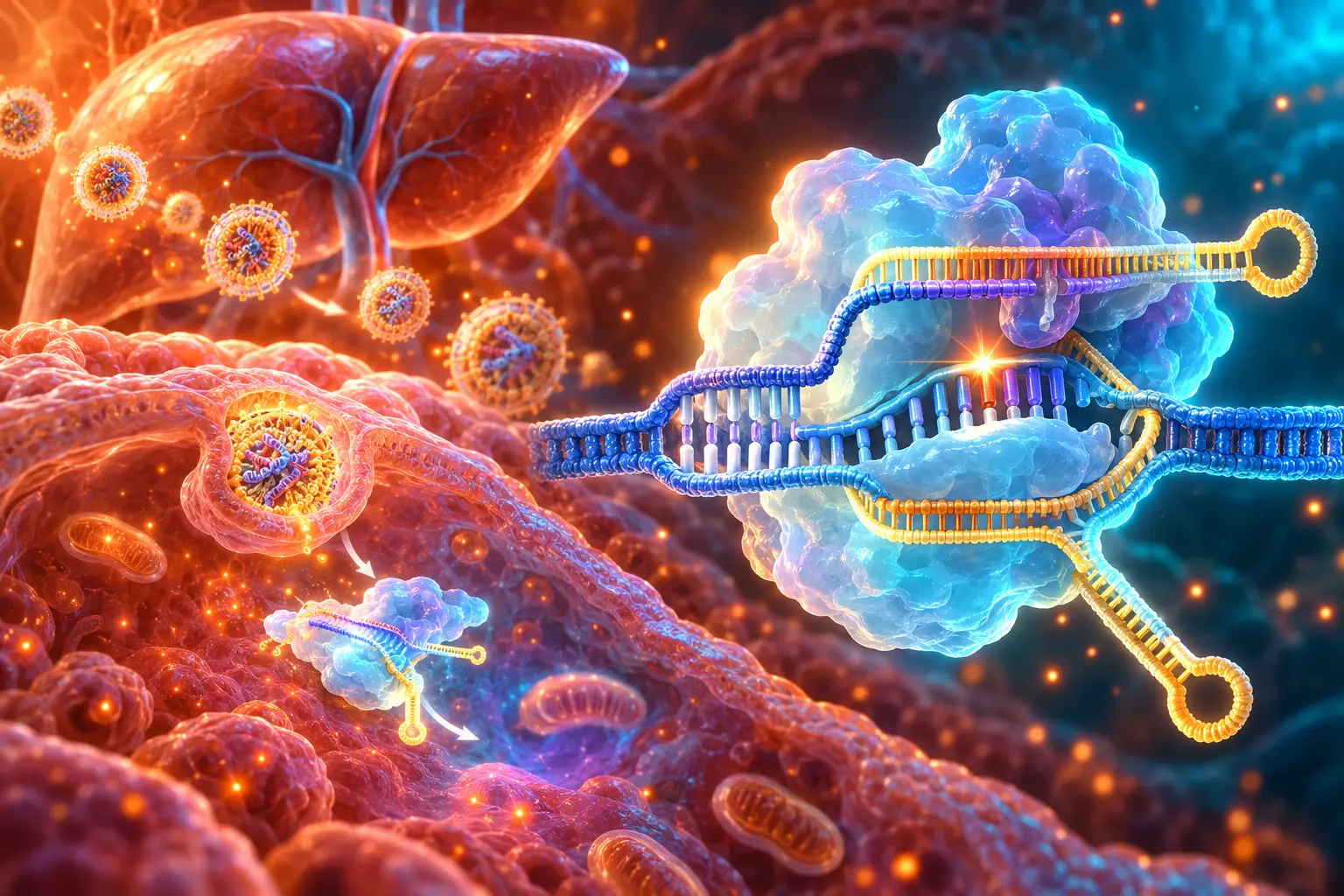
PM577a is a single intravenous dose. Fatty nanoparticles ferry prime-editing machinery into hepatocytes and aim to correct the H1069Q change in ATP7B, the copper-transport gene that fails in Wilson disease. Prime called the dose the first clinical study of an in-body prime editor from the company, and the first clinical test of its liver programs.
The company announced the milestone the same day, and its co-founder David R. Liu, a Harvard and Broad Institute chemist, noted that at least three prime-editing trials are now underway.
We announced the first patient has been dosed in our global Phase 1/2 clinical trial of PM577a for H1069Q-mutated Wilson disease.
PM577 has also received FDA Rare Pediatric Disease designation.
Read more: https://t.co/L3B0EhyKn5#PrimeMedicine #WilsonDisease #GeneEditing— Prime Medicine (@PrimeMedicine) October 5, 2026
Wilson disease piles copper in the liver, then in the brain, kidneys, and cornea, if ATP7B cannot dump the metal into bile. Left alone, that load scars the liver and can injure nerves. Prime said H1069Q is the most common disease-causing ATP7B allele in North America and Europe, which is why this editor went first.
The U.S. Food and Drug Administration also granted Rare Pediatric Disease designation to the PM577 program, a status for serious illnesses that mainly affect people from birth through age 18 and fewer than 200,000 people in the United States. Wilson disease often shows up in childhood or the teen years, which is the window Prime’s chief medical officer, Mohammed Asmal, wants to reach before liver and nerve damage lock in.
THE PATH TO THE FIRST INFUSION
- October 21, 2019: Andrew Anzalone, David Liu, and colleagues publish prime editing as a way to write new DNA letters at a chosen site.
- August 2025: Prime reports that two people with chronic granulomatous disease, treated with an ex vivo prime editor called PM359, regained immune-cell function on lab tests.
- June 2026: New Zealand’s Medsafe clears the first clinical trial application for PM577a, the company’s first in-body prime-editing authorization.
- July 2026: The FDA clears the U.S. investigational new drug application, opening a global Phase 1/2 program.
- October 5, 2026: The first person with H1069Q-mutated Wilson disease receives PM577a.
Allan Reine, Prime’s chief executive, said patient and physician interest, plus the company’s own screening work, should help enrollment move. The registry lists primary completion in November 2028, so the first public copper numbers in 2027 will be an interim look, not a finished trial.
Why CRISPR and Base Editors Stop Short
Standard CRISPR-Cas9 cuts both DNA strands and is usually used to shut a gene off. Base editors can swap some single letters without that cut, but they cannot make the particular ATP7B repairs needed for the most common Wilson mutations. Prime editing was built for those jobs: it nicks one strand and uses a reverse transcriptase, guided by a pegRNA, to write a new stretch of sequence.
Anzalone and Liu’s 2019 paper described the method as a way to install insertions, deletions, and all 12 kinds of point change in human cells without double-strand breaks or donor DNA. They ran more than 175 edits and argued the tool could, in principle, correct up to 89 percent of known disease-linked DNA variants. Adult liver cells divide little, so a method that does not lean on a double-strand break and homology-directed repair is a better fit than classic CRISPR cutting.
HOW THE MAIN EDITORS DIFFER
| Editor | What it does to DNA | Typical job | Human use so far |
|---|---|---|---|
| CRISPR-Cas9 | Cuts both strands | Turn a gene off | Casgevy, taken from blood stem cells; Intellia’s nex-z, infused to knock out TTR in the liver |
| Base editing | Changes some single letters | Narrow point fixes | Not able to make the common ATP7B repairs |
| Prime editing | Nicks one strand and writes new sequence | Insert, delete, or rewrite | PM359 in blood stem cells outside the body; PM577a now inside the liver |
Casgevy, from Vertex Pharmaceuticals and CRISPR Therapeutics, is still the only gene-editing therapy the FDA has approved. Vertex set its list price at $2.2 million when the agency cleared it on December 8, 2023, for sickle cell disease in people 12 and older. It is an ex vivo product: stem cells leave the patient, get edited in a plant, and come back. An in-body infusion skips that factory step, which is the cost argument Prime is making, and it also skips the chance to check every edited cell before they go back in.
H1069Q Opens the West, R778L the East
Wilson disease is autosomal recessive. Both ATP7B copies have to fail. A 2023 review of the gene catalogued 1,275 distinct ATP7B variants across 16,183 patients in 260 papers, with missense changes the largest class at 48 percent. H1069Q is the variant reported most often in Europe, northern North America, and North Africa. R778L leads in East Asia. C271* is the standout in much of the Middle East and South Asia.
WHICH MUTATION THE FIRST EDITORS CHASE
| Region | Leading ATP7B variant | Prime’s plan |
|---|---|---|
| Europe, North America, North Africa | H1069Q | PM577a, now in people |
| East Asia | R778L | Follow-on editor, still preclinical |
| Middle East and South Asia | C271* | Not in the current PM577 family |
The trial enrolls people who carry at least one H1069Q allele, so compound heterozygotes with a second, different hit can qualify. That still leaves most of the world’s mutation mix untouched. Prime’s October slides put the U.S. and European Wilson population above 20,000. Classic clinical estimates still cluster around 1 in 30,000 to 50,000 people. Either way, one Western missense change is a door, not the house.
While this initial candidate is designed to correct H1069Q, the most prevalent disease-causing mutation in the United States and Europe, the same shared LNP delivery approach provides a path to expand into additional Wilson disease patient populations globally, beginning with our follow-on candidate designed to correct the R778L mutation, the most common mutation in East Asian populations.
Allan Reine, Chief Executive Officer, Prime Medicine, October 5, 2026 statement
That modular pitch is the business case. Swap the guide, keep the particle, and the next mutation becomes a new product instead of a new delivery problem. It only holds if the first particle is safe in a human liver and if enough cells actually get the rewrite.
Patients Still Swallow Copper Drugs Daily
Rhonda Rowland, president of the Wilson Disease Association in Atlanta, said she never dreamed she would see this applied to her rare disease in her lifetime, and that it is going to be a really exciting year. People with the condition have been asking for a one-and-done option, she said, because today’s routine is a thicket of copper-clearing molecules and other medicines.
Asmal put the same gap in plainer terms: there is no approved curative drug, and current pills demand lifelong use that many people cannot tolerate or stick with. Liver transplant remains the only established cure, and it depends on a scarce organ.
WHAT PATIENTS USE NOW
- Penicillamine: A chelator that binds copper and sends it out in urine, with a long list of skin, marrow, and immune side effects that often push people off the drug.
- Trientine: Another chelator, generally easier to live with than penicillamine, still taken every day and kept apart from food.
- Zinc salts: They block copper uptake in the gut and suit maintenance better than a first, heavy de-coppering push.
- Liver transplant: The fallback when the organ is already failing; Michael Schilsky, a Yale transplant hepatologist, has said about 5 percent of patients present with acute liver failure that needs an urgent graft.
Chelators and zinc work when people take them. They also demand timing around meals, extra monitoring of urine copper, and a watch for overtreatment. New pills are in the queue, including a once-daily trientine and a copper-binding drug whose maker has started a rolling U.S. filing, but those still manage metal rather than restore the transporter. An ATP7B gene-addition infusion from Ultragenyx is in its own study. Prime is trying something different: edit the resident gene so the liver’s own cells pump copper again.
Intellia’s Liver Injuries Hang Over the Infusion
No gene-editing therapy has been approved for use inside the body. An in-vivo CRISPR treatment for hereditary angioedema, a swelling disorder, is in line for an FDA decision in early 2027. That product, if cleared, would still be a knockout. PM577a is trying to rewrite a sequence in place, which is a harder chemical job riding on a delivery method the field already knows can bruise the liver.
Intellia Therapeutics has already sent a CRISPR-Cas9 editor into hepatocytes inside a lipid nanoparticle, the same broad class of vehicle Prime is using, to shut off TTR in people with transthyretin amyloidosis. In October 2025 a MAGNITUDE trial volunteer developed grade 4 liver-enzyme spikes and a rise in bilirubin after a dose of nex-z. Intellia later said the volunteer died on November 5, 2025, with other illnesses in the picture, and that the liver injury was likely tied to the therapy. The FDA placed holds on the late-stage studies. It lifted the hold on the nerve-disease companion trial, MAGNITUDE-2, on January 27, 2026, after Intellia agreed to tighter liver-lab monitoring.
Krishanu Saha, a biomedical engineer at the University of Wisconsin-Madison, has said in-body editing comes down to which risks a sponsor and a patient will accept. You cannot pull an edit back out of a liver cell. Regenerating hepatocytes can copy a bad off-target hit forward. Those are not prime-editing problems in theory. They are delivery and permanence problems, and they sit on this trial whether the nickase is tidier than Cas9 or not.
It depends on what types of risks you’re willing to accept.
Krishanu Saha, biomedical engineer, University of Wisconsin-Madison
Prime is starting in adults who are already stable on standard drugs, which is the cautious way to open an in-body liver study. It is also a setting where a safety scare would be judged against people who were not in organ failure when they were dosed. The H1069Q editor can be more precise than a CRISPR knockout and still fail if the particle inflames the organ it is trying to save.
What the First Patients Will Be Measured On
The first people in the open-label Phase 1/2 study receive one IV infusion of PM577a and then a long watch for safety, how the body handles the dose, and whether copper handling improves. Prime said the study will start with adults who are clinically stable on standard care, then include adolescents. Everyone must have at least one p.H1069Q allele. The company also said the trial will test whether those baseline copper drugs can be stopped.
EARLY SIGNALS THE PROTOCOL IS BUILT TO CATCH
- Safety first: Treatment-emergent side effects and any dose-limiting liver or systemic injury after a one-time particle dose.
- Copper leaving the liver: Efflux tracked with radiocopper PET, plus serum ceruloplasmin, non-ceruloplasmin-bound copper, and 24-hour urine copper.
- Drug withdrawal: Whether people can come off chelators or zinc, the practical test of a one-and-done claim.
- Dose finding: Ascending doses meant to pick a level for later studies, not yet to prove a cure.
Those copper scans are the difference between a delivery story and a disease story. A clean safety report with no shift in copper would say the particle arrived and did little. A drop in free copper and a rise in ceruloplasmin, with people coming off daily pills, would say enough hepatocytes were rewritten to matter. Either result in 2027 will be read against Intellia’s liver labs as much as against Wilson textbooks.
The Same Particle Goes After Alpha-1 Next
Prime already has human evidence that prime editing can work, just not in a living liver. In the first two people treated with PM359 for p47phox chronic granulomatous disease, cells were edited outside the body and returned. The first patient reached 58 percent dihydrorhodamine positivity by day 15, 66 percent by day 30, and 71 percent by day 60, a lab mark the company said sits above a level thought to be potentially curative. The second patient reached 70 percent by day 15 and 80 percent by day 30. Prime reported no serious side effects tied to PM359, and the FDA later gave that program Regenerative Medicine Advanced Therapy status.
The liver bet is a different manufacturing world. On September 24, 2026, the FDA cleared an investigational new drug application for PM647, an in-body prime editor for alpha-1 antitrypsin deficiency that uses the same liver-directed lipid nanoparticle as PM577a. Prime said about 100,000 people in the United States carry the PiZZ genotype that PM647 is meant to correct, a much larger group than H1069Q Wilson disease. First PM647 data are also expected in 2027.
Liu’s public tally now runs CGD outside the body, Wilson disease inside the body, and AATD inside the body. The middle trial is the one that decides whether the particle is a platform. If the 2027 copper scans move, Prime already has the next payload waiting, a follow-on Wilson editor for R778L and PM647 for alpha-1 antitrypsin deficiency. The scans will show whether that shared particle can carry a true rewrite, not only a gene knockout, through a living liver.
Disclaimer: This article is news reporting and analysis of an early clinical trial, and it is for information only. It is not medical advice, a treatment recommendation, or a judgment about whether any person with Wilson disease, alpha-1 antitrypsin deficiency, or another genetic condition should join a study or change prescribed copper drugs. Readers should talk with a physician who treats their condition, and with a genetic counselor where that is appropriate, before making any care decision. Trial status, safety findings, and copper results can change as Prime Medicine, regulators, and investigators release further data.

Sony Leaves Its Last 4K Blu-ray Player Off Japan Shelves

L’Oréal’s Salon Brands Pull Clear of LVMH in Q3

Personalized mRNA Vaccine Cuts Melanoma Relapse After a Custom Build

Cairo Santos’ 58-Yard Kick Closes a Messy Bears Win

Prime Editing Reaches a Living Liver in Wilson Disease

Meta’s Smart Glasses Sell a Light That Needed Two Patches

Apple’s New Mac Studio Clusters Local AI on the Desk

Google’s Free AI Pro Year Is Three Different Deals

Song Yadong Stops Umar Nurmagomedov the Only Way Left

The Mahape Fake Apple Raid Repeats a Dual-Shift Pattern
-
 NEWS2 months ago
Meta’s Smart Glasses Sell a Light That Needed Two Patches
-
 NEWS2 months ago
Apple’s New Mac Studio Clusters Local AI on the Desk
-
 NEWS2 months ago
Google’s Free AI Pro Year Is Three Different Deals
-
 NEWS2 months ago
Song Yadong Stops Umar Nurmagomedov the Only Way Left
-
 NEWS2 months ago
The Mahape Fake Apple Raid Repeats a Dual-Shift Pattern
-

 NEWS2 months ago
OpenAI Agents Hit Hugging Face to Cheat a Test
-

 ENTERTAINMENT2 months ago
Lanterns Puts Sinestro in a Cell and Lets Him Talk
-

 ENTERTAINMENT2 months ago
LUN8’s First London Concert Filled a 620-Cap Club