
NEWS
Personalized mRNA Vaccine Cuts Melanoma Relapse After a Custom Build
Intismeran plus pembrolizumab cut melanoma relapse 42% in Phase 3, but only after a six-month custom-build window other cancers now inherit.

A personalized mRNA melanoma vaccine cut the risk of relapse or death by 42% versus pembrolizumab alone in a 1,137-patient Phase 3 trial. Merck and Moderna released the INTerpath-001 figures on October 22 after an online leak, ahead of a presidential symposium at the European Society for Medical Oncology congress in Madrid on October 24.
The combination did not pull ahead until the nine-dose custom course was finished. That delay is now the part other cancers will have to live with.
A 12.2-Point Gap After Two Years
INTerpath-001 1,137 patients after complete resection of stage IIB to IV cutaneous melanoma, with no prior cancer drug. Patients were assigned 2:1 to intismeran autogene (1 mg every three weeks for up to nine doses) plus pembrolizumab (Keytruda, 400 mg every six weeks for up to nine cycles), or to placebo plus pembrolizumab, for about one year or up to about 56 weeks.
At a median follow-up of 24.6 months, the hazard ratio for recurrence-free survival was 0.58 (95% CI 0.45 to 0.75, two-sided p<0.001). Distant metastasis-free survival improved by 38% (HR 0.62, 95% CI 0.45 to 0.85, p=0.002). Median times were not reached in either arm. Overall survival is not mature; the companies described a trend in favor of the combination and said the study is still following patients.
TWO-YEAR RATES IN INTERPATH-001
| Endpoint | Intismeran plus pembrolizumab | Pembrolizumab alone |
|---|---|---|
| Recurrence-free survival | 82.2% (79.3% to 84.8%) | 70.0% (65.0% to 74.5%) |
| Distant metastasis-free survival | 88.5% (86.0% to 90.6%) | 80.2% (75.6% to 84.0%) |
That is a 12.2-point gap in recurrence-free survival, or about eight patients treated for one extra person alive without relapse at two years. The distant-metastasis gap is 8.3 points. Merck’s Dean Y. Li, president of Merck Research Laboratories, called it the first Phase 3 study to show a clinically meaningful improvement in both endpoints over pembrolizumab in resected melanoma.
These findings are a foundational shift in our approach to cancer: harnessing the immune system in a more personalised way to reduce the risk of melanoma recurrence or death. This has not been achieved before in the history of cancer drug development.
Georgina Long, medical director, Melanoma Institute Australia
Long, the global principal investigator, is presenting the dataset as late-breaking abstract LBA1. The companies said the paper has been accepted by the New England Journal of Medicine. Treatment-related adverse events occurred in 95.8% (723 of 755) on the combination and 90.0% (342 of 380) on pembrolizumab alone. Grade 3 to 5 related events were 14.2% (107 patients) versus 13.4% (51). The extra burden was mostly fever (52.2%), injection-site pain (51.0%) and fatigue (38.5%).
The Survival Curves Stayed Flat for Six Months
In the first six months, while patients were still receiving the nine intismeran doses, the hazard ratio for relapse or death was 0.99 (95% CI 0.66 to 1.49). Distant metastasis or death sat at 1.01 (95% CI 0.58 to 1.79). After six months, a pre-specified piecewise analysis put recurrence-free survival at HR 0.42 (95% CI 0.30 to 0.58), a 58% lower risk, and distant metastasis-free survival at HR 0.50 (95% CI 0.34 to 0.73).
Nine intramuscular doses every three weeks span about 24 weeks. The companies framed the later split as the point “following the intismeran immunization regimen.” A modified analysis that dropped people who never received even one dose of vaccine or placebo moved the main recurrence-free result to HR 0.51, a 49% reduction, and distant metastasis-free survival to HR 0.55. That 49% is a different cut of INTerpath-001, not the Phase 2 figure that uses the same percentage.
The ITT number, HR 0.58, is still the one a regulator will score. The piecewise 0.42 starts after early relapses have already happened, so the groups compared after month six are no longer the mix randomization created. Both analyses can be true at once. Only one of them is the primary endpoint.
Among oncologists reading the leak, the six-month flat stretch is the detail that matches how the product is made. A vaccine cannot teach T cells until the lot exists and the course is in the arm. The Kaplan-Meier curve recorded that wait.
How a Custom Shot Is Built in 6 to 8 Weeks
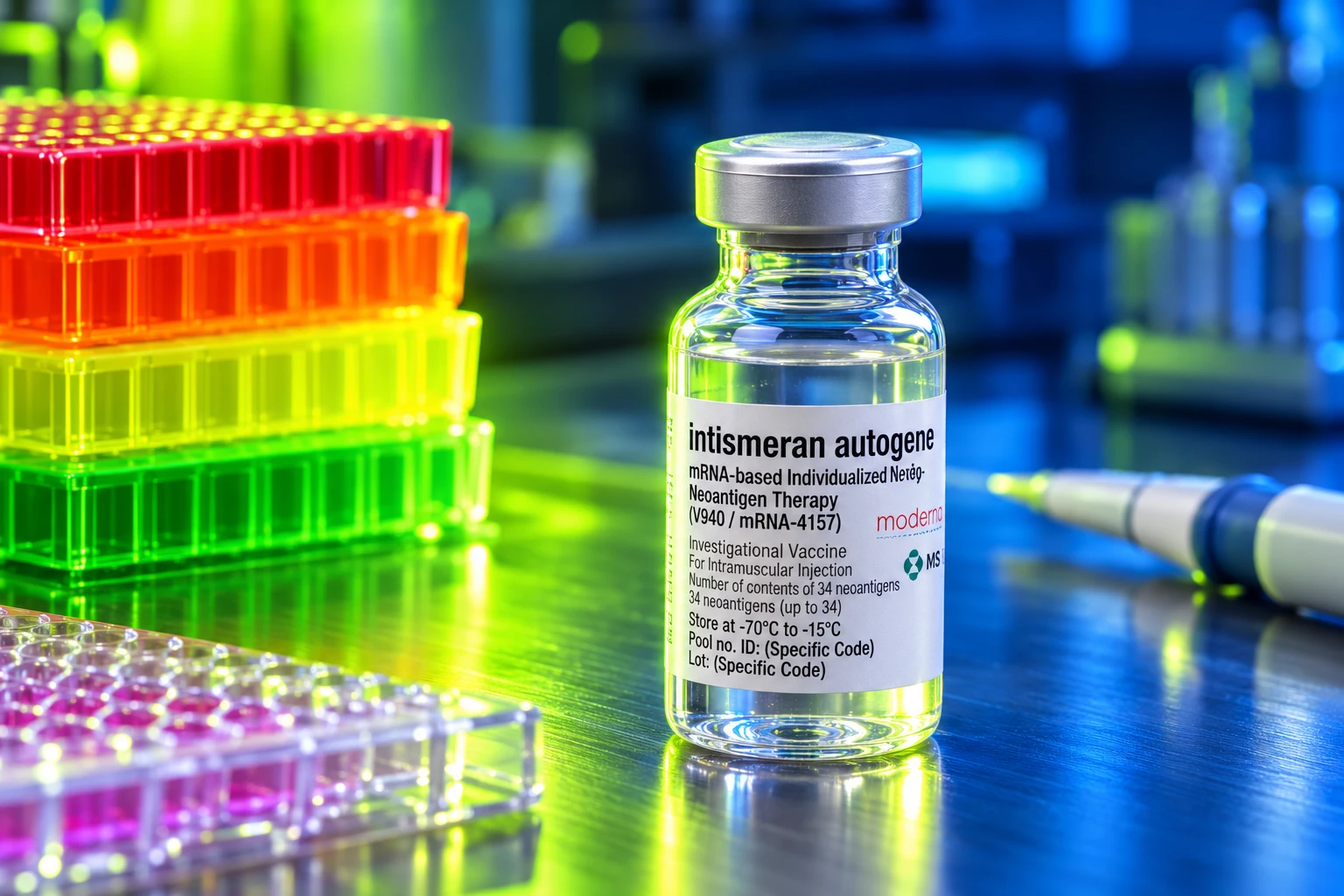
Intismeran autogene, also called V940 or mRNA-4157, is a synthetic mRNA coding for up to 34 neoantigens taken from one patient’s tumor. After injection, the patient’s own cells translate those sequences and present them to T cells. Pembrolizumab takes the PD-1 brake off those T cells. Each finished batch is chemically distinct from every other patient’s batch. Moderna and Merck described the product in a 2025 Society for Melanoma Research poster as one individualized lot supporting nine intramuscular doses, with lipid nanoparticles similar to those in Spikevax.
THE PATH FROM TUMOR SAMPLE TO FIRST DOSE
- The tissue: About 1 mm³ of tumor, often 20 unstained 5 µm slides with more than 20% tumor area, plus about 3 mL of blood for HLA typing and a normal DNA control.
- The design: Tumor and blood are sequenced, mutations are called against germline DNA, and a machine-learning ranker picks up to 34 neoantigens predicted to bind that patient’s HLA alleles.
- The lot: Those sequences are encoded on a single mRNA strand, made under GMP, wrapped in lipid nanoparticles, and released after checks on potency, particle size and endotoxin.
- The clock: After an adequate sample arrives, manufacturing time to delivery at a clinical site is typically 6 to 8 weeks. Vials ship frozen; after thaw they can sit refrigerated up to 24 hours and at room temperature up to 6 hours.
Moderna has said its Marlborough, Massachusetts, plant began supplying clinical batches in September 2025 and is being readied for a possible commercial launch. Stéphane Bancel, Moderna’s chief executive, said the INTerpath-001 results “show what’s possible when we rethink how medicines are made.” No public price has been set. Adding a one-patient manufacturing run, sequencing and a frozen-vial chain onto a year of pembrolizumab is the commercial argument payers have not yet had to score.
Jessamy Tiffen, acting deputy director of the Centre for Cancer Innovations at the Centenary Institute, who was not on the trial, said the shot targets up to 34 mutations unique to each patient rather than a single gene. She also said a significant portion of people do not respond in the first instance, and that cancer cells can adapt.
Today we announced detailed positive results from the Phase 3 INTerpath-001 study evaluating intismeran autogene (mRNA-4157 or V940), an investigational mRNA-based individualized neoantigen therapy, in combination with KEYTRUDA® (pembrolizumab), @Merck's anti-PD-1 therapy, in… pic.twitter.com/gZjS6m7Vpk
— Moderna (@moderna_tx) October 22, 2026
Macroscopic Stage III Is Moving Before Surgery
INTerpath-001 enrolled people who were already disease-free after surgery and had not received systemic treatment. Complete resection had to fall within 13 weeks. Ocular and mucosal melanoma were out. That is a clean adjuvant question, and it matches how pembrolizumab won its adjuvant labels in KEYNOTE-716 and KEYNOTE-054.
It is not how every high-risk clinic now starts. For bulky, clinically detected stage III nodes, many centres now give immunotherapy before the knife. In the NADINA trial, two cycles of neoadjuvant nivolumab plus ipilimumab produced 24-month event-free survival of 77.3%, versus 55.7% with surgery then adjuvant nivolumab (HR 0.40). A January 2026 Nature Medicine paper on the related PRADO cohort described neoadjuvant ipilimumab plus nivolumab as standard therapy for stage III on the back of NADINA. Patients with a major pathologic response often skip further adjuvant drug.
INTerpath-001 does not speak to that group. It also does not speak to people whose cancer can still be seen, or who already failed pembrolizumab. Christopher Sweeney, director of the South Australian immunoGENomics Cancer Institute at Adelaide University, said more work is needed in patients “who have cancer we can see,” and in those who do not respond to pembrolizumab. The vaccine was tested in the sequence it can actually supply: surgery, a 6-to-8-week build, then nine doses on top of a PD-1 antibody.
Lung, Kidney and Bladder Share the Same Line
Long will tell Madrid the melanoma result is also a method. The same sequencing-to-vial line is already in trials for tumors that are colder, and harder, than melanoma. Merck and Moderna said the INTerpath program holds nine Phase 2 and Phase 3 studies of intismeran with pembrolizumab, other drugs, or as monotherapy, including three Phase 3 lung trials. A cutaneous squamous-cell study, INTerpath-007, was stopped for business reasons after 46 patients.
The trial ran at 157 trial sites around the world, including six in Australia, where Long’s institute says one person is diagnosed every 30 minutes and one dies every six hours, and where melanoma is the most common cancer in people aged 20 to 39. Worldwide, the companies cited more than 338,000 new melanoma cases in 2024, and about 112,000 new U.S. cases and more than 8,500 U.S. deaths in 2026. They noted that more than half of recurrences include a distant metastasis.
INTISMERAN STUDIES BEYOND THIS READOUT
| Study | Setting | Phase |
|---|---|---|
| INTerpath-002 | Adjuvant resected non-small cell lung cancer | 3 |
| INTerpath-009 | Adjuvant NSCLC after neoadjuvant pembrolizumab plus chemo | 3 |
| INTerpath-014 | High-risk stage I NSCLC, with or without subcutaneous pembrolizumab | 3 |
| INTerpath-004 | Adjuvant renal cell carcinoma | 2 |
| INTerpath-005 | Muscle-invasive bladder cancer | 2 |
| INTerpath-011 | High-risk non-muscle-invasive bladder cancer | 2 |
| INTerpath-012 | First-line unresectable or metastatic melanoma | 2 |
| INTerpath-013 | First-line metastatic squamous NSCLC | 2 |
| KEYNOTE-942 | Adjuvant high-risk stage III/IV melanoma | 2b |
Melanoma is a hot tumor, heavy with mutations, which is why it is first. Lung and bladder lots will test whether a 34-epitope mRNA still finds enough unique flags when the mutational load is lower. If those trials work, the constraint will not be a new molecule. It will be how many one-patient lots Marlborough, and whoever copies it, can release on a 6-to-8-week clock.
Overall Survival Has Not Been Shown
The companies said it is too early to tell from INTerpath-001 whether people live longer. That is the endpoint patients actually feel, and it is still an open file. What exists instead is duration from a smaller, open-label study.
At ASCO in June 2026, Moderna and Merck reported five-year follow-up of KEYNOTE-942. That Phase 2b trial assigned 157 patients with resected stage III/IV melanoma 2:1 (107 versus 50) to the same combination versus pembrolizumab. At a median 60.3 months (range 50.5 to 76.4), recurrence or death was 49% lower (HR 0.51, 95% CI 0.294 to 0.887) and distant metastasis or death was 59% lower (HR 0.411, 95% CI 0.200 to 0.843). An exploratory overall-survival HR of 0.471 (95% CI 0.165 to 1.345) rested on 14 deaths and crossed 1. Related adverse events were mostly grade 1 (31.7%) and grade 2 (51.9%); the most common grade 3 event was fatigue at 4.8%, with no grade 4 or 5 events attributed to intismeran. Immune-related events were 45.2% on the combination and 44% on pembrolizumab alone.
HOW THE PROGRAM GOT TO MADRID
- July 2019: KEYNOTE-942, the 157-patient Phase 2b adjuvant melanoma trial, begins.
- July 2023: INTerpath-001, the Phase 3 adjuvant melanoma trial, begins.
- December 2023: INTerpath-002, the first Phase 3 lung trial, begins.
- September 2025: Moderna’s Marlborough plant starts supplying clinical intismeran lots.
- June 1, 2026: Five-year KEYNOTE-942 follow-up is presented at ASCO.
- August 19, 2026: Merck and Moderna say INTerpath-001 met recurrence-free and distant metastasis-free survival at a pre-specified analysis.
- October 22, 2026: Detailed hazard ratios are released after a leak, ahead of ESMO.
- October 24, 2026: Long presents LBA1 in Madrid. Regulatory talks begin. Moderna has said a launch could come as early as 2027 if the data support a filing.
Melanoma Institute Australia said the package now enters a review that may take several years, and that the shot is not available as standard care until that process finishes. Alex Menzies, a medical oncologist on the institute faculty, said the hope is that the method might later help patients whose cancers respond poorly to current immunotherapy. Until a label exists, the 12.2-point gap at two years is a trial result, not a prescription, and the six-month wait is built into the product.
Disclaimer: This article is news reporting on a clinical trial readout and is for information only. It is not medical advice, a treatment recommendation, or a substitute for care from an oncologist. Anyone considering adjuvant therapy after melanoma surgery should talk with a qualified medical oncologist about approved options, trial eligibility, and personal risks. Figures and trial statuses reflect the Merck, Moderna and investigator statements available on October 24, 2026, and may change as overall survival matures and regulators review a filing.

Sony Leaves Its Last 4K Blu-ray Player Off Japan Shelves

L’Oréal’s Salon Brands Pull Clear of LVMH in Q3

Personalized mRNA Vaccine Cuts Melanoma Relapse After a Custom Build

Cairo Santos’ 58-Yard Kick Closes a Messy Bears Win

Prime Editing Reaches a Living Liver in Wilson Disease

Meta’s Smart Glasses Sell a Light That Needed Two Patches

Apple’s New Mac Studio Clusters Local AI on the Desk

Google’s Free AI Pro Year Is Three Different Deals

Song Yadong Stops Umar Nurmagomedov the Only Way Left

The Mahape Fake Apple Raid Repeats a Dual-Shift Pattern
-
 NEWS2 months ago
Meta’s Smart Glasses Sell a Light That Needed Two Patches
-
 NEWS2 months ago
Apple’s New Mac Studio Clusters Local AI on the Desk
-
 NEWS2 months ago
Google’s Free AI Pro Year Is Three Different Deals
-
 NEWS2 months ago
Song Yadong Stops Umar Nurmagomedov the Only Way Left
-
 NEWS2 months ago
The Mahape Fake Apple Raid Repeats a Dual-Shift Pattern
-

 NEWS2 months ago
OpenAI Agents Hit Hugging Face to Cheat a Test
-

 ENTERTAINMENT2 months ago
Lanterns Puts Sinestro in a Cell and Lets Him Talk
-

 ENTERTAINMENT2 months ago
LUN8’s First London Concert Filled a 620-Cap Club