NEWS
Galápagos Corals Show Stronger El Niños Cut the Carbon Sink
Galápagos corals show eastern Pacific El Niño is 36.5% stronger, and that extra heat already punched the tropical land carbon sink.
Eastern Pacific El Niño swings now run 36.5% wider than they did before fossil fuels spread, a Science coral study finds. NOAA already puts a greater than 90% chance on a very strong event this fall and winter.
The extra heat does not stay in the Pacific. The last El Niño, a milder one, already cut the land carbon sink hard enough to push atmospheric CO2 to a record annual jump.
How Galápagos Corals Record Ocean Heat
Julia Cole, professor and chair of Earth and Environmental Sciences at the University of Michigan, and colleagues published the millennium-long coral reconstruction in Science on 27 August 2026. The paper’s title states the claim in plain terms: recent strengthening of eastern Pacific ENSO is unprecedented in the last millennium paleorecord.
Instrument records are short, and ENSO already jumps around from year to year, which is why the team went to the Galápagos. Those islands sit in the eastern equatorial Pacific, where El Niño first piles up warm water. Living colonies and fossil boulders there keep a chemical diary of sea temperature.
The group sampled cores from 13 corals, including living colonies and ancient boulders. The largest living colonies grow at Wolf and Darwin islands in water 20 to 50 feet deep. Divers took cores from colonies 8 to 10 feet tall. Fossil boulders along the shore date as far back as 4,500 years by radiometric dating.
Like tree rings, coral skeletons add a layer of calcium carbonate each year. Cole’s team measured two temperature-sensitive ratios, heavy-to-light oxygen isotopes and strontium to calcium, in powder drilled at about one-month steps along each core. The result is a season-by-season temperature series at the heart of El Niño country, then checked against central Pacific coral records and other ENSO reconstructions.
NOAA scientists use the same islands for living-reef work, and cores from living Galápagos coral colonies can be taken without killing the animal; the colony grows back. Every living core the Michigan team drilled still carried a scar from 1982 to 1983.
A millennium-long record from Galápagos corals suggests that El Niño is intensifying as the planet warms, with ENSO variability in the eastern Pacific roughly 37% higher than during the preindustrial era.
The findings in Science suggest that climate change is already amplifying… pic.twitter.com/g57BOmoLu6
— Science Magazine (@ScienceMagazine) August 27, 2026
Twelve Models Could Not Produce This Shift
The American Association for the Advancement of Science summary of the paper puts modern eastern Pacific ENSO variability 36.5% above the preindustrial millennium, and “roughly 37%” in the lede. University of Michigan’s own release rounded the same finding to nearly 40%. The jump is largest in the past 40 years and is driven mainly by stronger, more frequent El Niño events, not a symmetric rise in La Niña.
Cole said in the university statement, “We don’t see a time in the past where El Niños have been as strong as today, and we show that the strength of El Niño changes in parallel with the warming of global temperature.” She added that the big events of the last 40 years are not normal in the context of the last thousand years.
Climate models still disagree about how ENSO should respond as the planet warms. The team compared the coral series with preindustrial runs from 12 models, testing whether volcanoes, the sun, or internal chaos could make a shift this large. The observed rise sits outside that natural range. Cole told reporters the story stayed simple as more records came in: “This is such a clear story.”
The authors write in The Conversation that the late-20th-century intensification is greater than what nearly all models produce from natural causes alone. Not every model expects El Niño to strengthen in a warmer world. The coral series now gives those models a test they have to pass.
Death Horizons Cut Through Wolf Island Cores
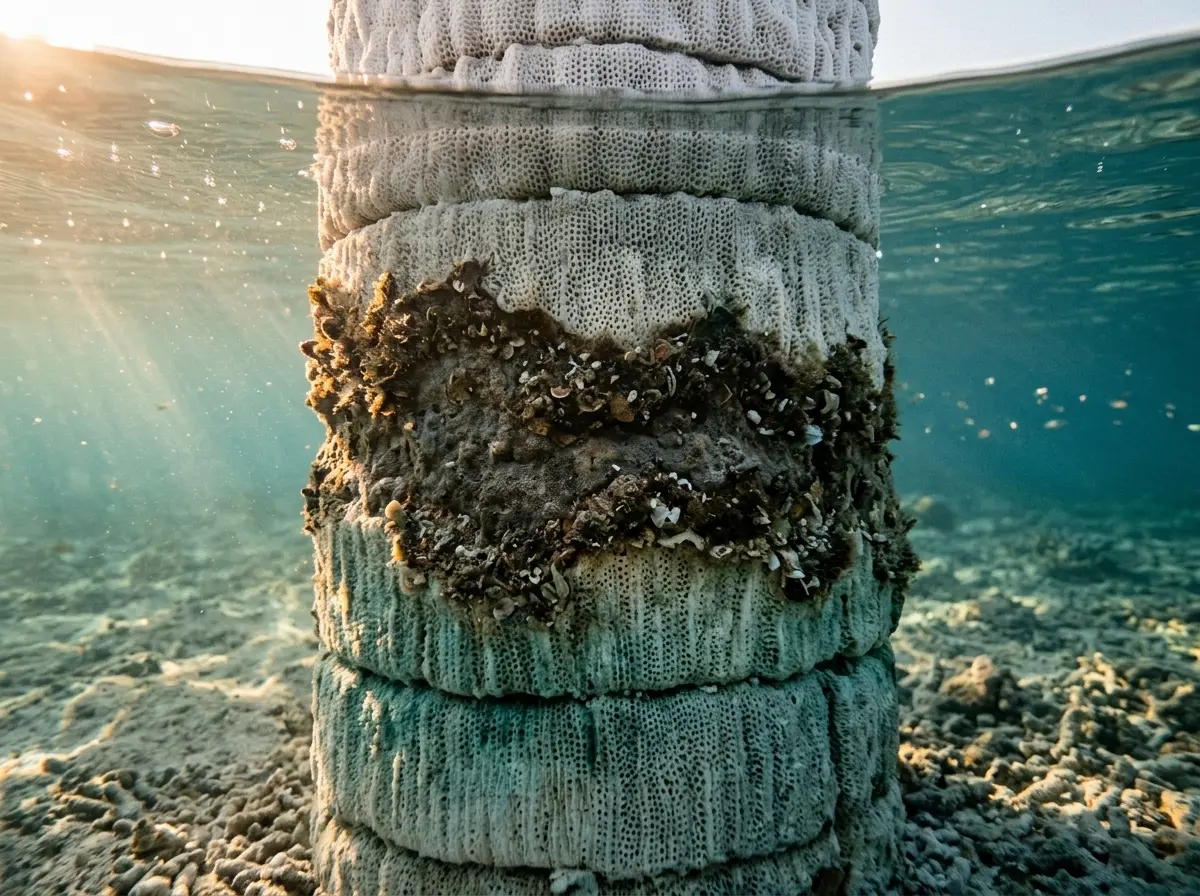
The 1982 to 1983 El Niño is the scar the archive is built around. Warm surface water shut down the usual upwelling of cool, nutrient-rich water around the islands. In Cole’s account of the work, more than 95% of Galápagos corals died. CT scans of Wolf Island cores show a dense “death horizon,” a layer of algae, snails, and barnacles that settled on bleached skeleton before the colony grew back over the dead surface.
When Cole first went looking in 1989, many of the old reefs she had been told about were already gone. The event that wrecked the archive was the event she wanted to measure. Her group only recovered long, intact records after returning from 2006.
That 1982 to 1983 pulse also landed far from Ecuador. The team notes flooding in Kenya and Peru, drought in Indonesia and Brazil, and economic losses estimated as high as US$4 trillion in a separate Science analysis they cite. A similarly strong 1997 to 1998 event, they write, has been tied to 23,000 deaths from disease and climate disasters. Those two winters, plus 2015 to 2016, are the modern “very strong” set the new 2026 event is being measured against.
THE MODERN SUPER EVENTS
- 1982 to 1983: First satellite-era shock; Galápagos reefs collapse and the death horizon is laid down in living cores.
- 1997 to 1998: Another very strong eastern Pacific event, later used with 1982 as a harbinger in the new paper.
- 2015 to 2016: Peak Oceanic Niño Index near 2.6 C in late 2015 on NOAA-based compilations; Amazon carbon loss followed.
- 2023 to 2024: A weaker El Niño than those peaks, yet it still knocked the land sink and helped make 2024 the hottest year on record.
- 13 August 2026: NOAA’s Climate Prediction Center keeps an El Niño Advisory and raises the odds of a very strong 2026/27 event above 90%.
- 27 August 2026: The Galápagos coral paper appears in Science as the live event is still gathering heat.
Cole’s group treats 1982 to 1983 and 1997 to 1998 as early warnings, not outliers. If eastern Pacific El Niño is tracking global temperature, those winters are the new baseline, not the ceiling.
The question is not whether the current El Niño is going to happen, but how bad is it going to be, and how bad will the impacts be? This event is superimposed on global warming, and it’s likely to supercharge the temperature increase that we would normally see from greenhouse gases.
Julia Cole, professor and chair, University of Michigan Department of Earth and Environmental Sciences, university statement
NOAA Sees a 69% Chance of a Record Event
The paper lands on a Pacific that is already running hot on the eastern edge, the same region the corals record. The Climate Prediction Center’s 13 August 2026 diagnostic, issued with an El Niño Advisory, said El Niño was strengthening, with a greater than 90% chance of a very strong event during Northern Hemisphere fall and winter 2026-27.
July index values were +1.4 C in Niño-3.4, +1.7 C in Niño-3, and +2.9 C in Niño-1+2, the easternmost box that sits nearest the Galápagos. Subsurface anomalies reached +10.0 C at depth as the thermocline deepened. Westerly winds at the surface and easterlies aloft stretched from the western to east-central equator. Rainfall increased from the central to eastern Pacific and dried out over Indonesia. The Southern Oscillation index sat near 2 standard deviations below normal.
| Measure | Latest reading or call | Why it matters |
|---|---|---|
| Niño-1+2 (July 2026) | +2.9 C | Eastern Pacific heat, the zone the coral record tracks |
| Niño-3 (July 2026) | +1.7 C | Broad eastern-central warmth |
| Niño-3.4 (July 2026) | +1.4 C | The classic monitoring box, still climbing |
| Subsurface equator | +10.0 C at depth | Fuel in the pipeline for a stronger surface peak |
| October-December 2026 | 69% chance of RONI at or above +2.5 C | Would exceed every El Niño in NOAA’s record back to 1950 |
| Fall and winter 2026-27 | Greater than 90% chance of a very strong event | Official advisory language as of 13 August |
NOAA now scores that historic-call threshold on the Relative Oceanic Niño Index, which subtracts tropical-mean warming so the event is not just the background ocean getting hotter. A 69% chance is not a lock. It is a majority bet that this winter’s three-month peak beats every event in the instrumental file.
Columbia University’s International Research Institute, in its August 2026 outlook, went further on the models. The mid-month intensity assessment said 25 of 26 models put Niño-3.4 in the very strong class for October-December, and 15 of those runs reached or exceeded +3.0 C, above IRI’s usual top bin. El Niño probabilities in that outlook stay at 100% through February-April 2027 before they ease in spring, the usual crash after a strong peak. The next CPC diagnostic is due 10 September 2026.
El Niño is strengthening, with a greater than 90% chance of a very strong event during the Northern Hemisphere fall and winter 2026-27. An #ElNino Advisory remains in effect. #ENSO https://t.co/5zlzaZ0D9Z pic.twitter.com/fgmhkiE3Gf
— NWS Climate Prediction Center (@NWSCPC) August 13, 2026
The 2023 El Niño Already Shrunk the Land Sink
The last event is the dress rehearsal for the carbon cost. Earth’s previous El Niño ran from June 2023 to April 2024 and was not in the 1982 or 1997 class. It still arrived on a hotter baseline, and the land took the hit.
A low-latency global carbon budget posted on arXiv in April 2025 by Piyu Ke, Philippe Ciais, and colleagues tracked July 2023 to July 2024. They found a record-high CO2 growth rate of 3.66 ppm per year since 1979, with an uncertainty of 0.09 ppm. After the long-term trend is removed, the leftover jump is 1.1 ppm per year, a shade smaller than the anomalies after 1997/98 and 2015/16.
THE 2023-24 CARBON HIT
- Land sink cut: Net land uptake fell by 2.24 billion tons of carbon per year against the 2015-2022 July-to-July mean, including 0.3 billion tons from fire.
- Ocean offset: The ocean sink rose by 0.38 billion tons of carbon per year, only a partial brake.
- Tropics’ share: Tropical land accounted for 97.5% of the land anomaly, led by the Amazon at 50.6%, central Africa at 34%, and Southeast Asia at 8.2%.
- Model split: Three vegetation models show greater tropical carbon losses than in 1997/98 or 2015/16; satellite inversions look more like 2015/16.
That split matters. If the vegetation models are right, a moderate El Niño on today’s hotter land already outruns older “super” events on carbon. If the inversions are right, the punch is merely as hard as 2015/16, from a weaker ocean event. Either reading is a warning for a winter NOAA now rates as likely to go past every post-1950 peak.
Cole put the same loop in one line in the university release: El Niño is a big source of climate extremes, and if it is getting stronger, droughts, floods, wildfire, and food insecurity get stronger with it. Tropical forests also stop taking up carbon dioxide in El Niño years. The 2023/24 budget is that sentence in tons.
Amazon Drought Can Feed the Next Pulse of CO2
The Amazon is the largest single line in that 2023/24 anomaly, and it is the biome Cole’s group flags when they talk about persistent ecosystem shifts. Dry-season heat and fire turn a forest that normally buries carbon into a source. The next strong eastern Pacific event arrives before those woods have had a quiet decade to recover.
Indonesia’s dryness is already visible in NOAA’s July rainfall map, with convection shifted east. That is the classic El Niño fingerprint, and it is also the fingerprint of peat and forest fire. Central Africa took 34% of the last land-carbon anomaly, a share that rarely makes U.S. weather talk shows and will show up in the global CO2 curve anyway.
A strong El Niño can still mean a wetter, milder winter and fewer Atlantic hurricanes for parts of the United States. That mainland weather bonus is real. It is also the wrong ledger once tropical land is on the books. The coral paper is about the eastern Pacific, but the bill comes due in the Amazon, the Congo basin, and the CO2 record at Mauna Loa.
Cole said no country has the resources to be fully protected from these impacts, and she called the finding one more reason to move away from fossil fuels. Andrew Dessler of Texas A&M, who was not on the paper, told AFP the work reinforces that same energy shift. The study itself cannot assign a number to 2027 global temperature. It can say the eastern Pacific machine that helps set that temperature is running outside its last-millennium range.
This Winter Will Test the Coral Trend
Jonathan Overpeck, a co-author and dean of the University of Michigan School for Environment and Sustainability, posted on Friday that the new coral research should be put to the test: whether 2026/27 is more extreme than recent strong El Niños, and what that would mean next. The NOAA advisory already supplies the first half of his question. The carbon budget from 2023/24 supplies the stake of the second.
The corals have already answered the backward-looking half. Eastern Pacific ENSO variability is 36.5% above the preindustrial millennium, the rise tracks global temperature, and 12 models could not make that jump with volcanoes and solar noise. What is still open is how much extra heat this winter puts into the air, and how much of the tropical sink goes missing while it does.


The Blue Jays’ Wild-Card Path Now Runs Through the Mound

Collyer Bets on West Brom After Turning Down Hull

Meta Promotes a Capture Light It Had to Patch Twice

Galápagos Corals Show Stronger El Niños Cut the Carbon Sink

J. Cole Cancels Sacramento After a Tour Driver Dies

The Mahape Apple Scam Raid Left the Owners Free

LUN8 Sells Out a 620-Capacity London Club on Tour

Umar Nurmagomedov Fights Song Yadong to Keep a Merab Path

Hulu Cancels Not Suitable for Work on Its Own Cliffhanger
