
NEWS
Roman Space Telescope Begins a Million-Mile Data Run
NASA’s Roman Space Telescope left Kennedy on August 30. The hard work is a million-mile cruise and 1.4 terabytes of sky sent home each day.

NASA’s Nancy Grace Roman Space Telescope left Earth at 7:26 a.m. EDT on August 30 aboard a SpaceX Falcon Heavy. The 2.4-meter observatory is now on a three-month trip of about one million miles to Sun-Earth L2, where it is built to send home 1.4 terabytes of infrared sky every day.
The pad work is finished. What remains is a long cruise, two instruments that are still dark, and a ground system that has to swallow more astrophysics data than Hubble or Webb ever produced.
Falcon Heavy Left Roman Flying on Its Own
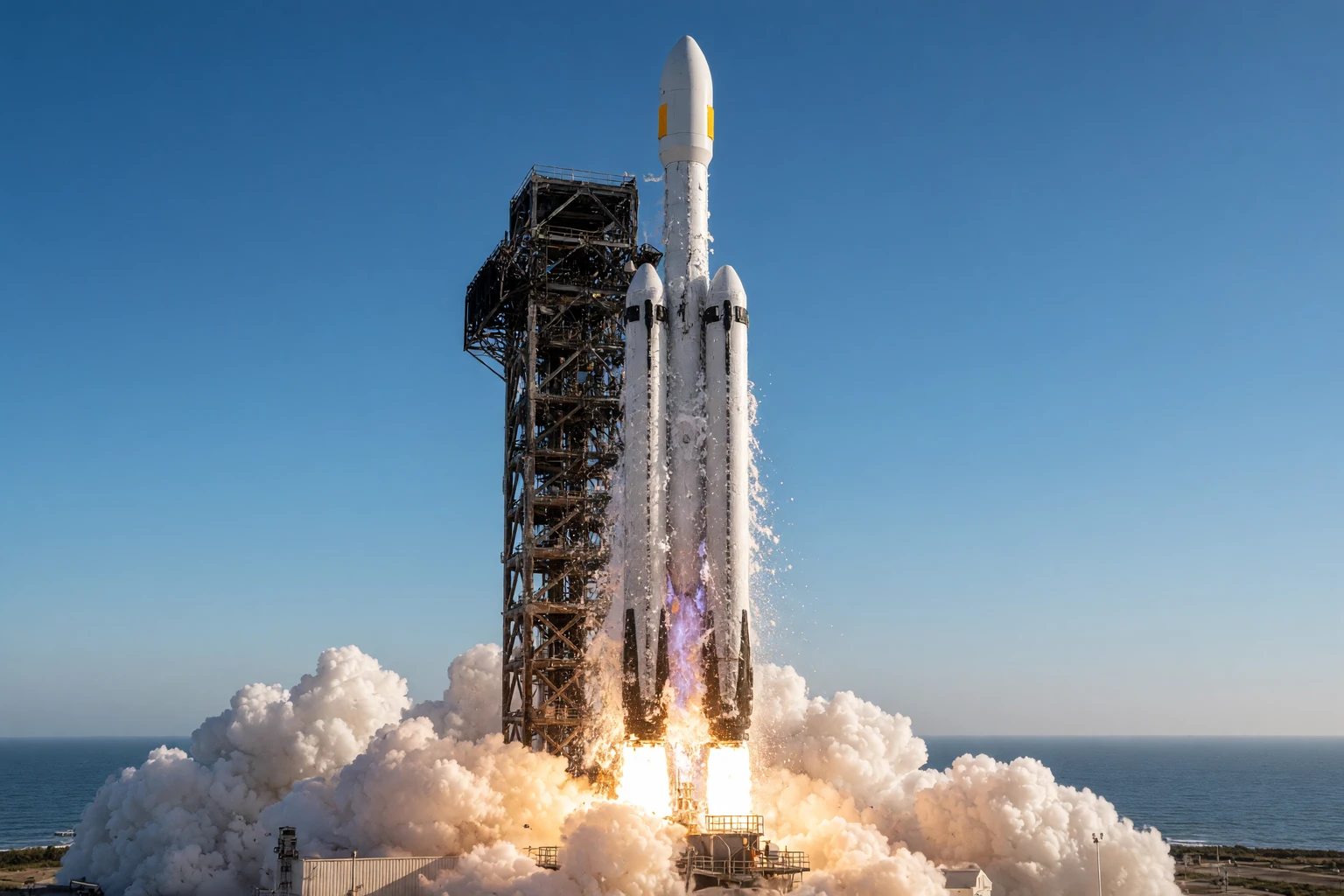
Liftoff came from Launch Complex 39A at Kennedy Space Center, the same Florida pad that has become ordinary for Falcon Heavy. Twenty-seven Merlin engines made more than five million pounds of thrust. NASA called this the agency’s fourth primary Falcon Heavy flight, and the boosters came back to the launch site for refurbishment.
Goddard Space Flight Center had telemetry seven minutes after liftoff. The rocket’s core stage let the observatory go 31 minutes into the flight. About 70 minutes in, NASA’s Deep Space Network took the signal through Canberra, then Madrid, then Goldstone, so the spacecraft was never out of contact on the climb away from Earth.
Solar panels and the lower instrument sun shade opened one hour and 23 minutes after launch. NASA Administrator Jared Isaacman, speaking for the agency after the flight, treated the calendar as the result worth repeating.
Delivered ahead of schedule and on budget, this mission reflects more than a decade of dedication from the NASA workforce and our industry partners.
Jared Isaacman, NASA Administrator, NASA Headquarters
NASA had carried a May 2027 launch-readiness date. Roman flew nine months early, after the Launch Services Program moved the Falcon Heavy slot to match hardware that was already done. The life-cycle cost NASA has been holding is $4.3 billion. Flagship telescopes almost never earn that pairing of an early ship date and a held budget, which is why Isaacman put ahead of schedule and on budget in the first breath.
A Falcon Heavy leaving 39A on a Sunday now looks like regular work. The remaining engineering is on the spacecraft.
The Antenna and the Visor Opened First
Roman is roughly the size and mass of a school bus. Before the cameras wake up, the bus has to unfold the hardware that keeps light out and data moving.
FROM LIFTOFF TO THE OPEN VISOR
- August 30, 2026, 7:26 a.m. EDT: Falcon Heavy lifts off from Launch Complex 39A.
- T+7 minutes: Goddard acquires telemetry.
- T+31 minutes: The observatory separates and flies on its own.
- T+70 minutes: The Deep Space Network takes communications through Canberra.
- T+1 hour 23 minutes: Solar panels and the lower instrument sun shade deploy.
- August 31, 2:03 p.m. EDT: The high-gain antenna finishes a four-minute deploy.
- September 1, 6:05 a.m. EDT: The aperture-cover visor springs up on three booms in about eight minutes.
The dish is 5.6 feet across and weighs 24 pounds. NASA built it from carbon composite so it can take the temperature swings of the cruise and still push radio at up to 500 megabits per second to stations in New Mexico, Australia, and Japan. One band carries commands and health. The other is for the science dump.
Next on the list is Coronagraph Instrument activation. The Wide Field Instrument, the 300-megapixel camera that will do the surveys, is due to power on in a couple of weeks. Both boxes then spend the rest of the three-month commissioning run in calibration, while the spacecraft keeps falling toward L2.
1.4 Terabytes Will Land on Earth Every Day
The Wide Field Instrument is an infrared camera with 18 detectors, each about the size of a saltine, tiled into a 300-megapixel mosaic. NASA says it has Hubble’s angular resolution and a field of view at least 100 times larger, and that the rigid bus can slew, settle, and expose fast enough to survey the sky 1,000 times faster than Hubble.
That speed becomes a plumbing problem. NASA’s stated daily science rate is 1.4 terabytes, the highest of any NASA astrophysics mission so far. The Space Telescope Science Institute’s planning tables put Hubble’s Wide Field Camera 3 near 2.7 gigabytes a day and Webb’s NIRCam near 58 gigabytes. Roman’s own account has said Hubble piled up 172 terabytes in its first 30 years, a stack Roman would match in about 123 days, or roughly four months of downlink.
HUBBLE, WEBB, AND ROMAN AT A GLANCE
| Camera | Daily data | Field of view | Pixels |
|---|---|---|---|
| Hubble WFC3 | 2.7 GB | 4.7 arcmin² | 1 megapixel |
| JWST NIRCam | 58 GB | 9.7 arcmin² | 34 megapixels |
| Roman WFI | 1.4 TB | 1,035 arcmin² | 300 megapixels |
At 1.4 terabytes a day, the spacecraft would send about 511 terabytes in a year. STScI has already told users they cannot treat Roman like a Hubble treasury program they download to a laptop. The Roman Research Nexus is built for cloud analysis beside the archive, so the compute moves to the files instead of the files moving to every desk.
NASA says machine learning, artificial intelligence, and citizen scientists will flag what the pipelines should not miss. The mission account is already handing the public a pixel in the first images, a small certificate against a map that does not exist yet. There is no proprietary lock. STScI’s survey rules put the core community programs in the open as soon as they are processed, with about 25 percent of the first five years left for general astrophysics proposals.
Earth to Roman! 📡
Our team has deployed Roman’s high-data-rate dish antenna. This antenna will be used to send more than a terabyte of science data down from the observatory daily.https://t.co/VCza9Jp04D pic.twitter.com/mHEmPcLgdg
— Nancy Grace Roman Space Telescope (@NASARoman) September 1, 2026
JPL Built a Starlight Blocker for the Next Flagship
The camera everyone will see first is the Wide Field Instrument. The quieter payload is the Coronagraph Instrument, designed and built at NASA’s Jet Propulsion Laboratory as a technology demonstration, not as a science camera with its own required discoveries.
Hubble and Webb already fly coronagraphs. Neither flies with the active wavefront control Roman is carrying, the deformable optics that dig a dark hole in starlight so a faint planet can show up beside it. NASA’s launch package said this box is meant to prove tools that a future Habitable Worlds Observatory could use to image Earth-like worlds, and that Roman’s own first step is pictures of Jupiter-like planets.
User documents at IPAC describe the instrument as a demonstrator for future planet imaging, with a predicted visible-light contrast near one part in 100 million. That is still short of what a later Earth-finder would need, which is the point of flying it now. NASA even parked the coronagraph under a separate management line during development so a science wish list could not hold the launch date.
Activation of that instrument is the next major milestone on the cruise. If the dark hole works in space, the five-year survey telescope also becomes a dress rehearsal for the mission NASA wants after this one.
Who Was Nancy Grace Roman?
NASA named the observatory in 2020 for Nancy Grace Roman, the agency’s first chief of astronomy and the official who spent the 1960s and 1970s pushing a large space telescope through Congress. Colleagues, especially later Hubble chief scientist Edward J. Weiler, called her the mother of Hubble. She died on December 25, 2018, at 93.
Roman was born in Nashville on May 16, 1925, earned a doctorate at the University of Chicago in 1949, and left academic astronomy after hitting the tenure wall that faced women in the field. She went to the Naval Research Laboratory, then joined NASA in 1959, six months after the agency opened, and became NASA’s first chief of astronomy. She retired in 1979 and still came back as a consultant on Hubble.
The idea of coming in with an absolutely clean slate to set up a program that I thought was likely to influence astronomy for 50 years was just a challenge that I couldn’t turn down.
Nancy Grace Roman, 1980 oral history, National Air and Space Museum
Hubble launched in 1990 with a flawed mirror and needed shuttle repair crews. Webb launched in 2021 after years of delay. The telescope that now carries Roman’s name left the ground on a commercial heavy lifter, early, with a survey camera and a coronagraph NASA was willing to fly as a demo so the calendar would hold.
Hubble’s Lifetime of Sky Fits in One Roman Year
Roman is not a pointed observatory in the Hubble or Webb sense. Those telescopes stare. This one tiles. A single Wide Field Instrument frame covers 0.281 square degrees, a patch bigger than the full Moon, at Hubble-like sharpness in visible through near-infrared light from 0.48 to 2.3 microns.
Nicky Fox, associate administrator for NASA’s Science Mission Directorate, called it a discovery machine for dark matter, dark energy, and planets outside the solar system. The same hardware will also feed work that is not in the brochure: transients, the outer solar system, and whatever turns up when a field that large is sampled again and again.
Most of the first five years is already spoken for by community-designed surveys, with STScI listing the four large programs that will dominate the calendar.
THE CORE COMMUNITY SURVEYS
- Galactic bulge time domain: Repeat visits toward the inner Milky Way, where gravitational microlensing can reveal planets down to a fraction of Earth’s mass, including worlds that do not transit.
- High-latitude time domain: A deep, repeating patch for supernovae and other changing objects that trace how fast the universe has been speeding up.
- High-latitude wide area: A huge near-infrared map of galaxies for weak lensing and large-scale structure, the dark-matter and dark-energy census.
- Galactic plane: A survey along the Milky Way’s disk that STScI has grouped with the core set for the first years of science.
Julie McEnery, Roman’s senior project scientist at Goddard, has said astronomers have not had eyes like these. The practical limit is no longer a night of Hubble time. It is whether the cloud pipelines, the citizen classifiers, and the guest programs can keep up with a telescope that can, in a year, send down several times the archive Hubble built in three decades.
First Public Images Wait on a 90-Day Checkout
Jeremy Perkins, on the science commissioning team, said during NASA’s launch broadcast that the first month is a checkout, then the work of aligning and focusing begins, with first starlight on the detectors. NASA’s public target for the first images is early 2027, after the three-month commissioning run that is happening on the way to L2, not after arrival as a separate season.
The spacecraft bus is listed with a 10-year operating goal on top of a five-year prime mission, and the technical sheet says it can be refueled in flight by a robot. That is how a survey machine with a 2.4-meter mirror and an 8-milliarcsecond jitter spec is supposed to outlive its first calendar. Goddard manages the project, with JPL, Caltech/IPAC, and STScI in the science chain, and BAE Systems, L3Harris, and Teledyne on the industrial side. ESA, JAXA, CNES, and the Max Planck Institute for Astronomy are in the contribution list.
McEnery’s line after launch still fits the next year better than any picture the public has seen. There is no telling what more will be known, and have been seen, by this time next year. The dish is open. The visor is up. The cameras are next.


Roman Space Telescope Begins a Million-Mile Data Run

FDA Clears MeRT for PTSD, With a Narrower Label

Guerrero’s Home Drought Outlasted Toronto’s 13-2 Loss

Collyer Bets on West Brom Minutes Over Hull City

Meta’s Smart Glasses Sell a Light That Needed Two Patches
Meta’s Smart Glasses Sell a Light That Needed Two Patches

Song Yadong Stops Umar Nurmagomedov the Only Way Left

The Mahape Fake Apple Raid Repeats a Dual-Shift Pattern

LUN8’s First London Concert Filled a 620-Cap Club

Gomez Says She Never Ran the Wondermind Investors Backed
-
 NEWS7 days ago
Meta’s Smart Glasses Sell a Light That Needed Two Patches
-
 NEWS1 week ago
Song Yadong Stops Umar Nurmagomedov the Only Way Left
-
 NEWS3 weeks ago
The Mahape Fake Apple Raid Repeats a Dual-Shift Pattern
-
 ENTERTAINMENT3 weeks ago
LUN8’s First London Concert Filled a 620-Cap Club
-
 ENTERTAINMENT3 weeks ago
Gomez Says She Never Ran the Wondermind Investors Backed
-
 ENTERTAINMENT1 week ago
Lanterns Puts Sinestro in a Cell and Lets Him Talk
-

 ENTERTAINMENT1 week ago
Hulu Cancels the Kaling Comedy Built for 10 Seasons
-
 NEWS3 weeks ago
Nueva Pescanova Drops the Octopus Farm as Wild Catch Continues