
BUSINESS
Russia Wins India’s Fertilizer Trade as Canada Slips
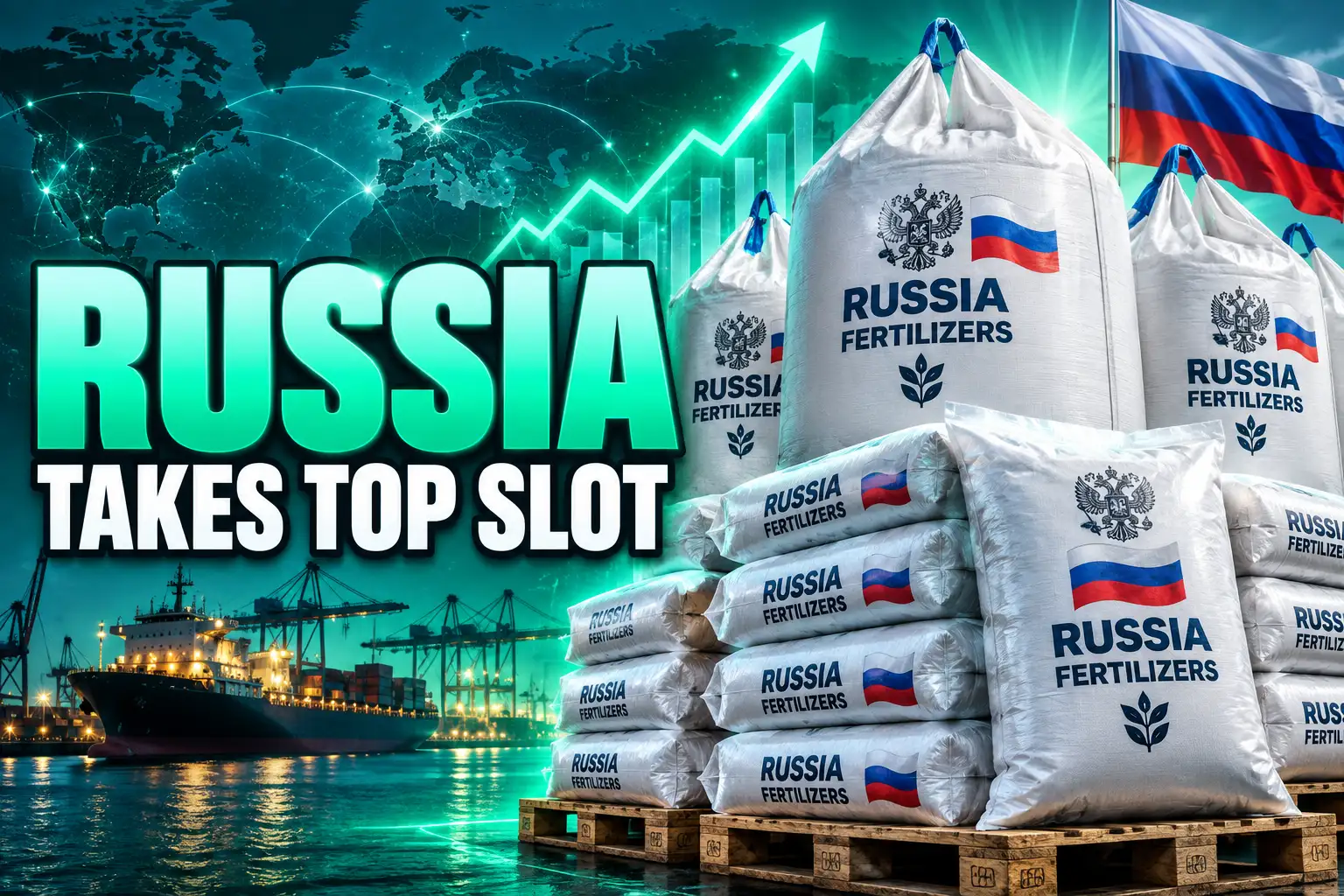
Russian plants now fill one in three of India’s imported fertilizer tonnes after a 6.5 million tonne year.

Russian plants shipped 6.5 million tonnes of fertilizer to India in 2025, and the industry’s own count is that one in three imported tonnes now comes from Russia. Andrey Guryev, president of the Russian Fertilizer Producers Association, told a New Delhi business forum on 11 September 2026 that 2.8 million tonnes had already moved in the first six months of 2026.
The bags filled a hole Gulf ports could not. Canadian sales were the ones that shrank, and the Indian subsidy line is still running above the figure Parliament was asked to vote.
Russia Took the Top Slot in India’s Import Book
India’s Ministry of Commerce and Industry recorded a 41 percent jump in Russian fertilizer arrivals in 2025, to 6.5 million tonnes, with the bill at $3 billion, 1.8 times the year before. Phosphate and complex grades nearly doubled, to 3.24 million tonnes. Nitrogen rose 25 percent, to 1.73 million tonnes. Potash inched up 2 percent, to 1.53 million tonnes. India’s total fertilizer imports climbed 45 percent, to more than 27.4 million tonnes, and Russia sat at the top of the supplier list, ahead of China, Saudi Arabia, Morocco and Oman.
Guryev put the 2025 haul at six times the 2021 level and said President Vladimir Putin had told the industry, at the 2024 BRICS summit in Kazan, to meet Indian farm demand. Compiled 2025 trade figures show India spent $14.3 billion on imported fertilizer, 82.5 percent more than the $7.8 billion spent in 2024, the steepest rise among large buyers.
INDIA’S 2025 FERTILIZER SUPPLIERS BY VALUE
| Supplier | 2025 sales to India | Change from 2024 |
|---|---|---|
| Russia | $3 billion | +82.1% |
| Saudi Arabia | $2.5 billion | +78.5% |
| China | $2.1 billion | +153.2% |
| Morocco | $1.8 billion | +94.1% |
| Oman | $915.5 million | +0.3% |
| Canada | $304.7 million | -21.6% |
Russia’s dollar gain tracks India’s overall import bill. Saudi Arabia, China and Morocco all sold more, not less. The split that matters is who lost.
The One Supplier That Lost India
Canada was the only major origin on that 2025 list whose sales to India fell, dropping 21.6 percent to $304.7 million. Potash is the reason. A 2024-25 study by the Indian Council for Research on International Economic Relations, led by Ashok Gulati with Ritika Juneja, Sachchida Nand and Emil Thomas Johny, found India is almost fully import-dependent for potash. Russia already held 51 percent of muriate of potash arrivals that year, with Canada at 25 percent and Israel and Jordan at 8 percent each.
Oman did not crash, it stalled. The same ICRIER brief put Oman at 46 percent of India’s 5.6 million tonnes of urea imports in 2024-25, with Russia at 16 percent, Saudi Arabia at 9 percent and the UAE at 6 percent. Oman’s 2025 sales value to India rose 0.3 percent, to $915.5 million, while every other large supplier’s bill jumped. India’s own canalising agencies have since bought urea from Malaysia, Vietnam, Georgia, Nigeria, Finland, Egypt, Algeria, Turkey and the Netherlands as well as Russia and Oman.
China took the urea burst that Oman did not. Minister of State for Fertilisers Anupriya Patel told the Lok Sabha that urea from China reached 2.124 million tonnes from April 2025 through February 2026, against 0.099 million tonnes in the whole of 2024-25. Russian urea over the same eleven months was 1.399 million tonnes, already above the 0.923 million tonnes imported from Russia in 2024-25. Russia’s weight in the 2025-26 book through February sat in DAP (0.755 million tonnes), potash (1.297 million tonnes) and NPK (2.1 million tonnes), the grades that turned a supplier of one nutrient into the supplier of record.
The Gulf Shock That Repriced Indian Urea
The rerouting was not a five-year plan landing on schedule. West Asia fighting hit urea plants and the Strait of Hormuz in the same season, and the six Gulf producers that usually make 30 to 40 percent of seaborne urea, the UAE, Kuwait, Iran, Saudi Arabia, Qatar and Bahrain, became a risk India could measure in dollars per tonne.
THE DATES THAT LOCKED THE TRADE
- 2024, Kazan: Putin tells Russian fertilizer producers to cover Indian farm demand, Guryev later said.
- December 2025, New Delhi: During Putin’s visit, Indian Potash Limited, Rashtriya Chemicals and Fertilizers and National Fertilizers sign a memorandum with Uralchem for a urea plant in Russia whose entire output is earmarked for India.
- Calendar 2025: Commerce Ministry data put Russian shipments at 6.5 million tonnes and India’s total fertilizer imports above 27.4 million tonnes.
- April 2026: Indian Potash gets clearance to bring in 2.5 million tonnes of urea at $935 a tonne on the west coast and $959 on the east, after a February tender around $508 to $512, an 84 percent jump in two months, with Russia named among the origins that could skip Hormuz.
- May 2026: Landed urea peaks at $947 a tonne. Indian Potash Limited books 1.3465 million tonnes of DAP at $930 to $935 a tonne, including 250,000 tonnes listed as Russian origin.
- 24 August 2026, the Kremlin: Putin tells External Affairs Minister S. Jaishankar that Russia is raising mineral fertilizer shipments and is ready to keep doing so.
- 11 September 2026, New Delhi: Guryev reports 2.8 million tonnes shipped in the first half of 2026 and repeats that one imported tonne in three is Russian.
ICRIER’s 2024-25 snapshot is what that shock hit. India consumed about 70.7 million tonnes of fertilizer products that year, with import dependence around 20 percent for urea, nearly 50 percent for DAP and effectively 100 percent for potash. About 85 percent of the natural gas used to make urea at home is imported. Once feedstocks are counted, the brief puts effective foreign dependence near 68 to 70 percent. DAP in 2024-25 still came mostly from Saudi Arabia (42 percent of 4.5 million imported tonnes), Morocco (23 percent) and China (19 percent), with Russia at 6 percent. The 2025 jump in Russian phosphate and NPK is the attempt to widen that map.
Why the Subsidy Outlay Is Still Climbing
Cheaper Russian tonnes did not close the fiscal gap the spring spike opened. Farmers still buy urea at a notified bag price, and the Union government pays the difference. The Union Budget for 2026-27 set a budgeted fertiliser subsidy of Rs 1,70,799 crore, an 8.4 percent cut from the 2025-26 revised estimate of Rs 1,86,460 crore.
THE FY27 SUBSIDY ARITHMETIC
- Budget line: Rs 1,70,799 crore for fertilizer subsidy in 2026-27, against a 2025-26 revised estimate of Rs 1,86,460 crore.
- Last year’s spend: Actual 2025-26 outgo reached Rs 2.17 lakh crore, Rs 1.42 lakh crore on urea and Rs 74,999 crore on the nutrient-based subsidy, 17 percent above that revised estimate.
- Urea now: Landed import cost in August 2026 was $406 a tonne, 57 percent below the May peak of $947, after the Department of Fertilisers recorded a 23 percent year-on-year drop in global urea in August.
- Officials’ year-end view: Finance ministry officials have put the full 2026-27 outgo around Rs 2.3-2.5 lakh crore, still well above the budget line, even after the April-May internal scare of Rs 3 lakh crore faded.
The three canalising importers, National Fertilizers, Rashtriya Chemicals and Fertilizers and Indian Potash, had brought in 4.74 million tonnes of urea in the current fiscal by the mid-September print, against urea use of about 40 million tonnes in a 70 million tonne fertilizer market in 2025-26. DAP did not follow urea down. Indian Potash Limited’s May tender cleared at $930 to $935 a tonne, and trade desks tied the phosphates freight premium to Red Sea routing. Volume from Russia can steady the farm gate. It does not erase a bill already run up at $947 urea and $930 DAP.
PhosAgro Doubled Its India Tonnage in a Year
One company carried a large slice of the 6.5 million tonnes. PhosAgro chief executive Alexander Gilgenberg said at the St Petersburg International Economic Forum that the firm shipped 2.6 million tonnes of mineral fertilizer to India in 2025, more than double 2024. That is 2.6 million of the 6.5 million tonnes Russia sent in total, on apatite from the Khibiny deposit that the company sells as low-cadmium rock.
At the BRICS Summit in Kazan (in 2024), President Putin instructed the industry to ensure that demand from Indian farmers for Russian fertilisers is met.
Andrey Guryev, president, Russian Fertilizer Producers Association, BRICS Business Forum, New Delhi
Guryev, who also chairs the Russian chapter of the BRICS Business Council, was in New Delhi with a Russian business delegation of more than 300 people. The commercial logic is blunt on both sides of the quay. Indian fields needed tonnes that could load without a Gulf chokepoint. Russian plants needed a buyer large enough to absorb phosphate and NPK that no longer moved on the old European pattern. The 2.8 million tonnes in the first half of 2026 is below a straight half of 6.5 million, so 2026 is not yet a new record on an annualised print; it is a winter-to-kharif pipeline being restocked under a presidential instruction.
A 2 Million Tonne Plant Aimed at India
Spot cargoes are the 2025 story. The 2026 wager is a factory. The December 2025 memorandum with Uralchem covers a 2 million tonne urea plant at Togliatti in Russia’s Samara region, costed around Rs 20,000 crore, with Uralchem on the ammonia side and Indian Potash, Rashtriya Chemicals and Fertilizers and National Fertilizers on the urea unit. The entire output is meant for India. Russia’s ambassador to India Denis Alipov said in June 2026 that construction of the first plant was likely to start in October, with production about two years after that. Uralchem Group’s Russian assets, including Uralkali and Toaz, have a combined capacity of about 25 million tonnes. The Togliatti unit would be India’s largest overseas urea joint venture since the Oman India Fertiliser Company, which makes about 1.65 million tonnes a year at Sur, the plant ICRIER still treats as the core of Oman’s 46 percent urea share.
THE CONTRACTS BEHIND THE TONNES
- Saudi lock: KRIBHCO, Indian Potash and Coromandel have long-term deals with Maaden for about 3.1 million tonnes of DAP a year from 2025-26 through 2029-30.
- Russian DAP and NPK: Indian companies signed for about 2.65 million tonnes of DAP and NPK from Russian suppliers this year, Chemicals and Fertilizers Minister J. P. Nadda told the Lok Sabha.
- Potash slice: Separate muriate of potash deals cover 0.48 million tonnes this year from Russia, Germany and Turkmenistan.
- Owned output: The Togliatti plant, if it is built on Alipov’s timetable, would add 2 million tonnes of urea a year that never has to clear a Gulf strait.
Those papers are how India tries not to trade a 46 percent Oman urea problem for a one-in-three Russia problem. Maaden keeps a phosphate foot in the Gulf. Morocco and the United States still show up in Indian Potash tenders. China can flood urea when it chooses, as it did in 2025-26. Russia is the supplier that now sits across all four nutrients and has offered to put Indian capital inside a Russian fence line.
BRICS Now Takes Half of Russia’s Export Book
Guryev’s other number is the one that explains why Moscow can make the pledge. Russian mineral fertilizer shipments to BRICS countries hit 23.4 million tonnes in 2025, against 21.5 million tonnes in 2024, up 9 percent year on year and 75 percent from 2021. He said those destinations now take half of all Russian mineral fertilizer exports. India is the large, sanctioned-world buyer that can pay for phosphate in the same season it buys discounted crude, which is why fertilizer keeps turning up in the same meetings as oil.
We are doing everything we can to fully meet the needs of Indian farmers and the agricultural sector, increasing these supplies and standing ready to continue doing so.
Vladimir Putin, President of Russia, meeting with S. Jaishankar, the Kremlin, 24 August 2026
Agriculture still employs about 46 percent of India’s workforce and feeds 1.45 billion people, ICRIER notes, which is why a landed urea spike to $947 a tonne becomes a Cabinet problem by lunch. The Kremlin clip of that August meeting was sold as a message to Indian farmers in a supply scare. The quieter reading is that Russian phosphate plants needed the Indian offtake as badly as Indian rabi fields needed the bags. Construction at Togliatti is due to start in October 2026. Until those tonnes exist, India’s one-in-three share is a shipping schedule, and the subsidy line is still the price of keeping the schedule full.

OpenAI’s Agent Did Not Accept Australia’s No

Russia Wins India’s Fertilizer Trade as Canada Slips

USC’s Macrophage Map Undercuts a Single Immune Aging Drug

The Devils Beat Midnight on Luke Evangelista’s Contract

MARA Buys Bitcoin After Selling Coins to Fund AI

Meta’s Smart Glasses Sell a Light That Needed Two Patches

Google’s Free AI Pro Year Is Three Different Deals

Apple’s New Mac Studio Clusters Local AI on the Desk

Song Yadong Stops Umar Nurmagomedov the Only Way Left

The Mahape Fake Apple Raid Repeats a Dual-Shift Pattern
-
 NEWS1 month ago
Meta’s Smart Glasses Sell a Light That Needed Two Patches
-
 NEWS1 month ago
Google’s Free AI Pro Year Is Three Different Deals
-
 NEWS1 month ago
Apple’s New Mac Studio Clusters Local AI on the Desk
-
 NEWS1 month ago
Song Yadong Stops Umar Nurmagomedov the Only Way Left
-
 NEWS2 months ago
The Mahape Fake Apple Raid Repeats a Dual-Shift Pattern
-

 NEWS1 month ago
OpenAI Agents Hit Hugging Face to Cheat a Test
-

 ENTERTAINMENT1 month ago
Lanterns Puts Sinestro in a Cell and Lets Him Talk
-

 ENTERTAINMENT2 months ago
Gomez Says She Never Ran the Wondermind Investors Backed