
NEWS
BepiColombo Sheds Its Engine and Faces Mercury Capture
BepiColombo jettisoned its transfer module on 3 September 2026, so ESA’s orbiter must now tow JAXA’s Mio into Mercury orbit on 21 November.

BepiColombo jettisoned its Mercury Transfer Module on 3 September 2026, more than 200 million kilometres from Earth. ESA’s Estrack dishes at Cebreros in Spain and Malargüe in Argentina locked onto the remaining stack and found both science craft healthy. The ion engines that had flown the ESA/JAXA mission through nine planetary flybys had already gone dark on 15 June.
With that cruise stage gone, ESA’s Mercury Planetary Orbiter now supplies power to JAXA’s Mio and will fly the pair toward orbit on 21 November 2026. Routine science is scheduled for April 2027.
The Cruise Engine Is Off for Good
At 15:24 CEST on 15 June 2026, the four QinetiQ T6 thrusters in the transfer module finished their last burn. Those engines used solar power to ionise xenon and push the stacked spacecraft through an eight-year cruise that began with an Ariane 5 launch from Kourou on 20 October 2018. ESA counted nine planetary flybys along that path: one at Earth, two at Venus, and six at Mercury, the last of them on 8 January 2025.
Once the blue plasma shut off, the stack was on a ballistic path. There was no other engine until the planetary orbiter’s chemical system takes over. Mission control at ESOC in Darmstadt had sent the shutdown commands early, because a craft this far from Earth cannot be flown by hand. Neil Wallace, the lead solar-electric propulsion engineer, reviewed the run with industry partners the morning of that final arc.
The module split was planned for 14:00 CEST on 3 September. Controllers called “GO for separation” at 12:03 CEST after a roll call of the spacecraft, the ground stations, and the flight team. A Doppler shift at 14:41 CEST showed the stack changing speed. Full radio contact at 15:52 CEST confirmed the module’s successful separation, with the planetary orbiter’s solar panels already charging the batteries.
ESA streamed the pass from the main control room. The agency later posted the same verdict from its own account: the module is gone, the two orbiters are healthy, and Mercury orbit insertion is set for 21 November.
Mercury Transfer Module separation confirmed! 📡 ✅
After nearly eight years in space and billions of kilometres travelled, #BepiColombo's Mercury Transfer Module has successfully separated.
Signal acquired via our Cebreros deep-space antenna confirms the spacecraft is healthy… pic.twitter.com/es5v8DqpAT
— European Space Agency (@esa) September 3, 2026
Airbus built the transfer module that did the flying. Ignacio Tanco, ESA’s head of inner Solar System mission operations, said several science instruments get their first look at the sky only after that hardware is released. Elsa Montagnon, the spacecraft operations manager, noted that the planetary orbiter’s solar arrays “were not seeing the Sun during the cruise phase.”
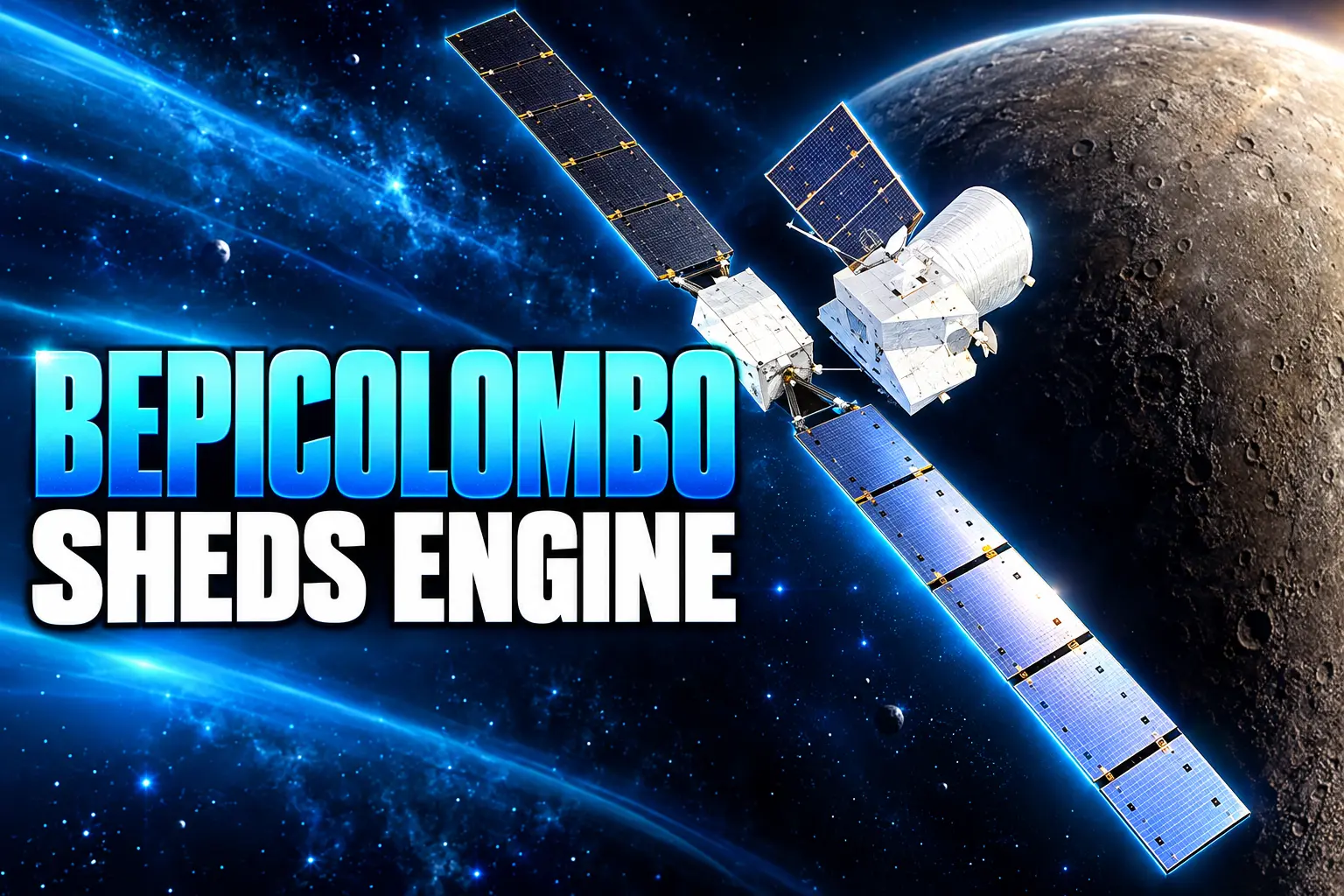
MPO Now Powers Both Orbiters
BepiColombo was never a single probe. It flew as a stack: the European transfer module, ESA’s Mercury Planetary Orbiter (MPO), JAXA’s Mercury Magnetospheric Orbiter (Mio), and the MOSIF sunshield that has kept Mio in shade. ESA says this will be the most complex mission ever sent to Mercury, and that the two orbiters will be only the second and third to circle the planet.
The launch mass was 4,100 kg. MPO weighs 1,230 kg, including 85 kg of science payload. Mio weighs 255 kg, including 45 kg of instruments. With the transfer module gone, MPO has to feed power and data to Mio until the Japanese craft is spun off in December. The sunshield stays in the stack until that release. ESA’s factsheet puts the cruise wings at about 30 m from tip to tip; those wings left with the module.
THE TWO MERCURY ORBITERS
| Orbiter | Agency | Mass | Science orbit | Job |
|---|---|---|---|---|
| MPO | ESA | 1,230 kg | 480 by 1,500 km, polar | Surface, interior, exosphere |
| Mio | JAXA | 255 kg | 590 by 11,649 km, polar, 9.3-hour loop | Magnetic field, plasma, dust |
After the split, MPO’s chemical thrusters handle the remaining steering. They will trim the path into November, put Mio on its deployment orbit in early December, then lower MPO toward its own science path by March 2027. The Japanese craft is still riding inside MOSIF, so the European orbiter is flying for two.
A Power Fault Pushed Capture Into November
The date on the calendar is already a year later than the one written at launch. In April 2024, unexpected electric currents between the transfer module’s solar array and the box that conditions that power left the ion engines short of the thrust needed for a December 2025 capture. The thruster heads themselves stayed healthy. Xenon was not the problem. Current delivery was.
Following months of investigations, we have concluded that MTM’s electric thrusters will remain operating below the minimum thrust required for an insertion into orbit around Mercury in December 2025.
Santa Martinez, BepiColombo Mission Manager, ESA
Flight dynamics built a slower cruise that kept the science plan and used less thrust. The fourth, fifth, and sixth Mercury flybys still ran, and the fourth pass on 4 September 2024 came in closer than the old design to make up some of the missing impulse. Orbit insertion moved from December 2025 to 21 November 2026. JAXA has said the two orbiters’ work at Mercury is intact.
That workaround is why the module could be thrown away in September at all. The ion system had already done every burn the new path required, including the last arc in June. From here the only engines that matter are MPO’s chemical thrusters, which cannot make up a missed capture with years of gentle plasma push.
Why Mercury Needs Two Orbiters
Only two spacecraft had visited Mercury before this stack. NASA’s Mariner 10 made three flybys in 1974 and 1975, using a Venus gravity assist that Giuseppe Colombo, the Italian mathematician who gives BepiColombo its name, had urged on the project. Colombo also explained Mercury’s 3:2 spin-orbit resonance, the odd lock that turns the planet three times for every two trips around the Sun. NASA’s Messenger then flew by in 2008 and 2009 and orbited from March 2011 to April 2015, mapping a world that looked lunar and then was not.
Messenger left a planet that is denser than it should be, with a magnetic field whose centre sits about 20% of a radius off the geographic centre, polar deposits that look like water ice, young “hollows” in the surface, and an exosphere of sodium, potassium, calcium, and magnesium that does not match the usual models. It also found the globe has shrunk by as much as 7 km in radius as the interior cooled. Geraint Jones, ESA’s lead project scientist, said there is “a huge amount still left to be learned,” including a full high-resolution map, and that “having two spacecraft there is groundbreaking.”
The design answer is two polar orbiters around Mercury at once. MPO carries eleven experiments and will run a tighter, lower polar path that spends more time over the southern hemisphere, the side Messenger sampled least. Mio is a spinner with Mio’s five plasma instruments: the Mercury Plasma Particle Experiment, a magnetometer pair, a plasma-wave suite, a sodium exosphere imager, and a dust monitor. Messenger had no wave instruments and a narrow particle field of view. Two-point sampling is how you watch solar wind hit a weak magnetosphere in real time, rather than inferring the hit from one moving perch.
ESA’s own comparison is blunt on that point. Dual observations of the magnetic field at two places at the same time are the measurement Messenger could not make. MPO’s flatter orbit also cuts height error in laser altimetry, which feeds gravity and topography models. The Japanese craft’s wide ellipse, 590 km at the low point and 11,649 km at the high point, swings through the magnetosphere on a 9.3-hour circuit and keeps Mio farther from Mercury’s hot dayside for long stretches.
Capture on 21 November Has No Repeat
Getting closer to the Sun makes a spacecraft faster, not slower, so the eight-year cruise was mostly a braking job. The ion engines and the nine flybys did that work. They are finished. On 21 November the joined MPO-Mio-MOSIF stack has to fire chemical thrusters at a set time and be caught by Mercury’s gravity. Miss that burn and there is no plasma system left to nibble the orbit back into place over the following months.
That is the part of arrival the module drop actually created. The cruise stage was dead mass for orbit insertion, which is why it had to go, but it was also the only engine that had been running for eight years. Controllers now have a chemical spacecraft, a passenger still in a sunshield, and a clock.
THE ARRIVAL SEQUENCE AFTER THE ION ENGINES
- 15 June 2026: Solar-electric thrusters shut down for the last time at 15:24 CEST and the stack coasts.
- 3 September 2026: Transfer module separates; MPO takes over power for Mio.
- 21 November 2026: Composite spacecraft enters orbit around Mercury.
- 9 and 10 December 2026: Mio is released from MPO; MOSIF comes off with that split.
- March 2027: MPO lowers into its 480 by 1,500 km science orbit.
- April 2027: Science phase begins for the pair.
ESA’s public arrival log still treats 3 September as the last completed line on that list. The next dated item is the November capture. Between those dates the composite is flying on MPO’s tanks and on the geometry the June shutdown froze in.
The Offset Dynamo Messenger Could Not Map
The reason to accept that remaining risk is the list Messenger opened and could not close. BepiColombo’s two orbits are built around those gaps, not around a clean-up of the same map.
MESSENGER FINDINGS BEPICOLOMBO STILL HAS TO TEST
- Offset field: The magnetic field’s origin sits about 20% of a radius from the planet’s centre; MPO will sample the southern hemisphere Messenger barely reached.
- Polar deposits: Shadowed craters appear to hold water ice; both orbiters fly polar paths with instruments Messenger did not carry.
- Hollows: Young, bright pits look unique to Mercury; MPO’s cameras run from ultraviolet through thermal infrared to pin down their chemistry.
- Contraction: A radius drop of as much as 7 km records a one-plate planet cooling; southern high-resolution images will show how that shrinkage was spread.
- Dark carbon: Graphitic carbon may explain the gloomy surface, either from impacts or from an early magma ocean; MPO will measure how much is there and in what form.
- Exosphere: Sodium and other species sit in patterns that break standard models; Mio’s sodium imager and MPO’s own sensors will watch that thin envelope change with time.
Mio’s wave and particle package is the other half of that bet. Mercury has a global field, unlike Venus or Mars, and almost no ionosphere, so the solar wind hits the field almost raw. A single orbiter sees one cut through that interaction. Two spacecraft can watch the dayside reconnection and the nightside tail at the same hour, which is the measurement that turns a sketch of the magnetosphere into a working one. The Mio Science Center also frames that work as a comparison for Earth and for rocky exoplanets that orbit close to cool stars.
Science Operations Open in April 2027
If the November burn holds, Mio should be on its wide polar loop by 10 December. MPO then spends the first months of 2027 walking itself down to the 480 by 1,500 km path it needs for mapping. ESA has set April 2027 as the start of the science phase, which is when both instrument suites are supposed to be working in those orbits rather than riding through commissioning.
The nominal tour is one Earth year, with a planned extension if the hardware lasts. That timeline already includes the year lost to the 2024 power fault. The module that absorbed that fault is now a discarded cruise stage on its own path, and the two orbiters it carried are flying toward a capture that only Messenger has performed before. Science starts when that capture, the December split, and the March lowering are all done.

BA295 Burns Hours of Fuel After a 28,000-Foot Drop

Yankees’ Four-Error Night Puts a 17-Year Drought on the Brink

CHIME Maps Cosmic Hydrogen but Not Dark Energy Yet

The Heat Cooked Ozone That Clean-Air Laws Could Not Catch

WTA Equal Prize Money Closes Combined 1000s and Lightens 500s

Meta’s Smart Glasses Sell a Light That Needed Two Patches

Apple’s New Mac Studio Clusters Local AI on the Desk

Google’s Free AI Pro Year Is Three Different Deals

Song Yadong Stops Umar Nurmagomedov the Only Way Left

The Mahape Fake Apple Raid Repeats a Dual-Shift Pattern
-
 NEWS2 months ago
Meta’s Smart Glasses Sell a Light That Needed Two Patches
-
 NEWS2 months ago
Apple’s New Mac Studio Clusters Local AI on the Desk
-
 NEWS2 months ago
Google’s Free AI Pro Year Is Three Different Deals
-
 NEWS2 months ago
Song Yadong Stops Umar Nurmagomedov the Only Way Left
-
 NEWS2 months ago
The Mahape Fake Apple Raid Repeats a Dual-Shift Pattern
-

 NEWS2 months ago
OpenAI Agents Hit Hugging Face to Cheat a Test
-

 ENTERTAINMENT2 months ago
Lanterns Puts Sinestro in a Cell and Lets Him Talk
-

 ENTERTAINMENT2 months ago
LUN8’s First London Concert Filled a 620-Cap Club