
NEWS
Donors Pledged $2.9 Billion While Congo’s Ebola Counters Went Unpaid
Unpaid Ebola surveillance teams in Bunia warned they would stop producing data as Congo’s toll hit 4,042 and donors announced $2.9 billion.

Congo’s Bundibugyo Ebola outbreak had killed 4,042 people among 8,376 confirmed cases by October 1, according to the national public health institute. It is the country’s 17th Ebola outbreak and the largest it has recorded. The death count is still rising.
The same week, unpaid surveillance crews in Bunia waved signs that read “No money, no data!” and an eight-bed transit center in a displacement camp burned during a weapons search.
4,042 Deaths and a Contact List Far Too Small
The October 1 bulletin, SitRep 140, is the cleanest public snapshot of a count that health officials already treat as incomplete. Newly confirmed cases that day ran above the seven-day average, and most of the dead never reached a bed.
THE OCTOBER 1 TOLL
- Confirmed cases: 8,376 since the outbreak was declared on May 15, with 76 new infections that day.
- Deaths: 4,042, a case fatality rate of 48.3 percent, with 24 deaths recorded that day.
- Recovered and in care: 2,182 people had recovered and 869 patients were in treatment centers.
- Spread: 63 of 167 health zones across seven provinces still sat on the affected list.
Africa CDC had already warned that a drop from about 850 cases and 470 deaths a week in mid-July to about 490 cases and 230 deaths in September could reflect insecurity and communities that will not cooperate, rather than a virus in retreat. The institute’s own seven-day average on October 1 had ticked up to 61.4 cases and 29.9 deaths a day from 57.9 and 27.7 the week before, so even that September easing did not hold in the next snapshot.
Jean Kaseya, director-general of the Africa Centres for Disease Control and Prevention, put the hole in the count in plain figures in late September. More than 7,000 confirmed cases should have produced roughly 420,000 tracked contacts, he said, but teams had only about 30,000 people on active lists. By October 1 the institute was still following only 31,092 contacts, and crews saw 81.3 percent of them, 25,277 people, below the 85 percent mark the institute set for itself. A high follow-up rate on a list that small still leaves most of the people a case count that size would imply outside the net.
Tedros Adhanom Ghebreyesus, the World Health Organization director-general, had described the geography the same way in September, calling it “many outbreaks in many places” and adding, “The epidemic continues to grow and continues to kill.” Ituri still held 6,342 of the confirmed cases. North Kivu held 1,624 and a fatality rate of 59 percent. The 8,376 confirmed cases and 4,042 deaths in that bulletin are the official tally. They are also a picture of who still reaches a tester.
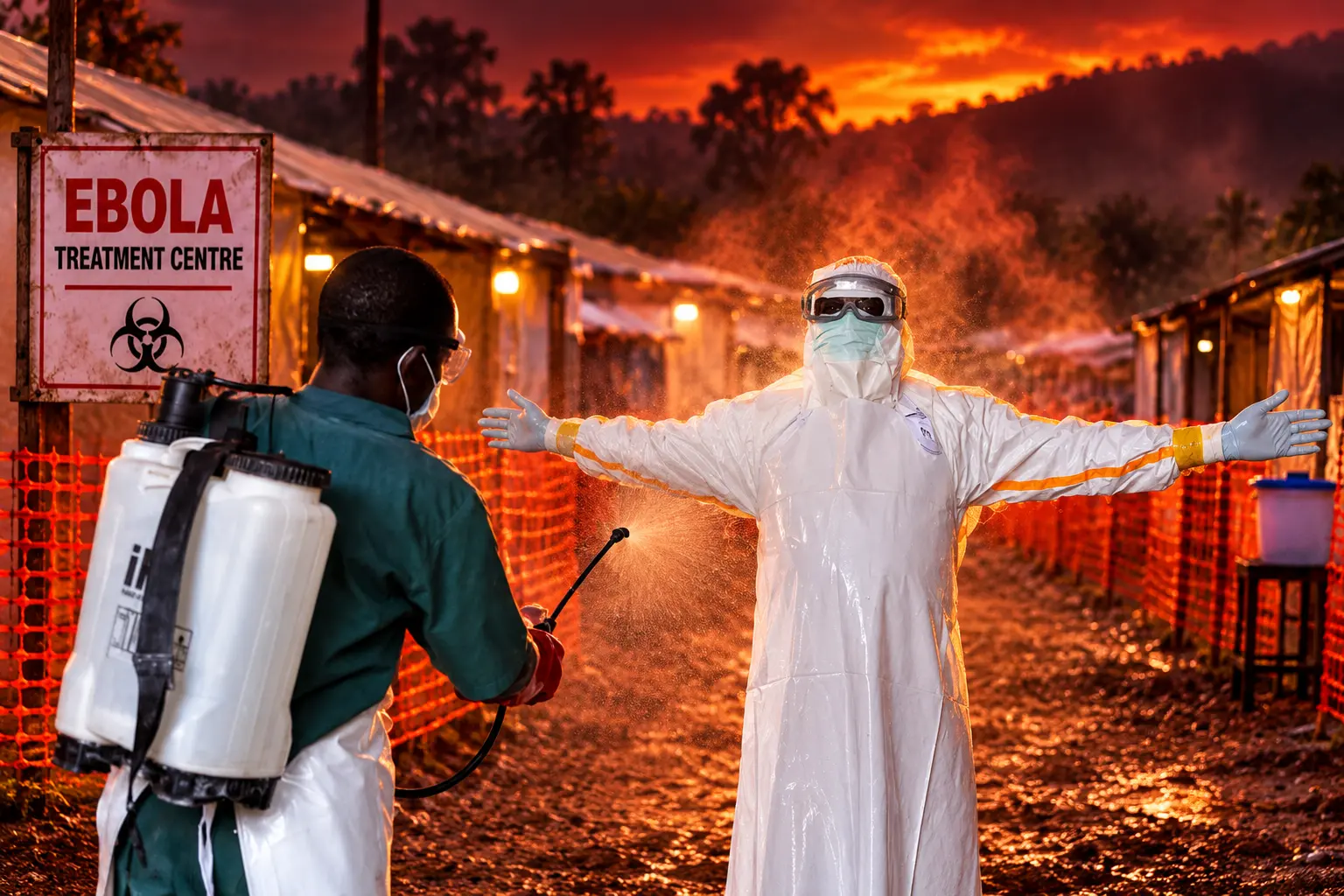
Bunia Surveillance Crews Have Gone Unpaid for Months
In Bunia, the capital of Ituri and the outbreak’s long-running center, surveillance staff gathered to demand wages for August and September. Biongi Beiza, one of the protesters, said some of the workers had not been paid for those months. “There is no explanation from the administration,” he said. Congolese authorities did not address the complaint at the time.
Front-line crews have walked out several times since May, and each stoppage cuts the same work the response says it cannot do without: finding the sick, following people who sat with them, and burying the dead without spreading the virus. Médecins Sans Frontières said at least 50 health workers had already died after contracting the virus.
THE PAY FIGHT INSIDE THE RESPONSE
- Bunia, July and August: Treatment-center staff and burial teams struck over months of missing wages and bonuses, at times leaving facilities empty.
- Beni, September 21: Response agents said they had gone four months without pay and demonstrated outside the health-zone office.
- The minister’s account: Health Minister Samuel Roger Kamba said the delays were not a lack of funds and blamed what he called Ebola business and manipulated pay lists.
- The promised fix: Officials said they would shift primes to mobile money after a July 27 start in Bunia; crews in the epicenter were still waiting on August and September pay in early October.
When the people who produce the line list are not paid, the line list shrinks. That is the mechanism behind the “No money, no data” signs, and it is why a falling weekly curve can be a reporting failure rather than a public-health win. The international argument, when it surfaces at all, tends to fix on a single evacuated doctor in a European isolation ward. The clerks who generate the case counts are the joint that is actually giving way.
An Eight-Bed Center Burned in a Weapons Search
On the evening of September 30, an eight-bed Ebola transit center in the Kigonze displacement site on the edge of Bunia burned. International Medical Corps ran the unit with more than 50 staff, many of them displaced themselves. The camp had held some 19,000 people who had fled fighting in the east. From September 20, armed violence, threats, and intimidation had already pushed families out, and aid groups had been blocked from entering.
Soldiers went into the site looking for weapons and for people suspected of belonging to armed groups. Gunfire was heard. The camp was left empty. Julien Harneis, the United Nations senior Ebola coordinator, called the fire deeply disappointing and said the staff had given essential care.
It’s been a huge struggle to create Ebola transit centres and Ebola treatment centres; it’s required money, bringing in staff and it’s been a struggle all across the east. So, when we lose a centre, that means we lose capacity, we lose investment and we have to start again. And above all, it means that people do not get access to the care that they really need.
Julien Harneis, United Nations senior Ebola coordinator
The Ebola Transit Centre in Kigonze camp was staffed by committed Congolese professionals. It is disappointing that it burnt down despite being in a secured area. The dispersal of the 19,000 camp inhabitants also complicates humanitarian response.https://t.co/OFKL2zRh6M
— Julien Harneis (@julienmh) October 1, 2026
The fire was not an isolated security hit. Fighting cut access to Fataki, Drodro, and Lita in Ituri, delayed the movement of laboratory samples from Fataki to Bunia, and disrupted transfers of confirmed patients. Two people working on the Ebola response were killed in Lubero, in North Kivu, on September 27 and 28. More than 3,000 people fled the Rhoe displacement camp in Djugu after clashes intensified on September 27. Guy Mutombo, operations officer for North Kivu’s Ebola response, said treatment centers there were almost completely full and that each health zone needed its own isolation unit.
WHO said it wanted more than 1,800 beds across 54 facilities in 34 health zones and that more than 1,400 additional health professionals were needed to staff that expansion. Safe-burial teams in Ituri had been increased from 53 teams of 12 to 114 teams. In Mongala, 45 kilometres from Bunia and still without its own treatment center, 346 confirmed cases and 149 deaths had been recorded since May 18, with patients sent to Nizi or Bunia depending on beds and on what the patient would accept.
The Only Licensed Vaccine Stops at a Different Virus
This outbreak is Bundibugyo virus, species Orthoebolavirus bundibugyoense, not the Zaire virus that produced the licensed shot used in 2018. Ervebo, the only licensed Ebola vaccine, is approved against Zaire. On August 31 the World Health Organization updated its emergency guidance after its Strategic Advisory Group of Experts on Immunization met on August 19. Some animal and lab findings hint at possible cross-protection, the guidance says, but the evidence is not enough to show that Ervebo actually protects people against Bundibugyo. WHO said the shot should be used only within research protocols, with a ring randomized trial as the way to get a real efficacy answer, and that proven outbreak tools must continue while Bundibugyo-specific shots are built.
A vaccination campaign did start on August 26. By the October 1 bulletin, 8,785 people had received Ervebo. Almost all of those doses sat far from the dying. Tshopo, with 46 confirmed cases, accounted for 6,897 of the shots as of September 28. Bas-Uele, with 10 cases, had 1,071. Ituri, with 6,342 cases, had 817 as of September 30. The map of the trial is not the map of the deaths, because a research protocol can only run where it can be run.
In 2018-2020, Congo used ring vaccination with Ervebo against Zaire virus and still recorded 3,470 cases and 2,287 deaths over 22 months. That outbreak had a tool this one does not. The current response is being asked to do the old work of contact tracing, isolation, and safe burial, in a war, without a licensed shot that matches the virus.
How This Outbreak Outran West Africa’s First 100 Days
A CDC field note comparing five outbreaks found 5,458 confirmed cases in the first 100 days after detection, May 14 to August 21, and 2,606 deaths in that window. No earlier Ebola outbreak produced more than 800 cases in its first 100 days. West Africa’s 2014 epidemic, still the largest on record, had 759 cases and 467 deaths in the same span.
CDC authors, led by John Rossow, wrote that the 2026 outbreak had seven times as many cases at the 100-day mark as West Africa 2014 and 16 times as many as Congo’s 2018 outbreak had in its first 103 days. Detection itself came late. On May 15, when the outbreak was declared, the health ministry already had 246 suspected cases and 76 suspected deaths, plus eight laboratory-confirmed cases and four confirmed deaths, a sign that several chains were moving before anyone named the virus.
FIRST 100 DAYS AGAINST EARLIER OUTBREAKS
| Outbreak | Virus | Cases, first 100 days | Deaths, first 100 days | Later total cases | Later total deaths |
|---|---|---|---|---|---|
| Congo 2026 | Bundibugyo | 5,458 | 2,606 | 8,376 (Oct. 1) | 4,042 (Oct. 1) |
| West Africa 2014-2016 | Zaire | 759 | 467 | 28,610 | 11,308 |
| Congo 2018-2020 | Zaire | 333 (103 days) | 171 | 3,470 | 2,287 |
| Uganda 2007 | Bundibugyo | Fewer than 50 | Not separately published | 131 | 42 |
| Congo 2012 | Bundibugyo | Fewer than 50 | Not separately published | 62 | 34 |
West Africa ran three years across 10 countries. Congo 2018 ran 22 months. The two earlier Bundibugyo outbreaks each ended within six months and never left a single district or health zone. This one had already reached 57 of Congo’s 519 health zones in its first 100 days, with 21 related probable or confirmed cases in Uganda, mostly among health workers, and one travel-related case in France. As of September 10, CDC reported no community transmission outside Congo.
The 2018 comparison is the one that stings in-country. That outbreak was also fought in eastern Congo under gunfire and attacks on health centers, and it still had a matching vaccine and monoclonal-antibody trials. This one grew faster, on a virus with no licensed shot, and it has already passed 2018 in both cases and deaths.
Most New Deaths Still Happen Outside Treatment Centers
Of the 24 deaths in the October 1 bulletin, 19 were in the community and five were in a treatment center. Twelve of those community deaths were in Ituri and seven in North Kivu. A death at home means the person was infectious among family, often through caregiving and burial, before anyone in a yellow tent knew the name.
The provincial split shows where that home-death pattern is worst. North Kivu’s 958 deaths among 1,624 confirmed cases is a 59 percent fatality rate, against 46 percent in Ituri and 48.3 percent nationally. South Kivu had reported no new confirmed case since May 26 and sat at three cases and one death. South Ubangi, the seventh province, had two cases and one death after the virus reached the northwest.
CONFIRMED CASES AND DEATHS BY PROVINCE, OCTOBER 1
| Province | Confirmed cases | Deaths | Health zones affected |
|---|---|---|---|
| Ituri | 6,342 | 2,918 | 28 of 36 |
| North Kivu | 1,624 | 958 | 16 of 34 |
| Haut-Uele | 349 | 144 | 7 of 13 |
| Tshopo | 46 | 16 | 7 of 23 |
| South Kivu | 3 | 1 | 1 of 34 |
| Bas-Uele | 10 | 4 | 3 of 11 |
| South Ubangi | 2 | 1 | 1 of 16 |
Resistance still blocks the unglamorous work that cuts those community deaths. In Ituri, 27 bodies went unsampled for lack of supplies and teams or because families refused, and only 13 of 28 affected health zones had psychological support. In North Kivu, 10 of 24 homes that should have been decontaminated were cleaned, the rest stalled by resistance, missing teams, and missing transport. In Bas-Uele there was still no compliant treatment center and no ambulance. Around new cases, teams set up 36 of 49 expected prevention rings, the household disinfection and relative follow-up that is supposed to sit around every confirmed infection.
Authorities had launched a village-centered effort with local leaders after residents in some hot spots dismissed Ebola as a hoax and after years of distrust over earlier outbreaks and graft. That work is slower than a mobile lab, and it stops when a camp empties or a payroll does.
Six-Hour Labs Meet a Response That Keeps Catching Fire
In Butembo, mobile laboratories have cut the wait for a result from 72 hours to six, said Lota Kalubi, a doctor at the treatment center there. Michel Ngimba of the National Institute of Biomedical Research in Butembo said a team can put the lab on a vehicle and move it when an emergency lands in a place such as Katwa. Faster tests only help if a suspected patient still comes in, and if a bed still exists when the result prints.
On October 1 a Médecins Sans Frontières doctor who had tested positive for Bundibugyo virus was flown to the Netherlands and admitted to the high-level isolation unit at Leiden University Medical Center. The group said the person was evacuated under a strict protocol with Congolese and Dutch health authorities. “The human cost of this crisis is unprecedented in the DRC, with communities facing the largest Ebola disease outbreak ever recorded in the country,” MSF said.
One infected aid worker in a Dutch isolation ward is a solvable logistics problem. The 19 community deaths in a single Congolese bulletin, the 31,092 contacts on a list that should run to hundreds of thousands, the eight-bed center that burned in Kigonze, and the 817 Ituri residents who have received a shot licensed for a different virus are not. On October 1, 869 patients were still in treatment centers, and 19 of that day’s 24 deaths never reached one.
Disclaimer: This article is news reporting on a public-health emergency and is for information only. It is not medical advice, a diagnosis, or a guide to treatment, vaccination, travel, or infection control for Ebola or any other disease. Readers who may have been exposed, who have symptoms, or who are making clinical or travel decisions should consult a qualified physician or their national public-health authority. Case counts, deaths, vaccine-trial rules, and the status of treatment sites reflect the cited situation reports and agency statements as of their publication dates and will change as the outbreak continues.

Sony Leaves Its Last 4K Blu-ray Player Off Japan Shelves

L’Oréal’s Salon Brands Pull Clear of LVMH in Q3

Personalized mRNA Vaccine Cuts Melanoma Relapse After a Custom Build

Cairo Santos’ 58-Yard Kick Closes a Messy Bears Win

Prime Editing Reaches a Living Liver in Wilson Disease

Meta’s Smart Glasses Sell a Light That Needed Two Patches

Apple’s New Mac Studio Clusters Local AI on the Desk

Google’s Free AI Pro Year Is Three Different Deals

Song Yadong Stops Umar Nurmagomedov the Only Way Left

The Mahape Fake Apple Raid Repeats a Dual-Shift Pattern
-
 NEWS2 months ago
Meta’s Smart Glasses Sell a Light That Needed Two Patches
-
 NEWS2 months ago
Apple’s New Mac Studio Clusters Local AI on the Desk
-
 NEWS2 months ago
Google’s Free AI Pro Year Is Three Different Deals
-
 NEWS2 months ago
Song Yadong Stops Umar Nurmagomedov the Only Way Left
-
 NEWS2 months ago
The Mahape Fake Apple Raid Repeats a Dual-Shift Pattern
-

 NEWS2 months ago
OpenAI Agents Hit Hugging Face to Cheat a Test
-

 ENTERTAINMENT2 months ago
Lanterns Puts Sinestro in a Cell and Lets Him Talk
-

 ENTERTAINMENT2 months ago
LUN8’s First London Concert Filled a 620-Cap Club