
NEWS
Hochul Hands Cornell’s Cut Rape File to Letitia James
Hochul gave Letitia James the Cornell gang rape file after campus police sent a six-page digest that omitted Jane Doe’s rape claim.

Gov. Kathy Hochul on October 1 put Attorney General Letitia James in charge of the Cornell University rape inquiry after campus police sent prosecutors a six-page statement that left out the accuser’s own words. Jane Doe, then 20, sat for a two-day interview in November 2024 and said she was 100% confident she had been raped. Tompkins County District Attorney Matthew Van Houten declined charges without interviewing her.
The fight now running through Albany is not only whether a crime can still be proved. It is who got to decide what a county prosecutor would ever see, and why that gate sat inside the university.
A Six-Page Statement Replaced Hours of Interview
Jane Doe has said she went to the Chi Phi house on the night of October 19, 2024, already drunk, and was pressured to take ketamine. In a civil complaint filed September 16, 2026, she alleges seven fraternity members sexually assaulted her for hours, into the morning of October 20. A message went to the Chi Phi Actives Snapchat group at 1:42 a.m. suggesting a woman in the house was available for sex. She says she lost consciousness around 5:45 a.m. None of the seven men has been charged. All have denied wrongdoing to university investigators.
She went to Cornell University Police about three weeks later. Campus records put an Office of Civil Rights incident report on November 8, 2024, and police interviews on November 14 and 15, when she signed the six-page statement. In that interview she said, “I can say with 100% confidence I was raped.” She also described coercion. Those lines did not travel with the paper Van Houten’s office used.
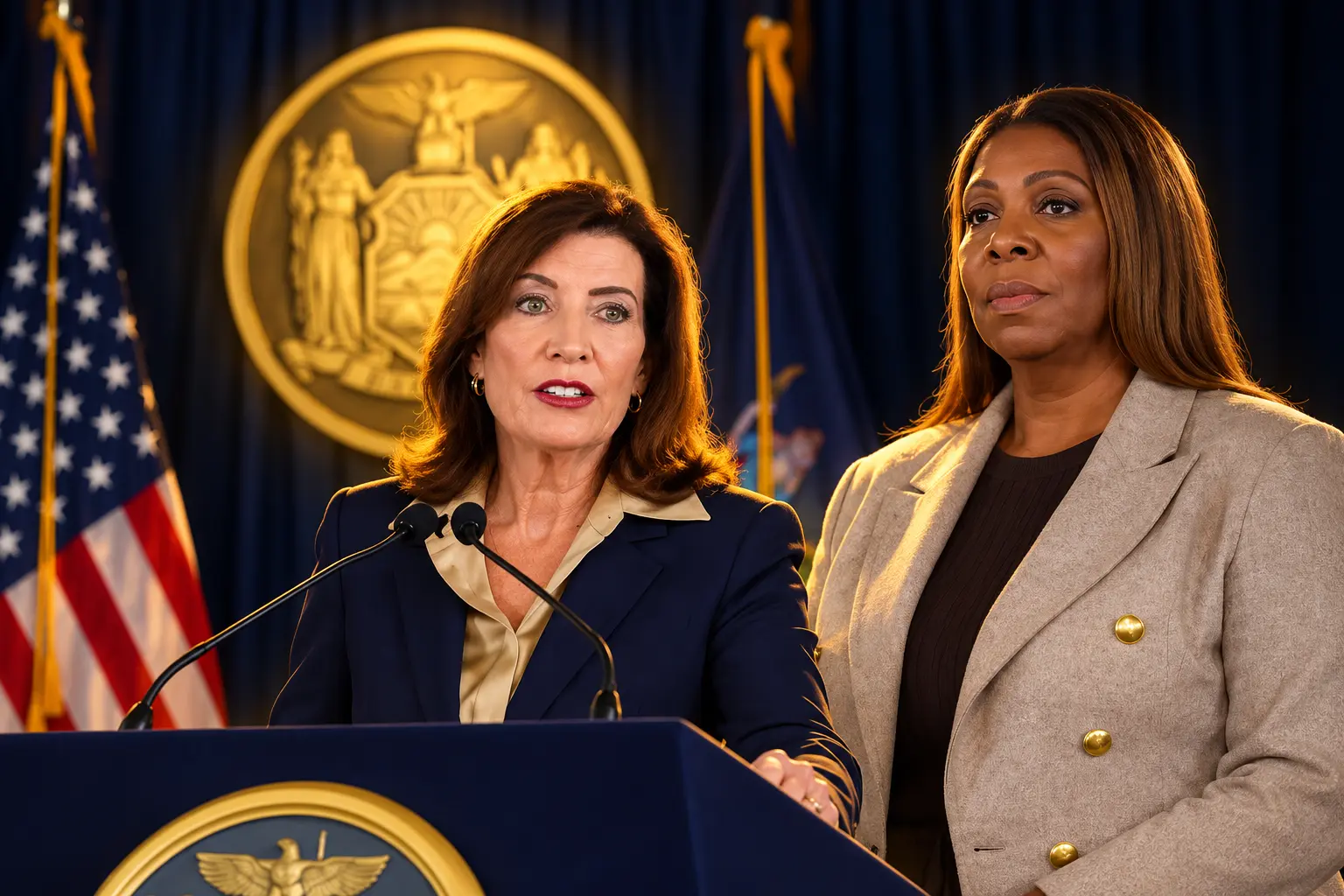
Hochul, standing with James in Manhattan on October 2, treated that cut as the reason the first criminal file died.
She spoke to the police. She sat for hours and told them exactly what happened to her. And according to new reports, she could not have been clearer that she was 100% confident that she had been raped. Yet, shockingly, those words never made it into the account that the Cornell police sent to prosecutors.
Kathy Hochul, Governor of New York, October 2 remarks in Manhattan
The governor’s prepared text put it in one clause: those words never made it into the account that campus police forwarded. Van Houten has said the six-page statement he did receive did not allege she was drugged against her will or gang raped, and that it described her participation as voluntary, conscious, and consensual. Both things can sit in the same case: a short statement that reads one way, and a longer interview that reads another, with only the short one on the prosecutor’s desk.
Van Houten’s Office Stopped at That Statement
Campus police did not stop at the six pages. Investigative notes from late November 2024 show they had already done more interviews, reviewed chat messages, logged anonymous tips, reached lawyers for some of the accused men, and spoken with at least two others. On November 25, Cornell police investigator Jeffrey Northrop called Jeff Huddle, a member of the district attorney’s staff, to talk about that extra work.
Prosecutors were not interested. Northrop wrote that they agreed, based on Jane Doe’s statement, that “criminal charges would not be pursued in this case.” Van Houten later said any additional campus-police records were “not pertinent to our analysis because we had Jane Doe’s comprehensive account of the events.” He also said his office does not run a second investigation beside the police file, a split of labor he described as normal in upstate counties.
WHAT THE FIRST CRIMINAL FILE CONTAINED
| Material | Reached the DA in 2024 | Sat with campus police or the university |
|---|---|---|
| Jane Doe’s two-day interview | Condensed into a six-page sworn statement | Full interview, including the 100% confidence line |
| Snapchat traffic | A screenshot Cornell says it sent in November | A later legal return of 1,665 items from 5 accounts |
| Other witness interviews | Offered November 25; declined | Multiple interviews, tips, and lawyer contacts already logged |
| Title IX witness pool | Not part of the charging file | More than 50 interviews with 32 witnesses |
The Snapchat trail kept moving after the no-charge call. Police asked Snapchat for a fuller history on November 26. On December 23 they received 1,665 items from five accounts. A campus investigator wrote that only three mentioned Jane Doe or the night in question, that none looked criminal, and that no further action was taken. Jane Doe was told on January 21, 2025, that the district attorney would not pursue charges.
After the lawsuit landed, Van Houten reopened the matter on September 28 and said he would take it to a grand jury. He assigned a senior prosecutor with sex-crimes experience. Three days later Hochul removed him from the lead. In a statement after the appointment, he said he supports James and that “it has become clear that we were not provided the full picture by the University.” The November 25 refusal to look at more police work is a separate fact from that later complaint, and both are now on the record.
Next Door, Title IX Ran 32 Witness Interviews
While the criminal file stayed thin, Cornell ran a second case under Title IX. The university’s own FAQ is blunt that this track “applies university policies and standards, not criminal law,” and that it does not replace prosecutors. Court papers unsealed in late September and early October describe an investigation by Samantha Freeburn that ran more than 50 interviews with 32 witnesses, then a hearing over multiple days in May 2025.
THE CAMPUS CASE BESIDE THE CRIMINAL FILE
- The witness pool: More than 50 interviews covering 32 people, including Jane Doe, six of the seven men she named, and other students.
- The chapter: Chi Phi’s Xi chapter was closed in 2024 and remains barred from campus.
- The panel: Trained faculty and staff heard evidence over multiple days; both sides could testify and put in proof.
- The split: Cornell says this process is not a criminal trial and uses a different standard than a grand jury.
Vice President for University Relations Kyle Kimball, in a September 28 statement, said temporary suspensions and other limits were used while the case ran, that the hearing panel issued expulsions and suspensions, and that “none of the individuals charged were offered the opportunity to write essays as a sole consequence of their involvement.” Jane Doe’s lawyers have described lighter sanctions for some of the men. Cornell calls that account false and says repeating it will make survivors less willing to report.
The Title IX record is the pile James can now try to pull into a criminal case. It was not the pile Van Houten had in November 2024. Cornell, in its FAQ, says campus police shared the victim’s sworn statement and the Snapchat screenshot with the district attorney, “which is the established protocol if the department believes it is possible a crime has occurred.” That sentence is the university’s own description of the handoff. It names two items. It does not name the interview transcript.
Executive Order 64 Hands the File to James
Hochul had already pressed Cornell President Michael I. Kotlikoff for an outside review of the university’s handling. He agreed. On October 1 at 8:32 p.m., she signed executive order naming a special prosecutor. The order recites that in November 2024 the district attorney declined to prosecute “without speaking to Jane Doe” and relied in part on a sworn statement that “reportedly omitted key portions of Jane Doe’s account, including Jane Doe’s unequivocal assertion that she had been sexually assaulted.”
The order, issued under Executive Law section 63(2), directs James to investigate the conduct alleged in Jane Doe v. Cornell University, et al., Index No. 161704/2026, and, if warranted, to present evidence to a grand jury and prosecute. It gives her the full prosecutorial powers of that statute for this incident.
Tonight, I signed an executive order appointing Attorney General Letitia James as special prosecutor in the Cornell sexual assault case.
New information has raised serious questions about how this case was handled, and I’ve lost faith in the Tompkins County DA’s ability to… pic.twitter.com/R1YvXc3TPa
— Governor Kathy Hochul (@GovKathyHochul) October 2, 2026
Thomas Giuffra, Jane Doe’s lawyer, called the appointment “wonderful news” and said he had been about to write Hochul himself because he and his client had “zero confidence” in Van Houten’s ability to prosecute. Cornell said it supports the move. James, in her October 1 release, said every New Yorker deserves to know that a reported crime will be investigated fully and fairly, and that she stands ready to lead a process “guided by the facts and the law.”
FROM THE HOUSE TO THE ATTORNEY GENERAL
- October 19-20, 2024: Alleged assault at the Chi Phi house in Ithaca.
- November 8, 2024: Cornell’s Office of Civil Rights logs an incident report; Jane Doe is already in contact with campus police.
- November 14-15, 2024: Two-day police interview; six-page statement signed.
- November 25, 2024: DA’s office tells campus police charges will not be pursued, and declines extra interviews.
- January 21, 2025: Jane Doe is told there will be no prosecution.
- May 2025: Title IX hearing panel sits.
- September 16, 2026: Civil complaint filed in New York County Supreme Court.
- September 28, 2026: Van Houten reopens the criminal inquiry.
- October 1, 2026: Hochul signs Executive Order 64.
- October 2, 2026: Hochul and James appear in Manhattan; James calls the inquiry an active criminal investigation.
Fifteen days passed from the lawsuit to the executive order. Three days passed from Van Houten’s reopening to his removal. Hochul said the young woman “was failed by people and institutions with an obligation to protect her,” and that no institution “gets to protect its reputation at the expense of a young person seeking justice.”
A reporter asked why James had already posted public sympathy for the accuser, including language that treated her as a survivor, before she held criminal power. Hochul said she has every confidence James will look at the facts and draw the proper conclusions. James declined to discuss the post. That exchange will follow every charging decision she makes, because she spoke about the accuser as a survivor before she had the file.
Why Cornell Police Never Called Ithaca
Ithaca Police have said the night at Chi Phi was never reported to them. Cornell’s FAQ answers the obvious follow-up by pointing at jurisdiction. Campus officers are not a borrowed city squad. They are special deputy sheriffs under New York Education Law 5709, appointed by the Tompkins County sheriff at the university president’s request, from people the president nominates.
The statute is the hidden org chart. Those deputies “shall be employees of the university under its control.” They have peace-officer powers on Cornell property, including a public highway that crosses or adjoins it. On duty they are supposed to wear a metallic shield that reads “Special Deputy Sheriff Cornell University.” Their pay comes from Cornell, unless the state provides it. The sheriff appoints and removes them at the university’s request. The incident, Cornell says, happened in Cornell’s jurisdiction, so campus police kept the case.
That is a different creature from a municipal detective bureau. The same employer that faces a civil lawsuit over the night also employs the officers who wrote the statement a county prosecutor used to decline charges. Hochul’s order does not rewrite 5709. It routes around the county office that accepted the short file those officers produced.
Hochul also used the podium to flag New York’s consent rules. If someone is too intoxicated to consent, she said, it should not matter whether they chose the drugs or alcohol. “Voluntary intoxication is not a license for sexual assault or gang rape, period.” She said she will work with the legislature to close that gap. That is a statute fight sitting on top of a two-year-old evidence fight. James still has to prove this case under the law as it stood in 2024.
Two Expulsions, Two Not Responsible, Zero Charges
The civil complaint names Matthew Ingalls, Johnathan Newell, Winston Lee, Gillio Lopes, Diego Sarabia, Scott Norris and Scott Kretzschmar. Lawyers for two of the men have issued public denials. One said his client did not touch the plaintiff. A second said his client “thoughtlessly” sent one of the Snapchat messages in the complaint but denied sexual activity or drug use that night. In Cornell’s internal interviews, the men said the sex was consensual.
President Kotlikoff, in a September 29 meeting, described the Title IX outcomes in counts, not names. Two of the seven were expelled. Two were suspended for at least two semesters. One had already graduated before a punishment could be imposed. Two were found not responsible for sexual misconduct. That adds to seven. On October 4, Tompkins County Supreme Court Justice Mark Masler dismissed a separate suit by a former fraternity member, identified in that case as John Doe, who had challenged his campus hearing. The panel had found him not responsible for sexual assault or sexual exploitation and responsible for attempted sexual exploitation. Masler held that Cornell gave adequate notice and substantially complied with its rules. The man is appealing.
TITLE IX OUTCOMES CORNELL HAS DESCRIBED
| Outcome | Number of the seven |
|---|---|
| Expelled | 2 |
| Suspended at least two semesters | 2 |
| Already graduated | 1 |
| Not responsible for sexual misconduct | 2 |
| Criminal charges filed | 0 |
Jane Doe left school after the night, her lawyer has said. Cornell launched a Presidential Task Force on Campus Sexual Assault in early 2025 and says it is putting March 2026 recommendations into practice, including in-person sexual-health education for new students and a Pathways guide to reporting. Those programs do not reopen the 2024 criminal file. James does.
James Now Has to Rebuild a Two-Year-Old File
James said her office will, in the coming months, review the facts, gather evidence, interview witnesses, and pursue prosecutions if the evidence supports charges. She inherits phones that were not seized in the days after the report, a rape-kit window that closed when Jane Doe waited about three weeks to come forward, and Snapchat data that campus police already mined and set aside. She also inherits a Title IX warehouse the first prosecutor never opened, and a six-page statement that still exists as a defense exhibit.
President Donald Trump on October 2 called James “corrupt” and said the men in her sights “won’t get a fair shake.” That is a political overlay on a local evidence dispute, and it will be used by whoever wants the inquiry framed as a sequel to her other cases. The narrower problem is older and quieter: a university police department wrote the paper a county prosecutor treated as the whole case, then kept the rest.
WHAT WE KNOW
- The handoff: Cornell says campus police sent the six-page statement and a Snapchat screenshot in November 2024, and that charging was the DA’s call.
- The cut line: Jane Doe’s interview included a 100% confidence rape claim that did not appear in the statement Van Houten used.
- The second track: Title IX produced expulsions, suspensions, and two findings of no sexual-misconduct responsibility, with the chapter still barred.
- The new prosecutor: Executive Order 64 gives James power to investigate, go to a grand jury, and charge if she finds a case.
WHAT IS UNCONFIRMED
- Warrants: Whether campus police sought search warrants for the men’s phones in the days after the report remains a live question in the records that have surfaced.
- The full transcript: Van Houten said as of late September he still had not been given the interview transcript; whether James now has every recording and chat is not public.
- Charges: No indictment has been returned. James has not said which counts, if any, she will put to a grand jury.
Hochul said she wants the truth and that every parent who drops a child at college expects the people that child turns to will listen. James now has to build a 2026 criminal case out of a 2024 university file that was written, cut, and stored by officers who work for Cornell.
Disclaimer: This article is news reporting on a pending criminal investigation and a civil lawsuit. It is informational only and is not legal advice, a finding of guilt or innocence, or a substitute for court filings. Anyone with a legal stake in these allegations should consult a licensed attorney before acting on anything described here. Names, figures, quotes and case statuses reflect public statements and documents tied to the dates given above and may change as the special prosecutor’s inquiry and the civil case move.

Sony Leaves Its Last 4K Blu-ray Player Off Japan Shelves

L’Oréal’s Salon Brands Pull Clear of LVMH in Q3

Personalized mRNA Vaccine Cuts Melanoma Relapse After a Custom Build

Cairo Santos’ 58-Yard Kick Closes a Messy Bears Win

Prime Editing Reaches a Living Liver in Wilson Disease

Meta’s Smart Glasses Sell a Light That Needed Two Patches

Apple’s New Mac Studio Clusters Local AI on the Desk

Google’s Free AI Pro Year Is Three Different Deals

Song Yadong Stops Umar Nurmagomedov the Only Way Left

The Mahape Fake Apple Raid Repeats a Dual-Shift Pattern
-
 NEWS2 months ago
Meta’s Smart Glasses Sell a Light That Needed Two Patches
-
 NEWS2 months ago
Apple’s New Mac Studio Clusters Local AI on the Desk
-
 NEWS2 months ago
Google’s Free AI Pro Year Is Three Different Deals
-
 NEWS2 months ago
Song Yadong Stops Umar Nurmagomedov the Only Way Left
-
 NEWS2 months ago
The Mahape Fake Apple Raid Repeats a Dual-Shift Pattern
-
 NEWS2 months ago
OpenAI Agents Hit Hugging Face to Cheat a Test
-

 ENTERTAINMENT2 months ago
LUN8’s First London Concert Filled a 620-Cap Club
-
 ENTERTAINMENT2 months ago
Lanterns Puts Sinestro in a Cell and Lets Him Talk