
NEWS
Blood Antibodies Flag IBD a Decade Before Symptoms
Frozen military blood shows Crohn’s and colitis antibody patterns a decade before diagnosis, on the same slow path type 1 diabetes already walked.

Antibody patterns in frozen military blood flagged Crohn’s disease and ulcerative colitis up to 10 years before diagnosis, according to a study presented in Barcelona. The maps come from 2,000 stored samples and sit on the same slow path type 1 diabetes already walked.
Researchers showed the work on October 19, 2026, at UEG Week, months after the journal Gut posted the paper on July 21, 2026. At least 3.8 million people worldwide live with inflammatory bowel disease, and most still start treatment after the gut is already inflamed.
Frozen Military Blood Holds a 10-Year Record
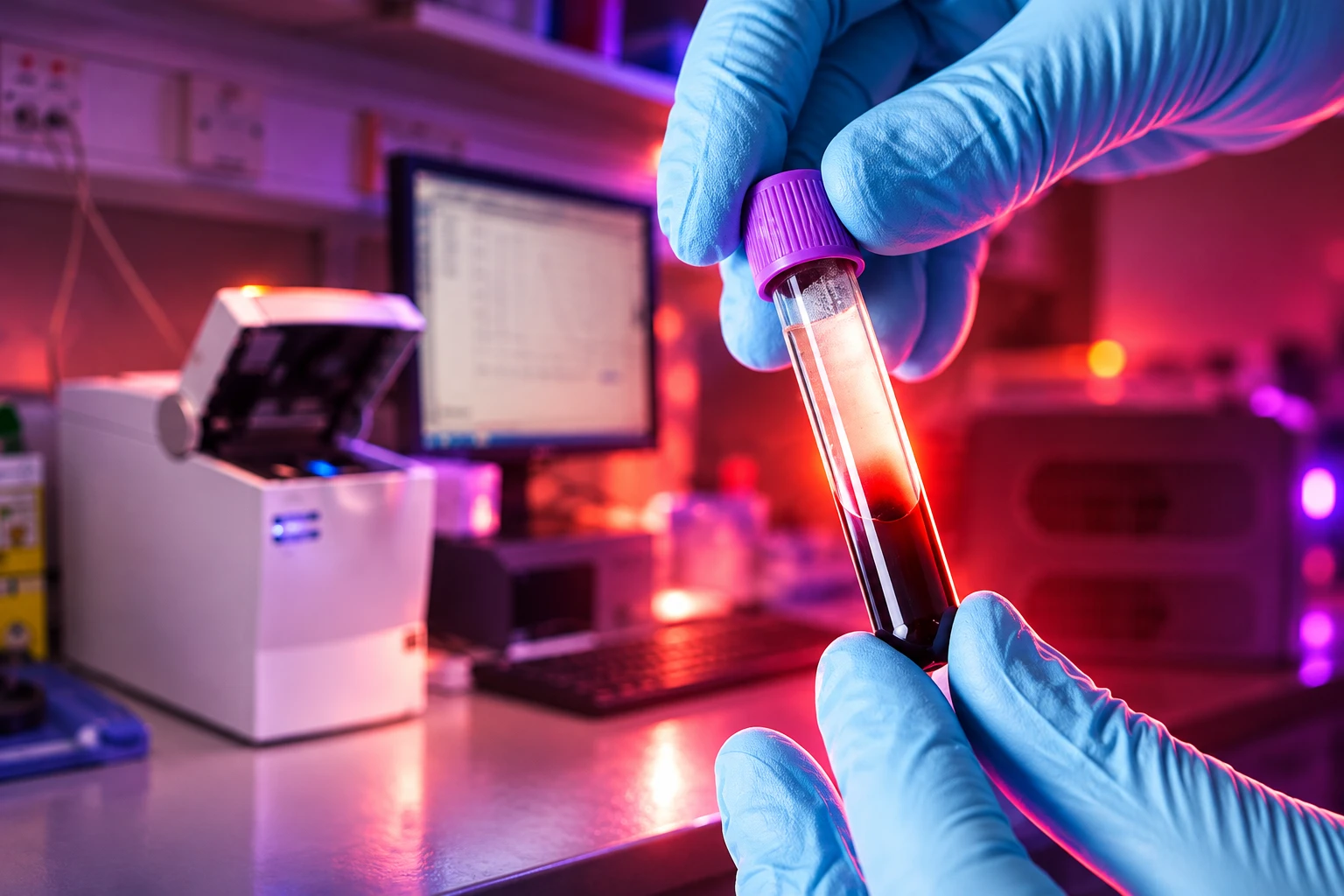
The team, led by Dr. Arno R. Bourgonje of the University Medical Centre Groningen and the Icahn School of Medicine at Mount Sinai, went back through the PREDICTS cohort of U.S. service members. They read 2,000 serum samples from 500 people: 200 who later developed Crohn’s disease, 200 who later developed ulcerative colitis, and 100 matched controls who developed neither.
Each person contributed blood at about 10 years, 4 years, and 2 years before diagnosis, and again around the time of diagnosis. Using phage-display immunoprecipitation sequencing, the group profiled antibody responses against 357,000 viral, bacterial and food antigens, plus peptides from the body’s own proteins.
THE COHORT IN FOUR FIGURES
- The samples: 2,000 stored serum vials drawn across four time points.
- The people: 500 U.S. military personnel, 200 later Crohn’s, 200 later colitis, 100 well.
- The panel: 357,000 microbial, viral, food, and immune peptides.
- The span: immune differences already visible about 10 years before diagnosis.
Antibody repertoires in people who later developed either disease became more variable up to about 4 years before diagnosis. Many of the strongest signals were already present at the earliest draw, a decade out. Saurabh Mehandru, a Mount Sinai gastroenterology professor and corresponding author, said IBD does not develop overnight, and that the immune system is already changing years before the first symptoms.
Crohn’s and Colitis Leave Different Marks
The two main forms of IBD did not share one fingerprint. Crohn’s disease showed elevated antibodies against herpesviruses, especially Epstein-Barr virus, and against bacterial flagellins, the whip-like proteins many gut microbes use to move. Those Crohn’s signals were strongest in people who later developed complicated or ileal disease, the forms that can narrow the bowel or open abnormal channels.
Ulcerative colitis followed a different path. Pre-colitis blood carried mixed antimicrobial and antiviral responses plus autoantibodies, including antibodies against the MAP kinase-activating death domain protein. In both diseases, antibody responses to encapsulated bacteria such as Streptococcus pneumoniae, Haemophilus, and Neisseria fell as diagnosis approached.
ANTIBODY PATTERNS BEFORE DIAGNOSIS
| Signal | Crohn’s disease | Ulcerative colitis |
|---|---|---|
| Epstein-Barr and other herpesviruses | Elevated up to 10 years before diagnosis | Rose through the silent phase |
| Bacterial flagellin antibodies | Elevated, strongest in complicated or ileal disease | Not the Crohn’s-style flagellin signature |
| Encapsulated bacteria | Responses fell toward diagnosis | Reactivity also fell |
| Self-protein antibodies | Not the lead Crohn’s mark | Present, including MADD protein |
In the Barcelona presentation, machine-learning models that combined those early signatures separated future Crohn’s from healthy controls with an AUC of 0.90, and future ulcerative colitis with an AUC of 0.84, up to 10 years before diagnosis. The same profiles separated people who later developed complicated Crohn’s from those who did not, with an AUC of 0.85, about a decade out. Bourgonje said complicated Crohn’s at diagnosis is tied to a distinct antibody profile years before the first clinical symptoms, and is not simply the result of damage after diagnosis.
Why a Common Virus Shows Up So Early
Epstein-Barr virus infects most adults. A yes-or-no antibody test for past infection would flag much of the planet, so the useful signal cannot be “has this person met EBV.” The useful signal is a high-resolution pattern against specific viral peptides, read beside flagellin antibodies and a falling response to encapsulated bacteria.
Mount Sinai’s July 22, 2026, release said the Crohn’s patterns support work on how infections, the gut microbiome, and the immune system meet in the earliest stages of IBD, and that they also fit molecular mimicry, in which a response to a virus or bacterium may hit the body’s own tissues. The paper itself reports a link, not proof that EBV or flagellin-bearing bacteria cause Crohn’s disease. That distinction matters, because a virus this common cannot be treated as a simple on-off switch for IBD.
The cohort is also a limit. Active-duty samples skew young and medically screened, and the findings still need to be repeated in other groups, including older civilians and people outside the United States. Jean-Frédéric Colombel, director of the Susan and Leonard Feinstein Inflammatory Bowel Disease Clinical Center at Mount Sinai and a co-corresponding author, said the work gives one of the clearest pictures yet of the immune changes that precede IBD.
Type 1 Diabetes Already Walked This Path
Gastroenterology is late to a sequence endocrinology has already finished once. Type 1 diabetes researchers spent years showing that two or more islet autoantibodies mark a silent stage of disease, then built screening networks for relatives, then tested a drug in people who still made insulin. On November 17, 2022, the U.S. Food and Drug Administration approved Tzield (teplizumab-mzwv) to delay the onset of stage 3 type 1 diabetes in people 8 years and older with stage 2 disease, meaning at least two autoantibodies plus abnormal blood sugar but no overt diabetes.
The approval rested on a 76-person trial. Over a median follow-up of 51 months, 45% of the 44 patients who received Tzield later reached stage 3, compared with 72% of the 32 patients who received placebo. Median time to stage 3 was 50 months with the drug and 25 months with placebo, a 25-month delay. The drug is given by intravenous infusion once daily for 14 consecutive days. John Sharretts, then director of the FDA division that reviewed it, said the delay may give patients months to years without the burdens of disease.
IBD still has no equivalent of that 14-day course. Treatment still relies on anti-inflammatory and immune-suppressing drugs after symptoms appear, and many patients do not respond. A large share go on to surgery to remove damaged bowel, and longstanding inflammation raises the risk of bowel cancer. The diabetes timeline is the honest comparison, because antibody maps arrived years before anyone had a licensed intercept drug to offer the people those maps would flag.
THE LONG CLOCK BEHIND BOTH DISEASES
- 1989: The Department of Defense Serum Repository opens to store leftover HIV-screening blood from service members.
- 2016: An earlier PREDICTS analysis finds antimicrobial antibodies in serum up to six years before a Crohn’s diagnosis.
- November 17, 2022: The FDA approves teplizumab to delay stage 3 type 1 diabetes in people already living with autoantibodies and abnormal blood sugar.
- January 1, 2025: INTERCEPT, a five-year Crohn’s prevention consortium, starts work on a blood risk score and a small intercept trial.
- July 21, 2026: Gut publishes the 10-year PhIP-Seq maps from 2,000 PREDICTS samples.
- October 19, 2026: The same work is presented at UEG Week in Barcelona.
That military freezer is the unglamorous reason a 10-year IBD clock exists at all. The repository, run by the Armed Forces Health Surveillance Division, holds more than 74 million frozen serum specimens in walk-in freezers and adds about 2.0 million vials a year, leftover from mandatory HIV testing that began in the 1980s and from pre- and post-deployment draws. PREDICTS was built on that archive so researchers could pull four samples per person and watch the immune system change before anyone had diarrhea, pain, or a scope.
A European Trial Is Recruiting Relatives
The people who drew the 10-year maps are already tied to the next bet. The Gut paper lists Bourgonje as supported by the Innovative Health Initiative grant INTERCEPT (101194780), and lists Colombel as a co-coordinator of that grant. INTERCEPT is a five-year public-private project that started on January 1, 2025, with a budget of €38.05 million, 21 partners, and teams in 16 countries. It is aimed at Crohn’s disease, not ulcerative colitis.
The IHI factsheet says the consortium will verify a biomarker panel and build a blood risk score meant to identify people at high risk of Crohn’s within five years. It plans to recruit 10,000 healthy first-degree relatives of Crohn’s patients across seven European countries. From that group, 80 people with the highest risk scores are slated for a trial of an established medical treatment, to test whether full-blown Crohn’s can be headed off before symptoms.
WHAT INTERCEPT IS BUILT TO TEST
- The screen: A blood risk score in 10,000 well relatives of people with Crohn’s.
- The window: High risk of Crohn’s within five years of that blood draw.
- The trial: 80 people at the top of the score, given an established drug.
- The aim: Intercept Crohn’s before the bowel is badly damaged.
Colombel has said researchers from Europe, North America, and South Korea are working together to predict and prevent Crohn’s disease, and that success would strengthen the idea that other immune diseases can be prevented too. Relatives are the practical starting pool, as they were for type 1 diabetes screening, because a random adult’s odds of Crohn’s are too low to justify a 357,000-peptide assay. Even a strong AUC in stored military blood is not the same as a cheap, repeatable test in a family clinic.
No Drug Yet Exists for This Silent Phase
Bourgonje was careful on that point in Barcelona. James Lindsay, a professor of gastroenterology at Barts Health who was not involved in the research, said the study offers important insights into the causes of Crohn’s disease and ulcerative colitis and may add tools to identify people at risk, but he also said the techniques are very much a research tool and not yet ready for the clinic. Marianne Radcliffe, chief executive of Crohn’s & Colitis UK, called the work a step forward in understanding changes that may occur years before symptoms appear.
This is not yet a test that can tell someone they will become ill, but it is an important step towards catching the disease earlier and, one day, preventing it.
Dr. Arno R. Bourgonje, University Medical Centre Groningen and Icahn School of Medicine at Mount Sinai, UEG Week 2026
A clinic test would need simpler chemistry than a 357,000-peptide phage library, confirmation outside a military cohort, and a clear next step for a person who screens “high risk” while still well. Type 1 diabetes had all three, including an approved drug, and it still took from antibody staging to November 2022. Crohn’s now has the maps and a 80-person intercept plan. Ulcerative colitis has a different antibody story and no matching prevention trial of that scale in the INTERCEPT design.
For too long, Bourgonje said, IBD has been treated only once the damage is done, and for many people that is too late. The frozen vials say the immune system was already writing that damage down a decade earlier. Until INTERCEPT reports, those vials still cannot tell a well relative what to take, or whether to take anything at all.
Disclaimer: This article is news reporting and analysis of published research and a scientific meeting presentation. It is for information only and is not medical advice, a diagnosis, or a recommendation to seek, skip, or change any test or treatment for Crohn’s disease, ulcerative colitis, or any other condition. Readers who are concerned about bowel symptoms, family history of IBD, or antibody testing should speak with a qualified physician or gastroenterologist before acting on any finding described here. Figures, trial designs, and regulatory statuses reflect the papers, agency releases, and project pages cited at the time of publication and may change as studies are repeated or as trials report.

Sony Leaves Its Last 4K Blu-ray Player Off Japan Shelves

L’Oréal’s Salon Brands Pull Clear of LVMH in Q3

Personalized mRNA Vaccine Cuts Melanoma Relapse After a Custom Build

Cairo Santos’ 58-Yard Kick Closes a Messy Bears Win

Prime Editing Reaches a Living Liver in Wilson Disease

Meta’s Smart Glasses Sell a Light That Needed Two Patches

Apple’s New Mac Studio Clusters Local AI on the Desk

Google’s Free AI Pro Year Is Three Different Deals

Song Yadong Stops Umar Nurmagomedov the Only Way Left

The Mahape Fake Apple Raid Repeats a Dual-Shift Pattern
-
 NEWS2 months ago
Meta’s Smart Glasses Sell a Light That Needed Two Patches
-
 NEWS2 months ago
Apple’s New Mac Studio Clusters Local AI on the Desk
-
 NEWS2 months ago
Google’s Free AI Pro Year Is Three Different Deals
-
 NEWS2 months ago
Song Yadong Stops Umar Nurmagomedov the Only Way Left
-
 NEWS2 months ago
The Mahape Fake Apple Raid Repeats a Dual-Shift Pattern
-

 NEWS2 months ago
OpenAI Agents Hit Hugging Face to Cheat a Test
-

 ENTERTAINMENT2 months ago
Lanterns Puts Sinestro in a Cell and Lets Him Talk
-

 ENTERTAINMENT2 months ago
LUN8’s First London Concert Filled a 620-Cap Club