
NEWS
Bleached Coral Recovers Fast Once a Clone Shares Algae
Stanford found bleached coral self-heals in weeks after clone contact, as donated algae divide about 10 times faster than on reefs.

Bleached coral fragments fully recovered in as little as four weeks after touching healthy clones in a Stanford laboratory. The Oct. 14 Science Advances paper is the fastest documented recovery from coral bleaching. Danny Collins, an oceans Ph.D. student at the Stanford Doerr School of Sustainability, said, “While bleached corals may be dying, they are not dead yet.”
The contact was only how the algae arrived. After about one week, cells inside the white tissue were dividing fast enough to finish recovery without the healthy partner.
Two Fragments Tipped Over in a Pacific Grove Tank
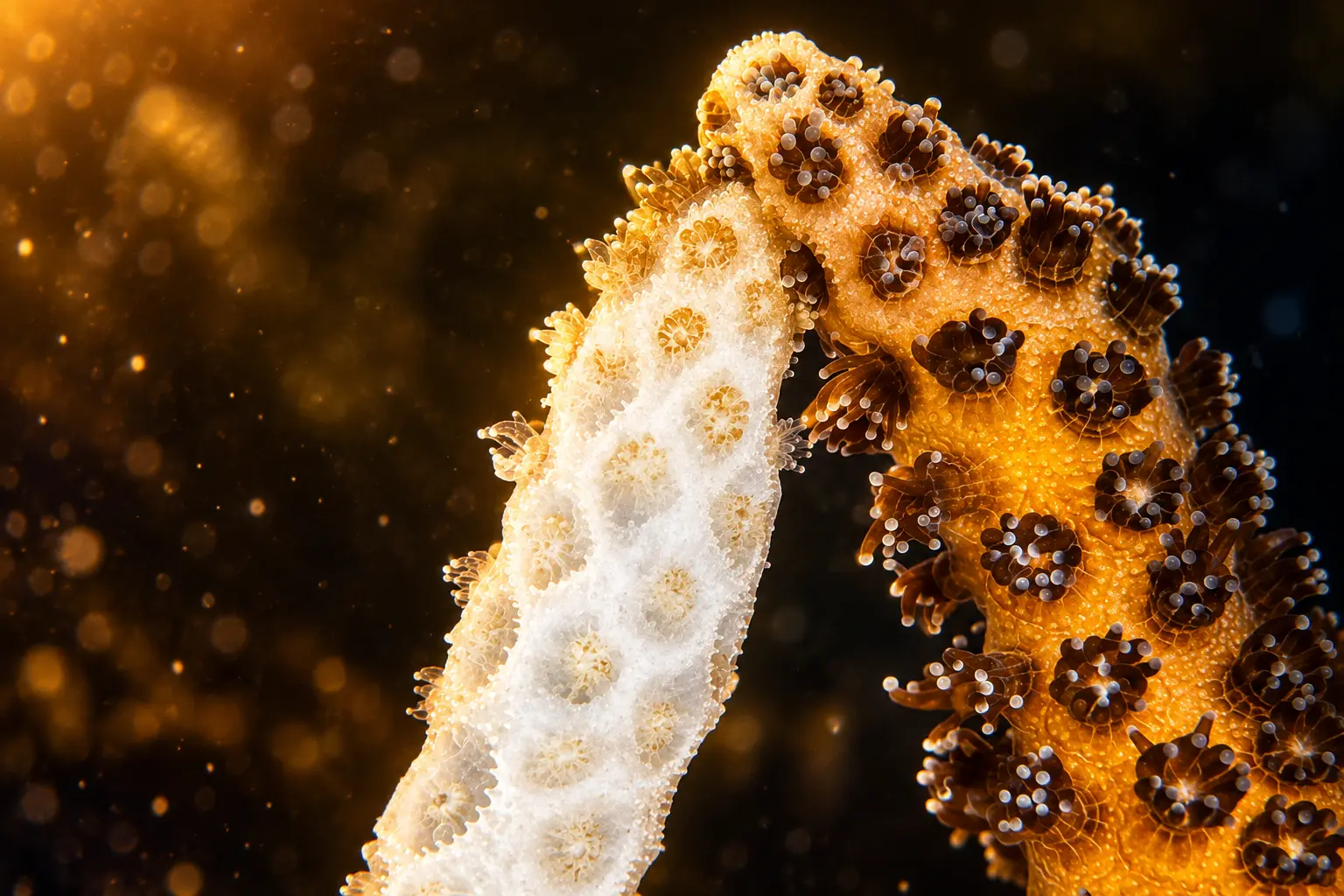
In 2025, Steve Palumbi, the Jane and Marshall Steel, Jr. Professor in Marine Sciences, noticed two pieces from the same colony had fallen against each other in a tank at Hopkins Marine Station in Pacific Grove, California. One fragment was healthy and brown. The other was bleached white. Color was returning at the point where they touched.
Collins was already asking how harmful bacteria on plastic debris get into coral through physical contact, and he flipped the question. If contact can carry a pathogen, he asked, could it also carry the microscopic algae that feed a coral and give it color? When seawater runs too warm, those algae leave the tissue, the animal turns pale, and it begins to starve. NOAA Coral Reef Watch treats four degree C-weeks of heat stress as the point where reef-wide bleaching is expected, and eight degree C-weeks as the range where many corals die.
If a colony lives through a heat wave, getting its algae back often takes months or years. Collins’s question was narrower. “The question we wanted to answer is, once a coral has bleached, what can we do?” he said.
He used aquarium-raised Pocillopora damicornis, a branching coral, and assembled ten pairs of coral fragments from the same animal. Five pairs touched. Five sat a few millimeters apart, close enough to pick up any algae drifting in the water and too far to fuse. A custom microscope mount, 3D-printed by research engineer Tom Rolander, let the team watch individual polyps.
Millimeters of Open Water Blocked the Algae
Every bleached fragment that touched its clone regained full color within eight weeks, and one of those five was fully recovered in four. By week 20 those pieces were growing new branches. The five that sat across a thin gap did not recover. Two died under invading algae, and algae covered at least 87 percent of the other three.
THE CONTACT TEST
| Treatment | Fragments | Result |
|---|---|---|
| Touching same-clone pairs | 5 | All recovered within eight weeks; one recovered in four weeks |
| Same clone, few millimeters apart | 5 | No recovery; two died under algae, three at least 87 percent covered |
| Healthy coral from a different colony | 6 | None recovered; healthy tissue grew over four of the six by week 9 |
A second run pulled pairs apart after set times, from one day to three weeks, with two pairs at each interval. Every bleached piece that had touched a healthy clone for a week or longer still reached full recovery in seven weeks after the twins were separated. One of the two pieces given five days did the same. Three days produced early color that later disappeared under algae. One day produced no recovery.
HOW LONG THE TWINS HAD TO TOUCH
- One week or more: Every tested fragment later recovered on its own in seven weeks.
- Five days: One of two fragments went on to full recovery.
- Three days: Color returned early, then invading algae took over.
- One day: No recovery after the fragments were pulled apart.
Once the twins were separated, no more algae could cross. Any later gain had to come from cells already inside the bleached piece. Andrew Baker, a coral biologist at the University of Miami who was not on the Stanford team, has said people are always looking for ways to speed recovery after bleaching. The gap result is the blunt limit on a waterborne shortcut: a few millimeters of open water was enough to stop the rescue.
Once Inside, the Algae Ran Their Own Clock
Under the microscope, channels in the tissue lined up after contact and made a path between the two animals. Algae and the sugars they make moved through that path. Cells showed up in bleached polyps within three days, and the bulk of the transfer began 36 to 60 hours after the pieces met. When the team later pulled recovering pairs apart, both sides carried a matching tear at the exact spot where color had first returned. A bridge of living tissue had been torn in two.
The paper on symbiont transfer from healthy corals is explicit about what happened next. After the first week, replication inside the bleached fragment, not a continuing pipeline from the donor, drove the rest of the comeback. Palumbi said the cells did not simply wander.
Once beneficial algae enter bleached corals, they don’t just spread out. They flood in and start dividing at the fastest rates seen in corals.
Steve Palumbi, Jane and Marshall Steel, Jr. Professor in Marine Sciences, Stanford Doerr School of Sustainability
Bleached polyps had lost 99.9 percent of their algae at the start of the test. During the second week of contact, the remaining population doubled about every four days, roughly 10 times faster than the rate the team cites for wild corals.
ALGAE INSIDE THE TISSUE
- Bleached start: About 7 algal cells per square millimeter in each polyp.
- Healthy neighbor: More than 6,700 cells per square millimeter.
- First six days: Numbers doubled about every 18 hours after cells arrived.
- Second week: Doubling slowed to about every four days and still outran wild rates.
That burst is the part of the study other labs can try to copy without gluing two animals together. If a starter population can be put into empty tissue, the coral’s own cells appear able to finish the refill at a speed reefs almost never see after a heat wave.
Why Clone Contact Cannot Restore a Reef
The same-clone rule is not a footnote. Most reef-building corals grow by making copies of themselves, so a colony is one genetic individual. When Collins paired bleached pieces with healthy coral from a different colony, both sides pushed out stinging filaments within hours along the line where they met. None of those bleached fragments recovered, and by week 9 the healthy pieces had grown over four of the six.
Palumbi compared the match to a transplant. Genetically identical corals recognize one another, he said, and their tissues fuse if they are from the same clone, much as an organ transplant often works when the donor is an identical twin. Mixed pairings trigger the coral version of rejection. A slower trickle of algae can still move when polyps take up cells on contact, even between different genets, but that path was not enough on its own to save a fragment.
The method therefore needs a healthy genetic copy of every bleached colony. The authors say that is not feasible at the scale of a reef. The fragments also lived in tanks and were fed more than wild coral, and the work used one species. How large an area one contact point can rescue, and whether other corals fuse this way, has not been tested. Palumbi, asked whether reef managers could try the same pairing in the ocean, said the exact method is not really practical on a real reef.
The Last Global Heat Wave Hit 84 Percent of Reefs
The lab clock matters because the ocean’s clock has shortened. NOAA determined that the fourth global coral bleaching event, confirmed on April 15, 2024, likely ended in mid-2025 after bleaching-level heat struck 84 percent of the world’s coral reef area from early 2023 to mid-2025, across the Pacific, Atlantic, and Indian Oceans, with mass bleaching documented in at least 83 countries and territories. Derek Manzello, coordinator of NOAA Coral Reef Watch, said the agency waited until no widespread bleaching was reported in the December 2025 to February 2026 austral summer before treating the event as over.
Each global event has been larger than the last. About 21 percent of reefs saw bleaching-level heat in 1998, 37 percent in 2010, and 68 percent in 2014 to 2017.
FOUR GLOBAL BLEACHING EVENTS
| Event | Years | Reef area under bleaching-level heat | Relative hard-coral cover loss |
|---|---|---|---|
| First | 1998 to 1999 | 21 percent | About 6.5 percent |
| Second | 2010 to 2011 | 37 percent | About 9.9 percent |
| Third | 2014 to 2017 | 68 percent | About 6.6 percent |
| Fourth | 2023 to 2025 | 84 percent | 8.9 percent in 2023 to 2024 |
The Global Coral Reef Monitoring Network’s Status of Coral Reefs of the World: 2025, released Aug. 31, draws on 21.1 million observations from 87,299 surveys at 36,886 sites across 124 countries and territories. Hard coral cover averaged 30.2 percent in 1980 to 2009 and 27.3 percent in 2020 to 2024, a 9.5 percent relative decline. Cover in 2024 was 25.8 percent. The 8.9 percent drop from 2023 to 2024 is the largest single-year loss on record, and the report notes that the fourth bleaching event is not yet fully captured. Satellite records in the same assessment show sea surface temperatures over reefs rose 0.81 C between 1985 and 2025.
Reefs can still rebound when heat eases. Global hard coral cover rose by a relative 6 percent between 2017 and 2019 after the third event. The problem is the gap between blows. Major disturbances once arrived about every 10 years and now often arrive every five or six, with no return to the old reference cover at any point since 2010. A tank recovery measured in weeks is interesting because wild recovery is being asked to finish inside a shorter quiet spell than it used to get.
Breeding and Nurseries Rarely Rescue Coral That Already Bleached
For decades the field has poured effort into stopping the next bleaching, or into growing new colonies to replace dead ones. Far less work has targeted tissue that is already white and starving. Collins and Palumbi place their contact result against that gap.
WHAT CURRENT TOOLS ACTUALLY DO
- Heat-tolerant breeding: Crosses and selection aim to produce stock that bleaches later, on a timeline of years, not weeks after a heat wave.
- Nurseries and outplanting: Fragments are grown and set back on the reef to replace coral that has already died.
- Microbiome transplants: Homogenized tissue from a hardy donor can raise heat tolerance in a recipient, but donors must be sacrificed and pathogens can ride along.
- Lab-evolved algae: Heat-trained symbionts can help recruits in tanks; scaling from millilitres of culture to the volume needed for millions of young corals has not been solved.
- Shading and probiotics: Temporary covers and bacterial doses try to limit damage during a hot spell, with mixed field results and no standard dose.
The Stanford paper notes that those approaches are largely preventative, built to limit bleaching before or during thermal stress. Fiorenza Micheli, the David and Lucile Packard Professor in Marine Science and Collins’s faculty adviser, said bleached corals are often treated as a lost cause because recovery after a heat wave is very slow, if it happens at all. The contact tests do not make those other tools obsolete. They say empty tissue is not automatically finished, if a large enough dose of growing algae can be put inside it before invading algae or starvation wins.
Researchers Now Want a Dose Without a Living Donor
Collins is already testing other ways to deliver a large load of healthy, growing algae that do not require a living twin glued to every bleached branch. The group plans to collect algae from healthy corals well before a heat wave, then apply them in bulk afterward. He has said he hopes to try delivery methods at field sites in Hawaii and Palau. Palumbi put the next experiment in one line: whether a dose can do what a touching twin did has not been run.
The National Science Foundation and Stanford’s Big Ideas for Oceans program funded the tank work, with imaging support from the Molecular and Cellular Biodiversity Imaging Center at Hopkins. Coauthors include Jana Sipkova, Nathaniel Mollica, Tom Rolander, Courtney Klepac, Gabriel Calistro, Vanessa Barone, Micheli, and Palumbi. Micheli, who also co-directs the Stanford Center for Ocean Solutions, framed the result as a door, not a field protocol.
We hope this new research will inspire solutions that keep corals healthy long enough to enable full recovery after heat waves through slower processes such as growth, reproduction, and recruitment of new colonies.
Fiorenza Micheli, David and Lucile Packard Professor in Marine Science, Stanford Center for Ocean Solutions
Even a full-color fragment in a tank is still one heat wave away from bleaching again. The study does not lower the ocean’s temperature, and it does not give a manager a healthy clone for every pale colony on a reef. What it does show is that once a starter population of algae is inside bleached tissue, those cells can multiply at a rate wild reefs almost never manage, and that the refill can finish after the donor is gone.

Sony Leaves Its Last 4K Blu-ray Player Off Japan Shelves

L’Oréal’s Salon Brands Pull Clear of LVMH in Q3

Personalized mRNA Vaccine Cuts Melanoma Relapse After a Custom Build

Cairo Santos’ 58-Yard Kick Closes a Messy Bears Win

Prime Editing Reaches a Living Liver in Wilson Disease

Meta’s Smart Glasses Sell a Light That Needed Two Patches

Apple’s New Mac Studio Clusters Local AI on the Desk

Google’s Free AI Pro Year Is Three Different Deals

Song Yadong Stops Umar Nurmagomedov the Only Way Left

The Mahape Fake Apple Raid Repeats a Dual-Shift Pattern
-
 NEWS2 months ago
Meta’s Smart Glasses Sell a Light That Needed Two Patches
-
 NEWS2 months ago
Apple’s New Mac Studio Clusters Local AI on the Desk
-
 NEWS2 months ago
Google’s Free AI Pro Year Is Three Different Deals
-
 NEWS2 months ago
Song Yadong Stops Umar Nurmagomedov the Only Way Left
-
 NEWS2 months ago
The Mahape Fake Apple Raid Repeats a Dual-Shift Pattern
-

 NEWS2 months ago
OpenAI Agents Hit Hugging Face to Cheat a Test
-

 ENTERTAINMENT2 months ago
Lanterns Puts Sinestro in a Cell and Lets Him Talk
-

 ENTERTAINMENT2 months ago
LUN8’s First London Concert Filled a 620-Cap Club