
NEWS
Darfur Camps Cross the Famine Line Without a Declaration
Two South Darfur camps have child malnutrition above the famine threshold, yet the IPC issued an alert, not a famine, as El Niño wrecks Sudan’s harvest.

Child malnutrition has passed the famine threshold in two South Darfur camps, the Integrated Food Security Phase Classification said on 12 October 2026. The hunger monitor still did not declare a famine. A severe El Niño drought and more than three years of war are emptying stores as a thin harvest comes in.
The alert warns of a growing risk of famine in Greater Darfur and Greater Kordofan. In the camps that have already been measured, the malnutrition line associated with famine is no longer a forecast.
Child Malnutrition Has Crossed the Famine Line in Two Camps
A survey of displaced people in Eastern Jebel Marra, South Darfur, found acute malnutrition in 38 percent of children in one camp and 30.8 percent in another. Both figures sit above the famine threshold, the IPC said, and death rates in the surveyed camps had reached emergency levels.
CAMP MALNUTRITION AGAINST THE FAMINE LINE
| Place | Child acute malnutrition | IPC reading |
|---|---|---|
| Eastern Jebel Marra camp 1 | 38 percent | Above the famine threshold |
| Eastern Jebel Marra camp 2 | 30.8 percent | Above the famine threshold |
The Famine Early Warning Systems Network, which uses the same scale, said teams assessed four camps there between late August and early September. In two of them, GAM exceeded the Famine threshold by weight-for-height. Food consumption and crude and under-five death rates still pointed to Emergency (IPC Phase 4), not to an area-wide Famine (IPC Phase 5) classification.
That split is why the October product is an alert. Across Greater Darfur, 13 of 17 nutrition surveys since January found critical acute malnutrition, and six of those surveys were above 20 percent. In Nyala, the share of children arriving at nutrition sites who needed treatment for severe acute malnutrition rose from 5 percent in January to 11 percent in August.
As of August, only 26 percent of children expected to need care for severe acute malnutrition with medical complications had received it. Without treatment, as many as two thirds of them could die, the alert said. In Kas locality the severe-malnutrition share among children seeking care rose from 4 percent to 17.4 percent between January and June. In Al Malha, admissions rose more than eleven-fold.
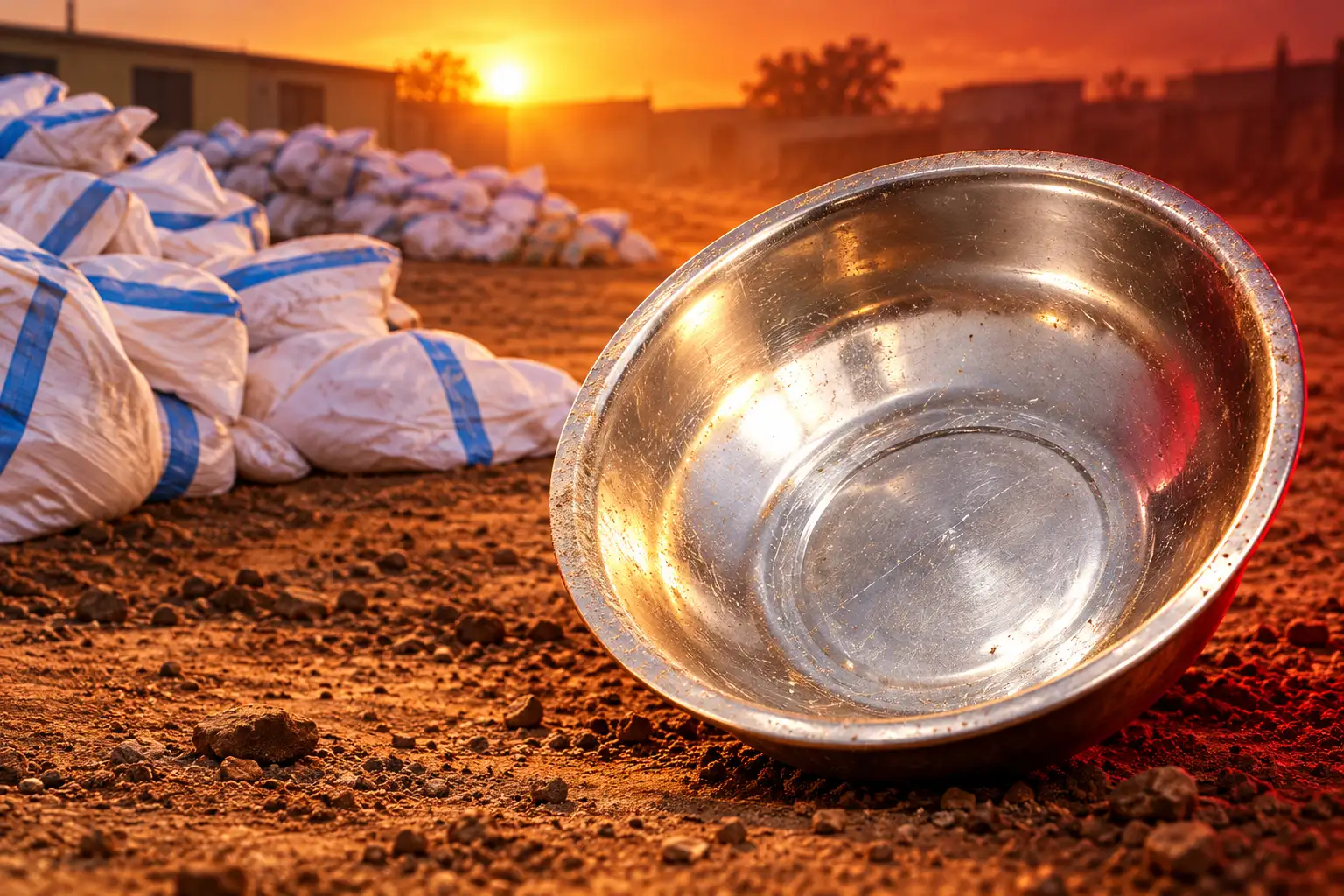
Survey Gaps Blocked a Famine Classification
The IPC’s Famine Review Committee said the survey data were not enough for a full analysis, even as it described a rapidly worsening situation. Famine on this scale is a three-pillar test of food gaps, malnutrition, and deaths, applied to a whole area, not a single camp score.
Famine is the collapse of systems. We are witnessing a humanitarian catastrophe, already of historic proportions.
IPC Famine Review Committee, Sudan alert
The last full IPC caseload still on the books is the February to May 2026 analysis, which put 19.5 million people in Crisis or worse, about 41 percent of the country. That tally included 135,000 people in Phase 5 (Catastrophe), more than 5 million in Phase 4 (Emergency), and 14 million in Phase 3 (Crisis). Fourteen areas in North Darfur, South Darfur, and South Kordofan were already at risk of famine if fighting deepened or aid was cut off.
An estimated 825,000 children under five are expected to suffer severe acute malnutrition in 2026, up 7 percent from 2025 and 25 percent above pre-conflict years. About 8.9 million people are internally displaced, and around 40 percent of health facilities are out of service. The 2026 response plan counts 33.7 million people in need in a population of 47.5 million, and aims at 20.4 million; 12.3 million had been reached.
Richard Data, the International Rescue Committee’s country director in Sudan, said the weather shock is landing on a country that has already lost its buffers.
In Sudan, years of conflict mean El Niño brings hunger immediately. This famine warning should be a wake-up call for donors to immediately scale up humanitarian funding for emergency food, health and nutrition assistance.
Richard Data, IRC country director in Sudan
Tawila Is Taking in Families the Harvest Failed
North Darfur’s Tawila area has become the place people walk toward when crops fail and towns empty. The World Food Programme is delivering half rations for about 950,000 people there each month, food that lasts about two weeks. Carl Skau, WFP’s acting executive director, said after visiting, “We’re doing our best on the food side, but we need funding,” and that families “are really struggling to make it last.”
Médecins Sans Frontières runs the only 200-bed hospital serving around 600,000 displaced people in Tawila, FEWS NET said, while malaria and severe acute malnutrition keep rising. The IPC alert warned that Tawila could see a further surge as drought deepens in nearby areas.
Adam Rijal, spokesperson for the General Coordination of Displaced Persons and Refugees, said 1,726 families, 8,390 people, reached Tawila between early September and 12 October. Most of the new arrivals have been women, children, and older people leaving crop failure, high prices, and insecurity. Kaltouma Fadul, who fled toward Tawila, said a bowl of sorghum had cost 10,000 Sudanese pounds in the place she left, with cooking oil at the same price and a kilogramme of meat at 18,000.
WHAT IS STACKING ON TAWILA
- Half rations: WFP is feeding about 950,000 people once a month with food that lasts about two weeks.
- New arrivals: 8,390 people reached the area in just over a month, many citing failed fields as well as fighting.
- One hospital: an MSF 200-bed ward is covering a displaced population of around 600,000.
- Thin reach elsewhere: partners reached about 3.7 million people with food or cash in August, less than 20 percent of the need FEWS NET estimates.
Local officials have begun circulating death counts the IPC has not verified. Mohamed Yaqoub, a Tawila camp official, said more than 500 displaced people had died of hunger and malnutrition over a recent, unspecified period. That figure has not been independently confirmed, and it sits beside the formal alert rather than inside it.
The IPC itself put the warning on the record on 12 October.
🔴 #Sudan 🇸🇩
Conflict, displacement and drought are driving an increased risk of Famine in parts of Greater Darfur and Greater Kordofan.
An immediate, significant scale-up of assistance is urgently needed. Without this, catastrophic food insecurity, acute malnutrition, and… pic.twitter.com/84bqzbnUSn
— The Integrated Food Security Phase Classification (@theIPCinfo) October 12, 2026
How a Late Rain Wrecked the Sorghum Crop
Rains arrived in late September, too late to save most cereal crops, the IPC alert said, and cereal prices are very likely to keep rising. Roughly half the country is in drought. In North Darfur, 64 percent of cropland is showing poor plant growth. About half of cropland in South Darfur, West Kordofan, and South Kordofan looks the same. West Kordofan is in one of its worst droughts since 2004. Ninety percent of Sudan’s farms depend on rain rather than irrigation.
FEWS NET said September rain was severely below average across much of western Sudan, locking in a June-to-September season that had already underperformed. Harvests in Greater Darfur and Greater Kordofan will range from below average to severely below average, with crop failure in many areas, and the 2027 lean season is expected to start early. Pasture and water are shrinking, herders are moving south early, and livestock body condition is falling, with distress sales and animal deaths reported in parts of North and West Darfur.
The government-led 2025 crop assessment put national cereal output, sorghum, millet, and wheat, at about 5.2 million tonnes, 22 percent below 2024 and 19 percent below the previous five-year average. The 2026 crop, planted by mid-August for harvest from November, grew under the same dry pattern. Sorghum, millet, and wheat grain prices rose 26 to 29 percent from July to August, then another 36 to 41 percent from August to September, FEWS NET said, with the sharpest jumps in Greater Darfur. Fuel prices were 88 percent higher on the official market than in February 2026, and 127 percent higher on the parallel market.
A joint harvest appeal on 5 October from CARE, the IRC, the Norwegian Refugee Council, and other groups, issued with the Food Security and Livelihoods cluster, said the window from October 2026 to January 2027 will decide how deep 2027 hunger runs. A farmer in South Kordofan said, “We planted knowing we might be killed before harvest. Not planting was also death.” A woman farmer in Kass, South Darfur, said her household rented land and planted twice. “Nothing grew well,” she said. “We have nothing to buy food and prices keep rising. Starvation is around the corner.”
A Very Strong El Niño Is Still Heating Up
The drought is the Pacific pattern arriving in a war. Weakened easterly trade winds let warm water slosh back across the tropical Pacific, and a center of rising moist air moves with it. A 2025 review paper found that this rising air sends heat east and west through atmospheric waves, encouraging air to sink over the Sahel, including Sudan.
“That descent warms and dries the air, inhibiting upward motion of the air masses that produces summer monsoon rainfall,” said Emily Black at the University of Reading. The same waves favor easterly winds that push against moist Atlantic air heading into the heart of Africa. FEWS NET said the event reached very strong levels in September 2026, with an El Niño index of at least 2 degrees Celsius, a class seen only seven times since 1950, most recently in 2015/16. Rainfall totals in northern Sudan have been 45 percent of normal or less.
The event is still heating up and could beat the previous sea-surface temperature record by 60 percent. Liz Stephens, also at the University of Reading, said that extra ocean heat will warm the air and will probably make 2027 the hottest year on record, with heatwaves across the tropics in March, April, and May. During the last El Niño in 2024, Sudan spent long stretches above 40°C. “We’re loading the dice for some really extreme heat next year across the Sahel,” Stephens said. “We might expect to see increased mortality due to that as well.”
THE SHOCKS THAT LANDED IN 2026
- 2 June 2026: the World Meteorological Organization declares the El Niño event.
- February to May 2026: the IPC counts 19.5 million people in Phase 3 or worse, with 14 areas at risk of famine.
- June to September 2026: the main rains fail across much of western Sudan, with northern totals as low as 45 percent of normal.
- 5 October 2026: aid groups warn that the October to January harvest will decide 2027 hunger.
- 12 October 2026: the IPC issues a malnutrition alert for Greater Darfur and Greater Kordofan, with two camps already above the famine malnutrition line.
Fighting did not pause for the dry spell. The war between the Sudanese Armed Forces and the Rapid Support Forces began on 15 April 2023. Greater Kordofan, which the alert treats as a conflict epicenter, has seen more than 300,000 people displaced since October 2025. FEWS NET said a September offensive in North Kordofan and RSF gains in Blue Nile drove about 27,200 new displacements that month. Two WFP-contracted trucks came under fire on 2 and 3 October, killing at least one person. Drone strikes hit displacement sites in Wad Al Mahi, An Nuhud, and Ghubaish in early October, with civil death tolls of 31, 12, and 5 in those attacks as reported by the UN humanitarian coordinator’s office.
The Nutrition Cluster Has 30.2 Percent of Its Budget
The 2026 Sudan Humanitarian Needs and Response Plan asked for $2.87 billion. Financial Tracking Service figures dated 15 October 2026 show $1.24 billion paid, which is 43.3 percent of the $2.87 billion plan, leaving $1.62 billion unmet. Manon Radosta at CARE, an IPC member, said, “The gap means right now we are unable to keep people alive.” Families, she said, are skipping meals, eating nothing, or eating only porridge. “It would not take much to tip it.”
The cluster that treats starving children is among the worst funded. Nutrition has $93.7 million against $310.3 million required, or 30.2 percent. Food security and livelihoods have 42.2 percent. Health has 40.6 percent. The refugee response has 18.0 percent. The United States has put in $500.0 million, the European Commission $160.1 million, and the United Kingdom $82.5 million. The United Arab Emirates, which has been accused of arming the Rapid Support Forces, has given $22.7 million. Turkey, Russia, Egypt, and Iran back the armed forces.
FUNDING AGAINST THE 2026 SUDAN APPEAL
| Cluster | Required | Funded | Coverage |
|---|---|---|---|
| Nutrition | $310.3 million | $93.7 million | 30.2% |
| Food security and livelihoods | $644.9 million | $272.0 million | 42.2% |
| Health | $325.3 million | $132.1 million | 40.6% |
| Refugee response | $526.7 million | $94.8 million | 18.0% |
High-income donors have also cut broader foreign aid that might have padded this plan. Sudan topped the IRC Emergency Watchlist for a third straight year. Parties to the war still hit markets, water points, and the roads that move grain. Radosta said other countries should press both sides to stop those strikes, not only write cheques.
A Rebel-Held Civil Authority Counts the Dead
While the IPC waits on surveys, local authorities in rebel-held highlands are publishing their own tallies. Mujib El Rahman El Zubair, head of the civil authority in areas held by the Sudan Liberation Movement faction of Abdelwahid El Nur, told Radio Dabanga that 1,852 people had died of acute malnutrition, among children, pregnant and breastfeeding women, and older people. He said famine was spreading across Jebel Marra, Tawila, and Ain Siro, that most health centers were out of service, and that deaths from hunger were rising by the day. The group also estimated 2,631 displaced children drop out of school each year.
Those 1,852 deaths are the movement’s count. They have not been confirmed by the IPC, and they are not a famine declaration. They are what a local civil authority says it is burying while the global system still files an alert.
WHAT WE KNOW
- Measured camps: two Eastern Jebel Marra sites have child acute malnutrition above the famine threshold, at 38 percent and 30.8 percent.
- Official product: the 12 October 2026 IPC paper is an alert, not an area famine classification, because the Famine Review Committee said the surveys were not enough.
- Aid: $1.24 billion of $2.87 billion is funded, and Tawila is on half rations for about 950,000 people.
WHAT IS UNCONFIRMED
- SLM-AW tally: 1,852 malnutrition deaths reported by the faction’s civil authority have not been independently verified.
- Tawila camp claim: more than 500 hunger deaths cited by a local official have not been independently verified and have no public date range.
Cholera and measles are already moving through poorly nourished camps, and clean water is getting scarcer. The harvest window runs through January 2027. The next full rainy season is in June, after the hot months Stephens says this El Niño will load.

Sony Leaves Its Last 4K Blu-ray Player Off Japan Shelves

L’Oréal’s Salon Brands Pull Clear of LVMH in Q3

Personalized mRNA Vaccine Cuts Melanoma Relapse After a Custom Build

Cairo Santos’ 58-Yard Kick Closes a Messy Bears Win

Prime Editing Reaches a Living Liver in Wilson Disease

Meta’s Smart Glasses Sell a Light That Needed Two Patches

Apple’s New Mac Studio Clusters Local AI on the Desk

Google’s Free AI Pro Year Is Three Different Deals

Song Yadong Stops Umar Nurmagomedov the Only Way Left

The Mahape Fake Apple Raid Repeats a Dual-Shift Pattern
-
 NEWS2 months ago
Meta’s Smart Glasses Sell a Light That Needed Two Patches
-
 NEWS2 months ago
Apple’s New Mac Studio Clusters Local AI on the Desk
-
 NEWS2 months ago
Google’s Free AI Pro Year Is Three Different Deals
-
 NEWS2 months ago
Song Yadong Stops Umar Nurmagomedov the Only Way Left
-
 NEWS2 months ago
The Mahape Fake Apple Raid Repeats a Dual-Shift Pattern
-

 NEWS2 months ago
OpenAI Agents Hit Hugging Face to Cheat a Test
-

 ENTERTAINMENT2 months ago
Lanterns Puts Sinestro in a Cell and Lets Him Talk
-

 ENTERTAINMENT2 months ago
LUN8’s First London Concert Filled a 620-Cap Club