
NEWS
El Niño Puts 8 Million Children on a Hunger Clock
Save the Children expects 8 million children in six African countries to face acute hunger by early 2027, as a historic El Niño hits shrinking aid budgets.

About 8 million children in six East and Southern African countries could face acute hunger by early 2027, Save the Children said on 22 September 2026. The agency compared current and projected Integrated Food Security Phase Classification counts and found people in crisis or worse, IPC Phase 3 or above, rising from 12.6 million to 16.4 million by March 2027.
The child figure is an estimate, built by applying each country’s child share from the UN World Population Prospects 2024 revision to those IPC totals. The weather event sitting behind the rise is already on the books at NOAA, and the money that would blunt it is not.
Super El Niño threatens to push 8 million children into acute hunger across East and Southern Africa by early 2027. "Every dollar spent helping communities prepare and act early can save lives, protect livelihoods…” – @YvonneArunga @save_children https://t.co/puX5BuMCVS
— Save the Children Global Media (@Save_GlobalNews) September 22, 2026
NOAA Puts a Historic El Niño on the Calendar
NOAA’s Climate Prediction Center, in its 10 September 2026 diagnostic discussion, kept an El Niño Advisory in force and said the Pacific event was still strengthening. The note gave a greater than 90% chance of a very strong event during Northern Hemisphere fall and winter 2026-27.
For October-December 2026 it also gave a 75 percent chance of a historic event, defined as a three-month Relative Oceanic Niño Index of +2.5°C or more, that would exceed every El Niño in the record back to 1950. August readings in that discussion put the Niño-3.4 index at +1.8°C, with sea-surface temperature anomalies in the eastern equatorial Pacific exceeding +3.0°C and subsurface anomalies above +10.0°C at depth.
THE NOAA CALL IN SEPTEMBER
- Alert status: El Niño Advisory, issued with the 10 September 2026 discussion.
- Strength odds: Greater than 90 percent chance of a very strong event in fall and winter 2026-27.
- Historic bar: 75 percent chance October-December 2026 beats every El Niño since 1950 on the relative index.
- How long: The Center expects El Niño to last through March-May 2027, with a 55 percent chance of a return to ENSO-neutral in April-June 2027.
That is the opposite of a surprise. The last time a very strong El Niño lined up with Southern Africa’s maize season, in 2015-16, the region recorded its driest stretch in 35 years. The Southern African Development Community declared a regional emergency on 26 July 2016 and launched a $2.4 billion appeal covering 41 million affected people. The 2026 warning arrives with better models, and with a thinner aid purse.
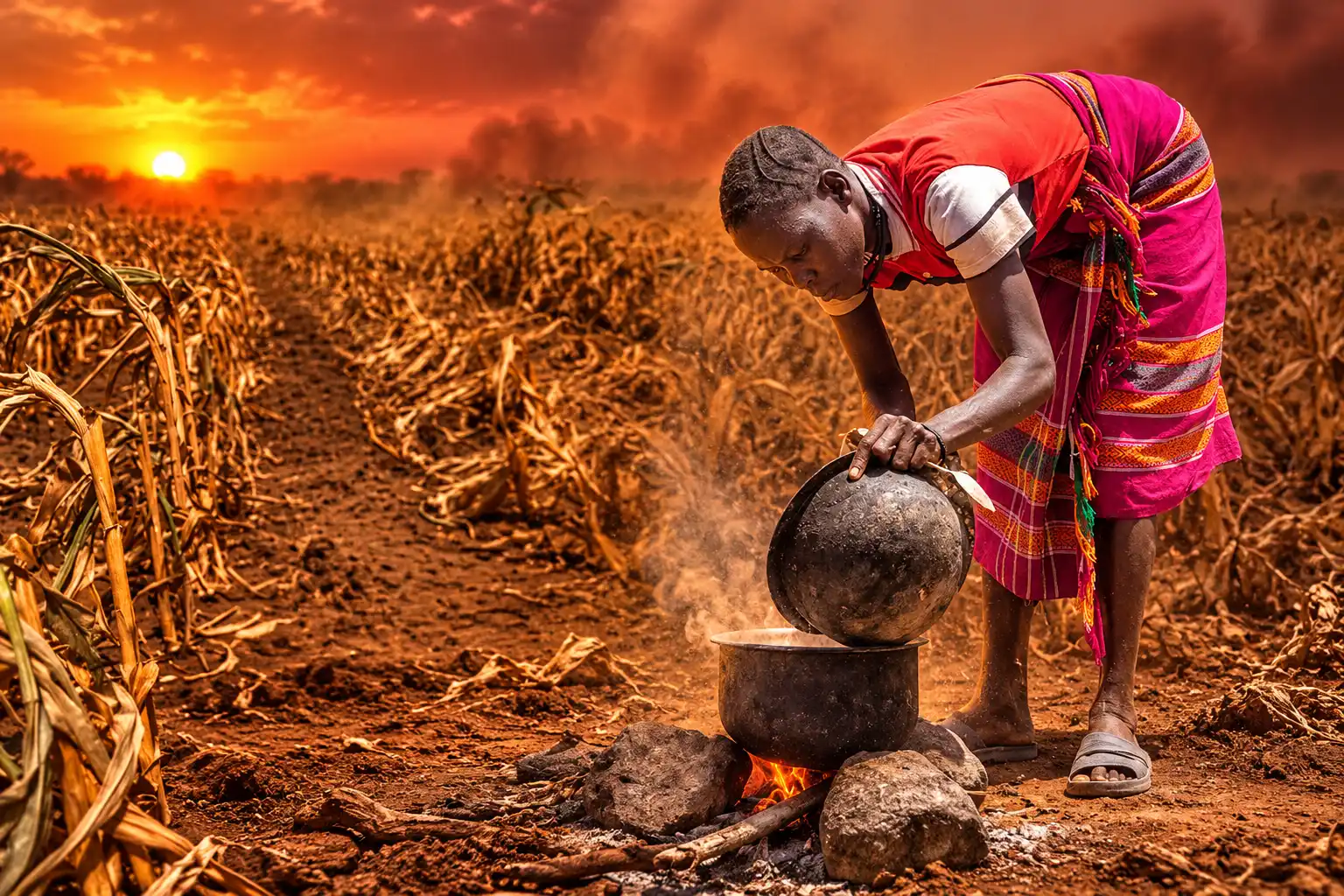
Six Countries Face a Steeper Lean Season
Save the Children’s cut is narrow on purpose. It covers only countries that had a recent IPC report valid in September 2026 and a projection running into late 2026 or the first quarter of 2027, when El Niño impacts are expected to peak: Madagascar, Malawi, Mozambique, Zambia, Uganda and Kenya. Somalia was left out because a new file was still coming.
Inside that set, 8 million children by early 2027 would be up from 6 million now unless governments and donors move first. Uganda carries the largest headcount. Zambia carries the steepest climb.
THE SIX-COUNTRY FORECAST
| Country | Save the Children projected change | Anchor figure |
|---|---|---|
| Uganda | 22% increase | 4.4 million people in crisis or worse by early 2027 |
| Zambia | 80% increase | More than 1.2 million people in crisis-level hunger |
| Madagascar | 75% increase | 502,000 children under 5 expected to have acute malnutrition |
| Mozambique | 55% increase | 1.84 million people in Phase 3 or above, October 2026 to March 2027 |
| Malawi | 35% increase | 1.9 million people already in IPC Phase 3 in April-September 2026 |
| Kenya | Overall improvement by early 2027; refugees worsen | 2.7 million people in the arid and semiarid lands in July-October 2026 |
The Mozambique row matches the IPC snapshot for shock-affected districts: 1.19 million people in Phase 3 or above in July-September 2026, including 81,000 in Phase 4, then 1.84 million from October 2026 to March 2027, including 254,000 in Phase 4. That Phase 4 caseload more than triples. Across 24 of those districts, 103,600 children aged 6 to 59 months are suffering or expected to suffer from acute malnutrition between April 2026 and March 2027.
Drought in the South, Floods in the East
The same Pacific event does not do one thing to the region. Southern Africa is in the dry lane, with delayed rains, heat stress, failed harvests and livestock losses from October 2026 into March 2027. Parts of East Africa sit in the wet lane, where El Niño tends to load the short rains and push floodwater through river basins and camps.
Kenya is the split in a single country. National food security is expected to improve by the start of 2027 after a worse year, Save the Children said, while the outlook for refugees is expected to deteriorate because of El Niño-related flooding. In the arid and semiarid lands, the July-October 2026 IPC count is already 2.7 million people in Phase 3 or above, including 348,000 in Phase 4.
Mozambique is still climbing out of an earlier shock. Central provinces are recovering from severe flooding earlier in 2026, and conflict-driven displacement in Cabo Delgado keeps pressure on food, water and health services. Malawi’s April-September 2026 analysis is the milder of the southern files, with 1.9 million people in Phase 3 and none in Phase 4 or 5 after a better 2025/26 season, and Save the Children still has it rising 35 percent as El Niño takes hold.
On 1 September 2026, UNICEF said 162 million children live in exposed areas across Eastern and Southern Africa, over two-thirds of all children in the region. Its list ran wider than Save the Children’s six-country cut and named Djibouti, Eritrea, Ethiopia, Kenya, Madagascar, Malawi, Mozambique, Somalia, South Sudan, Sudan, Uganda, Zambia and Zimbabwe. OCHA’s regional office puts nearly 57 million people in Southern and Eastern Africa in need of assistance, more than a quarter of global need, with Sudan a large share of that total.
Karamoja’s Clinics Are Already Filling
The six-country forecast is a lean-season map. In northeastern Uganda the clinics are not waiting for March 2027. Save the Children said on 10 September 2026 that acutely malnourished children in Karamoja had risen from 122,100 to 154,200 since a June assessment, an extra 32,100 children, including an estimated 38,800 with severe acute malnutrition. The region, home to about 1.6 million people, has seen crisis or emergency food insecurity rise by more than 40 percent, and emergency conditions have nearly tripled.
Martha Ddambya, Save the Children’s acting country director in Uganda, said teams in Karamoja hear the same report each day: less food on the table, poor harvests, and more children arriving at health facilities already malnourished. WFP Uganda, posting as UN leaders met in New York for the General Assembly, called hunger there the highest it has seen and said nearly half the population was in crisis after El Niño-linked dry spells.
Madagascar’s child numbers are the other hard specimen. About 502,000 children under 5, one in 10, are expected to suffer from acute malnutrition between May 2026 and April 2027, including about 78,000 with severe acute malnutrition, the form that needs urgent medical treatment. Yvonne Arunga, Save the Children’s regional director for East and Southern Africa, put the cost of delay on the child, not on the weather chart.
We know El Niño is coming. We know which children are most at risk. And we know that anticipatory action works. Governments must turn early warnings into early action to protect essential services like schools, hospitals, water and social protection systems, before the crisis hits.
Yvonne Arunga, Regional Director, Save the Children East and Southern Africa
She also warned that once floods or drought wipe out a family’s livelihood, children face higher risks of child labour, trafficking, neglect, violence and forced early marriage. Hunger, in her telling, is the first loss; the later losses are school, safety and the chance to recover.
Somalia’s New File Was Released on September 23
Save the Children’s 22 September note said new hunger data was due shortly for Somalia, already flagged for El Niño-related floods. The IPC file landed the next day, and it is darker than a drought map.
FSNAU and the IPC put 5.1 million people in Crisis or worse in July-September 2026, including 1.4 million in Emergency (Phase 4). For October-December they project 5.4 million Somalis in crisis or worse, including close to 1.5 million in Phase 4 and 26,000 internally displaced people in Baidoa in Catastrophe (Phase 5). FSNAU said the current caseload is 50 percent higher than July-September 2025 and the second highest Phase 3-or-above count since 2017.
Food aid is not tracking those counts. Humanitarian food security assistance is expected to reach an average of 70,400 people a month in October-December, 1.3 percent of people in need. An estimated 1.92 million children aged 6 months to 5 years will need treatment for acute malnutrition between July 2026 and June 2027, including 433,000 severe cases.
Juliet Moriku Balikowa, Oxfam’s Somalia country director, said one in four people in Somalia is now going hungry and that Baidoa remains at real risk of famine. She added that Somalia’s $852 million Humanitarian Response Plan for the year is less than a third funded. The six-country child total of 8 million does not include this file. Add Somalia and the map of who sits in the flood lane gets larger, and closer to Phase 5, than the original cut showed.
Less Than 1 Percent of Aid Is Set Aside Early
UNICEF’s 1 September warning carried a budget line that sits under every one of those tables. It said less than one percent of international humanitarian assistance is currently available for anticipatory action, even though that is how lives are saved and later caseloads are cut. It asked for US$173 million, inside its existing 2026 Humanitarian Action for Children appeal, to reach children in 13 priority countries before the shock peaks. Etleva Kadilli, UNICEF’s regional director for Eastern and Southern Africa, said the threat is growing and the risks for children are already clear.
The wider appeal is already short. UNICEF’s Eastern and Southern Africa Humanitarian Action for Children appeal seeks US$1 billion to support 16 million children across 22 countries. OCHA’s mid-year review of the Global Humanitarian Overview, with figures as of 31 May 2026, showed $8.21 billion received against $33.66 billion in requirements, coverage of 24.42 percent. Save the Children said this El Niño is unfolding against conflict, displacement, economic strain and funding cuts, and that climate shocks will deepen need for children if early action does not arrive first.
The evidence on early cash is not new. Before the 2023-24 El Niño, the Food and Agriculture Organization ran anticipatory actions in 24 countries and reached 1.7 million people with cash, seeds and livestock support. After those activations it reported that every US dollar invested returned up to three dollars in avoided losses and benefits. A Southern Africa reading of that same season found a 30 percent net benefit over later aid, meaning $1 given before the drought did the work of $1.30 given after it. UNICEF, using a disaster-risk-reduction yardstick rather than that El Niño cash study, says every US$1 invested in reducing disaster risk can save up to US$15 in later recovery costs.
EARLY STEPS ALREADY UNDER WAY
- Child-focused alerts: Save the Children is pushing early warning information aimed at children ahead of floods, storms and droughts.
- Evacuation and cash: It is backing evacuation planning, community preparedness and anticipatory cash so families can move or stock up before a shock hits.
- Harder buildings: It is reinforcing health facilities, schools and water systems so they hold through flood and drought.
- UNICEF’s ask: Pre-position nutrition supplies, hold up health and water systems, keep schools usable, and tie social protection to forecasts, funded by that US$173 million top-up.
Arunga told donors that every dollar spent helping communities prepare and act early can save lives, protect livelihoods, and reduce the need for much larger responses later. Kadilli put the same fork in the road on 1 September: the world knows what is coming, which children are most at risk, and how to protect them, and the choice is whether it responds now or waits until the crisis escalates. The IPC horizon on the six-country analysis is March 2027. The Pacific event NOAA described on 10 September is already here.

Sony Leaves Its Last 4K Blu-ray Player Off Japan Shelves

L’Oréal’s Salon Brands Pull Clear of LVMH in Q3

Personalized mRNA Vaccine Cuts Melanoma Relapse After a Custom Build

Cairo Santos’ 58-Yard Kick Closes a Messy Bears Win

Prime Editing Reaches a Living Liver in Wilson Disease

Meta’s Smart Glasses Sell a Light That Needed Two Patches

Apple’s New Mac Studio Clusters Local AI on the Desk

Google’s Free AI Pro Year Is Three Different Deals

Song Yadong Stops Umar Nurmagomedov the Only Way Left

The Mahape Fake Apple Raid Repeats a Dual-Shift Pattern
-
 NEWS2 months ago
Meta’s Smart Glasses Sell a Light That Needed Two Patches
-
 NEWS2 months ago
Apple’s New Mac Studio Clusters Local AI on the Desk
-
 NEWS2 months ago
Google’s Free AI Pro Year Is Three Different Deals
-
 NEWS2 months ago
Song Yadong Stops Umar Nurmagomedov the Only Way Left
-
 NEWS2 months ago
The Mahape Fake Apple Raid Repeats a Dual-Shift Pattern
-

 NEWS2 months ago
OpenAI Agents Hit Hugging Face to Cheat a Test
-

 ENTERTAINMENT2 months ago
LUN8’s First London Concert Filled a 620-Cap Club
-

 ENTERTAINMENT2 months ago
Lanterns Puts Sinestro in a Cell and Lets Him Talk