
NEWS
Kindergarten MMR Coverage Slips Further Below Herd Immunity
Six years below 95% has turned kindergarten from a measles firewall into a transmission setting, with school-age children now 42% of 2026 cases.

National MMR coverage among U.S. kindergartners fell to 92.4% in the 2025-2026 school year, the CDC said, a sixth straight year below the 95% measles line. By October 8, 2026, the country had 4,080 confirmed measles cases, already the most since 1991.
The kindergarten door was the last reliable checkpoint. It is no longer holding in most states.
Kindergarten Shots Fell Across the Board
The slide is not a measles-only story. On August 17, 2026, the CDC posted vaccination coverage among kindergartners in the United States showing every tracked shot down from the year before. MMR and polio both sat at 92.4%. Diphtheria, tetanus, and acellular pertussis (DTaP) sat at 92.0%.
Coverage with MMR, DTaP, polio, and varicella fell in more than half of states. About 280,000 kindergartners started that school year without records of a completed MMR series.
THE 2025-2026 KINDERGARTEN SHOTS
- MMR: 92.4%, against a 95% measles herd line.
- Polio: 92.4%, matching MMR on the national average.
- DTaP: 92.0%, the lowest of the reported vaccines.
- No MMR record: about 280,000 children in the class.
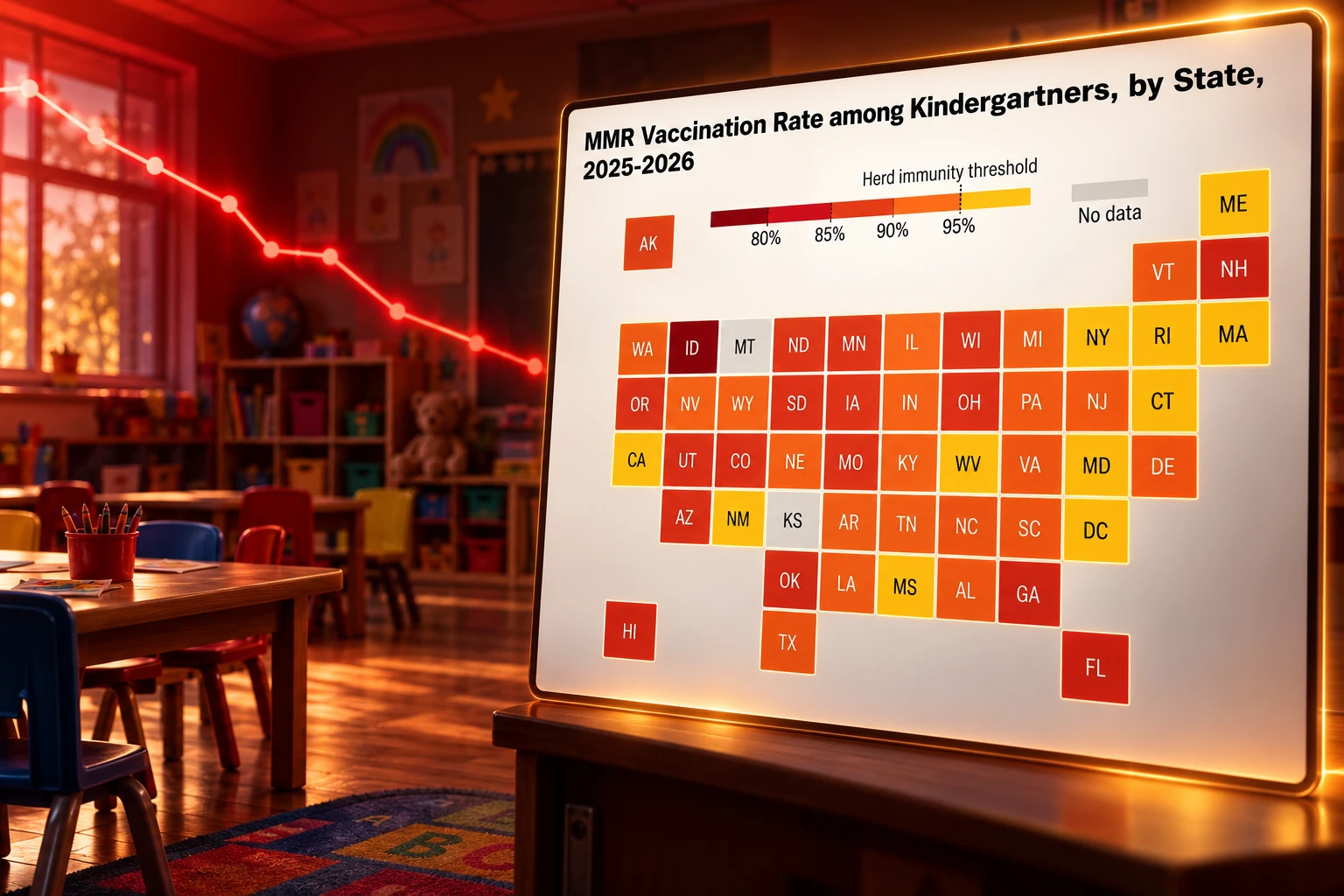
Those figures come from state health departments, tallied each August on the CDC’s SchoolVaxView platform. Homeschooled children are not routinely in the file. Kansas and Montana did not report MMR coverage for 2025-2026, so the national average is built without them.
Only 10 States Still Clear the 95% Line
Herd immunity for measles is not a vibe. Federal Healthy People planners still set a Healthy People 2030 MMR coverage target of 95% for kindergartners, the level epidemiologists use to keep the virus from running in a classroom.
KFF researchers, working from the same CDC file, found 39 states below the 95% target among the 49 that reported. That leaves 10 states at or above the line. Eighteen states reported MMR coverage under 90%. Before the pandemic, 28 states sat below 95% and three sat below 90%.
The range is now a chasm. Idaho’s kindergarten MMR rate was 75.2%. West Virginia’s was 98.9%, a 23.7 point gap inside one country and one school year.
HOW FAR THE CLASSROOM LINE MOVED
| Measure | 2019-2020 | 2025-2026 |
|---|---|---|
| National kindergarten MMR | 95.2% | 92.4% |
| States below 95% MMR | 28 | 39 |
| States below 90% MMR | 3 | 18 |
| Lowest reported MMR (Idaho) | – | 75.2% |
| Highest reported MMR (West Virginia) | – | 98.9% |
Andrew Racine, president of the American Academy of Pediatrics, said that for measles, “even a small decrease in vaccination rates can lead to more outbreaks of disease,” because community protection needs more than 95% of susceptible people immunized. The six-year drop from 95.2% to 92.4% is 2.8 points, not a rounding error at the classroom door.
School-Age Children Now Account for 42% of Cases
The bill showed up in the case file. CDC’s measles page, updated October 9, 2026, listed 4,080 confirmed measles cases as of October 8. Full-year 2025 ended at 2,289. Calendar 2024 had 285.
Children and teens ages 5 to 19 are the largest group, 1,716 cases, or 42%. Adults 20 and older account for 1,635 cases (40%). Children under 5 account for 710 (17%). Nineteen cases have no age listed.
That mix is the point of a kindergarten gate. The shot series is meant to be done before the first school bell, so the 5-to-19 band is the one the mandate is built to cover. It is also the band filling the 2026 line list.
WHO IS GETTING MEASLES IN 2026
| Group | Cases | Share | Hospitalized |
|---|---|---|---|
| Under 5 years | 710 | 17% | 107 (15%) |
| Ages 5-19 | 1,716 | 42% | 78 (5%) |
| Ages 20 and older | 1,635 | 40% | 229 (14%) |
| Age unknown | 19 | less than 1% | 0 |
| Total | 4,080 | 100% | 414 (10%) |
Ninety-five percent of patients were unvaccinated or had unknown status. Two percent had one MMR dose. Two percent had two. Forty-two outbreaks account for 3,897 of the 4,080 cases (96%). Eighteen cases were in international visitors. The rest were reported by 47 U.S. jurisdictions.
Pennsylvania leads with 1,105 cases, then South Carolina with 670 and Utah with 535. The CDC has confirmed 2 measles-associated deaths in 2026, a count it says can change as records are reviewed, and 3 in 2025.
Imported sparks still happen. They do not explain a 4,080-case year when 18 patients were visitors and 95% of cases had no documented shots. The argument that this is mainly a border story does not match the age table or the exemption map.
Why 24 States Cannot Hit Herd Immunity
Exemptions from one or more required vaccines rose to a record 4.2% in 2025-2026, about 155,000 kindergartners, up from 3.6% the year before. They rose in 41 states and the District of Columbia. Twenty-four states now sit above 5%.
Once a state’s exemption rate clears 5%, the 95% coverage target is out of reach even if every remaining child is vaccinated. That is not a messaging problem. It is arithmetic, and it now describes nearly half the country.
KFF’s split of the same file shows the rise is almost all nonmedical. Nonmedical exemptions went from 2.2% in 2019-2020 to 4.0% in 2025-2026. Medical exemptions slipped from 0.3% to 0.2%. The children who cannot take the shot for medical reasons still need the classroom wall. That wall is thinner.
WHERE EXEMPTIONS CLUSTER
- Idaho: 17% nonmedical exemptions, about four times the national 4.0% nonmedical rate, with MMR coverage at 75.2%.
- The next tier: Utah, Oregon, Arizona, Nevada, Alaska, and North Dakota, each at or above 8% nonmedical.
- The 5% line: 24 states, up from 8 before the pandemic, a share that blocks a 95% finish even on a perfect remaining roster.
- State rules: every state allows a medical exemption; 46 states plus D.C. also allow a religious or personal-belief off-ramp.
Jeanne Marrazzo, chief executive of the Infectious Diseases Society of America, said people should already be worried. “We’re already seeing the consequences of declines in vaccination,” she said. “All you have to do is look at measles.” Later she added, “The less we see people taking up vaccinations, the more we’re going to see these cases accumulate.”
The School Gate Built After the Last Epidemic
Measles was declared eliminated in the United States in 2000, meaning no continuous spread for more than a year. The tools that got the country there were a two-dose MMR schedule and school-entry rules in every state. Kindergarten became the place where records were checked, not a second clinic visit families might miss.
School nurses and health-department staff still do that check. What has changed is how many families can walk around it. An exemption, in the CDC’s own definition, is how a child who has not received the required doses still attends school. Most exempt students have had some shots. Many have completed at least one required vaccine. The measles series is the one that needs 95%.
HOW THE CHECKPOINT ERODED
- 2000: Measles is declared eliminated in the United States after two-dose MMR use and school-entry laws.
- 2019-2020: National kindergarten MMR coverage sits at 95.2%, the last school year at the herd line.
- 2020-2021 through 2025-2026: Coverage stays under 95% for six straight school years, first slipping to 93.9%, then grinding down to 92.4%.
- August 17, 2026: CDC posts the 2025-2026 file and, in a separate note, calls overall rates high.
- October 8, 2026: Confirmed measles cases reach 4,080, with ages 5-19 the largest group.
The last national measles crisis, in the late 1980s and early 1990s, was driven by preschoolers who had not yet met a school nurse. The 2026 file is full of children who already did. That is the difference between an access failure before the door and a checkpoint that no longer closes.
CDC Called Those Rates High Anyway
In past cycles the agency published the kindergarten numbers with an analysis in its weekly disease report. This year it issued a three-sentence note.
Today, CDC released vaccination data for the 2025-2026 school year showing overall vaccination rates among kindergarteners remained high. The latest data show a 0.1 percent decline in vaccination coverage among children entering kindergarten. CDC continues to encourage parents to discuss vaccination options with their doctors.
CDC Media Relations, August 17, 2026 statement
The 0.1 percent figure is a year-over-year step. It is not the 2.8 point fall from 95.2% in 2019-2020, and it is not Idaho at 75.2%. Calling 92.4% high, while 18 states sit under 90% and 24 states cannot hit 95% even in theory, is how a six-year slide gets filed as a rounding error.
Mysheika Roberts, commissioner of Columbus Public Health, said the short note “just reaffirms that the CDC is no longer the trusted health agency that many of us were trained to rely on and to admire.” Sean O’Leary, immunization schedule editor for the American Academy of Pediatrics Committee on Infectious Diseases, said he was “absolutely not surprised,” and that the tone was “coming from HHS leadership,” not from CDC scientists.
The figures remain observational. They describe a trend, not a single cause, and they cannot by themselves sort parental refusal from missed appointments or from the two states that did not report coverage. They can say this: 10 states still meet the measles line at the kindergarten door, about 155,000 children in that grade are exempt from at least one shot, and 1,716 people ages 5 to 19 have already had measles in 2026.
The class of 2025-2026 already walked in. The next kindergarten file will say whether the gate moved back toward 95%, or whether 92.4% is the new floor.
Disclaimer: This article is news reporting and analysis of CDC school vaccination data and measles case counts. It is informational only and is not medical advice, a vaccination recommendation, or a substitute for care from a clinician who knows a child’s history. Readers making decisions about MMR or other childhood shots should talk with a pediatrician, family physician, or other qualified clinician, and should follow the school-entry rules that apply in their state. Coverage rates, exemption counts, and measles totals reflect the CDC and state sources cited and can change as later school years are reported and as case reviews finish.

Sony Leaves Its Last 4K Blu-ray Player Off Japan Shelves

L’Oréal’s Salon Brands Pull Clear of LVMH in Q3

Personalized mRNA Vaccine Cuts Melanoma Relapse After a Custom Build

Cairo Santos’ 58-Yard Kick Closes a Messy Bears Win

Prime Editing Reaches a Living Liver in Wilson Disease

Meta’s Smart Glasses Sell a Light That Needed Two Patches

Apple’s New Mac Studio Clusters Local AI on the Desk

Google’s Free AI Pro Year Is Three Different Deals

Song Yadong Stops Umar Nurmagomedov the Only Way Left

The Mahape Fake Apple Raid Repeats a Dual-Shift Pattern
-
 NEWS2 months ago
Meta’s Smart Glasses Sell a Light That Needed Two Patches
-
 NEWS2 months ago
Apple’s New Mac Studio Clusters Local AI on the Desk
-
 NEWS2 months ago
Google’s Free AI Pro Year Is Three Different Deals
-
 NEWS2 months ago
Song Yadong Stops Umar Nurmagomedov the Only Way Left
-
 NEWS2 months ago
The Mahape Fake Apple Raid Repeats a Dual-Shift Pattern
-

 NEWS2 months ago
OpenAI Agents Hit Hugging Face to Cheat a Test
-

 ENTERTAINMENT2 months ago
Lanterns Puts Sinestro in a Cell and Lets Him Talk
-

 ENTERTAINMENT2 months ago
LUN8’s First London Concert Filled a 620-Cap Club