
NEWS
Senate Vote Shields the NCAA and Caps Athlete Transfers
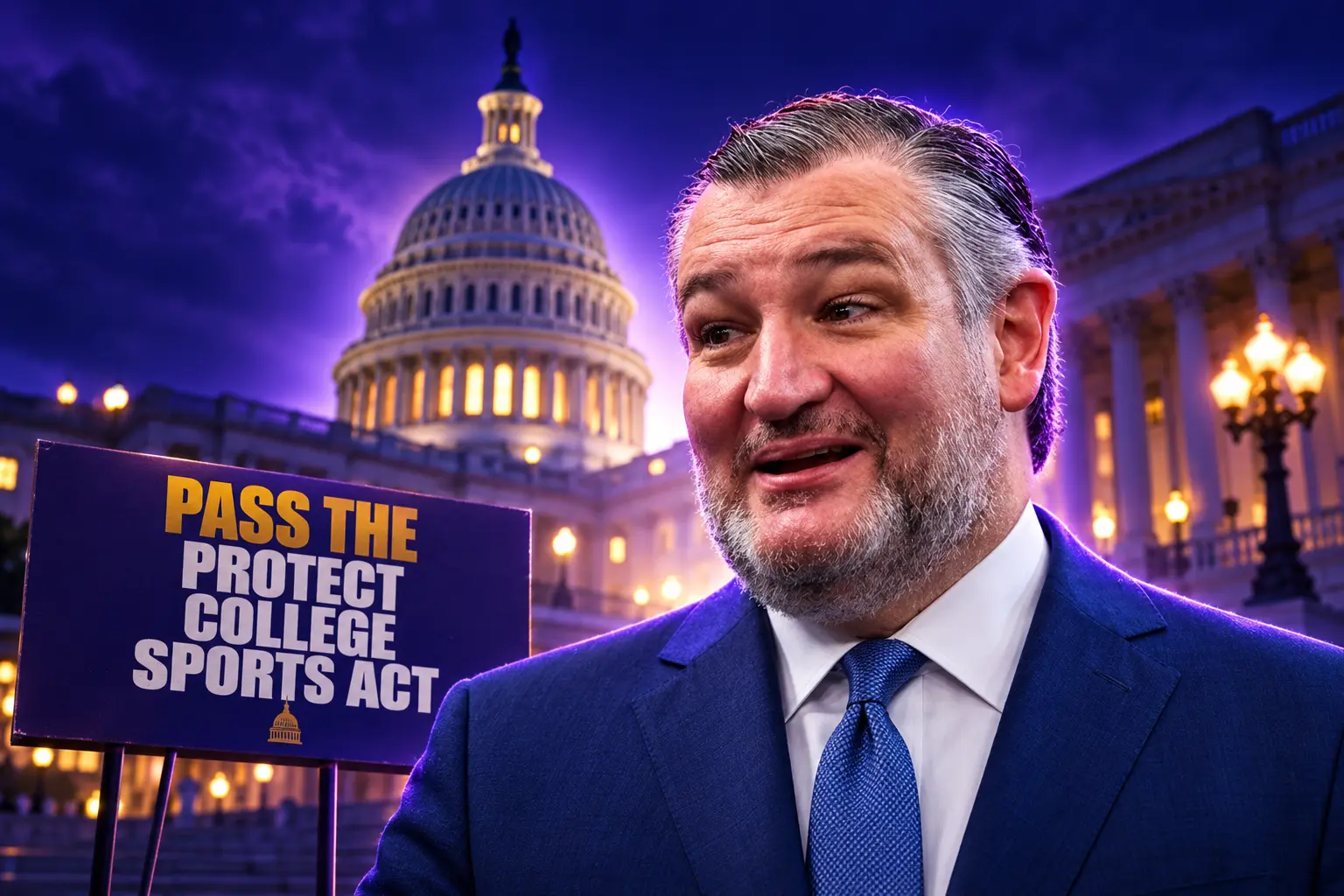
The Senate passed the Protect College Sports Act 77-22, giving the NCAA an antitrust shield while the House remains out until November.

The Senate passed the Protect College Sports Act 77-22 on Sept. 28, handing the NCAA a limited antitrust shield it has failed to win in court. The bill, S. 4668 as introduced in June, now goes to a House that is not due back until Nov. 9.
Power conferences get a 20-team ceiling and a brake on league-hopping. Athletes keep a federal NIL right and a new retention pot, and they lose unlimited transfers. Coaches keep their market. The House still has to say yes.
The NCAA Walks Out With an Antitrust Shield
The 77-22 roll call on passage came at 9:42 p.m. as Vote 250. Sen. Dan Sullivan, R-Alaska, did not vote. The yes column mixed almost every Republican with a large bloc of Democrats. The 22 noes were 19 Democrats, Sen. Rand Paul, R-Ky., Sen. Rick Scott, R-Fla., and Sen. Bernie Sanders, I-Vt.
Majority Leader Chuck Schumer voted no. So did Sen. Cory Booker, D-N.J., who spoke against the bill before the roll was called. Sen. Ted Cruz, R-Texas, and Sen. Maria Cantwell, D-Wash., wrote the package with Sens. Eric Schmitt, R-Mo., and Chris Coons, D-Del.
THE SENATE TALLY
- Final vote: 77 yes, 22 no, and 1 not voting on Sept. 28.
- Cloture: 74-25 on Sept. 24 to limit debate.
- Substitute: 77-23 the same day for the Cruz-Cantwell rewrite.
- Committee: 19-9 in Commerce on June 18 to send it to the floor.
The legal prize sits in the liability section. Schools, conferences, and the NCAA get targeted protection when they enforce the bill’s own rules on pay, eligibility, transfers, agents, recruiting, and tampering. That is the tool the association has lacked since courts stripped amateurism rules and opened the portal.
Cruz told reporters he did not want a squeaker at 60 or 61 votes. He wanted a margin large enough to show the House that college sports had a national rulebook waiting. “President Trump is eager to sign this legislation,” he said after the vote.
From the beginning, our objective was not to squeak by with 60 or 61 votes but to have a big bipartisan vote that demonstrates the importance of stepping in and saving and preserving college sports.
Ted Cruz, R-Texas, to reporters after the vote
NCAA president Charlie Baker treated the night as unfinished business, not a finish line, and pointed the next fight at the House.
Statement from NCAA President Charlie Baker about the Protect College Sports Act:
"Student-athletes from across the country and all three NCAA Divisions worked hard to get on this legislation moving and thanks to their advocacy, the bill just received a massive, bipartisan vote…
— NCAA News (@NCAA_PR) September 29, 2026
A 20-Team Cap on Leagues Above $700 Million
The map fight is why the SEC and Big Ten came on board in August. Conferences that report more than $700 million in annual revenue, the Power Four, are capped at 20 members. The Big Ten already has 18. A school leaving one of those leagues for another must first spend three years as an independent, a penalty written to expire six years after the law takes effect.
Section 205 is aimed at a breakaway. Those same high-revenue conferences cannot merge with one another or roll up another league’s media rights into a super league. Private equity is blocked from assembling those assets into a new association. Notre Dame, already independent, is outside the waiting-period logic that hits current Power Four members.
POWER CONFERENCE RULES IN THE SENATE BILL
| Rule | What passed the Senate |
|---|---|
| Membership cap | 20 schools for conferences above $700 million in annual revenue |
| Switching Power leagues | Three years as an independent first |
| Waiting-period sunset | The independent penalty expires after six years |
| Media-rights pool | Voluntary, and only if 75 percent of FBS schools join |
| Super league | Barred from combining those schools’ media rights |
Pooling is optional. Existing TV contracts stay in place. The covered entity has to offer membership on fair terms to every Division I school, keep rivalry games, and push women’s and Olympic sports onto the same pipes. Every football and basketball game would also have to be available to at least one local outlet in each home market.
The SEC called the vote “an important step toward establishing a clear and durable national framework for college athletics.” The Big 12 said the bill “moves our industry closer to a sustainable model.” Both promised to keep working the House. The August rewrite that won them over also locked in a hard revenue-share cap, folded associated-entity deals into that cap, and closed a private-equity path around the super-league ban.
What Changes for Players in the Transfer Portal
Athletes get a federal right to earn NIL money and a national standard that wipes conflicting state NIL, transfer, and eligibility laws. Deals above $600 must be reported. Agents have to register, sit in a public database, and live under a 5 percent fee cap, with a private right of action if they lie about a deal.
The pay stack is not one number. The House settlement’s revenue-share cap stays in federal law, with inflation adjustments, and it can lapse in nine years unless Congress extends it. On top of that cap, schools get a $22.5 million retention fund for players already on the roster. Up to $5 million more unlocks dollar-for-dollar when a school spends NIL money on women’s and Olympic sports, for a maximum of $27.5 million in that pot.
Movement is where the bill takes the most from the current market. An athlete gets one transfer without sitting. A second move costs a year, with a short list of exceptions. Eligibility is five years, starting at 19 or high school graduation, with breaks for pregnancy, a religious mission, military service, and other approved absences. Professional football and basketball players cannot come back to college.
WHEN A SECOND TRANSFER DOES NOT COST A YEAR
- Coach departure: The head coach leaves the program.
- Sport cut: The school drops the athlete’s sport.
- Graduate study: The athlete has the undergraduate degree and is going to graduate school.
- Misconduct: Sexual assault or harassment by someone tied to the team.
That is a narrower portal than the one courts forced open, and it is still wider than the pre-2021 sit-out rule. Graduate transfers remain a pressure valve. Tampering rules come with the same antitrust cover as the cap, so the NCAA can police contact outside designated windows.
The athlete-side add-ons are real. Scholarships cannot be pulled for injury or bad play, and the bill writes a ten-year scholarship guarantee so players can finish degrees. Division I schools must cover sports-injury costs during a career and for five years after the last game, plus second opinions and an exit physical. A medical trust of up to $100 million a year is supposed to help smaller schools and athletes with long-term conditions, including CTE. At least one-third of certain NCAA governing boards and rulemaking committees would have to be current or recent athletes. Arbitration clauses cannot block those claims.
Cantwell has sold that bargain as the point of the bill. “Athletes should have a federal law granting them the ability to earn compensation for their name, image, and likeness, and a federal law protecting their scholarships and healthcare,” she said when cloture was filed. She has also said revenue sharing is the piece she most wants locked in statute, because it is the first time federal law would say an athlete gets a cut of media rights, tickets, and sponsorship.
The Coach Pay Cap Never Survived a Floor Vote
Football coaches and key staff cannot leave midseason to run another FBS program, including through recruiting, roster work, NIL, or game planning. Supporters call it the Lane Kiffin Rule. It protects the school that just lost a coach, not the staffer looking for a raise in October.
Booker and Sen. Chris Murphy, D-Conn., tried to put coaches under a $5 million annual salary cap. Booker’s floor amendment “to establish certain standards with respect to coaches of varsity sports teams” failed 47-52. A second Booker amendment, to raise post-eligibility insurance and catastrophic-injury funding, failed 49-50. Rand Paul’s rewrite went down 1-94, with Paul as the only yes.
That split is the argument player groups will carry to the House. The bill can cap what a school pays athletes and how often they change zip codes. It does not cap what a school pays the person on the sideline. Murphy, writing with former NFLPA chief DeMaurice Smith, said the Protect College Sports Act protects a deeply exploitative system that hurts athletes.
The Congressional Black Caucus announced its opposition. So did the National College Players Association, the NAACP, and the AFL-CIO. They read the transfer limit and the pay cap as rules imposed on a workforce that is still not allowed to bargain them, and they note that many of the most valuable football and basketball players are Black. The bill’s employment section stays silent. It does not call athletes employees and it does not ban that label, a neutrality House Republicans have already said they want to replace with an outright ban.
Baker’s statement credited “student-athletes from across the country and all three NCAA Divisions” for moving the bill. Commerce has pointed to a joint SAAC letter and to endorsements from 28 conferences, more than 370 colleges, the NFL, MLB, NHL, NBA, the NFL and NBA players associations, and the U.S. Olympic and Paralympic Committee. Those are two different athlete voices. The association’s campus committees signed on. The groups that organize players as a labor interest did not.
The Next Vote Is Not Scheduled Until November
Cruz asked Speaker Mike Johnson to bring the House back early and said the chamber can pass the bill in one day. House leaders have said members are not returning before the Nov. 3 midterms. The scheduled return is November 9. If the text changes, it has to go back to the Senate. If it dies, the 120th Congress starts from zero on Jan. 3, 2027.
HOW S. 4668 GOT HERE
- May 27, 2026: Cruz, Cantwell, Schmitt, and Coons unveil the bill.
- June 2, 2026: Cruz introduces S. 4668 in the Senate.
- June 18, 2026: Commerce votes 19-9 to send it to the floor.
- August 2026: A revised text follows SEC and Big Ten endorsements, adding the $22.5 million retention fund.
- September 24, 2026: The Senate invokes cloture 74-25 and adopts the Cruz-Cantwell substitute 77-23.
- September 28, 2026: The Senate passes the bill 77-22 at 9:42 p.m.
- November 9, 2026: The House is scheduled to return after the Nov. 3 elections.
The House has already killed a related project. Cantwell opposed the SCORE Act, the last major college-sports bill in that chamber, and warned it would weaken NIL rights and health rules. This package is her rewrite, with Cruz as the Republican vehicle and Trump as the promised signature. That still leaves a 435-member body that has not debated the 20-team cap, the three-year independent penalty, or the antitrust grant, and that includes members whose campuses gained from the last round of realignment.
Schmitt, a former college athlete, has framed the alternative as programs closing. Cantwell has warned against pulling tuition and research money into a coaching arms race. The people who vote in the House will hear both pitches, plus the Murphy-Booker complaint that the only salary the Senate would not touch is the one in the headset.
Roster Floors for Women’s and Olympic Sports
Schools with $80 million or more in annual athletics revenue must keep grant-in-aid and roster spots for non-revenue sports, including women’s and Olympic sports, at 2024-25 levels. Division I conferences cannot cut the number of varsity or Olympic teams a member has to sponsor. Those floors can be waived for financial hardship and they expire nine years after enactment. Para-athletes can still walk on without blowing House-settlement roster limits.
Championship travel, hotels, meals, and medical care have to meet comparable standards for men’s and women’s teams. Schools that join the media pool must promote and distribute women’s and Olympic rights at current levels. Independent health officers, not the athletic department, are supposed to run concussion, heat, sickle cell, and asthma rules, and coaches cannot overrule a doctor on whether an athlete can play.
HBCUs get two seats on the Commission on the Future of College Athletics, and mid-sized conferences get two more. A separate NTIA grant, $180 million a year for five years, is written for HBCU broadband and live-sports infrastructure. Those are the parts Cantwell uses to tell Democratic colleagues the bill is not only a football-money lockbox.
The winners in the Senate are the parties that wanted a national referee they could not get from a judge: the NCAA, the Power Four, and the schools that need a hard cap they can actually enforce. The losers on the floor were the groups that wanted players to bargain those rules, and the senators who tried to put coaches under the same kind of ceiling. The House, empty until November, still holds the only vote that turns that split into law.

Sony Leaves Its Last 4K Blu-ray Player Off Japan Shelves

L’Oréal’s Salon Brands Pull Clear of LVMH in Q3

Personalized mRNA Vaccine Cuts Melanoma Relapse After a Custom Build

Cairo Santos’ 58-Yard Kick Closes a Messy Bears Win

Prime Editing Reaches a Living Liver in Wilson Disease

Meta’s Smart Glasses Sell a Light That Needed Two Patches

Apple’s New Mac Studio Clusters Local AI on the Desk

Google’s Free AI Pro Year Is Three Different Deals

Song Yadong Stops Umar Nurmagomedov the Only Way Left

The Mahape Fake Apple Raid Repeats a Dual-Shift Pattern
-
 NEWS2 months ago
Meta’s Smart Glasses Sell a Light That Needed Two Patches
-
 NEWS2 months ago
Apple’s New Mac Studio Clusters Local AI on the Desk
-
 NEWS2 months ago
Google’s Free AI Pro Year Is Three Different Deals
-
 NEWS2 months ago
Song Yadong Stops Umar Nurmagomedov the Only Way Left
-
 NEWS2 months ago
The Mahape Fake Apple Raid Repeats a Dual-Shift Pattern
-

 NEWS2 months ago
OpenAI Agents Hit Hugging Face to Cheat a Test
-

 ENTERTAINMENT2 months ago
Lanterns Puts Sinestro in a Cell and Lets Him Talk
-
 ENTERTAINMENT2 months ago
LUN8’s First London Concert Filled a 620-Cap Club