
NEWS
Starship Flight 14 Slips Again on a Familiar Calendar
SpaceX moved Starship Flight 14 to September 28 without saying why, another slip on a test calendar now aimed at first orbit.

SpaceX on Thursday moved Starship Flight 14 off a September 22 attempt and is now targeting Starship Flight 14 as early as Monday, September 28, pending regulatory approval. The company did not add a further reason. Elon Musk did not comment.
The 14th flight is still the first Starship attempt at Earth orbit, and the first planned to leave 26 Starlink V3 satellites there. That is a different job from the 13 suborbital tests that came before it, and it is sitting on the same kind of moving calendar this pad has used all year.
Now targeting to launch Starship Flight 14 as early as Monday, September 28, pending regulatory approval https://t.co/3nG9wffG6A
— SpaceX (@SpaceX) September 17, 2026
The Public Date Has Already Moved Twice
The September 22 target was only two days old when it vanished. SpaceX had posted that Tuesday on September 15, still gated on regulatory approval, with a 75-minute window opening at 7:15 a.m. CT from Starbase. The new Monday is a six-day slip, and it is not the first public move on this stack.
Air-traffic planning had already listed September 18 as the primary date, with September 19 as backup, before the FAA’s September 15 advisory shifted the block to September 22, 12:15 to 14:14 UTC (7:15 to 9:14 a.m. CT), and held the same hours on September 23. That FAA block is airspace planning, not the company’s 75-minute countdown. SpaceX has not posted a fresh FAA window with the Monday date.
THE FLIGHT 14 DATE TRACK
- August 21, 2026: Launch regulatory specialist Kristi Key signs an FCC experimental STA for backup radios for an orbital second stage on frequencies 2228.5 and 2234.5 MHz, covering September 15, 2026 through March 15, 2027.
- September 15, 2026: SpaceX sets a public target of Tuesday, September 22, pending regulatory approval, while FAA planning lists that Tuesday as primary and September 23 as backup after dropping September 18.
- September 17, 2026: SpaceX moves the earliest target to Monday, September 28, again pending regulatory approval, and does not say why the date changed.
An STA is radio authority, not a flight license. Trajectory data on that file goes to NTIA, the U.S. Air Force, and NASA, with the FAA Office of Commercial Space Transportation named as the launch licensing authority. Hardware work did not freeze while those dates moved. SpaceX fired a full-duration 33-engine Super Heavy static fire on August 28 and had already run a 60-second, six-Raptor ship firing on August 21.
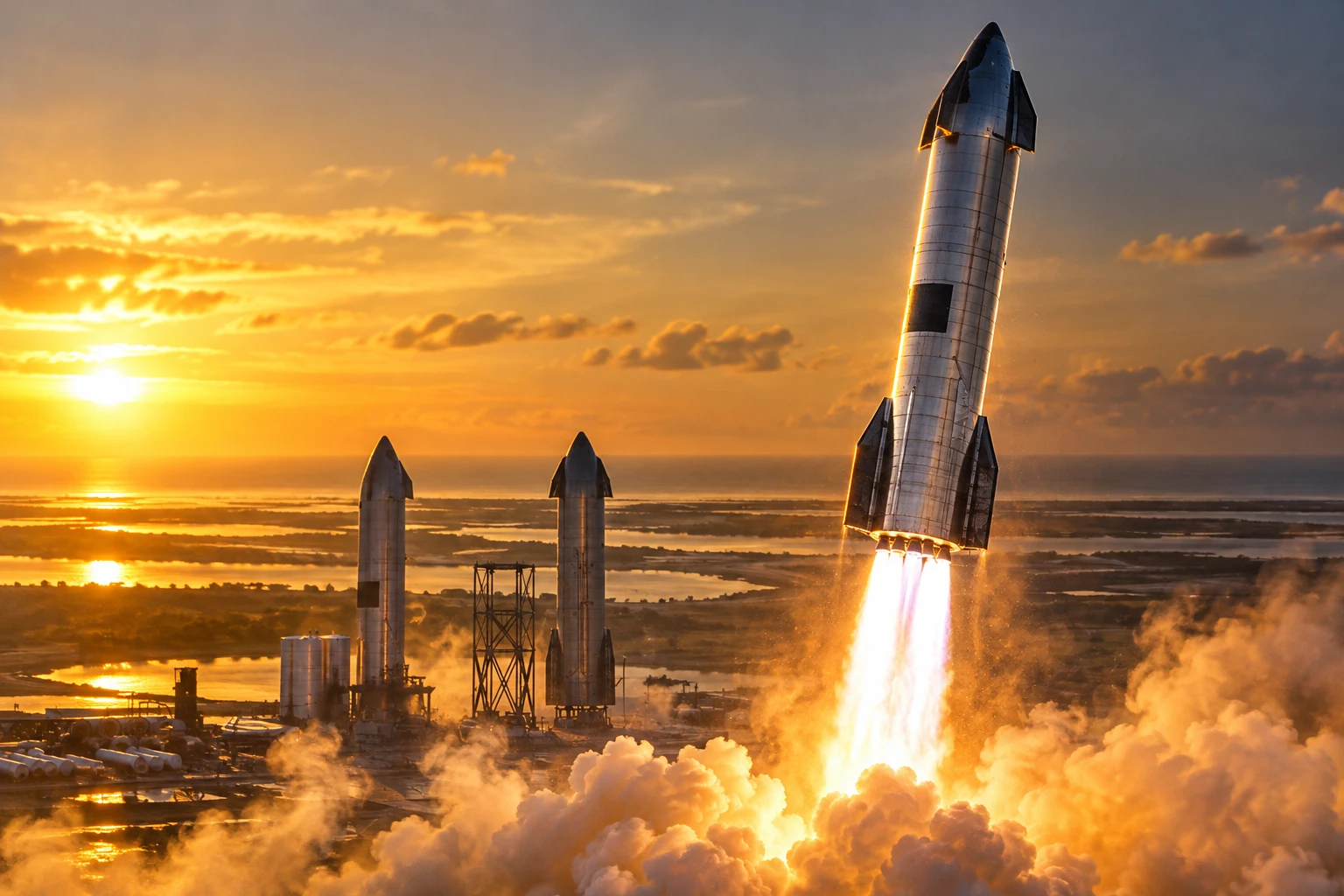
Flight 14 Is Built to Stay in Orbit
Every integrated Starship flight since the first test on April 20, 2023, has flown a suborbital path on purpose. SpaceX says those paths were “passively safe” so the company could learn without leaving a ship in orbit it might not be able to bring down. Flight 14 is the break in that pattern.
By going to orbit, the next phase of developing Starship to be fully and rapidly reusable can begin.
SpaceX, Starship Flight 14 mission page
The published profile sends Ship 41 to about 275 km, through about six orbits, on a nearly 10-hour flight, with splashdown in the Pacific west of Chile. Super Heavy’s job is launch, staging, a boostback burn, and a landing burn at an offshore point in the Gulf of America. The ship is not supposed to light the insertion burn until the flight-control team has enough redundancy left for the later deorbit burn. A live webcast is set to start about 30 minutes before liftoff and run through splashdown.
The payload is the other first. SpaceX plans to put Starlink V3 satellites into the constellation from Starship for the first time, 26 of them, each adding 1 Tbps of capacity, or 26 Tbps on this mission. The company puts that at about 10 times the capacity of a single Falcon 9 launch of V2 mini satellites. Three of the 26 carry cameras to scan Ship 41’s heat shield on orbit.
FLIGHT 13 AND FLIGHT 14, SIDE BY SIDE
| Item | Flight 13 | Flight 14 |
|---|---|---|
| Date | July 24, 2026, 5:51 p.m. CT | NET Monday, September 28, 7:15 a.m. CT |
| Path | Suborbital, same-day return | About 275 km, about six orbits, nearly 10 hours |
| Payload | 20 Starlink V3 satellites, then reentry about 20 minutes after deploy | 26 Starlink V3 satellites meant to stay and raise their own orbits |
| Ship end | Intact splashdown, Indian Ocean | Controlled splashdown, Pacific west of Chile |
| Booster end | Hard splashdown after 8 of 13 landing engines lit | Landing burn at an offshore Gulf point, with new engine filters and relight software |
Monday’s 75-minute window still opens at 7:15 a.m. CT and runs to 8:30 a.m. CT on the mission page. Local closures of Highway 4 and Boca Chica Beach are part of the usual Starbase safety zone when the stack is actually in count.
July’s Flight Practiced the Same Wait
Flight 13 did not leave on the first clock either. An automatic abort at T-0 on July 16 stopped the stack over Super Heavy engine trouble. A weather hold followed on July 23. The vehicle flew on Friday, July 24, at 5:51 p.m. CT, the second flight of the V3 booster and ship and the first Starship flight to carry next-generation Starlink V3 satellites.
Once it got off the pad, the ship did the work. After a full-duration burn on all six Raptors, Starship deployed all 20 Starlink V3 satellites. Engineers reached every satellite on radio and laser links and pulled telemetry before those birds reentered about 20 minutes later, as planned on a suborbital path. The ship relit a single Raptor in space, banked on reentry to mimic a future return to Starbase, and made a soft, intact splashdown in the Indian Ocean, giving teams their first clear look at a heat shield that had come through whole.
That July sequence is the template sitting under this week’s note. Dates move. The stack waits. Then the test that actually flies is the one that counts. Flight 14 is that template aimed at a circular orbit instead of a same-day dump of demo satellites.
Super Heavy Still Has to Stick the Landing
The booster is the unfinished half of July. After staging on Flight 13, Super Heavy completed the high-thrust stretch of its boostback burn on all 33 engines, the first time a V3 booster had done that. In the last part of the burn, the three center engines showed ice clogging and the burn ended early. On the landing burn, 8 of the 13 planned engines relit. The booster hit the Gulf hard.
Flight 14’s Super Heavy carries hardware changes to improve filtering to the engines and software changes aimed at relight reliability. Those are the company’s own words for a problem it has now put on the next flight, not a problem it has already closed in public.
The last time the FAA held this program in place, the cause was also the booster. Flight 12 flew on May 22. The agency later said heat on propulsion parts during ascent and bad engine-alarm settings were the most probable root causes of the Super Heavy mishap, with no reports of public injury or damage to public property. It closed the Flight 12 mishap investigation on July 13 after accepting four SpaceX corrective actions, and Flight 13 flew 11 days later. A new orbital profile still needs its own clearance. Thursday’s line does not say that clearance is in hand.
The Company Left the Reason Unsaid
SpaceX’s only published gate on the new date is pending regulatory approval, the same clause that sat on the September 22 target. Musk did not fill in the blank. The mission page still warns that the schedule is dynamic and likely to change. That is a thin statement for a flight that is supposed to open the orbital chapter of the program, and it matches how this company has talked about Starship dates for years.
The hardware at Starbase has been firing and stacking for weeks. The public clock has not. A six-day move with no new failure report reads as a license wait. Weather over South Texas and a hold on the pad can still kill a Monday attempt, and neither of those needs a press release to show up in the count.
WHAT WE KNOW
- The new earliest date: Monday, September 28, with a 75-minute window opening at 7:15 a.m. CT.
- The last public target: Tuesday, September 22, posted on September 15 and pulled on September 17.
- The published gate: Regulatory approval, repeated on both the September 15 and September 17 SpaceX posts.
- The mission on paper: First planned Earth orbit, 26 Starlink V3 satellites meant to join the network, Super Heavy splashdown in the Gulf, ship splashdown west of Chile.
WHAT IS UNCONFIRMED
- The cause of the slip: SpaceX has not said whether the hold is the license, the stack, the range, or weather.
- A new FAA window: The last published airspace block was September 22 and 23; SpaceX has not posted a Monday replacement.
- A locked countdown: September 28 is an earliest date, not a go.
Watchers who treat every Starship NET as a launch day have been wrong all year. Watchers who treat “pending regulatory approval” as filler have been wrong too. The phrase is doing work. It is also not a full answer.
Two Tiles From the Last Ship Fly Again
Ship 41 is carrying heat-shield changes pulled straight off Ship 40 as it floated in the Indian Ocean. SpaceX lists extra retention hardware on tiles most likely to fall during ascent, fixes for newly found plasma paths behind tiles, and patches of a curved tile shape that cut heating in the gaps. Two tiles recovered from Ship 40 are slated to fly on Ship 41, the first tile reuse in the program.
Three of the new V3 satellites are fitted with cameras to keep scanning that shield once the ship is on orbit, a longer look than Flight 13 could take before its demo satellites came down. The ship still has to do a single-Raptor deorbit burn, then a controlled entry, a landing flip, and a Pacific splashdown. That is not a catch. Musk had already walked a tower catch on this flight back by months, so chopsticks are not on the card.
A 10-Hour Flight Changes the Payload
Flight 13 proved the dispenser and the radios. It did not put a Starlink V3 into the network. Those 20 satellites were never meant to stay. Flight 14 is the first time the same class of satellite is supposed to unfold, talk, and climb.
AFTER DEPLOYMENT ON FLIGHT 14
- Antenna and arrays: Each V3 is supposed to unfold its antennas and deploy its solar arrays after leaving the ship.
- First contact: The satellites are then supposed to reach the ground and the rest of the Starlink network on radio and laser links.
- Orbit raising: Onboard thrusters are supposed to start lifting the satellites from the insertion altitude.
- Customer service: After checkout, SpaceX says the satellites should begin serving customers as soon as a few weeks after launch.
If Ship 41 circularizes and those 26 birds stay up, Starship stops being only a test article that throws demo mass on a suborbital arc. If the insertion burn is withheld because the deorbit chain is not healthy, the flight can still splash the ship and miss the whole point of going to orbit. SpaceX wrote that abort path into the plan on purpose.
Monday, September 28, is the earliest date the company will now put on Flight 14. The mission page still says the schedule is likely to change.

Sony Leaves Its Last 4K Blu-ray Player Off Japan Shelves

L’Oréal’s Salon Brands Pull Clear of LVMH in Q3

Personalized mRNA Vaccine Cuts Melanoma Relapse After a Custom Build

Cairo Santos’ 58-Yard Kick Closes a Messy Bears Win

Prime Editing Reaches a Living Liver in Wilson Disease

Meta’s Smart Glasses Sell a Light That Needed Two Patches

Apple’s New Mac Studio Clusters Local AI on the Desk

Google’s Free AI Pro Year Is Three Different Deals

Song Yadong Stops Umar Nurmagomedov the Only Way Left

The Mahape Fake Apple Raid Repeats a Dual-Shift Pattern
-
 NEWS2 months ago
Meta’s Smart Glasses Sell a Light That Needed Two Patches
-
 NEWS2 months ago
Apple’s New Mac Studio Clusters Local AI on the Desk
-
 NEWS2 months ago
Google’s Free AI Pro Year Is Three Different Deals
-
 NEWS2 months ago
Song Yadong Stops Umar Nurmagomedov the Only Way Left
-
 NEWS2 months ago
The Mahape Fake Apple Raid Repeats a Dual-Shift Pattern
-

 NEWS2 months ago
OpenAI Agents Hit Hugging Face to Cheat a Test
-

 ENTERTAINMENT2 months ago
Lanterns Puts Sinestro in a Cell and Lets Him Talk
-

 ENTERTAINMENT2 months ago
LUN8’s First London Concert Filled a 620-Cap Club