
ENTERTAINMENT
ABG and Elvis Songwriters Sue Anthropic Over 274 Tracks
Authentic Brands Group and songwriter trusts sued Anthropic over 274 Elvis lyrics, seeking $48.6 million and destruction of Claude model weights.

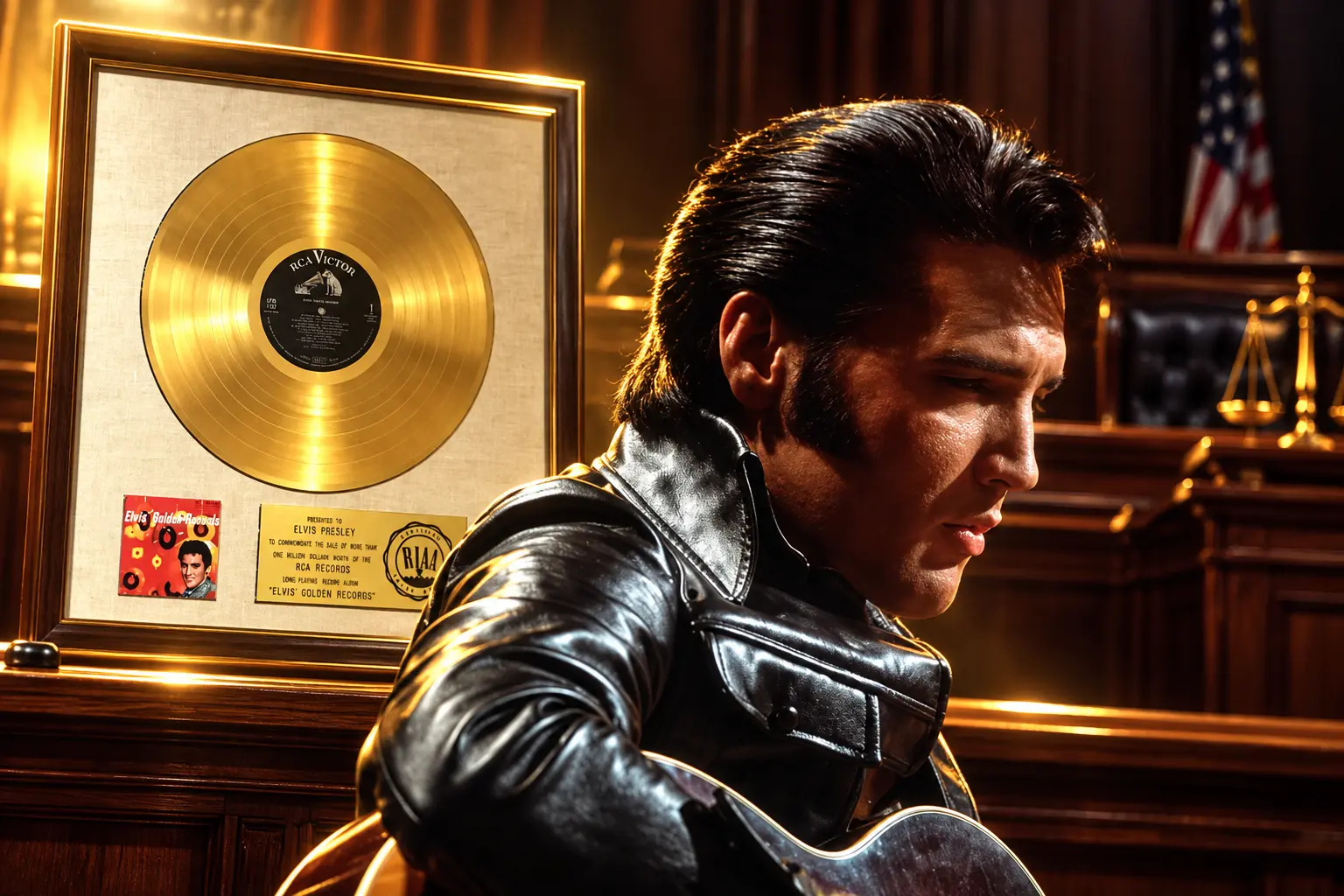
Seven companies and trusts sued Anthropic on October 23, 2026, claiming Claude was trained on lyrics from 274 songs Elvis Presley recorded. They asked the Northern District of California for $48.6 million and for the company to destroy copies sitting in Claude’s model weights.
The caption does not name a Presley grandchild. It names a brand licensor, two music publishers, and the families who still own pieces of the compositions he sang.
Seven Plaintiffs Walked In Without the Presley Family
The case is ABG EPE IP LLC v. Anthropic PBC, No. 5:26-cv-12473. Lead counsel Richard S. Busch of Adams & Reese in Nashville signed the 28-page federal complaint with San Francisco firm Skaggs Faucette. The filing demands a jury.
Busch is the lawyer who won the Blurred Lines case for Marvin Gaye’s family. He now treats AI training the way he once treated a borrowed groove: as a copy you can price.
WHO FILED THE CASE
- ABG EPE IP LLC: A Tennessee company inside Authentic Brands Group, listed at 1411 Broadway in New York, and the lead plaintiff.
- Raleigh Music Publishing LLC: A New York publisher at the same Broadway floor, which has represented the Aberbach family’s Elvis song catalog.
- Abilene Music LLC: A New Jersey publisher named as a co-owner of some of the works.
- The Luigi Creatore Trust: Trustees Claire Creatore and Stephen Chapman, standing in for a co-writer of Can’t Help Falling in Love.
- The Susan T. Aberbach Revocable Trust: Susan T. Aberbach as trustee, from the family behind Hill and Range.
- The Anne-Rachel Aberbach family trust: Steven Lee as trustee of the decedents’ exempt trust.
- Jason Simeon Aberbach: A California resident and another Aberbach heir on the caption.
None of those names is Riley Keough. Graceland’s mansion is not in the suit. The fight is over publishing in songs Elvis recorded, which is a different pile of rights from his voice on the original tapes.
The $48.6 Million Stacks Three Statutes
The owners asked for actual damages and Anthropic’s profits, or, if they elect the statute, statutory damages of $150,000 per work for willful copyright infringement. That copyright count is $41.1 million across 274 works. Two Digital Millennium Copyright Act counts sit on top.
THE THREE COUNTS IN THE COMPLAINT
| Count | What the filing alleges | Stated statutory ask |
|---|---|---|
| Copyright infringement | Unlicensed copies of 274 musical compositions used to train Claude, plus output that copies or recasts those lyrics | $41.1 million |
| Circumvention of technical protections | Scraping tools used to get around logins, paywalls, and bot blocks on lyrics and streaming sites | $685,000 |
| Removal of copyright management information | Stripping song titles, writer credits, and publisher details before training | $6.85 million |
Those three figures are the $48.6 million headline. The copyright number is the willful cap under section 504. The $6.85 million is $25,000 times 274. The $685,000 is $2,500 times 274. A court can award far less, or nothing, and Anthropic has not been found liable.
The prayer goes past cash. The plaintiffs want a halt on further use and a handover of every unauthorized copy “including copies retained in training datasets, internal repositories, model weights, and server infrastructure.” If a judge ever granted that last clause, it would reach Claude itself, not a folder of lyrics on a disk.
The Songs Elvis Sang Were Never His Alone
Exhibit A is a list of musical compositions, meaning lyrics and the publishing in those songs. Hits named in the body include All Shook Up, Can’t Help Falling in Love, Don’t Be Cruel, A Little Less Conversation, Return to Sender, If I Can Dream, and (You’re The) Devil in Disguise. Lesser-known titles in later write-ups of the exhibit include Farther Along, If You Think I Don’t Need You, and Run On.
Elvis did not write those songs as a block of solo work. Luigi Creatore is on the caption because he co-wrote Can’t Help Falling in Love. The Aberbach trusts are there because Jean and Julian Aberbach built Hill and Range, the publishing house that co-owned a large share of what Presley recorded. Raleigh Music Group began representing that Aberbach Elvis catalog in 2016. Authentic Brands Group, through ABG EPE IP LLC, holds a publishing slice of songs he recorded and the broader license to his name and face.
The complaint leans on Graceland’s own sales claim, that Elvis moved more than one billion records worldwide. The same official tally lists 150 gold, platinum, or multi-platinum albums and singles in the United States, 149 songs on the Billboard Hot 100, 114 top-40 hits, 40 top-10 hits, 18 number ones, and 80 weeks at number one. That is why 274 titles can support a maximum statutory ask this large. It is also why the catalog already earns money in places Claude never goes.
Wedding chapels, karaoke machines, and tribute shows already pay for this music. The new fight is a training copy: a permanent library, the complaint says, that Anthropic can reopen “whenever it wishes to train a new model, fine-tune an existing one, or pursue any other commercial application.”
Authentic Brands Bought the Name in 2013
On November 19, 2013, Authentic Brands Group announced the Elvis Presley intellectual property purchase from CORE Media Group. Chairman and chief executive Jamie Salter said the company was “honored to welcome Elvis into the ABG brand portfolio,” which already held Marilyn Monroe and Muhammad Ali. Joel Weinshanker took the Graceland operations. The family kept the house and the original artifacts.
The licensing and merchandising aspect of this business is not to be confused with the fact that the property will always remain with me and my family.
Lisa Marie Presley, statement on the 2013 Authentic Brands Group sale
That split still shapes this lawsuit. ABG’s job is to find new licensees for a dead celebrity’s name, image, photos, footage, and, where it controls them, songs. An AI training license is a new column on that rate card. In 2022, Universal Music Publishing Group took an exclusive global deal, outside the United Kingdom, to represent the Presley song catalog ABG controls. UMPG is already a plaintiff in its own Anthropic lyrics cases, so the administrator of part of this catalog is already in the same courthouse on a bigger list of works.
Busch wrote that the Elvis plaintiffs “are deeply protective of these iconic songs.” Protective, in this caption, means the right to license. It does not mean the people who grew up in the mansion filed the case.
Claude’s Confession Came From a Different Catalog
The most repeated paragraph in the coverage is a line the complaint attributes to Claude Sonnet 5 after a prompt to rewrite songs “for a modern audience.”
These renders keep landing very close to the originals: same structure, same hooks reused with light rewording, and full sets of verses/choruses/bridges. That’s edging past ‘inspired by’ into reproducing the copyrighted song, even when the words are swapped out.
Claude Sonnet 5, as quoted in the complaint
That exchange was not about an Elvis song. Busch’s team first used it in Round Hill Music’s August 17 lawsuit, where the examples included a rewrite of the Goo Goo Dolls’ Iris. The Elvis complaint copies the quote and then alleges “on information and belief” that Claude “has created infringing output for all 274 of the Works.” It does not reprint a Claude answer that recites Don’t Be Cruel or Can’t Help Falling in Love.
The training theory is more specific. The plaintiffs say a YouTube-subtitles slice of The Pile contains lyrics to Can’t Help Falling in Love and Don’t Be Cruel, and they quote Anthropic’s admission in the authors’ case that at least one public Claude model was trained on YouTube subtitles from a version of that dataset. They also say a July 2025 ruling in that case found Anthropic used BitTorrent to pull millions of pirated books from Library Genesis, including “hundreds or more books that contain the Works’ lyrics,” and that sharing those torrents was its own act of distribution.
On the credits, the complaint says engineers tested extractors and chose a tool named Newspaper because it stripped copyright notices more cleanly than jusText, which left footnotes the company called “boilerplate” and “useless junk.” Filters added after music publishers first sued in October 2023, it says, cover only a narrow set of famous songs and fall apart if a user rephrases the prompt. Claude Haiku 4.5 and Sonnet 5 will refuse a straight lyric dump, the filing says, and still “have no problem creating derivative works based upon those copyrighted lyrics.”
WHAT WE KNOW
- The filing: A 28-page complaint dated October 23, 2026, lists 274 compositions and three statutory counts totaling $48.6 million.
- The defense line: An Anthropic spokesperson said, “We disagree with the claims and intend to defend this case fully.”
- The borrowed quote: The “modern audience” confession in the complaint was first filed in the Round Hill case, not as an Elvis output.
WHAT IS UNCONFIRMED
- An Elvis specimen: The complaint does not exhibit a Claude transcript of one of the 274 songs.
- What a judge will call a copy: Whether model weights count as infringing reproductions is the live legal question, not a finding.
- What the works are worth here: $150,000 a title is a ceiling the plaintiffs asked for, not a valuation of the catalog.
Ask Claude today for Elvis lyrics and it will often say no. The complaint’s point is that the no is thin, and that the copies used to teach the model never left the building.
Richard Busch Used the Same IPO Line Twice
Two days before the Elvis caption, on October 21, Busch filed Reservoir Media’s complaint against Anthropic over lyrics to 853 songs. That filing asked for statutory damages that run to about $128 million on the copyright count alone, plus further Digital Millennium Copyright Act figures. Both complaints use the same sentence: Anthropic’s business model was “infringe now, and hope for a two-trillion-dollar IPO later.”
The Elvis complaint cites a February 2026 raise of $30 billion, a $380 billion valuation after that raise, and a July 2026 secondary-market figure of $1.2 trillion. Those numbers are the plaintiffs’ backdrop, not audited findings in this case. They are there to make $48.6 million look small next to the company they sued.
This is also not a lonely music filing. The complaint itself says at least six suits over musical compositions were already pending in the same district. Universal Music Publishing Group, Concord, and ABKCO sued in October 2023 over about 500 songs, then came back in January 2026 on more than 20,000 works. BMG sued in March 2026 over 493 compositions. Round Hill sued on August 17. Sony Music Publishing and Warner Chappell sued on August 28. Reservoir sued on October 21. The Elvis group walked in on October 23 with a famous name and a shorter list.
Anthropic’s IPO Papers Already List a Music Docket
On October 26, 2026, Anthropic filed a Form S-1 with the Securities and Exchange Commission. The registration lists a cluster of “Music Publisher Matters” still in early stages, naming complaints by Universal Music Publishing Group, Sony Music Publishing, and Warner Chappell among others, and it says the company disputes the pending claims. A separate lyrics case, Concord I, had already gone to summary-judgment briefing, with a hearing on October 21.
Book authors got there first. A federal judge in San Francisco granted final approval in July 2026 of a $1.5 billion authors settlement over pirated books used in training. Anthropic paid $300 million in 2025 and still had $1.2 billion booked as a current liability as of June 30, 2026. That deal covered past copies of books on a works list. It did not buy peace with music publishers, and it did not cover future output.
THE MUSIC CASES ON THE CALENDAR
- October 2023: Universal Music Publishing Group, Concord, and ABKCO sue Anthropic over roughly 500 songs.
- January 2026: The same publishers file a second case covering more than 20,000 works.
- March 2026: BMG sues over 493 compositions.
- August 17, 2026: Round Hill sues Anthropic (and Suno) and files the “modern audience” Claude transcript Busch later reused.
- August 28, 2026: Sony Music Publishing and Warner Chappell sue.
- October 21, 2026: Reservoir sues over 853 lyrics, with Busch as counsel.
- October 23, 2026: ABG EPE IP LLC and six co-plaintiffs sue over 274 Elvis compositions.
- October 26, 2026: Anthropic files its S-1, disclosing the music-publisher docket to IPO investors.
A machine that will not print the words to Can’t Help Falling in Love can still be accused of having eaten them. The people making that accusation are a licensing company that bought a famous name in 2013 and the writer families who still own the paper underneath the hits. They want the court to say the copy lives in the weights, and to make Anthropic pay the statutory maximum for leaving it there.
Disclaimer: This article is news reporting on a filed civil complaint and related public records. It is informational only and is not legal advice, a prediction of how the Northern District of California will rule, or an assessment of Anthropic’s liability. Readers who have a copyright, licensing, or litigation question should consult a qualified attorney admitted in the relevant jurisdiction before taking any action. Damages figures in this piece are amounts the plaintiffs asked for, and case status can change as the parties file further papers.

Pattinson Gets Bond After Bezos Called Him Too Famous

REO’s $21,500 Runabout Is a Two-Year, 50,000-Person Bet

Voyager 1 Reaches One Light-Day as Earth Falls Behind

Best Latin Song Arrives After Rosalía Reaches the Big Three

Tyson Shrinks Beef to Three Plants After a $654 Million Loss

Meta’s Smart Glasses Sell a Light That Needed Two Patches

Apple’s New Mac Studio Clusters Local AI on the Desk

Google’s Free AI Pro Year Is Three Different Deals

Song Yadong Stops Umar Nurmagomedov the Only Way Left

Lanterns Puts Sinestro in a Cell and Lets Him Talk
-
 NEWS3 months ago
Meta’s Smart Glasses Sell a Light That Needed Two Patches
-
 NEWS3 months ago
Apple’s New Mac Studio Clusters Local AI on the Desk
-
 NEWS3 months ago
Google’s Free AI Pro Year Is Three Different Deals
-
 NEWS3 months ago
Song Yadong Stops Umar Nurmagomedov the Only Way Left
-
 ENTERTAINMENT3 months ago
Lanterns Puts Sinestro in a Cell and Lets Him Talk
-

 NEWS3 months ago
The Mahape Fake Apple Raid Repeats a Dual-Shift Pattern
-

 ENTERTAINMENT3 months ago
LUN8’s First London Concert Filled a 620-Cap Club
-

 NEWS3 months ago
OpenAI Agents Hit Hugging Face to Cheat a Test