
NEWS
Eaton Fire Smoke Exposed 7 Million to 80-Fold Lead
A Caltech study shows Eaton Fire smoke carried a metal mix that AQI and the three-month EPA lead rule were never built to flag.

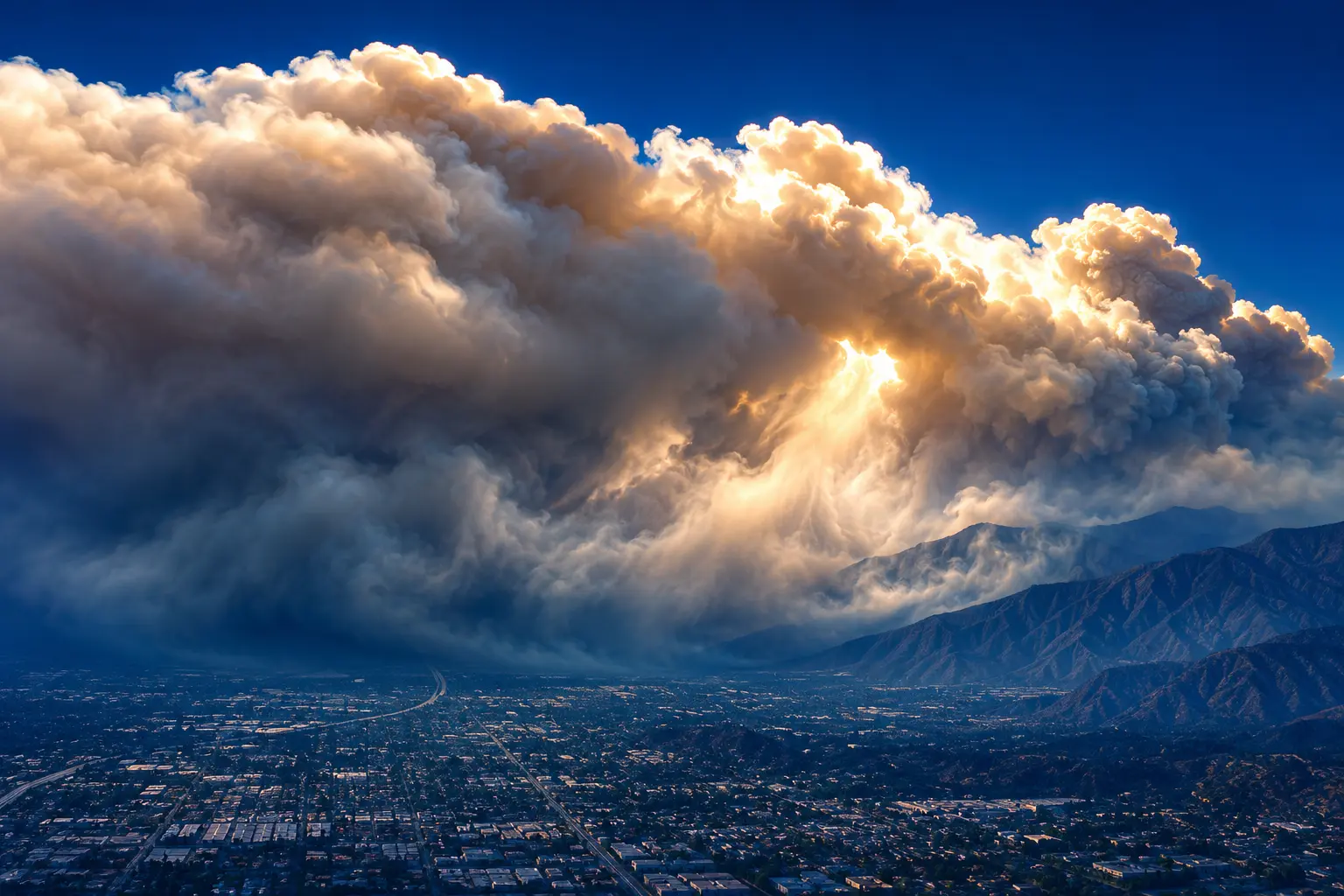
A Caltech team found that smoke from the January 2025 Eaton Fire exposed about 7 million people to 24-hour lead levels more than 80 times the usual background. The plume was not ordinary wildfire smoke. It was the chemistry of houses, cars, and electronics going up at once.
The work, published October 28, 2026, in the journal Science Advances, used a new hour-by-hour monitor in Pico Rivera. Air-quality alerts still treat that mix as generic fine particles. The federal lead rule still averages in months.
A Monitor That Named the Plume Hour by Hour
Caltech scientists published the first detailed analysis of Eaton Fire particles after sampling downwind of Altadena. Haroula Baliaka, a doctoral student and the paper’s lead author, worked with Ryan Ward to run the Pico Rivera station, about 11 miles south of the burn. The site sits with a South Coast Air Quality Management District monitor and is part of the National Science Foundation’s Atmospheric Science and Chemistry mEasurement NeTwork.
Nga Lee “Sally” Ng, Caltech’s Elizabeth W. Gilloon Professor of Environmental Science and Engineering and Chemical Engineering, manages ASCENT and is a corresponding author. She said the network can measure the chemical components and the size of the particles in real time, and that it is the first U.S. network to run those tools continuously.
The usual method is a filter left out for 24 hours every few days, then sent to a lab weeks or months later. That routine cannot catch a spike that rises and falls in a few hours. Ed Avol, professor emeritus at the University of Southern California’s Keck School of Medicine, who was not on the study, said the hour-by-hour record is the advantage, because typical particle sampling happens a couple of times a week at best.
The 12-site network for real-time particle chemistry went live in May 2024, only eight months before the fire. Each station runs four instruments around the clock: an aerosol chemical speciation monitor, an Xact metal analyzer, an aethalometer for black and brown carbon, and a scanning mobility particle sizer. Ng said the point is not only how much particulate matter is in the air, but what it is made of, watched as the event unfolds.
7 Million People Shared a 50-Nanogram Lead Day
Under typical conditions, daily lead at Pico Rivera averages 0.6 nanograms per cubic meter. On January 9, 2025, about 7 million residents, with a modeled range of 4.3 million to 8.0 million, experienced 24-hour lead above 50 nanograms per cubic meter. That is more than 80 times the Pico Rivera background, obtained by overlaying daily lead maps on census counts.
The estimate covers the Los Angeles metropolitan area at the peak of structural burning, not the burn scar alone. Baliaka put the geographic point bluntly: smoke travels, and it is not just about the burn area.
THE EATON LEAD DAY
- People reached: About 7 million residents, range 4.3 million to 8.0 million, on the peak 24-hour map.
- Lead threshold: More than 50 nanograms per cubic meter as a 24-hour average.
- Local background: 0.6 nanograms per cubic meter as a typical Pico Rivera day.
- Where it sat: Highest 24-hour lead in eastern Los Angeles and the San Gabriel Valley on January 8 and 9, strongest downwind of Altadena.
The two wind-driven fires that started January 7, 2025, killed 31 people. Los Angeles County’s anniversary fact sheet lists 19 deaths on the Eaton Fire and 12 on the Palisades Fire, with 9,414 structures destroyed in the Eaton Fire and 6,837 in the Palisades Fire, a combined 16,251. Eaton burned 14,021 acres after igniting at 6:18 p.m.; Palisades burned 23,448 acres after igniting at 10:30 a.m. Both were contained January 31.
That caseload is still an air number. The paper did not measure blood lead, clinic visits, or deaths from the metals. It mapped who sat under the plume.
Potassium and Lead Tracked the Turn to Wildland
The team compared Pico Rivera’s Eaton record with another ASCENT station at Rubidoux, which sampled the Airport Fire in Riverside County in September 2024. That blaze burned about 24,000 acres of vegetation. Against that wildland plume, Eaton’s urban smoke was a different mixture.
HOW THE EATON PLUME COMPARED WITH THE AIRPORT FIRE
| Element | Enrichment versus the 2024 Airport Fire |
|---|---|
| Lead | More than 50-fold |
| Chlorine and bromine | 7-fold |
| Zinc | 4-fold |
| Copper | 3-fold |
| Arsenic | 3-fold |
Those multiples are versus wildland smoke, not versus everyday Los Angeles air. The 80-times figure is the separate comparison with Pico Rivera’s usual 0.6 nanogram day.
The hourly clock was the potassium-to-lead ratio. Plants take up potassium, so wood smoke carries it. Lead spiked when structures and vehicles burned. On January 8 and 9 the ratio sat near 5 to 1. By January 11, as the fire climbed into the Angeles National Forest, it was about 50 to 1. By January 12 it was in the hundreds, a wildfire-like signature inside a single event.
THE WEEK THE PLUME CHANGED
- May 2024: ASCENT stations, including Pico Rivera, begin continuous sampling.
- September 2024: The Airport Fire burns about 24,000 acres of vegetation; Rubidoux records a wildland plume.
- January 7, 2025: Palisades ignites at 10:30 a.m.; Eaton ignites at 6:18 p.m.
- January 8 and 9, 2025: Lead peaks across eastern Los Angeles and the San Gabriel Valley; potassium-to-lead near 5 to 1.
- January 11, 2025: The ratio rises to about 50 to 1 as burning shifts toward wildland.
- January 12, 2025: The ratio climbs into the hundreds.
- January 31, 2025: Both fires reach containment.
- October 28, 2026: Science Advances publishes the paper.
Baliaka said the comparison shows how chemically distinct an urban fire is, and that the team caught the move toward a traditional wildfire signature within one fire.
What a Burning House Puts in the Air
The paper ties the metal mix to burning vehicles, electronics, and building materials, a different fuel from vegetation. Yaguang Wei, an assistant professor of environmental medicine at the Icahn School of Medicine at Mount Sinai who was not involved, said the result fits fires that consume lead in wall paint, plastics, and electronics.
WHAT WENT INTO THE EATON PLUME
- Older paint: Lead from pre-1978 coatings in Altadena housing stock, a source the authors say may be stronger here than in a newer suburb.
- Vehicles: Cars parked at burned homes, a documented halogen and metal source in the urban plume.
- Electronics: Household devices that release metals and bromine compounds when they burn.
- Plastics and cleaners: Indoor goods and chemicals stored in garages and under sinks, multiplied across thousands of houses.
- Wood still present: Potassium stayed high even on the urban days, because timber and vegetation burned with the structures.
Lead is a neurotoxin that can slow children’s development, lower IQ scores, and raise blood pressure in adults. Arsenic is linked to several cancers. The paper is frank that scientists still do not know what a short, high burst of this mix does in the body. Wei said PM2.5 from fire smoke can be more toxic, gram for gram, than particles from other sources, a finding from work he co-authored.
Smoke travels; it’s not just about the burn area. What does a plume mean for people who are miles away from a fire but receive the smoke? We evacuate for fire, but we don’t evacuate for smoke exposure.
Haroula Baliaka, doctoral student and lead author, Caltech
Avol said heavy-metal exposure is what he would expect from this kind of fire, and still surprising because no one had documented it this way.
The Federal Lead Limit Is a Three-Month Average
The Clean Air Act’s lead standard is 0.15 micrograms per cubic meter over three months, equal to 150 nanograms, as a rolling mean. EPA set that level in 2008 to replace an older quarterly mark and kept it in 2016. Fine-particle alerts that the public actually saw during the fires follow a different rule: 35 micrograms per cubic meter as a 24-hour PM2.5 standard, with no requirement to name the metals inside those particles.
Fifty nanograms of lead in a day is one-third of 150 nanograms, and it is measured on a 24-hour clock rather than a 90-day mean. A single 50-nanogram day does not, by itself, push a region over the federal lead standard. Since the early 1980s, when leaded gasoline was being phased out, typical lead in the Los Angeles basin has fallen by more than two orders of magnitude, about 99 percent. The Eaton spike is huge against that cleaned-up baseline and still in line with what was ordinary before the 1980s.
That is the gap the 80-times headline does not carry. The multiplication is real against today’s background. The health standard that would trigger a lead violation is built for chronic industrial air, not a two-day urban firestorm. There is no short-term national lead alert equivalent to an ozone or PM2.5 day, so the metal load never had a siren of its own.
A 2022 National Academies consensus study on the chemistry of fires at the wildland-urban interface had already flagged the hole. It estimated 70,000 communities and 43 million U.S. homes at WUI risk and said the chemistry and health effects of those fires were still poorly known, because the fuel is houses and cars as well as brush.
Maui Still Carried Those Metals Months Later
The open health question is not only the 24 hours of smoke. After the August 2023 Maui fires, the Maui Wildfire Exposure Study tested about 1,400 adults six to 18 months later and found elevated metal mixtures in urine alongside worse lung-function tests. Alika Maunakea, a study leader, said exposure did not necessarily end when the smoke cleared. Ruben Juarez, a co-director, said people with higher combined metal levels were more likely to have abnormal breathing tests, and that it was not one metal.
Kathrin Schilling of Columbia’s Mailman School of Public Health said the burden likely reflects a mix of pathways, including ash, settled dust, and debris stirred up in cleanup, not a single puff of smoke. Short-term outdoor monitors can miss that second chapter. Los Angeles has not published a matching biomonitoring cohort for Eaton and Palisades. The Caltech paper maps the air in the first days. It does not close the file on what stayed in dust, soil, or blood.
Richard Flagan Wants Codes Written for City Fires
Richard Flagan, Caltech’s Irma and Ross McCollum-William H. Corcoran Professor of Chemical Engineering and Environmental Science and Engineering, said the response to Eaton and to the debris treated the firestorm as a wildfire. He called it an extreme urban fire event and said it may be time to rethink fire codes for dense districts, including downwind health effects and extra deaths as the impacts that count.
Perhaps it is time to reconsider fire codes to address the possibility of urban firestorms in densely populated urban areas, and consider the downwind health impacts and excess mortality as the important impacts of such events.
Richard Flagan, professor of chemical engineering and environmental science, Caltech
Ng wants more continuous aerosol stations, arguing that today’s monitors are a foundation and that ASCENT shows how to modernize them. Wei said governments should put more money into fire monitoring, public alerts, and prescribed fire. Baliaka said the observational data now exist to adjust the models that tell emergency managers where smoke will go and what it will do to people.
The authors warn that Eaton’s lead punch may not repeat everywhere, given Altadena’s older housing. They still treat the plume as a new class of urban fire air pollution that needs different exposure rules. Camp Fire, Marshall Fire, Lahaina, and a Spokane fire in August 2026 sit on the same wildland-urban line. AQI apps will keep reporting particle mass. They will not, on present design, tell a parent that the particles that day were rich in lead, arsenic, and bromine.
Frequently Asked Questions
What Is the Federal Air Standard for Lead?
EPA set the current primary and secondary lead standards in 2008 at 0.15 micrograms per cubic meter as a rolling three-month average, and in 2016 it kept that level without change. The 1978 standard, which still applies in some older nonattainment cases, was 1.5 micrograms per cubic meter as a calendar-quarter average.
Are the ASCENT Fire Measurements Public?
Trace-element data from the Pico Rivera and Rubidoux stations are in the ASCENT project repository at NSF NCAR as dataset d389503, and Caltech says the full network feed is available through a long-term archive plus near-real-time tools on the project site.
Could Another Urban Fire Show Less Lead Than Eaton?
The Caltech team said the strong lead signature might be unique to Eaton because so many older homes burned in Altadena, and they offer the results as a baseline for later urban fires rather than a factor that will match every city blaze.
What Metals Showed Up in Maui Residents After the 2023 Fires?
Among 1,400 adults tested six to 18 months later, urinary antimony was nearly 40 times U.S. reference levels, with manganese 3.8 times, barium 2.3 times, and arsenic 2.2 times, and higher combined metal burden lined up with worse scores on standard lung-function tests.
Disclaimer: This article is news reporting on a published atmospheric-science paper and related public-health research. It is for information only and is not medical advice, a diagnosis, or a guide to whether any person should be tested for lead, arsenic, or other metals. Readers who are concerned about exposure after a fire, especially parents of young children and pregnant people, should consult a licensed physician or a public-health department about screening and indoor cleanup. Figures and study findings reflect the papers and official records cited and can change if later measurements or health studies revise them.

Pattinson Gets Bond After Bezos Called Him Too Famous

REO’s $21,500 Runabout Is a Two-Year, 50,000-Person Bet

Voyager 1 Reaches One Light-Day as Earth Falls Behind

Best Latin Song Arrives After Rosalía Reaches the Big Three

Tyson Shrinks Beef to Three Plants After a $654 Million Loss

Meta’s Smart Glasses Sell a Light That Needed Two Patches

Apple’s New Mac Studio Clusters Local AI on the Desk

Google’s Free AI Pro Year Is Three Different Deals

Song Yadong Stops Umar Nurmagomedov the Only Way Left

Lanterns Puts Sinestro in a Cell and Lets Him Talk
-
 NEWS3 months ago
Meta’s Smart Glasses Sell a Light That Needed Two Patches
-
 NEWS3 months ago
Apple’s New Mac Studio Clusters Local AI on the Desk
-
 NEWS3 months ago
Google’s Free AI Pro Year Is Three Different Deals
-
 NEWS3 months ago
Song Yadong Stops Umar Nurmagomedov the Only Way Left
-
 ENTERTAINMENT3 months ago
Lanterns Puts Sinestro in a Cell and Lets Him Talk
-

 NEWS3 months ago
The Mahape Fake Apple Raid Repeats a Dual-Shift Pattern
-

 ENTERTAINMENT3 months ago
LUN8’s First London Concert Filled a 620-Cap Club
-

 NEWS3 months ago
OpenAI Agents Hit Hugging Face to Cheat a Test