
BUSINESS
Five Drugmakers Halt New Trials at China’s Military Hospitals
Five U.S. drugmakers told Congress they will not start new military-hospital trials in China, leaving the country’s faster trial machine largely intact.

Merck, Eli Lilly, AbbVie, Pfizer and Bristol Myers Squibb told a House committee they will not start new clinical trials at Chinese military hospitals. The House Select Committee on China disclosed the pledges on Nov. 19, after opening the inquiry with letters dated June 29. A smaller group of those firms also said it does not plan to open new trial sites in Xinjiang.
The line is new sites. It leaves standing the much larger Chinese hospital networks that, the committee says, enroll patients three to five times faster than U.S. sites, and that already log more registered trials than the United States.
Five Companies Draw a Narrow Line
All five companies indicated they would not initiate new clinical studies at sites linked to the People’s Liberation Army, the military wing of the Chinese Communist Party. That is the only promise the committee attributed to the full group. Xinjiang, the western region that U.S. law already treats as the center of a forced-labor system, was handled more loosely: some of the largest firms said they would not start new sites there either.
Rep. John Moolenaar, the Michigan Republican who chairs the committee, had asked the companies for due-diligence files, data-protection rules, and lists of licensing deals with Chinese biotechnology firms. His letters said there was no evidence any of the five had broken the law. They argued that work in Xinjiang and at military hospitals still exposed American intellectual property and left open questions about informed consent.
WHAT WE KNOW
- The PLA line: All five companies said they will not start new studies at sites linked to the People’s Liberation Army.
- The Xinjiang line: Only some of the five said they have no plans to open new trial sites in Xinjiang.
- The paper trail: The committee built its lists from ClinicalTrials.gov and ChinaDrugTrials.org.cn and called those lists incomplete.
WHAT IS UNCONFIRMED
- Existing protocols: The disclosed pledges do not say that patients already enrolled at those hospitals will be moved or that those studies will close.
- Civilian China: The committee did not say the companies will stop opening sites at ordinary Chinese hospitals, including large public centers with no stated military tie.
- Who froze Xinjiang: The public disclosure did not name which of the five, beyond Pfizer’s earlier statement, joined the Xinjiang promise.
That gap is the whole design of the concession. Congress can point to two place names. The companies can retire the most radioactive addresses and keep using the rest of a trial system they spent years building.
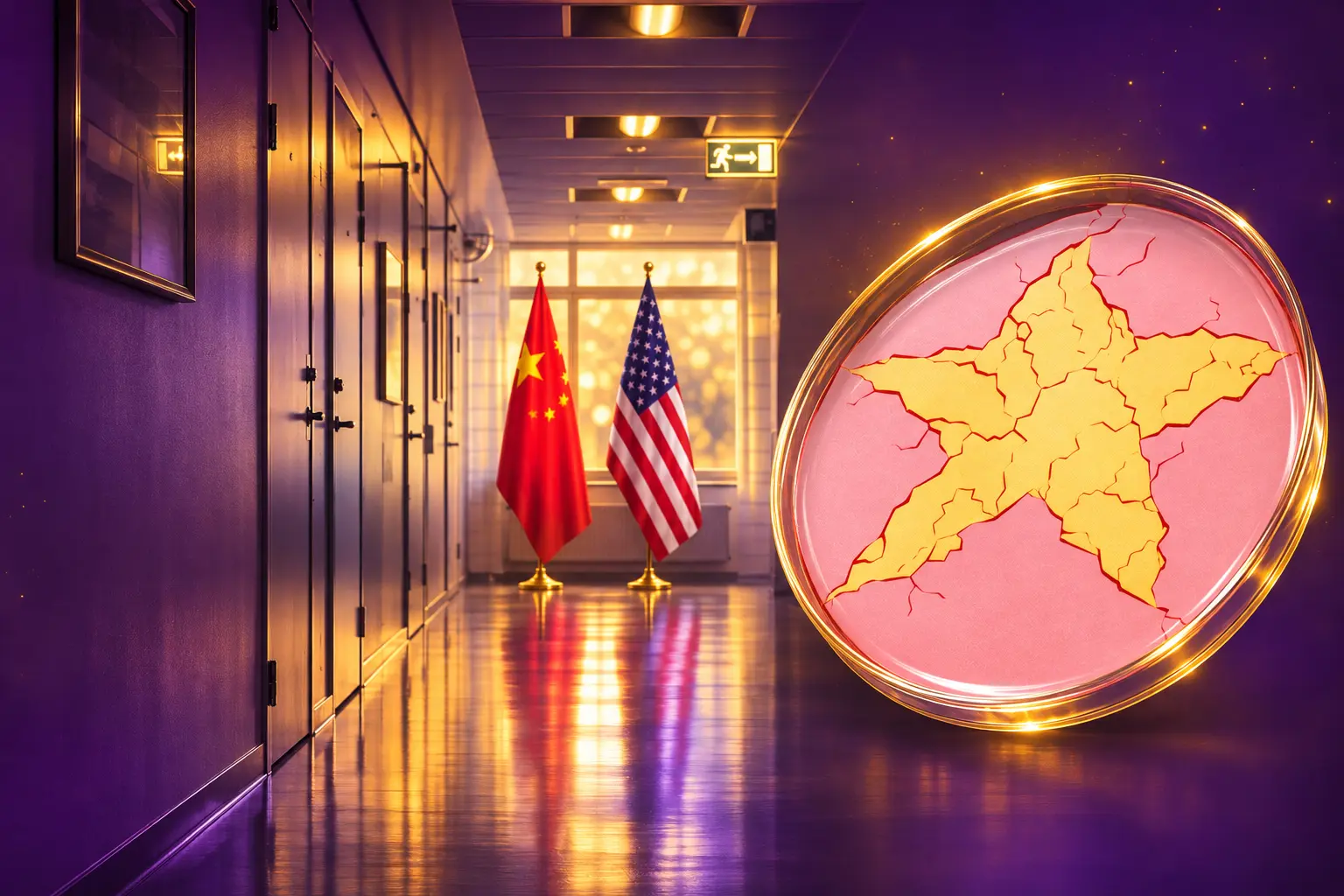
The Committee’s Count, Company by Company
Moolenaar’s staff did not claim these were secret programs. They pulled public registrations and counted studies that listed a Xinjiang hospital or a military medical center among their sites. Several of those studies were still marked ongoing when the letters went out.
TRIALS THE COMMITTEE FLAGGED
| Company | Xinjiang trials | Military-hospital trials |
|---|---|---|
| Merck | at least 31 | at least 40 |
| Pfizer | at least 6 | at least 43 |
| AbbVie | at least 17 | at least 16 |
| Eli Lilly | at least 11 | at least 16 |
| Bristol Myers Squibb | at least 8 | at least 17 |
| Five-company total | at least 73 | at least 132 |
Merck’s China file was the deepest on Xinjiang: 224 studies in the country since 2005, including Crohn’s disease and arthritis programs. Pfizer led the military-hospital count. Lilly, the committee said, had sponsored more than 220 China studies since 2003, some in Type 2 diabetes and heart disease. AbbVie was listed with more than 100 China studies since 2007.
Each letter went to a named chief executive: Robert Davis at Merck, David Ricks at Lilly, Robert Michael at AbbVie, Albert Bourla at Pfizer, and Chris Boerner at Bristol Myers Squibb. Answers were due July 17.
Pfizer Moved First, Months Before the Others
Pfizer did not wait for the November round. In the June 30 letter to Bourla, Moolenaar wrote that he already understood the company will no longer sponsor trials in Xinjiang and at PRC military hospitals in the future.
I understand that Pfizer will no longer sponsor trials in Xinjiang and at PRC military hospitals in the future. I commend this decision, and I would like to learn more about the company’s due diligence efforts that led to it.
Rep. John Moolenaar, chairman, House Select Committee on China, June 30 letter to CEO Albert Bourla
The November disclosure is the rest of the group catching a line Pfizer had already drawn. Merck, Lilly, AbbVie and Bristol Myers Squibb now say they will not start new PLA-linked studies. That still leaves a live question the June letters asked and the public readout did not answer: how those companies police partnerships with Chinese biotechnology firms that run their own early studies, then license the assets west.
Select Committee Chairman @RepMoolenaar sent a letter to @Merck, which conducted clinical trials at Chinese military hospitals and in Xinjiang, the epicenter of the CCP's genocide against Uyghurs.
Our investigation requests information on the company’s policies and due… pic.twitter.com/gzTXO61LR4
— Select Committee on China (@ChinaSelect) June 30, 2026
On June 30 the committee’s account posted the Merck letter and the Xinjiang and military counts in public. The November pledges arrived with far less noise, which fits the substance. The industry had months to write a narrow rule and hand it back.
Why Military Hospitals and Xinjiang Were the Test
The committee’s security case is straightforward. Data generated at a PLA hospital, Moolenaar wrote, could feed Chinese military biotechnology research. The chemical structures of experimental drugs are not, by themselves, export-controlled. A trial still moves protocols, patient-level results, and know-how through a site the committee treats as a military end user.
The ethics case sits on a different pile of paper. In the Bristol Myers Squibb letter, Moolenaar noted the company had sponsored or collaborated on about 180 clinical studies since 2004, including Xinjiang work that was still starting as recently as May 2024. He then quoted a 2023 review of informed consent in Chinese cancer trials.
WHAT A 2023 CHINA CANCER-TRIAL REVIEW FOUND
- Standard of care: 91.2% of surveyed participants mistook clinical trials as the standard-of-care treatment.
- No other option: 55.9% said their doctors offered no alternative besides the trial; 41.2% were unsure whether any other option had been offered.
- Proven best: More than 70% believed the regimens under study were already proven to be the best treatment.
- Side effects: 80% mistakenly believed drugs in clinical trials would not cause severe side effects.
U.S. rules require legally effective consent, in a language the subject understands, under conditions that limit coercion. China has consent laws too. The review, and later Chinese papers the letter cites, say practice often lags the statute. In Xinjiang the committee went further, pointing to the Uyghur Forced Labor Prevention Act of December 2021 and to reporting on forced medical testing and biodata collection. If independent audits are already treated as unreliable for goods from that region, the letter asked, why would a trial site there be easier to vouch for?
Military hospitals add a mapping problem the pledge does not solve. PLA facilities do not always advertise the affiliation on a trial record, and a multi-country study may list a city rather than a hospital. A company can promise to avoid “PLA-linked” sites and still need a clean way to know which buildings count.
China Already Runs a Parallel Trial Machine
The political cut landed on two labels because those labels photograph well in a hearing room. The operational reason the five firms were in China is speed, and speed is not a Xinjiang specialty. The committee’s own background text says China’s trial system became the cheapest and fastest place to run early human studies through regulatory changes, subsidies, large patient pools around big hospitals, and, in the committee’s telling, weak consent practice.
REGISTERED TRIALS, CHINA VS. THE UNITED STATES
- 2014: China 1,826 registered trials; the United States 7,268.
- 2023: China 11,268 registered trials; the United States 7,569.
- The source: Figures cited in the Bristol Myers Squibb letter from a TranspariMED analysis that called China now a global clinical-research powerhouse.
By 2023 China had passed the United States on that registry measure, and U.S. volume had barely moved. That is the machine a PLA-and-Xinjiang freeze does not turn off. Big civilian hospitals in coastal provinces can still fill a Phase 2 arm while a U.S. site is still recruiting. First-in-human data, the letter said, is the currency of the sector: whoever gets it first de-risks the bet and moves to larger studies.
The same letter noted that its hospital lists omitted early Chinese studies on drugs later licensed by Bristol Myers Squibb, including a partnership with Hengrui Pharmaceuticals worth up to $15.2 billion, with $600 million up front across 13 programs. A freeze on new PLA sites does not, by itself, police that inbound pipeline. On Nov. 19, the same day the pledges became public, the National Security Commission on Emerging Biotechnology warned that Western firms had struck 57 licensing and related deals with Chinese companies from the start of 2023 through October, and that Beijing’s plan aims at inventing 25% of the world’s new drugs. Caitlin Frazer, the commission’s executive director, said U.S.-China pharma deals are starting to favor Chinese startups and that the trend should alarm policymakers.
Ongoing Studies Were Left Off the Table
Read the pledges the way a trial lawyer would. They are prospective. They do not say Merck will pull Crohn’s or arthritis protocols that already listed a Xinjiang hospital. They do not say Pfizer’s older migraine or dermatitis sites at military centers will be closed mid-study. They do not say Lilly’s diabetes work at a flagged hospital will be moved.
Bristol Myers Squibb’s attachment is the clearest picture of how ordinary this work looked on a spreadsheet. One Ozanimod multiple-sclerosis study listed the First Affiliated Hospital of Xinjiang Medical University in Urumqi and started in May 2024. A nivolumab liver-cancer study listed Tangdu Hospital at the Fourth Military Medical University and other PLA hospitals, with a December 2015 start. Those are not exotic one-off collaborations. They are line items in global programs, sitting beside sites in other countries, generating the safety and efficacy tables that later show up in a filing.
Stopping new sites is the cheap concession because it does not force a protocol amendment, a patient transfer, or a conversation with a Chinese investigator already holding a contract. It also means the intellectual-property and consent questions Moolenaar raised about work already done do not disappear. Data from those studies can still support a U.S. application. The companies have not said they will discard it.
The Next Fight Is Over China-Generated Data
If the hospital freeze is a perimeter fence, the live fight is whether Washington will accept the data that comes from inside the rest of the country. That campaign started two years before these five letters.
HOW THE PRESSURE BUILT
- August 20, 2024: Moolenaar and then-Ranking Member Raja Krishnamoorthi ask the FDA to examine U.S. company trials at PLA hospitals and in Xinjiang, and flag doubts about data from PLA institutions.
- January 10, 2025: The committee asks Commerce to treat PLA medical infrastructure as a military end user and to require a license before a U.S. firm runs a clinical trial there.
- December 18, 2025: BIOSECURE becomes law in the fiscal 2026 defense bill, limiting federal work with designated biotechnology suppliers, not hospital trial sites.
- June 29, 2026: Moolenaar sends the five company letters, with answers due July 17.
- November 19, 2026: The committee says all five will not start new PLA-linked studies, and that some will not open new Xinjiang sites.
BIOSECURE squeezed contract manufacturers and lab vendors. It did not tell Merck where it may open a Phase 3 site in Chengdu. The voluntary pledges now do a slice of that job, without a statute, and only for the two categories Congress named. In May, Moolenaar advanced bill language that would bar the FDA from accepting covered clinical data generated at a clinical investigation site in China. He and Rep. Ben Cline later asked the agency to refuse China-generated data for U.S. filings unless inspectors had audited the site in person within 12 months.
The administration’s counter-offer is domestic speed. HHS has advertised a Phase 1 pilot meant to cut U.S. development time by 6 to 12 months. That is the policy rhyme: if China wins on enrollment, try to win on review clocks at home. It does not replace a Chinese site network overnight, and it does not decide what to do with the studies already running at hospitals the committee spent the summer putting on letterhead.
Several of those Xinjiang and military-hospital studies were still listed as ongoing when the June letters went out. The November pledges do not say those patients come off the protocol.

FBI Crime Database Breach Puts Traffic-Stop Checks in Doubt

Nine Die in Dymer as Rescuers Dig Through the Night

Nick Cannon’s Lupus Hospital Post Halts Wild ‘N Out Dates

Dodgers Buy Royce Lewis After the Year That Cut His Price

GTA 6 Turns $100 Copies Into a $3.79 Billion Day

Meta’s Smart Glasses Sell a Light That Needed Two Patches

Apple’s New Mac Studio Clusters Local AI on the Desk

Google’s Free AI Pro Year Is Three Different Deals

Song Yadong Stops Umar Nurmagomedov the Only Way Left

Lanterns Puts Sinestro in a Cell and Lets Him Talk
-
 NEWS3 months ago
Meta’s Smart Glasses Sell a Light That Needed Two Patches
-
 NEWS3 months ago
Apple’s New Mac Studio Clusters Local AI on the Desk
-
 NEWS3 months ago
Google’s Free AI Pro Year Is Three Different Deals
-
 NEWS3 months ago
Song Yadong Stops Umar Nurmagomedov the Only Way Left
-
 ENTERTAINMENT3 months ago
Lanterns Puts Sinestro in a Cell and Lets Him Talk
-
 NEWS3 months ago
The Mahape Fake Apple Raid Repeats a Dual-Shift Pattern
-

 ENTERTAINMENT3 months ago
LUN8’s First London Concert Filled a 620-Cap Club
-

 ENTERTAINMENT3 months ago
Gomez Says She Never Ran the Wondermind Investors Backed