
NEWS
Hera Starts the Close Audit of DART’s Asteroid Kick
Hera images Didymos from 28.5 km while Dimorphos stays in shadow, starting the audit of DART’s 33-minute orbital kick.

ESA’s Hera spacecraft is imaging Didymos from 28.5 km, after NASA’s DART cut Dimorphos’s orbit by 33.0 minutes. The moonlet that took the hit still sits almost entirely in shadow.
That gap is the job. Earth already timed the shove. Hera is there to weigh the rock, map the wreckage, and turn a one-off smash into a number a defender could use.
The 33-Minute Shift Still Needs a Mass
On 26 September 2022, NASA’s 580 kg DART spacecraft hit Dimorphos at 6.1 km/s and threw a debris plume across 10,000 km of space. ESA says the strike shortened the moonlet’s path around Didymos by 33 minutes, give or take a minute, a much larger change than the simple spacecraft-only case.
A 2023 analysis of Earth-based lightcurves and radar reported an orbital period change of 33.0 minutes, plus or minus 1.0 minute at 3-sigma. If DART had only handed over its own momentum in a perfectly inelastic collision, that paper put the expected shift at about 7 minutes. Flying debris supplied the rest.
THE DART DEFLECTION LEDGER
| Case | Figure | What it assumes |
|---|---|---|
| Spacecraft-only hit | about 7 minutes | Momentum of the 580 kg probe alone |
| Measured period change | 33.0 ± 1.0 minutes | Includes recoil from ejected rock |
| Along-track slowdown | 2.70 ± 0.10 mm/s | Speed change of Dimorphos on its path |
| Momentum factor beta | 2.2 to 4.9 | Density 1,500 to 3,300 kg/m³, mass still unknown |
Researchers using that period change put the momentum factor, beta, between 2.2 and 4.9 across a density range from 1,500 to 3,300 kg per cubic metre. If both rocks share a density of 2,400 kg per cubic metre, the same work gives beta of 3.61. The spread is the mass. Until someone weighs Dimorphos, a defender cannot convert the 2022 test into a burn plan for a rock that is actually aimed at Earth.
Patrick Michel, Hera’s principal investigator and director of research at CNRS / Observatoire de la Côte d’Azur, said the probe has arrived to learn how the impact changed Dimorphos, what the asteroid’s mass is, and which properties explain its response. Mission manager Ian Carnelli said Hera’s task is to turn kinetic impact from a one-off experiment into a technique that might be repeated if Earth comes under threat.
Didymos Fills the Frame While Dimorphos Hides
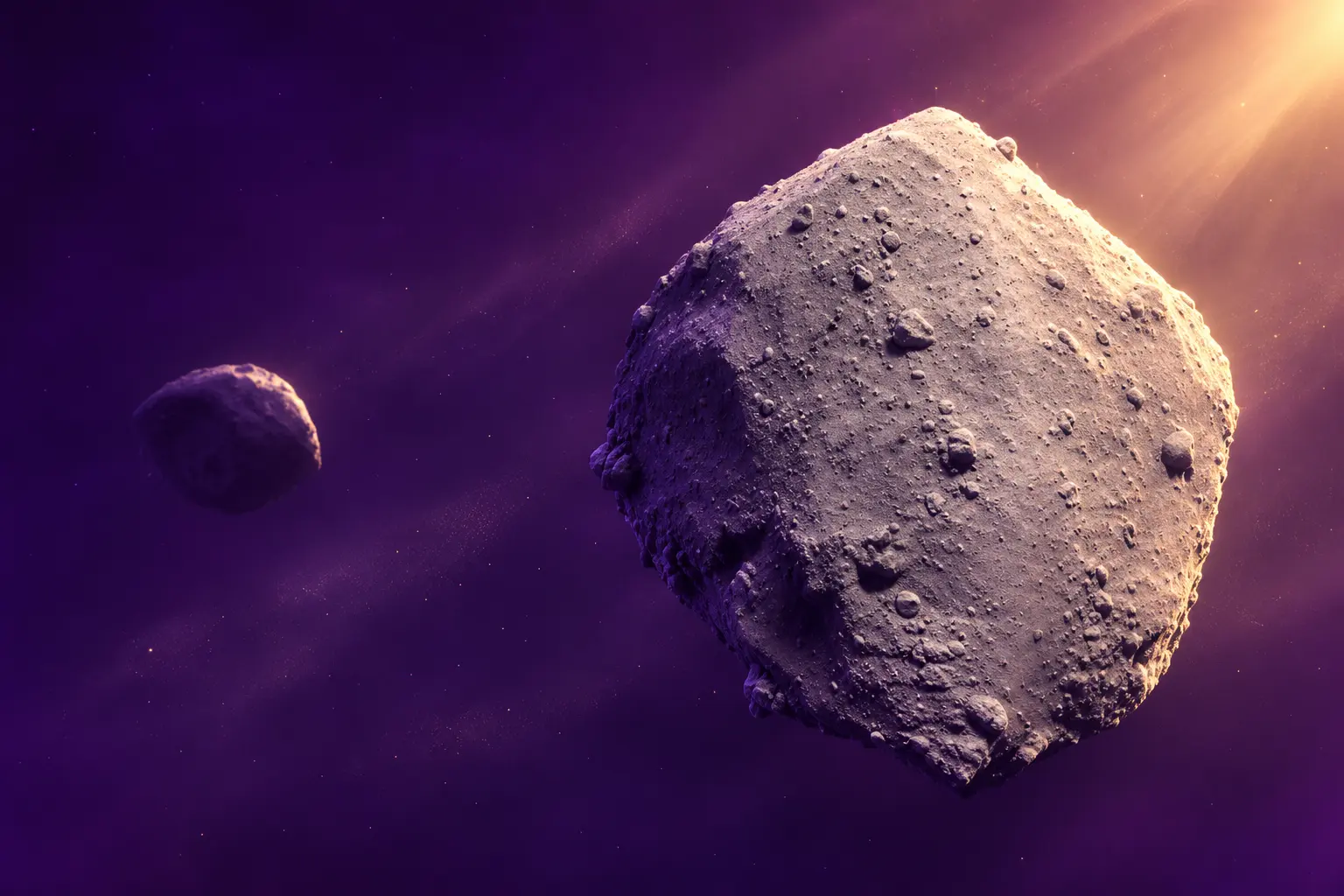
The first pictures do not yet show that wreckage. Hera resolved the pair as two dots on 18 October 2026 from 1,280 km, after braking burns slowed it to a relative speed of 20 m/s. On 5 November, from 60 km, the Asteroid Framing Camera returned a clear view of 780-metre Didymos. Most of 151-metre Dimorphos was lost in the larger body’s shadow. The spacecraft was then 196.8 million km from Earth.
Michel was looking at the far side of Didymos, the face DART never showed on its way in.
The first thing we said was wow! This is the other side of Didymos from the one that DART’s camera showed us shortly before impact, so this feels like looking at a whole new world.
Patrick Michel, Hera principal investigator, ESA
He said this side still carries the equatorial ridge seen before, but otherwise looks different, with boulders, craters, and patterns that resemble grooves or ridges. Didymos is a spinning top, fat at the middle, and it rotates every 2.2 hours. Michel said that spin may be driving loose material toward the equator and helping build the ridge.
ESA mission scientist Michael Kueppers noted that a lot of impact ejecta should have crossed the roughly 1 km of space from Dimorphos to Didymos, so some of those grooves and boulder fields may be imported wreckage. Sorting native terrain from dumped debris is now part of the survey. The moonlet that actually took the punch remains a sunlit speck in the visible frames, which is why the 25 November release is the date that matters for the crash site itself.
TIRI Sees the Moonlet the Cameras Miss
By 6 November Hera was 28.5 km out, close enough for the framing camera to sample about 2.7 m per pixel. ESA released the same geometry in visible light, color bands and heat, because one channel cannot carry the mass question.
WHAT EACH INSTRUMENT CAN SEE
- Asteroid Framing Camera: Black-and-white navigation and science stills; the 6 November frame shows Didymos’s ridge, boulder fields, clearer patches, and possible landslide traces toward the equator.
- HyperScout H: The surface in 25 hues from visible red into near-infrared, so reflected sunlight can be matched to meteorite and mineral samples in the lab.
- TIRI: JAXA’s thermal infrared imager, described by ESA as Superman-style heat vision from hot in red to cool in blue; it is the channel that shows the whole 151-metre moonlet while the others catch only a speck.
Solid rock dumps heat slowly. Porous rock, broken rock, and dust do not. Mapping how temperatures change across a spin tells the team whether they are looking at bedrock or rubble, which is the difference between a crater that stays put and a body that rearranges. In the thermal frame Dimorphos appears as a cooler body beside Didymos, the first time the struck moonlet is visible across its full width in this round of releases.
Our Hera mission is now studying asteroid Didymos from just 28.5 km away in visible light and infrared to reveal its surface features, composition and temperature. ☄️
These observations will help us better understand asteroid properties and improve planetary defence.
Read more:… pic.twitter.com/zFiTw92rYy
— European Space Agency (@esa) November 17, 2026
ESA’s own post from 17 November put the spacecraft at 28.5 km and tied the three channels to surface features, composition, and temperature. The public argument on that thread is the same hole the images show: 28.5 km is already closer than a long commute, yet the crater still is not in the picture.
What Kinetic Impact Still Cannot Promise Earth
DART proved a spacecraft can move an asteroid. It did not prove that the next spacecraft would move the next asteroid by a predicted amount. Beta is a multiplier. A value near 2 means debris roughly doubled the probe’s own push. A value near 5 means the flying rock did most of the work. That is a wide band when the warning time for a real object is measured in years and the miss distance is measured in Earth radii.
ESA has been blunt about the remaining unknowns. Did the impact leave a crater, or did it reshape the whole moonlet? What is the precise makeup, structure, and mass of Dimorphos, and which of those properties explain a deflection so much larger than the spacecraft-only case? Hera’s early characterization phase, which JAXA’s Hera-Japan team dated from 4 November 2026, is built to start answering the mass and spin questions from 20 to 30 km along a rectangular path that keeps both rocks in view.
WHAT WE KNOW
- The orbit: Dimorphos now circles Didymos 33.0 minutes faster, plus or minus 1.0 minute, after a 2.70 mm/s along-track slowdown.
- The parent body: Didymos is a 780-metre spinning top with a sharp equatorial ridge and a 2.2-hour day.
- The geometry now: Hera has closed from 1,280 km to 28.5 km and is running visible, 25-band, and thermal surveys together.
WHAT IS UNCONFIRMED
- The crater: ESA still asks whether DART punched a hole, rebuilt the moonlet’s shape, or did both.
- The mass: Beta stays a range from 2.2 to 4.9 until Dimorphos is weighed.
- The interior: TIRI can flag rubble versus rock at the surface; radar from a CubeSat is what probes the inside.
The rectangular crawl is not a flourish. At these masses, a tidy circular orbit is a luxury. JAXA’s plan has Hera firing at the corners about twice a week, taking three to four days per side, and pointing home about twice a day to dump data. Kueppers said the next few months bring closer passes, and that two shoebox-sized CubeSats go out early in the new year to take risks the mothership will not.
Juventas and Milani Drop Toward Dimorphos in January
Those two 6U CubeSats are how the bet gets a density, not another photograph. JAXA’s Juventas and Milani release timeline has Hera climbing back to 20-30 km in mid-January 2027 for deployment, then sending the pair in to work for two to three months before they try to land on Dimorphos.
Juventas carries radar to look through the moonlet and a gravimeter for the surface pull. Milani is the composition craft, with visible and near-infrared imaging of the dust and the scar. ESA says both are meant to finish on the surface. If the radar finds a rubble pile, the large beta makes sense: a loose body throws more debris, and debris is what multiplied DART’s shove. If the interior is more coherent, the models that assumed a weak target will have to be rewritten before anyone flies a second kinetic impactor in anger.
THE MONTHS AHEAD AT DIDYMOS
- 2 December 2026: Detailed characterization begins on a bowtie path at 8-20 km, with TIRI keeping both asteroids in the same thermal frame.
- 16 January 2027: Juventas is released from about 30 km to start the radar and gravity work.
- 30 January 2027: Milani follows, mapping surface composition and sampling dust.
- 3 February 2027: Close observation starts, with flybys between 4 and 22 km aimed at the DART scar and at three-point gravity with the CubeSats.
- 28 April 2027: Experimental flybys come in as close as about 1 km from Dimorphos for the sharpest look at the impact site.
Hera launched at 14:52 UTC on 7 October 2024 on a Falcon 9 from Cape Canaveral, after ESA shifted off Ariane 6 to hold the window. Carnelli later said the team got there through a funding scare, a pandemic, and a hurricane on launch day. The cruise included a Mars swing-by. Arrival operations began in early November 2026, a month sooner than the original late-2026 plan. Nominal work runs into June 2027, with a possible extra phase after that.
Berlin’s Dinosaur Hall Gets the First Crash Pictures
The public still has not seen Dimorphos up close. ESA will present the first close-up images of Dimorphos on Wednesday, 25 November 2026, from the dinosaur hall of the Museum für Naturkunde in Berlin. A media briefing runs from 11:00 to 14:00 CET, in person and online. Those frames stay under embargo until 18:30 CET, then ESA’s livestream runs from 19:45 to 20:30 CET on ESA WebTV and YouTube, with the public show at 20:00 CET under the title Double Impact!
Carnelli said the night will share the first images of how people altered Dimorphos. Michel called it a thorough look at a deflected asteroid, packed with firsts, to give an unbiased picture of the first planetary defense test. Kueppers stressed that the unveiling is only the start of the exploration.
Until that embargo lifts, the record is lopsided on purpose. Didymos is sharp enough to show landslides toward a ridge. Dimorphos, the body a spacecraft actually moved, is a speck in sunlight and a cool shape in infrared. The kinetic-impactor bet is live in that gap: the shove was real, the multiplier is still a range, and the mass that would close it is sitting 28.5 km from a European probe that has only just started to look.

FBI Crime Database Breach Puts Traffic-Stop Checks in Doubt

Nine Die in Dymer as Rescuers Dig Through the Night

Nick Cannon’s Lupus Hospital Post Halts Wild ‘N Out Dates

Dodgers Buy Royce Lewis After the Year That Cut His Price

GTA 6 Turns $100 Copies Into a $3.79 Billion Day

Meta’s Smart Glasses Sell a Light That Needed Two Patches

Apple’s New Mac Studio Clusters Local AI on the Desk

Google’s Free AI Pro Year Is Three Different Deals

Song Yadong Stops Umar Nurmagomedov the Only Way Left

Lanterns Puts Sinestro in a Cell and Lets Him Talk
-
 NEWS3 months ago
Meta’s Smart Glasses Sell a Light That Needed Two Patches
-
 NEWS3 months ago
Apple’s New Mac Studio Clusters Local AI on the Desk
-
 NEWS3 months ago
Google’s Free AI Pro Year Is Three Different Deals
-
 NEWS3 months ago
Song Yadong Stops Umar Nurmagomedov the Only Way Left
-
 ENTERTAINMENT3 months ago
Lanterns Puts Sinestro in a Cell and Lets Him Talk
-

 NEWS3 months ago
The Mahape Fake Apple Raid Repeats a Dual-Shift Pattern
-

 ENTERTAINMENT3 months ago
LUN8’s First London Concert Filled a 620-Cap Club
-

 ENTERTAINMENT3 months ago
Gomez Says She Never Ran the Wondermind Investors Backed