
NEWS
Apple, Chase and United Failed Without a Single Hack
Apple, Chase and United each blamed a bug or update, not a hack, as an FBI ARTEX warning spread the same day.

Apple Pay, Chase, United Airlines, Microsoft, the FAA and the NSA all broke between November 12 and November 17. Each operator named a different cause, and none of them named a hack.
On the Friday the FAA halted departures nationwide, the FBI also warned that an open-source AI pentest tool called ARTEX was already being used to break into companies in under three hours. Those two files collided in public, and a field-office post on Apple’s down afternoon made them look like one campaign.
Six Outages, Six Separate Causes
The week’s failures were real. So were the explanations the operators put on the record, and they do not match each other.
Microsoft’s trouble started Thursday, November 12, when Outlook, Teams and Copilot failed across 74 countries. Executive Charles Lamanna said a hidden July fix for network-gateway servers caused lock contention under load, that nearly 14 percent of gateway capacity was already offline from an unrelated issue, and that traffic failovers then knocked remaining machines down. At the low point, more than 80 percent of those servers stopped responding. Lamanna and the company’s status account both said this was not a cyberattack.
The product sits on more than 450 million commercial paid seats. Courts, city halls and hospitals lost mail. In Britain, hospital operations canceled after mail failed, and some jails could not process bond payments.
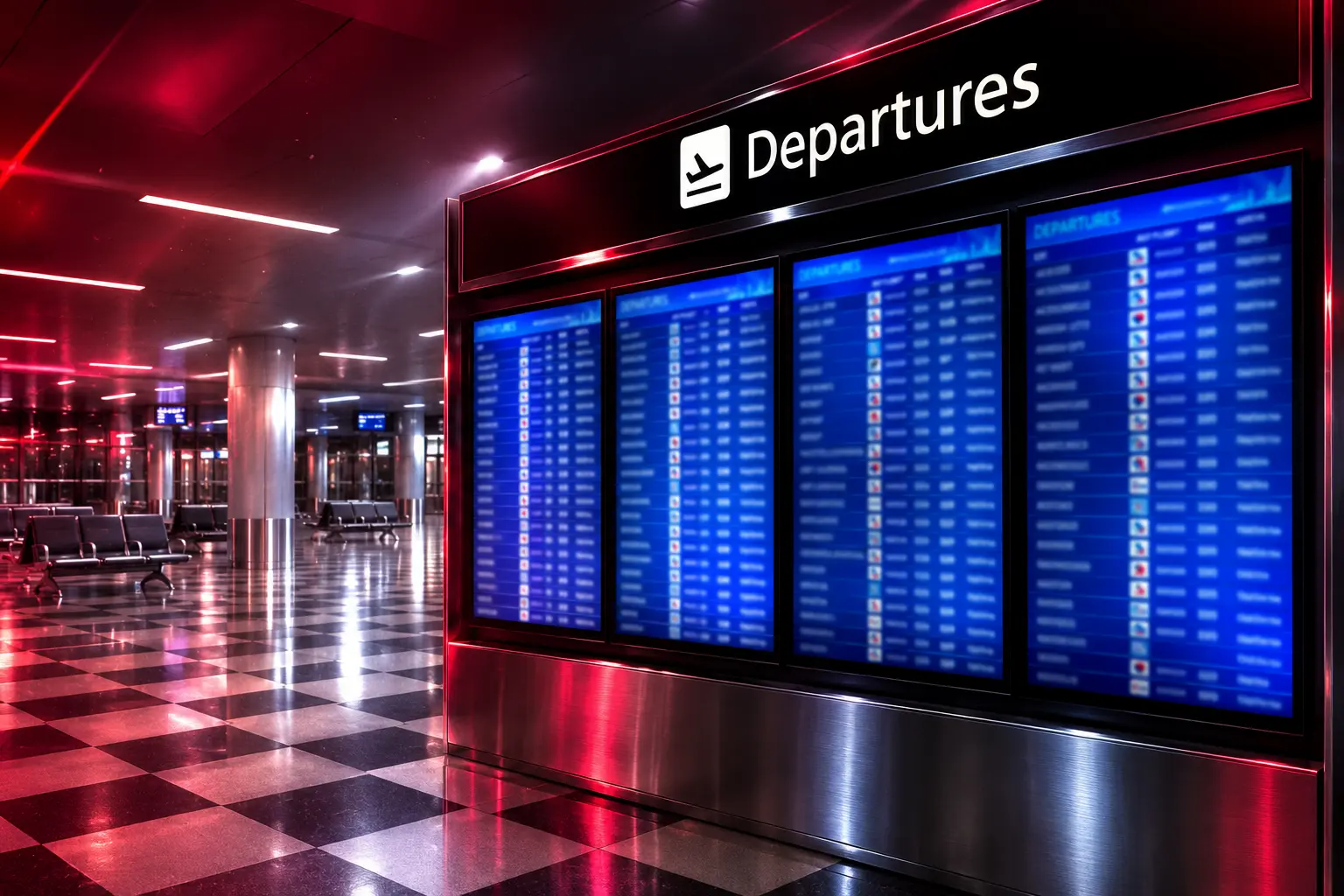
Friday, November 13, was worse in the sky. The FAA said a technical problem at about 3:30 p.m. ET led it to stop departures nationwide out of caution, and that the network was stable again at 8:15 p.m., a span of 4 hours 45 minutes. Legacy gear on the FAA FTI network became unstable when data flooded in at 1,000 connection attempts every 4 to 5 seconds, which shook radio and radar feeds. Investigators pointed at a radar site in Amarillo, Texas, and a radio site in El Dorado, Arkansas, where contractor L3Harris had been putting in a new router. About 3,500 aircraft already aloft landed safely. Operators logged approximately 12,462 flights canceled Friday, including 9,082 at major airlines. Equity research firm Bernstein put the ground stop and the weekend recovery at $345 million for the four biggest U.S. carriers combined. The FAA said it has no indication this was a cyberattack or an outside actor.
Monday, November 16, hit money and more flights. JPMorgan Chase spokesman Joe Evangelisti said a software bug in an on-premise hardware system delayed transactions, including Zelle payments to other banks, and that the problem was not cyber-related. User-report trackers logged more than 4,700 Chase complaints by 2 p.m. ET; Evangelisti said transactions were processing normally later that Monday. The same day, United said it had resolved a technology issue that delayed departing flights for more than 90 minutes, with no effect on flights already in the air or on United Express, and no sign it was cybersecurity-related. Accounts of the fault point at a system used to set a plane’s final weight.
Tuesday, November 17, closed the cluster. Apple blamed an internal update for an outage that hit iCloud, Apple Pay, the App Store and other services, and said it was not a cyberattack. Trackers counted about 2,300 Apple Pay reports in the United States around 12:20 p.m. ET and around 1,800 for iCloud. The NSA described a temporary degradation on its classified internal network, NSANet, during scheduled routine maintenance.
THE WEEK’S NAMED CAUSES
| Date | System | Cause given | Called a hack? |
|---|---|---|---|
| Nov. 12-14 | Microsoft 365 | July gateway defect, load, lost capacity | No |
| Nov. 13 | FAA national airspace | FTI flood from El Dorado and Amarillo | No |
| Nov. 16 | Chase and Zelle | On-premise software bug | No |
| Nov. 16 | United departures | Weight-calculation system | No |
| Nov. 17 | Apple Pay, iCloud, App Store | Internal update | No |
| Nov. 17 | NSANet | Scheduled maintenance | No |
First-week postmortems can be wrong, and the FAA is still working the router question with L3Harris. What the public file does not contain is a shared attacker, a shared tool, or a shared method tying those six events together.
The FBI Posted a Real Warning on the Same Friday
The other file is not a rumor. On November 13 the FBI released FLASH-20261113-001, a TLP:CLEAR alert titled “Threat Overview of ARTEX Autonomous Penetration Testing Framework.”
ARTEX is an open-source, LLM-driven agent platform written in Go. It takes a goal in plain language and turns it into commands run by specialized agents, with little human work after the objective is set. It has no model of its own. It calls outside systems, including Anthropic Claude, OpenAI GPT, DeepSeek, GLM, Grok and Kimi. The bureau said attacker-run copies most often use Chinese models, with the DeepSeek Flash family dominating because the models are capable, cheap, and weakly guarded when framed as pentesting.
Developer Autumn-27 put the code on GitHub in July 2026. It reached an estimated 1,500 to 2,000 stars within 10 weeks. The developer said it was meant for authorized tests inside a defined scope, then pulled the repository on October 8 after reports of abuse. Forks, archives, localized copies and a paid build called ARTEX PRO kept it in circulation. Researchers counted over 1,600 publicly exposed ARTEX consoles in early November, with more likely sitting behind firewalls.
The FLASH says a mix of criminal and other malicious actors have used the tool since at least August against finance, government, technology, defense, semiconductors, energy, healthcare, manufacturing, telecom and law. Some intrusions went from first targeting to under three hours to privileged access. The document never uses the word outage, and it never names Apple, Chase, United, the FAA or the NSA.
On November 17, after the FLASH spread again, the FBI said the advisory had gone out the previous Friday, that it was not a new announcement, and that no further warning had been issued. An FBI official said ARTEX does not appear connected to the consumer incidents, and that the alert was aimed at year-end preparedness. The Secretary of State said officials had found zero evidence tying the outages together or to malicious actors.
A Dallas Field-Office Post Did the Rest
The fusion was a timing problem, not a forensic one. The FLASH and the ground stop shared a Friday. Then, on Tuesday, November 17, the same afternoon Apple Pay and iCloud failed, FBI Dallas posted the ARTEX warning to a huge audience and named the October ConnectWise campaign in the same breath.
The #FBI issued a FLASH advisory warning that cybercriminals and state-aligned hackers are exploiting ARTEX, a super intelligence-powered penetration testing framework, to automate attacks against businesses and organizations worldwide. ARTEX can accelerate intrusions from… pic.twitter.com/TwsbGYJfH4
— FBI Dallas (@FBIDallas) November 17, 2026
Replies treated that post as a confession that the week’s broken apps were the ARTEX campaign. The objection that keeps coming back is blunt: if the bureau is warning that state-aligned hackers can own a network in under three hours, the denials from airlines and banks sound like public relations. That reading skips what the FLASH actually describes, and it skips what each operator put in writing. Homeland Security Secretary Markwayne Mullin, pressed at a hearing on Wednesday, November 18, said he was 98 percent confident the incidents had nothing to do with adversaries hacking U.S. systems.
The White House briefing on the ground stop had already left a messier impression. Transportation Secretary Sean Duffy talked about old switches and routers overloaded with data. Mullin talked about new equipment and new technology overwhelming the older system. Duffy had said the new gear itself did not go down. Video of the pair in the Brady Briefing Room circulated as a shoulder bump and a grimace. None of that argument was about ARTEX. It was about a copper-to-fiber job on a network the FAA still calls a legacy TDM system.
What ARTEX Has Already Stolen
Strip the outage rumor off the FLASH and a quieter campaign remains, with victims who never trended next to Apple Pay.
DOCUMENTED ARTEX CAMPAIGNS
- South Korea banks: The FBI cites financially motivated attacks on South Korean financial institutions that took personal information from approximately 67,000 people.
- ConnectWise backup: A supply-chain compromise of ConnectWise Cloud Backup led to attempted sign-ins to more than 2,250 downstream Microsoft 365 tenants. Microsoft has tied that campaign to a China-aligned group it calls Storm-0940.
- Southeast Asia finance: Microsoft has separately described a Cambodia-based, money-driven cluster, Storm-3358, using ARTEX against financial firms, mostly in Southeast Asia.
The ConnectWise path is the specimen. Agents used credentials that the vendor’s own apps already held, so the usual login prompt never appeared and multifactor checks never fired. From a backup product, the same session could walk into customer tenants that already trusted the software. That is a vendor-trust failure run at machine tempo, not a nationwide ground stop.
The FLASH says ARTEX is strongest on the edges companies under-watch: partner portals, supplier logins, mobile backends, employee apps, sales tools, old services and third-party add-ons. Agents have mapped cloud trust links, abused unsigned SAML, and, in at least one observed case, moved against iOS app-distribution kit through exposed cloud credentials. Small crews can run several of those jobs at once because the slow middle of an intrusion, the enumeration and the chaining, no longer waits on a human.
The Patch Window Collapsed to Three Hours
Snehal Antani, cofounder and CEO of the security firm Horizon3, has been describing the same compression in plainer terms. He said skilled operators used to spend days or weeks chaining steps that now finish in hours, and that anyone with the tool can rattle remote doors to see which ones are unlocked.
Going forward, expect this to become normal rather than exceptional. We should expect persistent disruption of digital services in the coming months as these organizations scramble to quickly improve their cyber resilience.
Snehal Antani, cofounder and CEO, Horizon3
That forecast can be true even if this particular week’s consumer failures were bugs and upgrades. The uncomfortable dual-use point is built into the product. ARTEX was published as a pentest framework so defenders could find exactly these holes. The same agents, pointed at someone else’s network and wired to a cheap model with weak guardrails, become a production break-in kit. Pulling the GitHub repo did not pull the copies. Over 1,600 consoles still sat on the public internet in early November.
Defenders who still patch on a monthly cycle, leave admin pages on the open internet, or grant broad app consent are working on a clock the FLASH says no longer exists. Taking a system offline to patch, which is often the only safe move left, then looks to customers like the outage they already feared. October already had a name in the trade after unpatched utility servers from Black October left U.S. cyber staff playing catch-up. November added a public that can no longer tell a failed upgrade from an AI-run intrusion, because both end with the same lock screen.
A Router in El Dorado Took Down the Sky
The largest single hit of the week was still a network flood in Arkansas and Texas. Instability showed up at 17 of the FAA’s 22 Air Route Traffic Control Centers and spread into several approach-control rooms. Some frequencies and radar feeds kept working, the agency said, which is why every airborne flight landed. L3Harris blocked the two suspect sites, the FAA disabled the broadcasting function on the new routers, and it turned the same function off on more than 60 other Juniper units, then paused further installs.
Duffy has used the episode to argue for a full replacement of old copper plant. Mullin, speaking later, floated an unnamed expert’s idea that advanced AI systems may be overwhelming older technology, without offering technical evidence that this is what happened in El Dorado. The FAA’s own Q&A still points at legacy TDM gear and a contractor router job done in daylight at a remote site, work it said has been routine for decades.
WHAT WE KNOW
- Named causes: Microsoft, the FAA, Chase, United, Apple and the NSA have each published a distinct technical explanation, and each has said it was not a cyberattack.
- The ARTEX file: The November 13 FLASH documents a live, spreading pentest framework used since August, with Korean bank data and the ConnectWise tenant campaign on the record.
- Same-day overlap: The FLASH and the nationwide ground stop were both issued November 13; the Dallas post that spread the warning landed November 17, during the Apple outage.
WHAT IS UNCONFIRMED
- A common attacker: No agency has attributed the six consumer and government failures to one actor or to ARTEX.
- The El Dorado root cause: The FAA and L3Harris are still investigating why the new router flooded the FTI network.
- Revised findings: A later review could still change an operator’s first-week account; nothing public has done so.
The FAA said it has paused new Juniper router installs and disabled the same function on more than 60 other units while that investigation with L3Harris continues.

FBI Crime Database Breach Puts Traffic-Stop Checks in Doubt

Nine Die in Dymer as Rescuers Dig Through the Night

Nick Cannon’s Lupus Hospital Post Halts Wild ‘N Out Dates

Dodgers Buy Royce Lewis After the Year That Cut His Price

GTA 6 Turns $100 Copies Into a $3.79 Billion Day

Meta’s Smart Glasses Sell a Light That Needed Two Patches

Apple’s New Mac Studio Clusters Local AI on the Desk

Google’s Free AI Pro Year Is Three Different Deals

Song Yadong Stops Umar Nurmagomedov the Only Way Left

Lanterns Puts Sinestro in a Cell and Lets Him Talk
-
 NEWS3 months ago
Meta’s Smart Glasses Sell a Light That Needed Two Patches
-
 NEWS3 months ago
Apple’s New Mac Studio Clusters Local AI on the Desk
-
 NEWS3 months ago
Google’s Free AI Pro Year Is Three Different Deals
-
 NEWS3 months ago
Song Yadong Stops Umar Nurmagomedov the Only Way Left
-
 ENTERTAINMENT3 months ago
Lanterns Puts Sinestro in a Cell and Lets Him Talk
-

 NEWS3 months ago
The Mahape Fake Apple Raid Repeats a Dual-Shift Pattern
-

 ENTERTAINMENT3 months ago
LUN8’s First London Concert Filled a 620-Cap Club
-

 ENTERTAINMENT3 months ago
Gomez Says She Never Ran the Wondermind Investors Backed