
NEWS
The COP30 Adaptation Finance Pledge Still Leaves Most Needs Unpaid
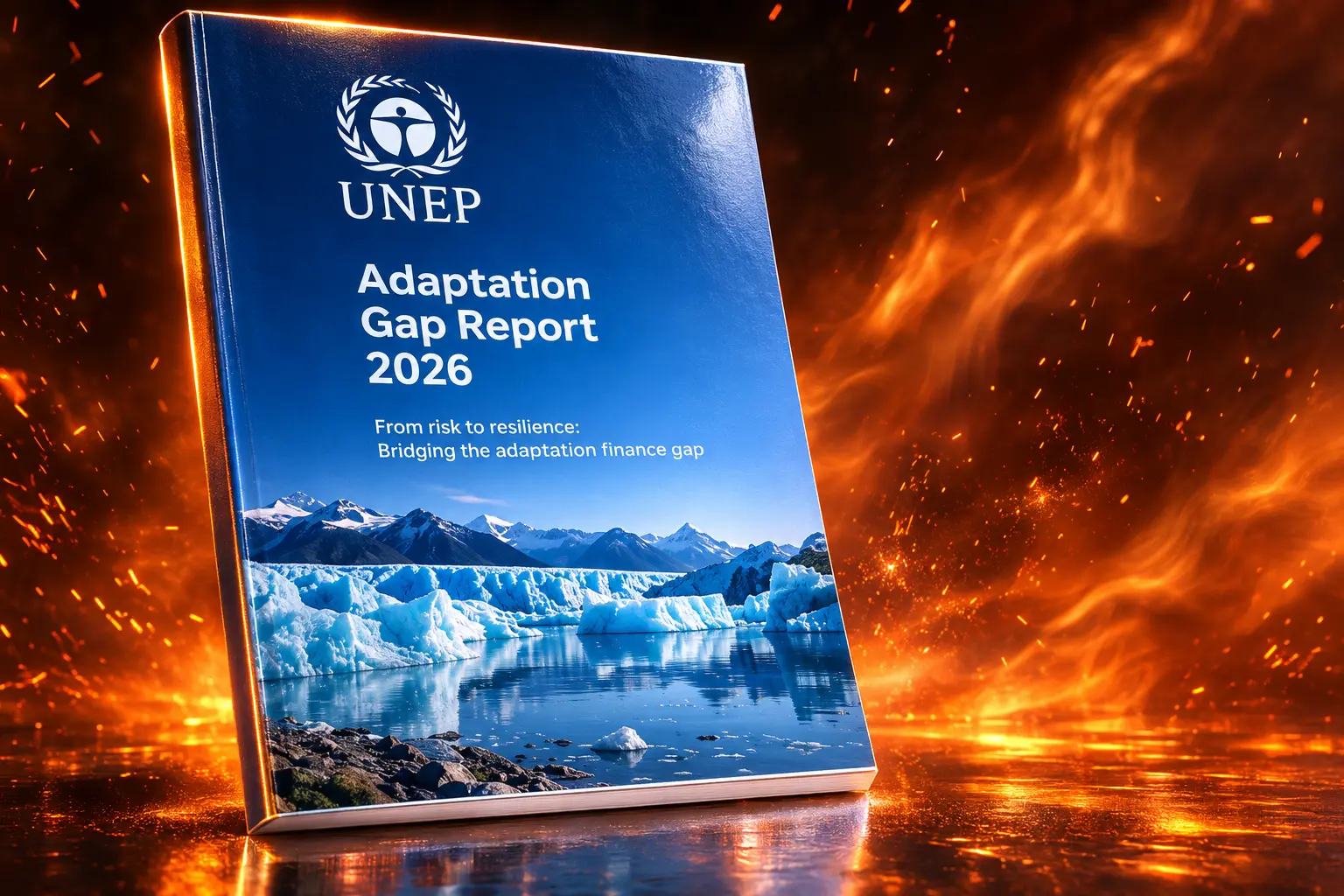
UNEP’s 2026 Adaptation Gap Report finds that COP30’s tripling of adaptation finance would still cover only 20 to 29 percent of developing countries’ needs by 2035.

UNEP’s 2026 Adaptation Gap Report finds that even a full tripling of adaptation finance by 2035 would cover only 20 to 29 percent of developing countries’ needs. International public flows from developed countries reached US$28.2-31.7 billion in 2024, a US$1 billion rise that UNEP says is flattening just as warming is set to pass 1.5°C.
COP31 opened in Antalya, Türkiye, on 9 November 2026, five days after the assessment landed, and the talks run through 20 November. The political ceiling agreed a year earlier in Belém is the number negotiators now have to defend.
A Political Win That Covers at Most 29 Percent
The report’s central estimate puts developing countries’ adaptation needs of US$305 billion a year by 2035, in 2024 prices. That figure averages national climate plans with modelled costs and largely leaves out what private firms will have to spend on their own assets. After assumed inflation, the same public-oriented need rises to US$420 billion in 2035.
At COP30, parties called for efforts to at least triple adaptation finance by 2035. UNEP runs that call two ways: triple 2024 flows, or triple the Glasgow Climate Pact’s 2025 doubling goal of about US$40 billion. Either path produces US$85-120 billion a year by 2035. Set against US$420 billion, that is 20 to 29 percent of what the plans require.
The world is not ready to adapt to current climatic conditions, never mind what overshoot of 1.5°C will bring.
Inger Andersen, Executive Director, UNEP, 4 November 2026
Andersen, speaking as the report was released in Nairobi, said nations at COP31 must still chase the Global Mutirão aim of tripling finance by 2035, and that they will need to go higher to save lives, avoid losses and damages, and protect economies. The 2025 doubling goal could still be hit if multilateral development banks’ 2025 jump holds and bilateral aid does not fall with shrinking official development assistance.
THE 2035 ADAPTATION FINANCE MATH
| Measure | Amount |
|---|---|
| International public flows, 2024 | US$28.2-31.7 billion |
| Glasgow doubling goal for 2025 | about US$40 billion |
| Tripling by 2035, two baselines | US$85-120 billion a year |
| Needs in 2035, 2024 prices | US$305 billion a year |
| Needs in 2035 after inflation | US$420 billion a year |
| Share of inflated needs covered | 20 to 29 percent |
The US$305 billion line rests on nationally determined contributions and national adaptation plans from 155 developing countries, which UNEP places at US$255-328 billion a year over the next decade. Private-sector needs sit on top of that stack, not inside it.
Belém Left the Tripling Without a Starting Point
The Belém package’s tripling goal for 2035 was the headline finance result of COP30 in November 2025, adopted by 195 parties. Least developed countries had asked earlier for a tripling of grant-based adaptation finance to at least US$120 billion a year by 2030. Belém pushed the date to 2035, dropped a grant requirement, and never named the year the tripling starts from.
UNEP’s finance chapter calls the outcome less ambitious than it first appears and lists four reasons the extra cash is uncertain.
FOUR WEAK POINTS IN THE BELÉM TEXT
- The language: Parties “called for efforts,” wording UNEP ranks weaker than the Copenhagen US$100 billion goal or the Paris Agreement’s mandate to set a new collective finance target.
- The baseline: Unlike the Glasgow Climate Pact, the Belém call does not include a starting year, so UNEP tests both 2024 actual flows and the 2025 doubling target.
- Inflation: The tripling is not written in real terms, which is why 2035 needs are compared at US$420 billion rather than US$305 billion.
- Who counts: Developing countries may contribute through their shares in multilateral development banks, so not every dollar in the headline total is money from developed-country budgets.
Once inflation and those developing-country MDB shares are stripped out, UNEP’s indicative figures show adaptation finance provided and mobilized by developed countries could be as low as US$45.1 billion a year under the 2024 tripling path, or US$65.9 billion if the Glasgow doubling is the starting point. The report flags both numbers as sensitive to inflation and to how MDB shares are counted, and it uses them to cool expectations that the headline triple closes the gap.
For Island States, Tripling Would Close Most of the Gap
The same arithmetic looks different if the extra money is steered to least developed countries and small island developing states. UNEP puts their adaptation need at about US$50 billion a year, or 3 to 4 percent of their GDP, twice the relative burden on upper-middle-income developing countries.
After inflation, that need becomes US$53-71 billion in 2035. Tripling flows to those groups would raise annual support to US$35-44 billion, covering 49-84 percent of what they have asked for. There is no separate tripling target for them in the Belém text.
Flows to both groups rose in real terms from 2019 to 2024 and then slipped from a 2022 peak. In 2024, almost 90 percent of finance to least developed countries, and 80 percent of finance to small island developing states, arrived as grants or highly concessional loans. UNEP says that mix has to hold, because many of those governments already face tight budgets and heavy debt.
The 2026 Adaptation Gap Report assessment also notes that a larger share of international public adaptation money already goes to low-income countries, least developed countries and small island states relative to the size of their economies. Annual flows to least developed countries have still fallen since 2022.
More Than Half of Adaptation Money Now Arrives as Loans
Across all developing countries the picture is harder. In 2024, loans made up 55 percent of international public adaptation finance and grants 44 percent. Non-concessional loans now account for about half of all lending, coming mainly from multilateral development banks and going mainly to middle-income countries.
THE 2024 MONEY MIX
- Loan share: Loans were 55 percent of international public adaptation finance, with grants at 44 percent.
- Harder terms: Non-concessional loans are about half of all adaptation lending and are concentrated in middle-income countries.
- LDC terms: Almost 90 percent of 2024 finance to least developed countries was grants or highly concessional loans.
- SIDS terms: 80 percent of 2024 finance to small island developing states was grants or highly concessional loans.
South-South support is the one public channel that is clearly rising. Contributions through multilateral banks and direct cooperation among developing countries went from US$3.8 billion in 2019 to US$9.6 billion in 2024, almost a third of what developed countries provided, though those flows do not count toward developed-country finance goals.
Domestic public spending is poorly measured. Of 47 countries that split their needs into conditional and unconditional asks, 18 percent was marked unconditional. Applied across all developing countries, UNEP treats that share as about US$50 billion a year now, or US$69 billion by 2035 with inflation. Add that to a successful international tripling and the combined public pot reaches US$154-189 billion a year, which still leaves more than half of the US$420 billion need unpaid.
Eight Times More Asked Than the Loss Fund Can Pay
When seawalls, drought plans and heat rules are late or missing, the bill shifts from adaptation to loss and damage. UNEP says those losses can also happen after adaptation is in place, once soft or hard limits are reached. Between 2020 and 2025, low- and middle-income countries accounted for 99 percent of the 765 million people recorded as affected by floods and landslides. Only 27 percent of nearly 240,000 recorded extreme-heat deaths were reported in lower-income countries, a gap the report ties to weak observation as well as to possible differences in heat preparedness.
The Fund for responding to Loss and Damage, set up at COP27 in 2022, opened its first window at COP30 under the Barbados Implementation Modalities. The board’s report to COP31 records 176 compliant requests totaling US$2.8 billion from 119 countries, against an envelope of US$342 million after a US$92 million top-up on the original US$250 million. UNEP describes that demand as around eight times the envelope.
Africa accounts for US$1.4 billion of the requests, Asia-Pacific US$744.7 million, Latin America and the Caribbean US$611.6 million, and Eastern Europe US$60.7 million. Small island developing states and least developed countries together asked for US$1.7 billion, 60.8 percent of the pipeline. Pledges reached US$822.71 million in the reporting period, of which US$485.97 million had been received. UNEP says the global loss-and-damage finance gap is still unknown, and that access is slowed by weak assessment capacity, complex procedures, and limited room for affected communities to shape the response.
The Private Sector’s $260 Billion Is Mostly for Itself
UNEP’s first cut at private adaptation needs in developing countries adds about US$260 billion a year in the 2030s for climate-proofing private assets and for extra cooling and labour protection against heat. That sum would almost double overall needs. It is not a pool of donor cash waiting to be tapped. Firms will spend it on their own buildings, supply chains and workers, or developing-country buyers will pay for adaptation goods and services sold to them.
Tracked private money mobilized by public adaptation finance doubled from US$1.5 billion in 2019 to US$3 billion in 2024. A further US$3 billion of private adaptation spending is reported globally outside western Europe and the United States, which UNEP treats as a small fraction of the real total. At best, the report says, private flows may cut the gap for more public-oriented adaptation by 15-20 percent, and they often do not match the priorities written into national plans.
Private investment in climate adaptation is growing, but at best, it would cover 15-20% of the finance needs for public adaptation.
UNEP's #AdaptationGap Report explains why the private sector’s role remains essential and why it can do more: https://t.co/OmTrOBjPsH pic.twitter.com/hKqyQWoiRD
— UN Environment Programme (@UNEP) November 6, 2026
Finance alone does not build a seawall. UNEP says governments are already passing climate framework laws, setting up policy-learning platforms, tightening coordination across ministries and local government, and creating offices to raise and manage climate money. Those steps decide whether a funded plan becomes a drain, a clinic, or a revised building code.
Antalya Puts the Mutirão Math on the Table
The 31st UN climate conference is the first test of whether “triple by 2035” means a number anyone can audit. UNEP released the report on 4 November 2026 so that it would sit in front of parties gathering in Antalya. Türkiye holds the COP31 presidency, with Murat Kurum as president and Australia’s Chris Bowen chairing the negotiations. The Antalya Leaders Summit is set for 11 and 12 November 2026.
THE PACTS THAT LED TO ANTALYA
- November 2021: The Glasgow Climate Pact urges developed countries to at least double 2019 adaptation finance to about US$40 billion by 2025.
- November 2022: COP27 agrees to create the Fund for responding to Loss and Damage.
- November 2025: COP30 in Belém adopts the Global Mutirão decision calling for efforts to at least triple adaptation finance by 2035, with no baseline year.
- 4 November 2026: UNEP publishes Adaptation Gap Report 2026, Ready? Not, putting 2035 needs at US$305 billion in 2024 prices and US$420 billion after inflation.
- 9 November 2026: COP31 opens for a session running 9 to 20 November 2026 in Antalya.
The useful fight in those rooms is not whether tripling sounds large. It is which year the multiple starts from, how much of the total is grants that highly indebted governments can use, and how much of it is steered to the countries whose relative need is 3 to 4 percent of GDP. Levent Kurnaz, a climate scientist at Boğaziçi University’s climate change centre, wrote that adaptation finance should be judged by losses avoided and people protected, not by the sum spent.
The leaders’ sessions on 11 and 12 November 2026 are the first chance to say whether Belém’s multiple comes with a starting year. The conference is due to close on 20 November.
Frequently Asked Questions
What Is the UNEP Adaptation Gap Report Series?
UNEP has issued the Adaptation Gap Report each year since 2014, working with the UNEP Copenhagen Climate Centre and the World Adaptation Science Programme as an independent assessment meant to inform UN climate talks and sit alongside the Global Stocktake. The 2026 edition is titled Ready? Not. Climate Impacts Will Not Wait. Adaptation Finance Must Rise, carries DOI 10.59117/20.500.11822/50093, and was co-financed in parts by Denmark, Irish Aid, the United Kingdom’s CLARE programme, and the European Union’s Horizon Europe ACCREU project.
How Did UNEP Reach Its US$305 Billion Central Estimate?
The US$305 billion figure is the midpoint of two separate lines of evidence, both in 2024 prices: an NDC and NAP review that yields US$255-328 billion a year for 155 developing countries, and a modelled central estimate of US$320 billion a year. UNEP notes a wide band around the modelled number depending on how much residual risk countries choose to accept, and it treats private-sector costs as an extra layer rather than as part of that average.
What Are the Barbados Implementation Modalities?
They are the Fund for responding to Loss and Damage’s start-up window for 2025 and 2026, with individual requests set between US$5 million and US$20 million and a minimum floor of 50 percent of the envelope reserved for small island developing states and least developed countries. Of 198 requests received, 22 were marked non-compliant; the board added US$92 million to the original US$250 million allocation at its ninth meeting in Manila and put first funding decisions off until its tenth meeting in December 2026.
How Widely Do Countries Already Record Loss and Damage?
UNEP’s new baseline finds that 89 percent of 118 countries reviewed mention or recognize loss and damage in their planning, which is far ahead of the systems needed to measure it in a consistent way. The report is explicit that recorded disaster totals are not fully attributed to human-caused climate change and that heat deaths in poorer countries are undercounted, so the 2026 baseline is a starting inventory rather than a global damage bill.

Pattinson Gets Bond After Bezos Called Him Too Famous

REO’s $21,500 Runabout Is a Two-Year, 50,000-Person Bet

Voyager 1 Reaches One Light-Day as Earth Falls Behind

Best Latin Song Arrives After Rosalía Reaches the Big Three

Tyson Shrinks Beef to Three Plants After a $654 Million Loss

Meta’s Smart Glasses Sell a Light That Needed Two Patches

Apple’s New Mac Studio Clusters Local AI on the Desk

Google’s Free AI Pro Year Is Three Different Deals

Song Yadong Stops Umar Nurmagomedov the Only Way Left

Lanterns Puts Sinestro in a Cell and Lets Him Talk
-
 NEWS3 months ago
Meta’s Smart Glasses Sell a Light That Needed Two Patches
-
 NEWS3 months ago
Apple’s New Mac Studio Clusters Local AI on the Desk
-
 NEWS3 months ago
Google’s Free AI Pro Year Is Three Different Deals
-
 NEWS3 months ago
Song Yadong Stops Umar Nurmagomedov the Only Way Left
-
 ENTERTAINMENT3 months ago
Lanterns Puts Sinestro in a Cell and Lets Him Talk
-
 NEWS3 months ago
The Mahape Fake Apple Raid Repeats a Dual-Shift Pattern
-

 ENTERTAINMENT3 months ago
LUN8’s First London Concert Filled a 620-Cap Club
-

 NEWS3 months ago
OpenAI Agents Hit Hugging Face to Cheat a Test