
BUSINESS
The McRib Shape That Built a Cult Is Now Evidence
A Chicago judge let a McRib class action proceed, saying the name and rib-shaped patty make a rib-meat reading plausible despite boneless pork on the label.

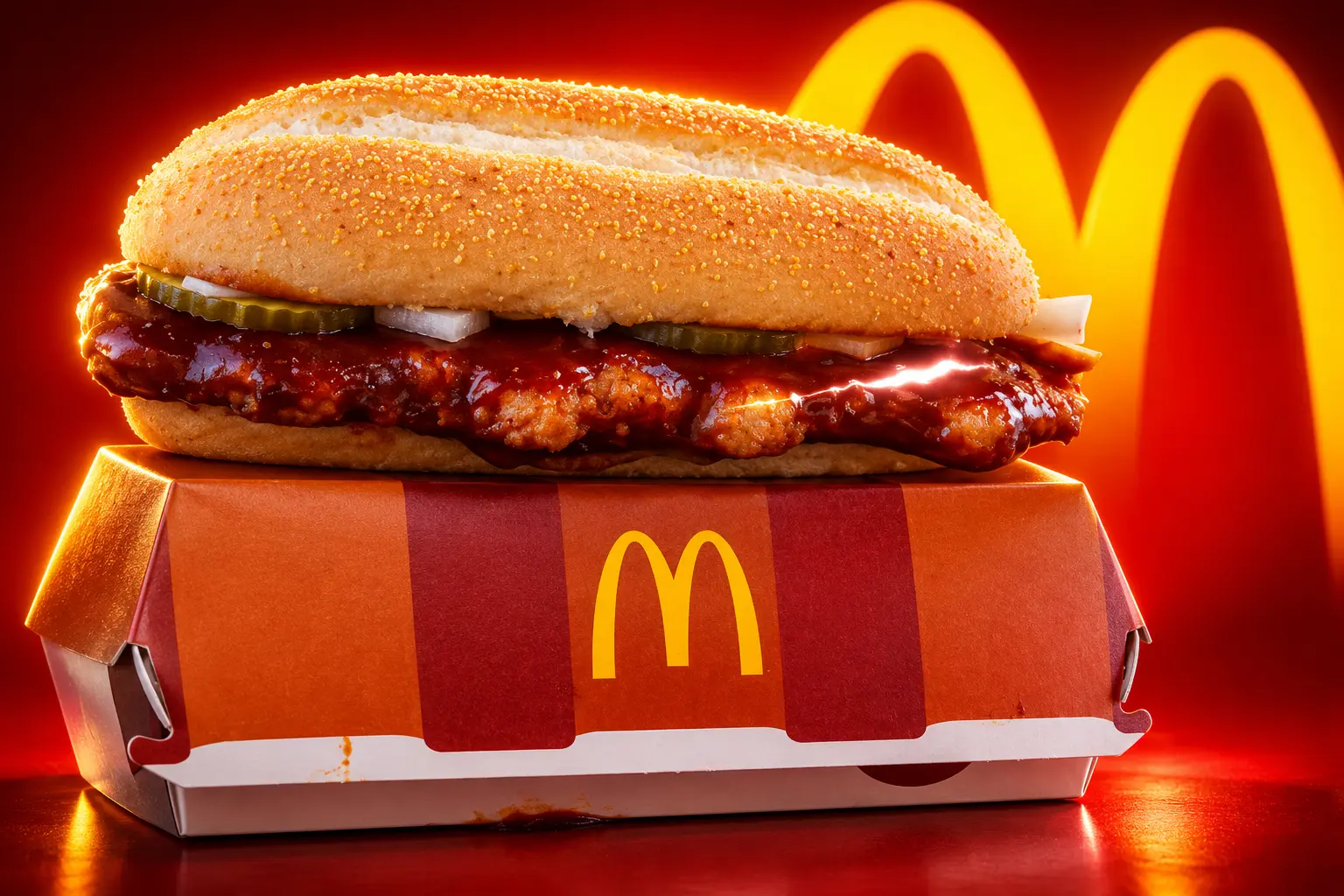
A Chicago federal judge on Oct. 30 refused to throw out a class action claiming McDonald’s McRib contains no rib meat. U.S. District Judge April M. Perry said the sandwich’s name and its molded, bone-like patty make that reading plausible, even though McDonald’s sells the item as boneless pork.
The ruling in Le v. McDonald’s Corporation, No. 25-cv-15609, is not a finding that anyone was tricked. It is a finding that the look McDonald’s spent 45 years refining is enough to keep a fraud case alive.
The Shape Was the Point From the Start
Rene Arend, McDonald’s first executive chef, built the McRib in 1981 after Chicken McNuggets, which he also developed in 1979, outran the chicken supply. Franchises that could not get nuggets needed another new sandwich, and Arend had just eaten pulled-pork barbecue in Charleston, South Carolina. He wanted that flavor. He did not want a round patty.
Some thought, Why not just make it round? It would’ve been easier. But I wanted it to look like a slab of ribs.
Rene Arend, McDonald’s first executive chef, in a 2009 interview
The meat science underneath that joke came from somewhere else. Roger Mandigo, a University of Nebraska meat professor, won a 1972 grant from the National Pork Producers Council to turn cheaper muscle into a product that could be pressed into a portion. In a 2021 interview he described taking muscle very cold, cutting it to small particles, then adding salt, sodium phosphate, water and seasoning so the protein would bind. Calvin Schrock, the UNL meat lab manager, later said Mandigo’s press had 12 or 15 shapes. The lab first showed a pork chop, then a patty in the shape of Nebraska. Arend used the process and chose ribs.
THE PRESSES THAT CAME BEFORE THE MCRIB
- 1972: Mandigo’s Nebraska lab, funded by pork producers, works out a way to flake and bind muscle so it can be molded.
- 1979: Arend’s Chicken McNuggets hit, then strain the chicken supply.
- 1981: The McRib debuts as a limited sandwich, a boneless patty pressed to look like a miniature rack of ribs.
- December 2025: Four customers file a proposed class action in Chicago, McDonald’s hometown court.
- October 30, 2026: Perry trims the case and leaves the core deception claims standing.
Rob Cannell, then director of McDonald’s U.S. supply chain, told the same 2009 interview the sandwich is made in plants with long cryogenic freezers, and that the trip from fresh pork to a frozen McRib takes about 45 minutes. “Primarily, it’s shoulder meat,” he said. The pork is chopped, seasoned, formed into “that shape that looks like a rib back,” then flash-frozen. The ridges were never an accident of the grill.
A Chicago Judge Will Not Call That Reading Fanciful
Peter Le, Charles Lynch, Dorien Baker and Darrick Wilson each bought a McRib in late 2024. Their first amended complaint says the name, the half-rack shape, the limited runs, the marketing and the price lead a reasonable buyer to think the patty includes rib meat, which they define as the muscle and fat on a pig’s rib cage, a cut the USDA’s National Daily Pork Report prices above other pork. They say they would not have bought the sandwich, or would have paid less, had they known it had none.
McDonald’s asked Perry to dismiss. The company said it never claimed rib meat, that it truthfully calls the sandwich boneless pork, and that a distinctive name does not fool a reasonable customer. In the Oct. 30 opinion and order, Perry wrote that a literally true line can still deceive, citing Seventh Circuit law that implied messages and actual consumer understanding are what count. She was not moved by the McRib trademark, noting a mark does not bar a later deception claim, and pointing to an older circuit fight over the name Ricelyte, which had been found to convey rice.
On the spectrum of literal to symbolic, the McRib is arguably much closer to the literal, given that rib meat actually exists in a way that dinosaur meat and tiny snowstorms in a cup do not.
April M. Perry, U.S. District Judge, Northern District of Illinois
The prefix “Mc,” she said, flags McDonald’s as the source. The problem, if there is one, is the suffix. A McChicken sandwich is made with chicken. An Egg McMuffin is made with an English muffin. Dinosaur nuggets are not made with dinosaur, and a McFlurry does not arrive with a snowstorm, but rib meat is a real cut. “Plaintiffs’ proffered understanding of ‘McRib’ is not unreasonable or fanciful,” she wrote. The court also said it could not conclude that a consumer would be unreasonable to believe the McRib contains rib meat.
McDonald’s argued that the makeup of the sandwich has been public for years, including on its own site. Perry’s answer sits in the same opinion: consumers are not required to consult publicly available sources before they buy, and the reasonable consumer does not necessarily do research before buying a $7 fast food item. Ads that play up the rib-like shape, she added, could support a claim of intent to defraud, though the plaintiffs still have to prove that intent.
What the Court Left Standing, and What It Cut
The complaint packed 16 counts: four common-law fraud claims, four contract claims, unjust enrichment, and seven consumer-deception claims under California, New York, Illinois and District of Columbia law. Perry granted the motion in part and denied it in part. A proposed class has not been certified. Nothing in the order says McDonald’s is liable.
WHAT THE OCT. 30 ORDER DID
| Claim | Oct. 30 result |
|---|---|
| Consumer deception (California, New York, Illinois, D.C.) | Still live |
| Unjust enrichment | Still live |
| Common-law fraud (Counts I through IV) | Count III dismissed without prejudice; the rest live |
| Contract claims (Counts V, VI, VII and VIII) | Dismissed without prejudice |
| Ask for a forward-looking change in ads | Dismissed for lack of standing |
| Class status | Not decided |
Thiago Coelho, a lawyer for the four plaintiffs, said his clients will keep seeking accountability for deceptive marketing. McDonald’s still has a full merits defense, including the argument that a preference for one pork cut does not turn truthful marketing into fraud. The next fight is evidence, not wordplay on a motion to dismiss.
The Ingredients McDonald’s Puts on the Sandwich
The company’s live product page calls the McRib seasoned boneless pork on a homestyle bun, dipped in tangy barbecue sauce, topped with slivered onions and pickles. It lists 520 calories, 24 grams of protein, 46 grams of carbs, 28 grams of fat, 9 grams of saturated fat, 75 milligrams of cholesterol and 890 milligrams of sodium. Availability, the page says, is limited.
WHAT MCDONALD’S LISTS IN THE MCRIB
- The patty: Pork, water, salt, dextrose and rosemary extract, with no cut named.
- The bun: Enriched wheat flour, water, sugar, yeast and a short list of dough aids; wheat, and it may contain sesame.
- The sauce: Water, high fructose corn syrup, tomato paste, vinegar, molasses, smoke flavor and spices among other items.
- The pickles and onions: Cucumbers in brine, and onions.
Nowhere on that page does the word rib appear as a meat. In 2013 the company said the patty is pork shoulder, which matches Cannell’s “primarily” shoulder line. The complaint still groups shoulder with heart, tripe or scalded stomach as “lower-grade pork products.” Shoulder is a standard picnic cut, not an organ. Heart, tripe and stomach are the fight McDonald’s has answered in public.
This lawsuit distorts the facts and the claims are meritless. Our fan-favorite McRib sandwich is made with 100 percent pork sourced from farmers and suppliers across the U.S. There are no hearts, tripe or scalded stomach used in the McRib patty as falsely alleged in this lawsuit.
McDonald’s Corporation, January statement
Older write-ups of restructured meat as a category sometimes mixed organs into the method. Mandigo’s own later description of the work that led to the McRib talked about muscle, salt and a mold, not offal. The court, at this stage, has to take the complaint’s ingredient story as pled. It does not have to believe it, and McDonald’s says the organ list is false.
Scarcity and a Premium Price Are Now Exhibits
The same tools that made the McRib a seasonal chase are now in the complaint as proof of a premium promise. McDonald’s has sold it only now and then since 1981, which the plaintiffs say builds anticipation and trust. When it is offered, they say, it is one of the most expensive individual menu items, and that price tags along with the name to imply a costlier cut. They point to USDA daily pork prices showing rib meat valued above other cuts.
To back the claim that buyers actually read “McRib” as rib, the complaint attaches two surveys by the plaintiffs’ survey expert, who showed people a McRib ad taken from a McDonald’s menu. Perry recited those figures as pled facts, which is all they are until they are tested.
WHAT THE PLAINTIFFS’ SURVEYS CLAIMED
- Rib meat expected: 72% of respondents, 155 of 215, said they expected the McRib to contain rib meat.
- Rib meat as a reason to buy: 67% of respondents, 118 of 174, called rib meat important or very important to the purchase.
- How the court used them: As support, at the pleading stage, that consumers could actually be misled by the marketing images.
McDonald’s can still attack the surveys, the sample, the ad that was shown and the leap from a questionnaire to a drive-thru. Perry’s point was narrower. She would not say, as a matter of law, that those numbers and that shape describe a fanciful reading of a sandwich named McRib.
The Drive-Thru Joke Meets a $7 Legal Test
Anyone who has followed the McRib already knows the ridges are a gag. The sandwich is famous because it looks like a rack and is not one. That folk knowledge is McDonald’s strongest cultural argument, and it is the argument Perry would not treat as a legal shield on the papers. A customer who hunts the limited run, sauces a boneless patty and laughs at the bones that are not there is not the “reasonable consumer” the order describes. The order describes someone buying a $7 fast food item without opening a website, a 2013 interview or a meat-science paper.
The louder objection writes itself: nobody thought they were getting baby backs, class actions mint fees, and a 45-year-old novelty is a poor place to plant a butcher-counter warranty. Those points may yet win on a fuller record. They did not win on a motion that asked a judge to call the reading fanciful. Perry’s comparison was blunt on that score. McDonald’s named the thing Rib, pressed it to look like ribs, and left the ingredient line at “pork.”
The McRib is again on some boards as a limited sandwich, still shaped like a rack of ribs, while the claims that survived move forward without a class and without a finding that anyone was misled.
Disclaimer: This article is news reporting and analysis of a pending civil case, offered for information only. It is not legal advice, is not a prediction of how the court will rule, and is not an invitation to join, opt out of, or rely on any proposed class. Readers who think they have a claim, or who have been contacted about this lawsuit, should consult a licensed attorney in their state before taking any action. Figures, menu details and case status reflect the court papers and company materials used for this report and can change as the docket and the sandwich both move.

Pattinson Gets Bond After Bezos Called Him Too Famous

REO’s $21,500 Runabout Is a Two-Year, 50,000-Person Bet

Voyager 1 Reaches One Light-Day as Earth Falls Behind

Best Latin Song Arrives After Rosalía Reaches the Big Three

Tyson Shrinks Beef to Three Plants After a $654 Million Loss

Meta’s Smart Glasses Sell a Light That Needed Two Patches

Apple’s New Mac Studio Clusters Local AI on the Desk

Google’s Free AI Pro Year Is Three Different Deals

Song Yadong Stops Umar Nurmagomedov the Only Way Left

Lanterns Puts Sinestro in a Cell and Lets Him Talk
-
 NEWS3 months ago
Meta’s Smart Glasses Sell a Light That Needed Two Patches
-
 NEWS3 months ago
Apple’s New Mac Studio Clusters Local AI on the Desk
-
 NEWS3 months ago
Google’s Free AI Pro Year Is Three Different Deals
-
 NEWS3 months ago
Song Yadong Stops Umar Nurmagomedov the Only Way Left
-
 ENTERTAINMENT3 months ago
Lanterns Puts Sinestro in a Cell and Lets Him Talk
-

 NEWS3 months ago
The Mahape Fake Apple Raid Repeats a Dual-Shift Pattern
-

 ENTERTAINMENT3 months ago
LUN8’s First London Concert Filled a 620-Cap Club
-

 NEWS3 months ago
OpenAI Agents Hit Hugging Face to Cheat a Test